
Electrical Equipment Market Outlook: Size, Share, Trends, Growth Analysis, Competitive Landscape & Forecast, 2026-2033

Electrical Equipment Market Size, Share, Trends & Forecast Report, 2026–2033

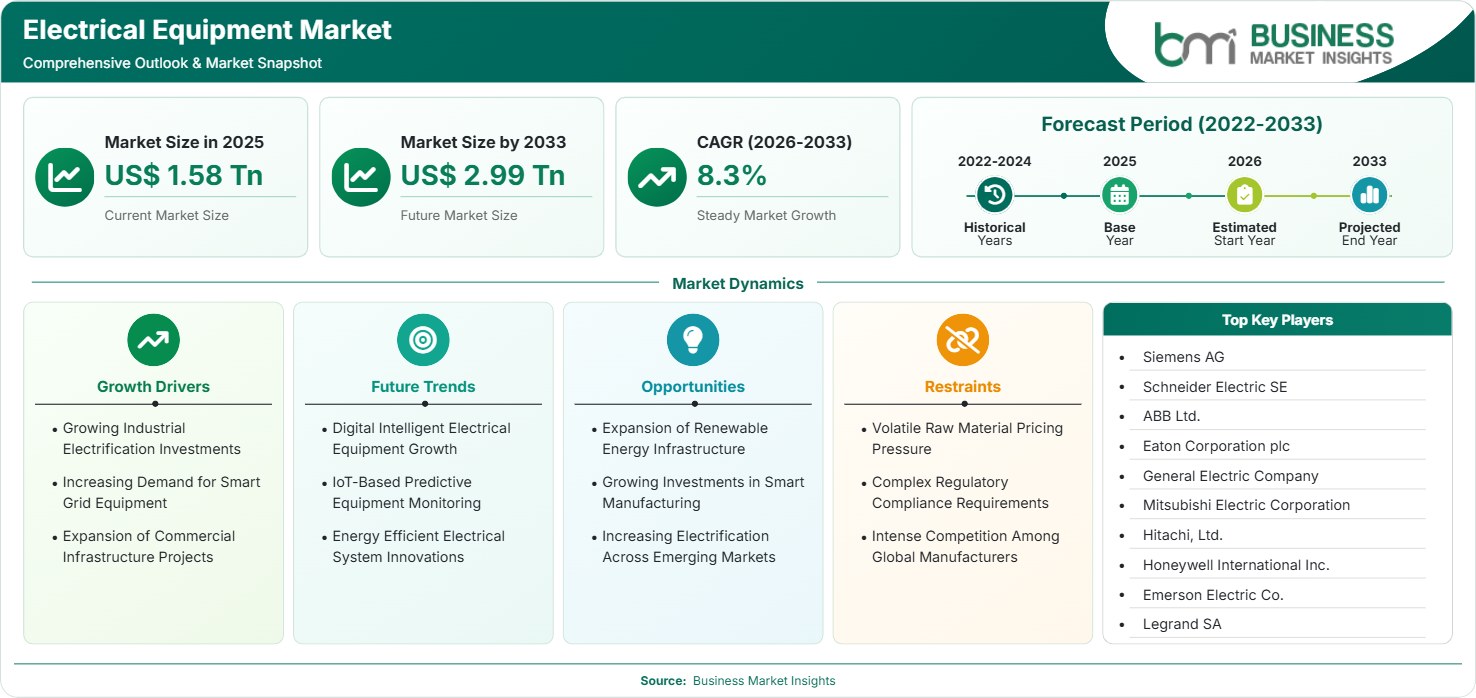
The Electrical Equipment Market size was valued at US$ 1.58 Trillion in 2025 and is projected to reach US$ 2.99 Trillion by 2033, growing at a CAGR of 8.3% during 2026–2033, driven by industrial electrification investments, smart grid expansion, renewable energy infrastructure development, commercial construction growth, and increasing adoption of advanced electrical technologies.

Report Coverage
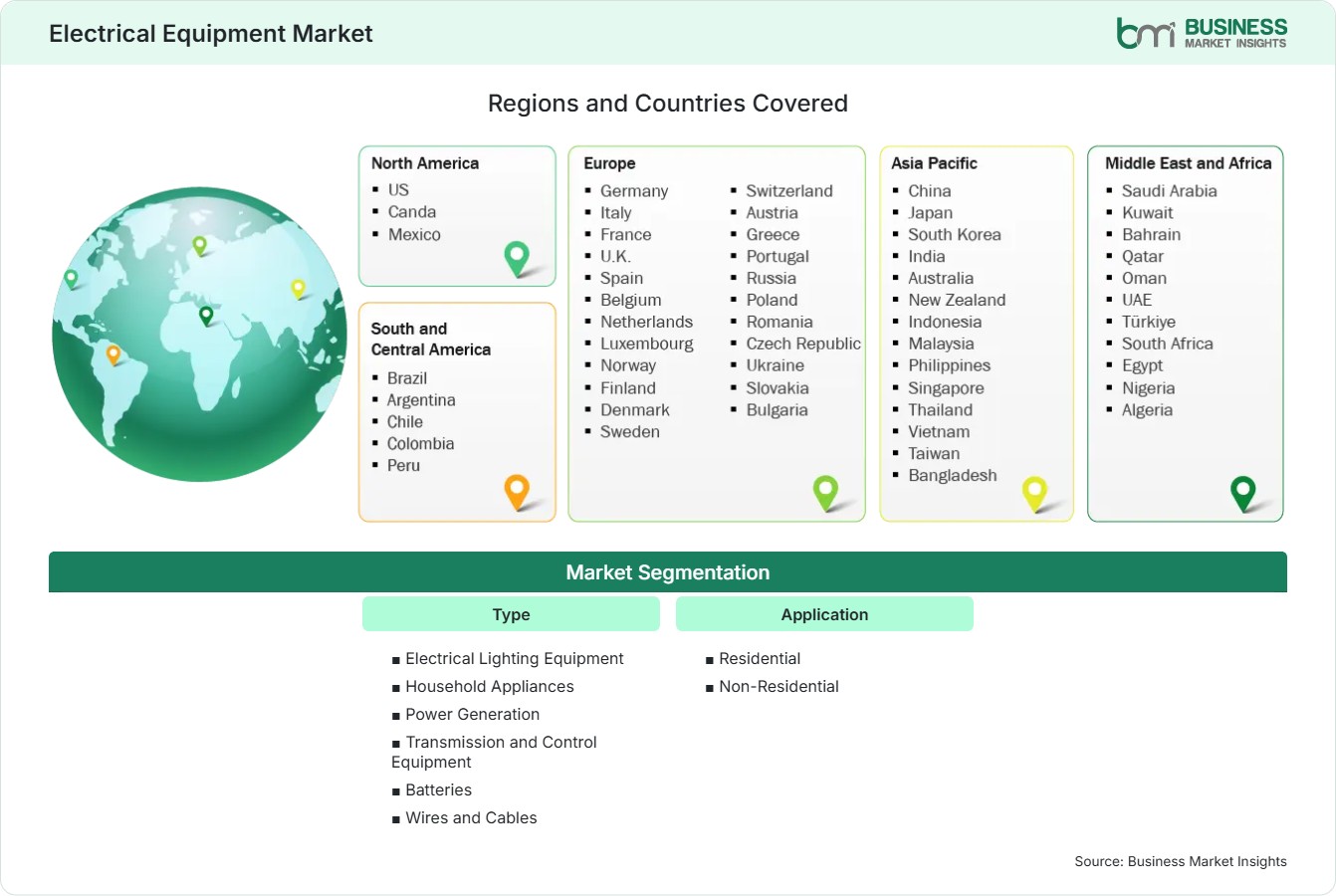
  • Type: Electrical Lighting Equipment, Household Appliances, Power Generation, Transmission and Control Equipment, Batteries, Wires and Cables
  • Application: Residential, Non-Residential
US$ 1.58 Tn Market size in 2025
US$ 2.99 Tn Market Size by 2033
8.3% CAGR, 2026 - 2033
2026-2033 Forecast Period

AI Overview

Electrical Equipment Market Summary

  • North America Region: North America holds 25%–28% market share in 2025, growing with a CAGR of 7.8%–8.3% during 2026–2033, supported by grid modernization, industrial automation, renewable energy investments, and infrastructure upgrades. The United States remains the primary contributor due to energy transition programs and is expanding at a CAGR of 7.9%–8.4%.
  • Fastest Growing Region: Asia Pacific accounts for 39%–42% market share in 2025 and is projected to grow at a CAGR of 8.8%–9.3% during 2026–2033, driven by industrial expansion, urbanization, smart city initiatives, renewable power installations, and increasing electricity demand across developing economies.
  • Leading Segment: Power Generation, Transmission and Control Equipment represents the leading segment with 32%–35% market share in 2025 and is expected to grow at a CAGR of 8.4%–8.9%, supported by grid expansion, renewable integration, electricity infrastructure modernization, and increasing demand for reliable power management systems.
  • High Growth Segment: Batteries represent the high-growth segment with 11%–14% market share in 2025 and are projected to expand at a CAGR of 10.2%–10.7%, supported by energy storage demand, electric mobility growth, renewable energy integration, and increasing requirements for backup power solutions.
  • Key Market Opportunity: Expansion of renewable energy infrastructure, smart manufacturing systems, energy storage technologies, and electrification programs across emerging economies is creating opportunities for advanced electrical equipment providers.
  • Major Market Players: Siemens AG, Schneider Electric SE, ABB Ltd., Eaton Corporation plc, General Electric Company, Mitsubishi Electric Corporation, Hitachi, Ltd., Honeywell International Inc., Emerson Electric Co., Legrand SA.
Strategic Insights

Electrical Equipment Market: Strategic Insights

Electrical Equipment Market Strategic Framework
FREE PDF
Request your free sample
Request free sample
Stakeholder View

Key Takeaways

  • The market value chain includes electrical equipment manufacturers, component suppliers, utility companies, construction firms, industrial automation providers, and energy solution integrators. Companies with broad product portfolios covering power systems, automation technologies, and digital energy solutions are strengthening their market positions through integrated offerings.
  • Power generation, transmission, and control equipment remain critical growth areas due to increasing electricity demand, grid modernization programs, renewable energy integration, and infrastructure expansion. Battery technologies and energy storage systems also provide strong upside as industries transition toward flexible and resilient power networks.
  • Technological advancement is focused on smart electrical systems, digital monitoring, automation, energy management platforms, and connected grid infrastructure. Manufacturers are investing in intelligent equipment that improves operational efficiency, reduces energy losses, and enables predictive maintenance across industrial and commercial environments.
  • Asia Pacific presents significant investment potential due to rapid industrialization, urban development, manufacturing expansion, and renewable energy deployment. China, India, Japan, and Southeast Asian economies are increasing investments in electricity infrastructure and advanced power management technologies.
  • Strategic partnerships, acquisitions, and technology collaborations are shaping competitive strategies as companies expand capabilities in electrification, automation, renewable integration, and energy efficiency solutions. Market participants are strengthening global service networks to support growing infrastructure requirements.
  • Increasing electrification across transportation, buildings, and industrial processes is creating long-term opportunities for companies developing energy-efficient equipment, intelligent control systems, and sustainable electrical solutions.
Geographic Outlook

Electrical Equipment Market Regional Highlights

North America Electrical Equipment Market

North America accounted for 25%–28% of the global market share in 2025 and is projected to grow at a CAGR of 7.8%–8.3% during 2026–2033. The region benefits from grid modernization initiatives, renewable energy investments, industrial automation adoption, and infrastructure redevelopment programs. The Electrical Equipment Market share is supported by strong demand from utilities, commercial facilities, manufacturing industries, and data infrastructure operators across the United States and Canada.

  • The United States represents the largest regional contributor due to power grid modernization, industrial electrification initiatives, and renewable energy infrastructure expansion.
  • Utilities are investing in advanced transmission and distribution equipment to improve grid reliability and support renewable power integration.
  • Industrial sectors are adopting intelligent electrical systems to enhance energy management, automation, and operational efficiency.
  • Commercial infrastructure development is increasing demand for lighting systems, power control equipment, and electrical distribution solutions.

US Electrical Equipment Market

The United States accounted for 21%–24% of the global Electrical Equipment market share in 2025 and is expected to grow at a CAGR of 7.9%–8.4% through 2033. The country benefits from large-scale infrastructure investments, energy transition initiatives, industrial automation adoption, and modernization of aging electrical networks. Increasing demand for reliable power systems and smart energy management technologies is encouraging adoption across utilities, manufacturing facilities, and commercial buildings.

  • Grid enhancement programs are supporting demand for advanced transmission, distribution, and control equipment.
  • Renewable energy deployment is increasing requirements for electrical systems capable of managing variable power generation.
  • Manufacturing facilities are investing in automation-compatible electrical equipment to improve productivity and energy efficiency.
  • Data centers and commercial infrastructure projects are creating additional demand for reliable power management solutions.

Europe Electrical Equipment Market

Europe accounted for 22%–25% of the global Electrical Equipment market share in 2025 and is projected to grow at a CAGR of 7.6%–8.1% during 2026–2033. The region benefits from renewable energy expansion, industrial automation adoption, energy efficiency initiatives, and modernization of aging electricity infrastructure. Germany, France, the United Kingdom, Italy, and the Netherlands represent key markets. Germany and the Nordic countries are experiencing strong growth due to industrial electrification, clean energy investments, and advanced power management requirements.

  • Germany remains a leading contributor due to manufacturing strength, industrial automation adoption, and demand for advanced electrical systems across multiple sectors.
  • France is supporting market expansion through renewable energy projects, grid upgrades, and investments in efficient electricity distribution infrastructure.
  • The United Kingdom is increasing demand through offshore renewable energy development, smart grid deployment, and commercial infrastructure modernization.
  • The Netherlands and Nordic countries are benefiting from sustainable energy projects, digital infrastructure growth, and electrification initiatives.
  • European industries are adopting intelligent electrical equipment to improve energy efficiency and comply with evolving sustainability requirements.

Asia Pacific Electrical Equipment Market

Asia Pacific represented 39%–42% of the global Electrical Equipment market share in 2025 and is expected to register the fastest growth with a CAGR of 8.8%–9.3% during 2026–2033. The region benefits from rapid industrialization, urbanization, renewable energy deployment, manufacturing expansion, and increasing electricity consumption. China, India, Japan, South Korea, and Southeast Asian countries are major markets due to infrastructure investments, smart city development, and growing demand for advanced electrical equipment.

  • China dominates regional demand due to extensive power infrastructure development, manufacturing growth, and renewable energy installation programs.
  • India is witnessing strong growth through electrification initiatives, industrial expansion, smart grid projects, and increasing energy access programs.
  • Japan supports market development through advanced automation systems, energy efficiency technologies, and modernization of electrical infrastructure.
  • South Korea contributes through semiconductor manufacturing growth, industrial automation, and investments in advanced power systems.
  • Southeast Asian countries are creating opportunities through urban development, infrastructure expansion, and increasing adoption of modern electrical solutions.

Rest of World Electrical Equipment Market

The Rest of World region accounted for 8%–11% of the global Electrical Equipment market share in 2025 and is estimated to grow at a CAGR of 7.5%–8.0% during 2026–2033. Growth across Latin America, the Middle East, and Africa is supported by infrastructure development, renewable energy projects, industrial expansion, and increasing electrification programs. Brazil, Mexico, Saudi Arabia, the United Arab Emirates, and South Africa represent important markets due to rising investments in energy systems and commercial infrastructure.

Latin American nations are making efforts to invest in their electricity systems, industries, and renewable energy sources to boost economic growth. Middle Eastern nations are focusing on energy diversification, infrastructure improvements, and major construction projects, whereas African countries are working towards better electricity supplies.

  • Brazil promotes regional development through its initiatives in renewable energy, industrialization, and improvement of power infrastructure.
  • Mexico has been witnessing demands arising from growth in manufacturing and industry, as well as in the electricity distribution infrastructure.
  • Saudi Arabia is focusing on intelligent infrastructure, renewable energy projects, and sophisticated electrical infrastructure through its economic diversification initiatives.
  • The United Arab Emirates is developing electrical equipment through commercial development, smart cities, and energy transition initiatives.
  • African markets are making greater investments in electrification projects, power generation infrastructure, and grid expansion programs.
Global Market Geography
FREE PDF
Request your free sample
Request free sample
Segment Analysis

Electrical Equipment Market Segmentation

Type

Type classification includes Electrical Lighting Equipment, Household Appliances, Power Generation, Transmission & Control Equipment, Batteries, and Wires & Cables. The Power Generation, Transmission & Control Equipment segment will hold a 32%-35% market share until 2025 and is expected to witness a CAGR of 8.4%-8.9% between 2026-2033, driven by grid modernization, the adoption of renewables, and the need for an efficient electric power network. This category still plays an important role in utilities, industries, commercial installations, and energy transition projects.

  • Electrical Lighting Equipment: The use of lighting equipment is growing due to energy-efficient technologies, intelligent lighting systems, LED technology, and infrastructure development.
  • Household Appliances: Demand for household appliances is supported by rising urbanization, improving living standards, adoption of energy-efficient products, and increasing residential electrification across developing regions.
  • Power Generation, Transmission and Control Equipment: This category supports the development of electrical infrastructure via grid technology, power management solutions, integration with renewables, and industrial energy needs.
  • Batteries: Battery technology is becoming more significant owing to the requirement for renewable storage, the growth of electric vehicles, backup energy sources, and grid flexibility.
  • Wires and Cables: Wires and cables remain essential components for power distribution, construction activities, industrial facilities, and expanding electricity transmission networks worldwide.

Application

The Application segment consists of Residential and Non-Residential users adopting electrical equipment for power distribution, automation, energy management, and operational efficiency. Non-Residential applications accounted for 67%–70% market share in 2025 and are projected to grow at a CAGR of 8.5%–9.0% during 2026–2033 due to industrial expansion, commercial construction, infrastructure development, and increasing automation requirements. The segment benefits from investments in manufacturing, utilities, data centers, transportation infrastructure, and renewable energy facilities.

  • Residential: Residential applications are expanding due to rising electrification, smart home adoption, energy-efficient appliances, residential construction growth, and increasing demand for reliable electrical systems.
  • Non-Residential: Non-residential applications include industrial facilities, commercial buildings, utilities, and infrastructure projects requiring advanced electrical equipment for power management and automation.
Market Forces

Electrical Equipment Market Dynamics

Key Market Drivers

Growing Industrial Electrification Investments

Industrial electrification investments are accelerating demand for advanced electrical equipment as manufacturers transition toward automated, energy-efficient, and digitally connected operations. Industries are adopting electrical systems for machinery, process control, automation, and energy management to improve productivity and reduce operational costs. The market growth is supported by increasing deployment of industrial control systems, electrified manufacturing processes, and smart energy solutions. The Electrical Equipment Market trends indicate rising preference for intelligent equipment capable of monitoring energy consumption, improving efficiency, and supporting sustainability objectives. Growing investments in industrial infrastructure, particularly across emerging economies, are creating sustained demand for power distribution systems, control equipment, and energy management technologies.

Increasing Demand for Smart Grid Equipment

Increasing demand for smart grid equipment is supporting market expansion as utilities modernize electricity networks to improve reliability, efficiency, and renewable energy integration. Smart grids require advanced electrical equipment, including control systems, monitoring devices, distribution technologies, and automation solutions. The growth in the use of renewable energy sources is driving increased demand for flexible grid systems that can accommodate fluctuating energy generation. Digital technologies that enable real-time monitoring, predictive maintenance, and improved power distribution performance are being introduced by utilities. The developers of electrical machinery are creating devices that can contribute to the development of dependable electricity grids and efficient energy consumption. The trend towards intelligent electricity grid development offers chances for businesses that provide innovative transmission and distribution systems.

Expansion of Commercial Infrastructure Projects

With the growth of infrastructure development projects in the business sector, demand for electrical products in offices, retail facilities, healthcare institutions, transportation infrastructure, and data infrastructure is increasing. With rising urbanization and construction activities, there is increased investment in power distribution, lighting, automation, and energy management systems. Electrical systems have been used by commercial firms to ensure energy efficiency and improve productivity. In addition, smart buildings have been contributing to the increasing demand for electrical systems with automation features. Digital infrastructure, including data centers and communication networks, has opened up new opportunities in efficient electrical systems.

Key Market Opportunities

Expansion of Renewable Energy Infrastructure

Renewable energy infrastructure is creating significant opportunities for equipment makers, as projects such as solar and wind require modern technology for power generation and transmission. The use of renewable energy requires efficient electrical equipment that can handle energy variability, stabilize the grid, and integrate energy storage devices. Rising investments in clean energy generation capacity have created demand for transformers, control systems, switchgear, cables, and batteries. The production of sustainable, digitally enabled electricity equipment is likely to be supported by energy transition programs. Growing deployment of renewable energy across developed and emerging markets is expected to increase demand for advanced electrical infrastructure to support decentralized and resilient power networks.

Growing Investments in Smart Manufacturing

Growing investments in smart manufacturing are creating opportunities for electrical equipment market forecast providers as industries adopt automation, robotics, and digitally connected production systems. There are ways to improve efficiency and productivity by implementing smart factory solutions, including electrical infrastructure, intelligent controls, and an energy management system. Manufacturers have begun integrating industrial automation with electrical systems to improve their processes and reduce electricity use. With the implementation of Industry 4.0, organizations have become aware of the need for devices that support data analytics and maintenance. The businesses providing solutions for electrical and automation are well-placed to take advantage of industrial transformation initiatives across the automotive, electronics, semiconductor, and manufacturing sectors.

Increasing Electrification Across Emerging Markets

Increasing electrification across emerging markets is creating substantial growth opportunities as governments invest in expanding electricity access, industrial infrastructure, and urban development. Developing countries have increased their energy expenditure and the use of energy-efficient devices to promote economic development. With the rise in industrial activity and urban population, the need for electrical equipment is increasing. The manufacturers are concentrating on products that are scalable and economical for developing countries with changing energy needs. Programs for electrification, smart cities, and infrastructure development will drive demand for electrical equipment in the coming years.

Market Restraints and Challenges

Volatile Raw Material Pricing Pressure

Factor: Volatile raw material pricing pressure, including fluctuations in copper, aluminum, steel, and semiconductor component costs, creates challenges for electrical equipment manufacturers by increasing production expenses. Impact: Rising material costs can reduce profit margins, increase product prices, and create uncertainty in supply chain planning for manufacturers and end users. Electrical equipment production relies heavily on metals and specialized components, making companies vulnerable to commodity price fluctuations. Manufacturers are adopting supply chain diversification strategies, material optimization approaches, and long-term procurement agreements to reduce cost pressures. However, continued volatility in raw material markets remains a challenge affecting pricing strategies and production stability across the electrical equipment industry.

Complex Regulatory Compliance Requirements

Factor: Complex regulatory compliance requirements related to electrical safety standards, energy efficiency regulations, environmental guidelines, and regional certification processes increase operational complexity for manufacturers. Impact: Compliance requirements can extend product development timelines, increase testing expenses, and create barriers for companies entering new geographic markets. Electrical equipment providers must continuously update designs to meet changing standards related to energy consumption, safety, and sustainability. Different regional regulations require customized product approaches and additional certification procedures. Companies investing in compliance management systems, research capabilities, and standardized product platforms can better manage regulatory challenges while maintaining competitiveness across global electrical equipment markets.

Company Analysis

Competitive Landscape

The Electrical Equipment Market analysis shows fierce competition, with competitors including global corporations operating in electrical engineering technology, automation, energy, and infrastructure equipment. The main players focus on digitalization, integrating renewable energy, smart grids, and energy efficiency to consolidate their market positions.

Company Name

Overview

Products and Services relevant to this market

Siemens AG

Global technology company providing electrification, automation, and digital solutions.

Electrical distribution systems, automation equipment, industrial power solutions, and smart grid technologies.

Schneider Electric SE

Energy management and automation company serving global infrastructure markets.

Electrical distribution equipment, energy management systems, automation solutions, and smart technologies.

ABB Ltd.

Technology company specializing in electrification and industrial automation solutions.

Switchgear, electrical systems, power distribution solutions, and automation technologies.

Eaton Corporation plc

Power management company providing electrical and industrial solutions worldwide.

Electrical components, power distribution equipment, circuit protection, and energy management systems.

General Electric Company

Industrial technology company delivering power and energy solutions.

Power generation equipment, grid technologies, electrical systems, and energy solutions.

Mitsubishi Electric Corporation

Japanese technology company serving industrial and infrastructure sectors.

Electrical systems, automation equipment, power devices, and energy management solutions.

Hitachi, Ltd.

Technology company providing digital and infrastructure solutions.

Power systems, grid solutions, electrical equipment, and energy infrastructure technologies.

Honeywell International Inc.

Technology company offering industrial automation and building solutions.

Electrical control systems, automation technologies, building management, and energy solutions.

Emerson Electric Co.

Industrial technology provider focused on automation and process solutions.

Electrical control equipment, automation systems, industrial technologies, and energy management solutions.

Legrand SA

Global specialist in electrical and digital building infrastructure.

Electrical components, wiring devices, cable management, and building electrical solutions.

Industry Activity

Recent Developments

May 2026

ABB Ltd. announced a US$200 million investment across Europe to expand medium-voltage electrical equipment manufacturing capabilities, including production of next-generation switchgear and grid automation technologies. The investment supports rising demand from utilities, industrial customers, renewable energy projects, and data center infrastructure markets.

April 2026

Eaton Corporation plc announced a new 370,000-square-foot manufacturing facility in Nebraska, USA to increase production of medium-voltage switchgear. The expansion targets growing demand for electrical distribution equipment used in data centers, utilities, and industrial power systems, with production expected to begin in 2027.

November 2025

Schneider Electric SE secured approximately $2.3 billion in U.S. data center infrastructure agreements, including contracts for power modules, cooling systems, UPS systems, and switchgear solutions. The deals strengthen Schneider Electric’s position as a supplier of electrical equipment for AI-driven data center expansion.

October 2025

Legrand SA completed the acquisition of Avtron Power Solutions, a U.S.-based provider of load banks and power quality solutions used in data centers, healthcare, renewable energy, and industrial applications. The acquisition expands Legrand’s electrical infrastructure portfolio, particularly in critical power and energy transition segments.

Trust & Transparency

Research Methodology

The market analysis combines proprietary research with secondary data from government agencies, company disclosures, regulatory filings, industry databases and expert interviews. Market estimates are validated through data triangulation, cross-market benchmarking and analyst review.

View Full Research Methodology

Questions Answered

Frequently Asked Questions

What information is covered in the Electrical Equipment Market Report?

The market report provides analysis of market size, growth factors, segmentation, regional trends, competitive landscape, recent developments, opportunities, challenges, and future industry outlook.

Which region provides strong opportunities for electrical equipment manufacturers?

Asia Pacific provides significant opportunities due to rapid industrialization, urbanization, renewable energy investments, smart city projects, and expanding electricity infrastructure across China, India, Southeast Asia, and other developing economies.

How is renewable energy influencing electrical equipment demand?

Renewable energy expansion is increasing demand for transformers, transmission systems, energy storage equipment, control technologies, and grid solutions required to integrate variable renewable power sources into electricity networks.

Which segment dominates the market?

Power Generation, Transmission and Control Equipment represents the leading segment due to increasing electricity demand, grid modernization programs, renewable energy integration, and infrastructure investments requiring advanced power management solutions.

What factors are driving the Electrical Equipment Market growth?

The market is driven by industrial electrification investments, smart grid modernization, renewable energy expansion, commercial infrastructure development, and increasing adoption of energy-efficient electrical systems across residential and non-residential applications.

Access the Full Electrical Equipment Market Report

Get segment-level forecasts, regional estimates, competitive benchmarking, company profiles and downloadable Excel datasets.

Access the full Electrical Equipment Market Report
350 pages PDF & Excel | 2026-08-04