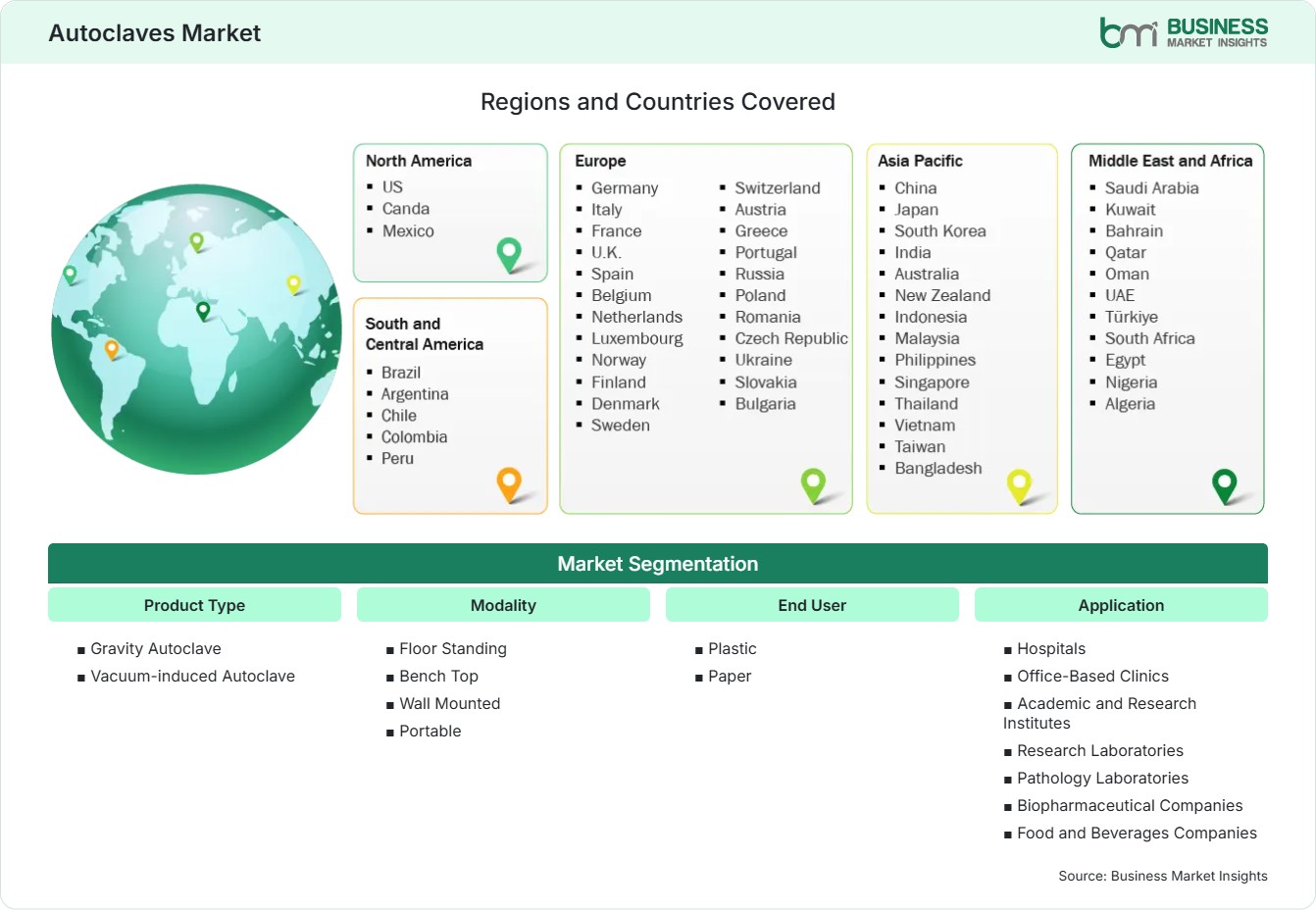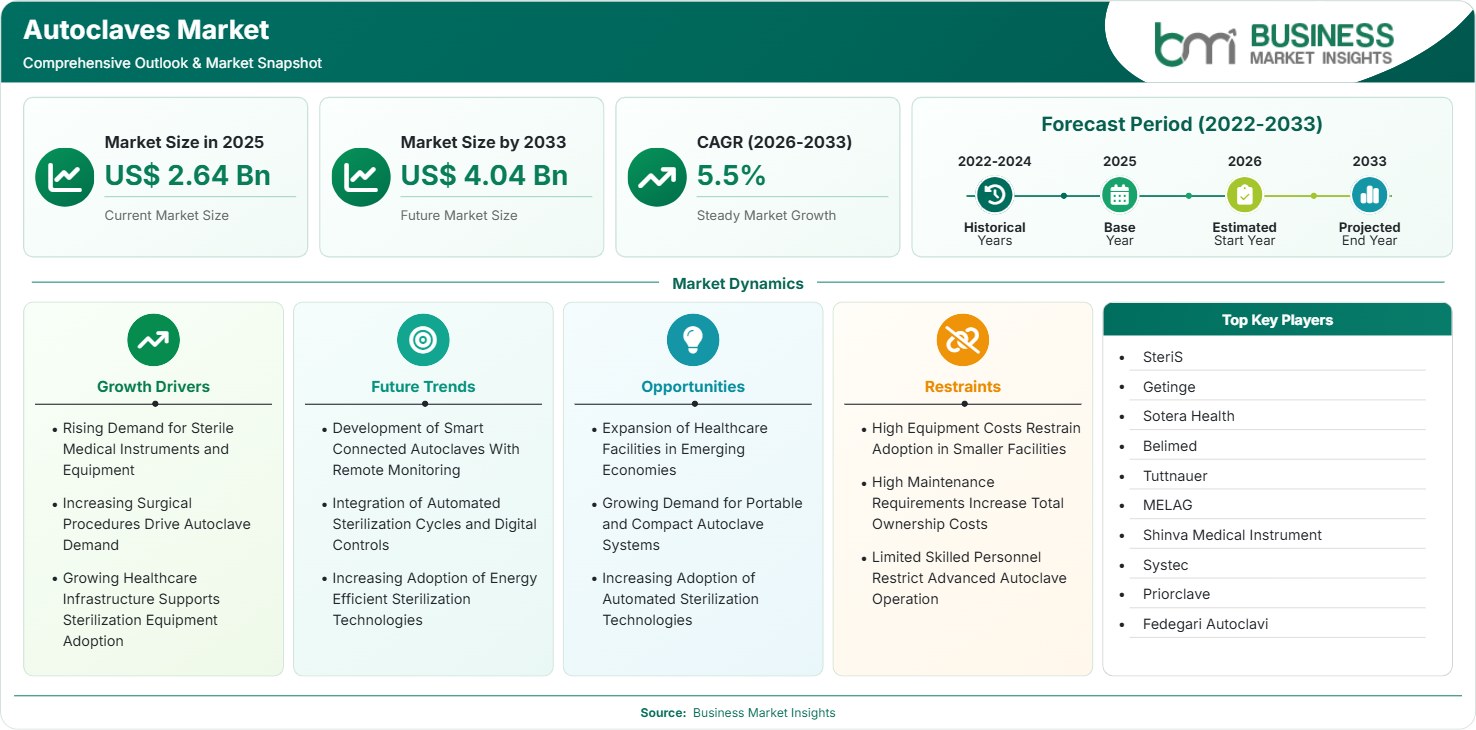
Autoclaves Market Regional Highlights
North America Autoclaves Market
North America held an estimated 32%–36% share in 2025, with the Autoclaves Market share supported by established healthcare infrastructure, high surgical volumes, mature laboratory networks, stringent infection-control practices, and ongoing replacement of aging sterilization equipment. The region is projected to grow at a 5.1%–5.5% CAGR through 2033.
- The hospital and outpatient markets are constantly investing in new sterilization technologies due to the increasing number of surgeries that need reliable machines with automated monitoring systems.
- Research institutions and biopharmaceutical companies are increasing demand for specialized sterilization equipment as laboratory capacity expands and production processes require consistent contamination control.
- Equipment replacement creates recurring opportunities because older autoclaves require modernization, improved energy performance, enhanced cycle controls, and stronger digital connectivity.
- Service contracts and preventive maintenance are becoming important competitive differentiators as healthcare organizations prioritize equipment uptime, regulatory compliance, and predictable operating costs.
US Autoclaves Market
The U.S. represented an estimated 29%–33% share in 2025 and is projected to grow at a 5.2%–5.6% CAGR through 2033. Demand is supported by hospital modernization, outpatient surgical expansion, laboratory activity, and stringent infection-prevention practices. The Autoclaves Market increasingly favors automated equipment with digital documentation, validated cycles, and efficient workflows that can support high-throughput sterilization requirements.
- Growth in ambulatory surgery and office-based procedures is creating demand for appropriately sized sterilization equipment that supports efficient instrument turnover outside large hospital facilities.
- Hospitals are investing in digitally enabled autoclaves that provide cycle records, automated monitoring, and traceability to strengthen quality assurance and infection-control workflows.
- Research and biopharmaceutical facilities represent attractive opportunities because specialized sterilization requirements support demand for reliable, high-performance systems with configurable operating parameters.
- Replacement demand remains important as healthcare providers seek to modernize equipment, reduce downtime, and improve operational efficiency across central sterilization departments.
Europe Autoclaves Market
Europe held an estimated 24%–28% share in 2025 and is projected to grow at a 5.3%–5.7% CAGR through 2033. Germany, the UK, France, and Italy represent leading Autoclaves Markets supported by mature healthcare systems and strong sterilization standards. Germany is projected to grow at a 5.5%–5.9% CAGR, while France and Italy provide opportunities through hospital modernization and laboratory investment.
- Germany remains a major market due to advanced healthcare infrastructure, established medical technology manufacturing, and strong demand for validated sterilization processes across healthcare facilities.
- The UK provides opportunities through hospital equipment replacement and increasing use of outpatient care settings that require reliable instrument sterilization capabilities.
- France benefits from healthcare modernization and research activity, supporting demand for autoclaves across hospitals, laboratories, and pharmaceutical-related applications.
- Italy offers growth opportunities as healthcare facilities upgrade sterilization systems and improve operational efficiency through automation and digitally monitored equipment.
Asia Pacific Autoclaves Market
Asia Pacific represented an estimated 27%–31% share in 2025 and is projected to grow at a 6.7%–7.1% CAGR through 2033. China, Japan, India, and South Korea lead regional demand, with India projected to grow at a 7.3%–7.7% CAGR. Healthcare infrastructure development, rising procedure volumes, research investment, and expanding pharmaceutical manufacturing are strengthening sterilization equipment opportunities.
- China represents a major opportunity as hospital construction, medical manufacturing, pharmaceutical production, and laboratory development increase demand for modern sterilization infrastructure.
- India offers strong growth potential because healthcare expansion, rising surgical activity, pharmaceutical manufacturing, and laboratory development are creating new requirements for reliable sterilization equipment.
- Japan's mature healthcare system supports replacement demand, with facilities increasingly seeking automated systems that improve operational efficiency and provide stronger process documentation.
- South Korea benefits from advanced healthcare and biopharmaceutical capabilities, supporting demand for technologically sophisticated autoclaves in hospitals, laboratories, and production facilities.
Rest of World Autoclaves Market
South and Central America had an approximate market share of 8%-10% in 2025 and are anticipated to register a CAGR of 5.0%-5.4% until 2033. Brazil and Mexico are leading players in the region. The Middle East and Africa accounted for an estimated market share of 7%-9% and are anticipated to register a CAGR of 5.8%-6.2%, supported by healthcare infrastructure expansion and laboratory development.
- Brazil offers opportunities through hospital modernization, increasing healthcare capacity, and growth in laboratory services requiring dependable sterilization equipment.
- Mexico benefits from expanding healthcare facilities and pharmaceutical activity, creating demand for equipment that combines reliable sterilization performance with manageable operating requirements.
- Saudi Arabia is investing in healthcare infrastructure and specialized medical services, creating opportunities for modern sterilization equipment across hospitals and clinical facilities.
- The UAE provides opportunities through healthcare development, private medical facilities, research activity, and pharmaceutical investment requiring advanced contamination-control and sterilization capabilities.