
Industry 4.0 Market Outlook: Size, Share, Trends, Growth Analysis, Competitive Landscape & Forecast, 2026-2033

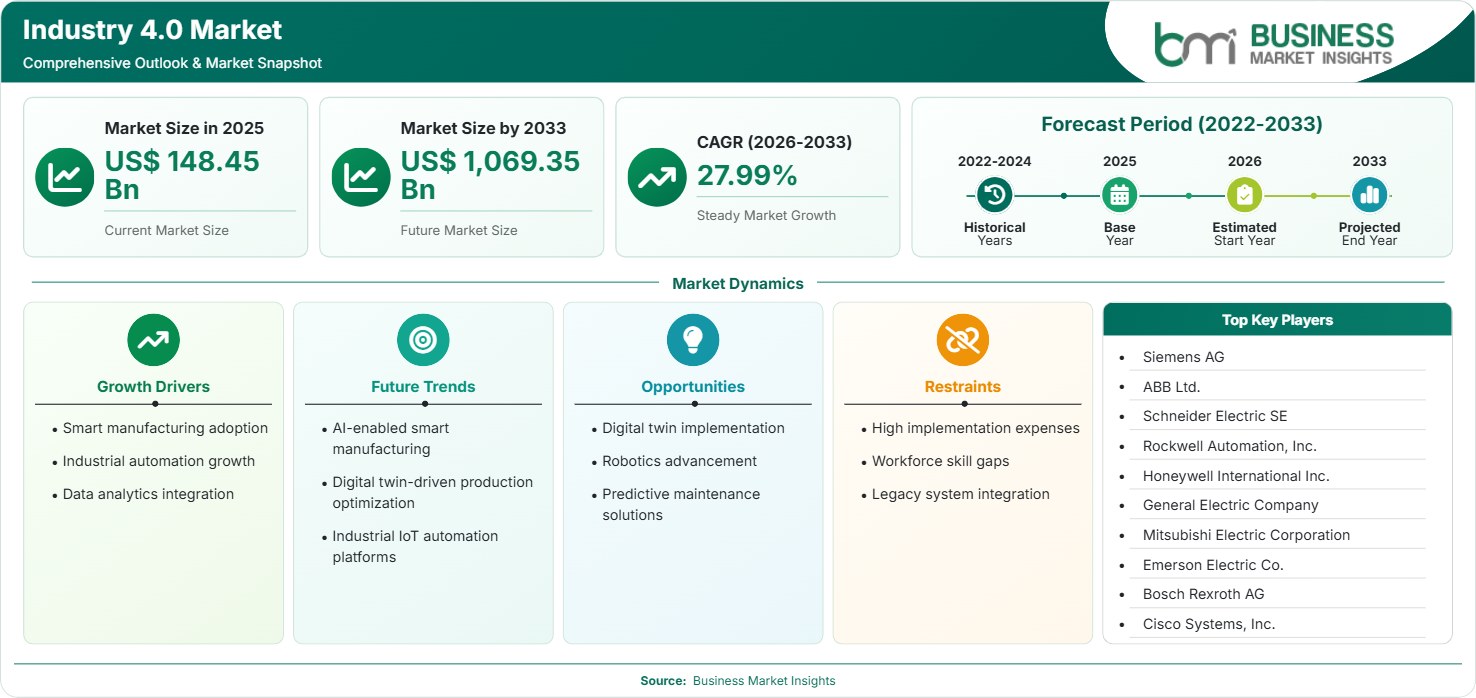
The Industry 4.0 Market size was valued at US$ 148.45 billion in 2025 and is projected to reach US$ 1,069.35 billion by 2033, growing at a CAGR of 27.99% during 2026–2033. Accelerating smart manufacturing adoption, industrial automation expansion, advanced data analytics integration, digital transformation initiatives, and increasing demand for connected production ecosystems are driving market growth and creating opportunities across industrial sectors.

Report Coverage
  • Technology: Industrial Robots, Blockchain, Industrial Sensors, Industrial 3D Printing, Machine Vision, HMI, AI in Manufacturing, Digital Twin, AGVs, Machine Condition Monitoring
  • End-Use Industry: Manufacturing, Automotive, Oil & Gas, Energy & Utilities, Electronics & Foundry, Food & Beverage, Aerospace & Defense, Others
US$ 148.45 Bn Market size in 2025
US$ 1,069.35 Bn Market Size by 2033
27.99% CAGR, 2026 - 2033
2026-2033 Forecast Period

AI Overview

Industry 4.0 Market Summary

  • North America Region: North America holds an estimated 31%–35% market share in 2025 and is projected to expand at a 26.5%–27.5% CAGR during 2026–2033. Strong manufacturing digitization, industrial automation investments, artificial intelligence adoption, and cloud-based industrial platforms support regional growth. The United States remains the leading region in Industry 4.0 report, growing at a 26.8%–27.8% CAGR, driven by smart factory investments, robotics deployment, and industrial data analytics adoption.
  • Fastest Growing Region: Asia Pacific accounts for approximately 34%–38% share in 2025 and is forecast to register a 29.0%–30.5% CAGR through 2033. Manufacturing expansion, automation initiatives, electronics production growth, and government-backed digital industrial programs are accelerating market growth.
  • Leading Segment: Industrial Sensors represent an estimated 18%–22% share in 2025 and are expected to grow at a 26.8%–27.8% CAGR as per Industry 4.0 Market forecasts. Increasing demand for real-time production monitoring, connected equipment, and industrial data collection is supporting segment leadership.
  • High Growth Segment: Digital Twin technology accounts for approximately 10%–14% market share in 2025 and is projected to expand at a 31.0%–32.5% CAGR. Growing adoption of virtual modeling, predictive optimization, and simulation-based manufacturing strategies is driving rapid expansion.
  • Key Market Opportunity: Digital twin deployment, robotics advancement, and predictive maintenance solutions are creating opportunities for manufacturers to improve operational efficiency, reduce downtime, optimize production processes, and enable intelligent industrial decision-making.
  • Major Market Players: Siemens AG, ABB Ltd., Schneider Electric SE, Rockwell Automation, Inc., Honeywell International Inc., General Electric Company, Mitsubishi Electric Corporation, Emerson Electric Co., Bosch Rexroth AG, Cisco Systems, Inc.
Strategic Insights

Industry 4.0 Market: Strategic Insights

Industry 4.0 Market Strategic Framework
FREE PDF
Request your free sample
Request free sample
Stakeholder View

Key Takeaways

  • The market ecosystem is evolving from isolated automation systems toward integrated industrial platforms connecting machines, sensors, software providers, cloud infrastructure companies, and manufacturing operators. Value creation is shifting toward interoperable solutions that combine operational technology with information technology for improved industrial intelligence.
  • Manufacturing, automotive, electronics, and energy sectors represent significant growth opportunities due to increasing automation requirements, production complexity, and demand for real-time operational visibility. Companies adopting connected factories and intelligent systems are positioned to achieve productivity improvements and stronger resource optimization.
  • Innovation is advancing through artificial intelligence-driven manufacturing, autonomous robotics, digital twins, industrial edge computing, and advanced sensor technologies. Technology providers are focusing on solutions that enable predictive decision-making, automated workflows, and continuous optimization of industrial processes.
  • Asia Pacific offers a strong investment opportunity due to large manufacturing bases, government-led industrial digitization programs, and increasing automation adoption across China, Japan, South Korea, and India. The region’s expanding electronics, automotive, and semiconductor industries are accelerating demand for smart manufacturing technologies.
  • Investment activity is increasingly focused on strategic partnerships, industrial software development, robotics integration, and expansion of digital transformation portfolios. Technology companies are strengthening capabilities through acquisitions and collaborations to provide comprehensive automation, analytics, and connected manufacturing solutions.
  • Cybersecurity is becoming a critical strategic consideration as industrial systems become increasingly connected. Stakeholders are prioritizing secure architectures, data protection frameworks, and resilient communication networks to manage risks associated with interconnected manufacturing environments.
Geographic Outlook

Industry 4.0 Market Regional Highlights

North America Industry 4.0 Market

North America accounted for an estimated 31%–35% share of the global industry 4.0 market in 2025 and is projected to expand at a 26.5%–27.5% CAGR during 2026–2033. The region benefits from advanced manufacturing capabilities, strong technology infrastructure, automation investments, and widespread adoption of industrial software platforms. The United States represents the primary contributor due to smart factory initiatives, artificial intelligence integration, and increasing deployment of connected industrial systems across manufacturing sectors.

  • The United States leads regional adoption through strong investments in automation, robotics, industrial software, and advanced manufacturing transformation initiatives.
  • Canada is expanding Industry 4.0 adoption through manufacturing modernization, digital infrastructure development, and increasing industrial technology investments.
  • Manufacturers are integrating industrial sensors, analytics platforms, and automation systems to improve productivity and operational visibility.
  • Industrial companies are prioritizing cybersecurity solutions to protect connected production environments and critical operational data.

US Industry 4.0 Market

The United States represents approximately 27%–30% of the global Industry 4.0 market revenue in 2025 and is expected to grow at a 26.8%–27.8% CAGR through 2033. Strong industrial automation capabilities, advanced manufacturing investments, and technology adoption across automotive, aerospace, electronics, and energy sectors are accelerating market development. Enterprises are increasingly implementing artificial intelligence, robotics, digital twins, and predictive maintenance solutions to enhance production efficiency.

  • Automotive manufacturers are deploying connected factory technologies to improve production flexibility, quality control, and operational efficiency.
  • Aerospace and defense organizations are adopting advanced simulation, digital twins, and automated manufacturing technologies for complex production environments.
  • Industrial enterprises are investing in cloud-based platforms and analytics solutions for real-time operational decision-making.

Europe Industry 4.0 Market

Europe accounted for approximately 22%–26% share of industry 4.0 market in 2025 and is projected to grow at a 26.0%–27.0% CAGR between 2026–2033. The region remains a major industrial technology hub due to strong engineering capabilities, manufacturing expertise, and government-supported digital transformation initiatives. Germany leads regional adoption, while countries including France, the United Kingdom, and Italy are expanding smart manufacturing investments through automation and industrial innovation programs.

  • Germany maintains leadership through advanced manufacturing ecosystems, industrial automation expertise, and strong adoption of connected production technologies.
  • The United Kingdom is increasing Industry 4.0 adoption through industrial digitalization programs, artificial intelligence integration, and manufacturing modernization.
  • France is expanding smart factory initiatives through robotics deployment, industrial software adoption, and automation investments.
  • Italy is strengthening digital manufacturing capabilities through modernization of industrial facilities and adoption of connected technologies.
  • European manufacturers are prioritizing sustainable production systems, energy efficiency, and data-driven operational improvements.

Asia Pacific Industry 4.0 Market

Asia Pacific represents the fastest-growing regional market, accounting for approximately 34%–38% share in 2025 and expanding at a 29.0%–30.5% CAGR through 2033. The region benefits from large manufacturing bases, increasing automation adoption, semiconductor production growth, and government-backed industrial digitization programs. China represents the largest market, while India, Japan, and South Korea are experiencing rapid adoption through manufacturing technology investments.

  • China leads regional demand through smart manufacturing initiatives, industrial automation expansion, and large-scale factory digitization programs.
  • India is accelerating adoption through manufacturing development programs, industrial modernization, and increasing automation investments.
  • Japan continues advancing Industry 4.0 implementation through robotics leadership, precision manufacturing, and advanced industrial technologies.
  • South Korea is expanding connected manufacturing through semiconductor production, electronics automation, and industrial artificial intelligence adoption.
  • Regional manufacturers are increasing investments in industrial sensors, robotics, and data analytics platforms to improve productivity.

Rest of World Industry 4.0 Market

The Rest of the World contributes approximately 7%–10% of global revenue in 2025 and is forecast to grow at a 27.5%–28.5% CAGR through 2033. South America is adopting industrial automation through manufacturing modernization, while Middle East and Africa markets are investing in digital industrial infrastructure, energy optimization, and smart production systems. Brazil, Mexico, the United Arab Emirates, and Saudi Arabia represent key Industry 4.0 Market growth markets.

  • Brazil is increasing Industry 4.0 adoption through manufacturing automation, industrial technology investments, and digital transformation initiatives.
  • Mexico is expanding connected manufacturing capabilities due to automotive production growth and industrial automation demand.
  • The United Arab Emirates is investing in smart industrial ecosystems through digital infrastructure and advanced manufacturing programs.
  • Saudi Arabia is developing industrial technology capabilities through diversification initiatives and automation-focused investments.
  • Regional industries are adopting predictive maintenance and industrial analytics solutions to improve operational performance and reduce downtime.
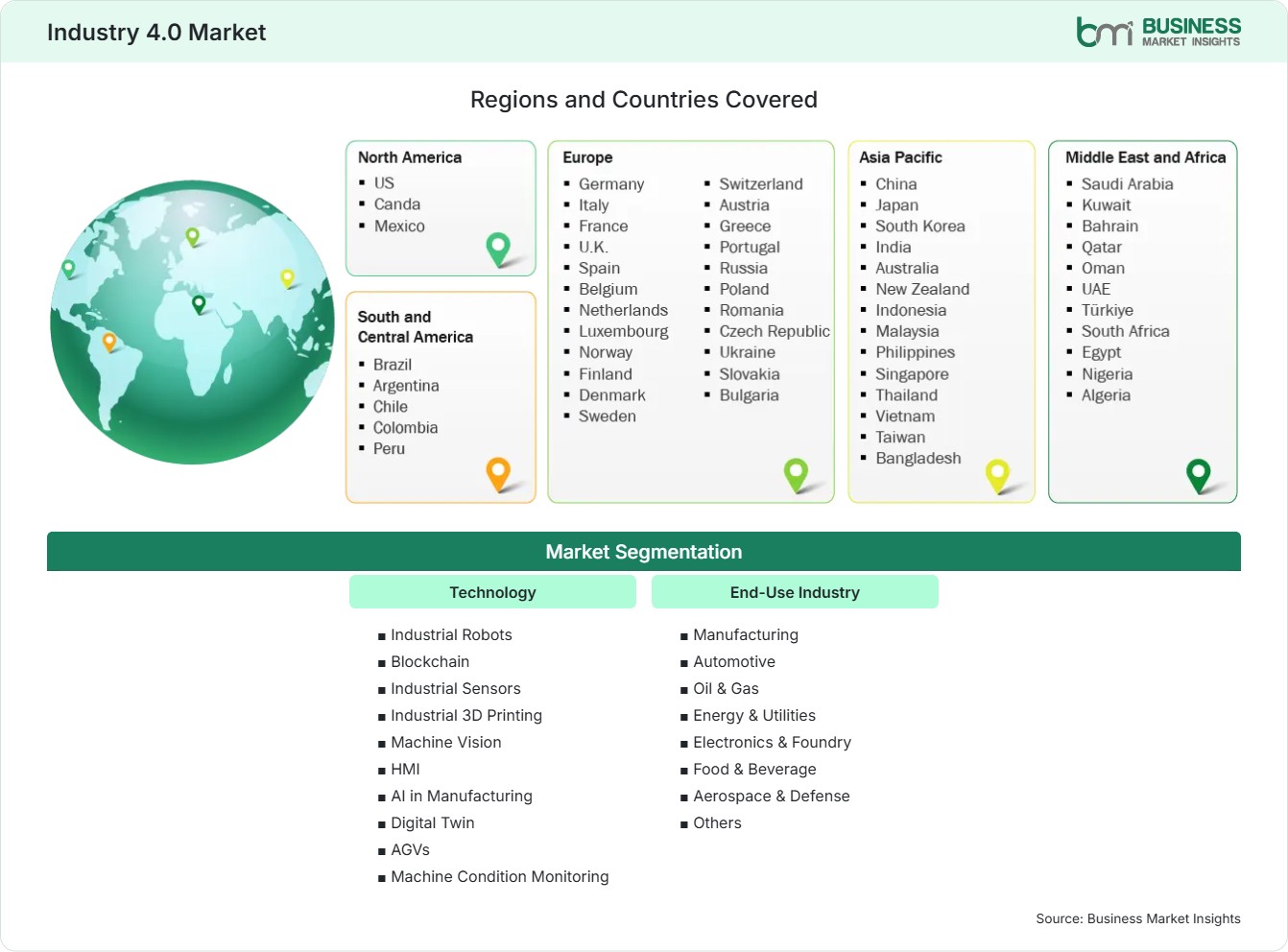
Global Market Geography
FREE PDF
Request your free sample
Request free sample
Segment Analysis

Industry 4.0 Market Segmentation

Technology

The technology segment represents the foundation of industrial digital transformation, integrating automation, connectivity, intelligence, and real-time operational management capabilities. The segment accounted for an estimated 100% of the Industry 4.0 Market share in 2025 and is projected to expand at a 27.99%–28.6% CAGR during 2026–2033. Industrial organizations are increasingly adopting interconnected technologies to improve productivity, reduce operational costs, enhance asset performance, and enable data-driven manufacturing decisions across complex production environments.

  • Industrial Robots: Industrial robots are gaining adoption through automated production lines, improved precision requirements, labor optimization, and increasing demand for flexible manufacturing operations.
  • Blockchain: Blockchain technology supports industrial ecosystems through secure data exchange, supply chain transparency, traceability improvements, and enhanced trust among connected manufacturing participants.
  • Industrial Sensors: Industrial sensors maintain strong adoption due to increasing demand for real-time monitoring, equipment connectivity, operational analytics, and intelligent manufacturing control systems.
  • Industrial 3D Printing: Industrial 3D printing is expanding through rapid prototyping, customized manufacturing, reduced material waste, and advanced production applications across multiple industries.
  • Machine Vision: Machine vision systems are increasingly deployed for quality inspection, defect detection, automated verification, and improved production accuracy in manufacturing environments.
  • Human-Machine Interface (HMI): HMI solutions support operator interaction with industrial systems through improved visualization, process control, and efficient machine management capabilities.
  • Artificial Intelligence in Manufacturing: Artificial intelligence adoption is increasing through predictive analytics, automated decision-making, production optimization, and intelligent process improvement applications.
  • Digital Twin: Digital twin technology is expanding rapidly through virtual simulation, operational optimization, predictive analysis, and improved lifecycle management of industrial assets.
  • Automated Guided Vehicles (AGVs): AGVs are gaining traction through automated material handling, warehouse optimization, and improved logistics efficiency within smart manufacturing facilities.
  • Machine Condition Monitoring: Machine condition monitoring solutions support predictive maintenance strategies through real-time equipment analysis, failure prevention, and improved asset reliability.

End-Use Industry

The end-use industry segment reflects broad adoption of Industry 4.0 technologies across manufacturing-intensive sectors. The segment represented an estimated 100% share in 2025 and is expected to grow at a 27.99%–28.7% CAGR between 2026–2033. Manufacturing industries are implementing automation, analytics, and connected systems to improve productivity, operational efficiency, and competitiveness. Increasing digital transformation initiatives across industrial sectors continue supporting technology adoption.

  • Manufacturing: Manufacturing remains the primary adoption area due to smart factory development, automation integration, production optimization, and demand for connected industrial ecosystems.
  • Automotive: Automotive companies are deploying Industry 4.0 solutions through robotics, digital twins, automated production, and advanced quality management systems.
  • Oil & Gas: Oil and gas companies are adopting industrial technologies for asset monitoring, operational safety improvement, predictive maintenance, and process optimization.
  • Energy & Utilities: Energy and utilities organizations are implementing connected systems for infrastructure monitoring, efficiency improvement, and intelligent resource management.
  • Electronics & Foundry: Electronics and foundry industries are adopting automation, precision technologies, and advanced analytics to support high-volume manufacturing requirements.
  • Food & Beverage: Food and beverage manufacturers are using connected technologies for production monitoring, quality control, traceability, and operational efficiency enhancement.
  • Aerospace & Defense: Aerospace and defense organizations are adopting digital manufacturing solutions for complex production processes, simulation, precision engineering, and lifecycle management.
  • Others: Other industries are integrating Industry 4.0 technologies to improve automation, data visibility, operational control, and productivity across diverse industrial applications.
Market Forces

Industry 4.0 Market Dynamics

Key Market Drivers

Increasing Adoption of Smart Manufacturing Systems

The adoption of smart manufacturing systems is accelerating as industries seek improved productivity, operational flexibility, and real-time process visibility. Industry 4.0 expansion is fueled by investment in technology that includes connecting machines, industrial sensors, automation systems, and analytics solutions. Firms are evolving from conventional manufacturing practices to smart factories where monitoring and optimizing can be done autonomously. Industry 4.0 market trends suggest that there will be more use of artificial intelligence, cloud computing, and industrial internet platform to enhance decision making and minimize production inefficiencies. Competition, complex supply chains, and need for customization have pushed companies to upgrade their industrial processes using digitalization.

Expansion of Industrial Automation and Robotics

Growing industrial automation adoption is strengthening demand for robotics, automated guided vehicles, machine vision systems, and advanced control technologies. Manufacturers are deploying automated solutions to enhance production accuracy, improve workplace safety, reduce operational costs, and address workforce availability challenges. The automotive industry, electronics, aerospace industry, and manufacturing have been among the pioneers because of the need for accuracy and speed in their operations. With robotic developments, the future involves collaborative work with robots and flexible manufacturing plants. More investment in automation systems is resulting in the digital transformation of industries and the need for Industry 4.0 technologies.

Integration of Data Analytics Across Industrial Operations

The increasing availability of industrial data is driving adoption of analytics platforms capable of transforming operational information into actionable insights. Connected sensors, manufacturing equipment, and enterprise systems are generating large volumes of data that organizations use for process optimization, quality improvement, and predictive decision-making. With data analytics integration, companies can detect inefficiencies in their manufacturing processes, optimize resource usage and enhance the performance of assets. Firms have been utilizing edge computing, artificial intelligence, and cloud computing to accelerate the analysis process and gain real-time operational control. The increasing trend of relying on data-oriented manufacturing practices has been fueling the implementation of Industry 4.0.

Key Market Opportunities

Expansion of Digital Twin Implementation

The adoption of digital twin technology is a key advantage, as manufacturing companies look to create virtual models in order to improve their processes and increase efficiency of equipment. Digital twin technology helps companies test processes and predict possible failures. Industries such as automotive, aerospace, energy, and manufacturing are adopting these solutions to improve efficiency and reduce operational risks. Technology providers developing scalable digital twin platforms integrated with artificial intelligence and real-time data analytics can capture growing demand. Increasing focus on lifecycle management, asset optimization, and production simulation is expected to accelerate adoption across industrial environments.

Advancement of Industrial Robotics Solutions

Robotics advancement is creating significant opportunities as manufacturers require flexible automation systems capable of supporting complex production environments. Modern industrial robots are becoming more intelligent through artificial intelligence, machine learning, improved sensors, and enhanced human-machine collaboration capabilities. Robots are being used by companies to enhance efficiency, ensure quality, and streamline production processes. Applications of robots are autonomous material handling, assembly, inspection, and collaborative robots. The more industries require automation, the more robotic systems that offer flexible and affordable solutions will be needed due to the increasing digitization of industry.

Growth of Predictive Maintenance Solutions

Predictive maintenance solutions are gaining importance as organizations focus on reducing equipment downtime and improving asset reliability. These systems combine industrial sensors, artificial intelligence, and analytics platforms to monitor equipment conditions and identify potential failures before disruptions occur. Maintenance predictive solutions are increasingly being adopted in different manufacturing, energy, oil and gas, and transportation sectors in order to make sure that maintenance is made efficient in reducing cost spent during the operations. Technology companies that have developed an integration platform for monitoring, machine learning, and diagnostics should benefit from the increasing demand.

Market Restraints and Challenges

High Implementation Expenses

Factor: Industry 4.0 adoption requires substantial investment in automation equipment, industrial software, connected infrastructure, cybersecurity systems, and workforce training.

Impact: The high cost of implementing technologies can cause delays in the digital transformation process for small and mid-sized manufacturers who have lower budgets allocated for adopting new technologies. Integrating new systems into the manufacturing process can be difficult for organizations, resulting in increased complexities and higher costs. However, technology companies are trying to solve this issue by offering scalable, modular platforms and subscription-based options. Nevertheless, the upfront cost issue continues to be a big problem.

Workforce Skill Gaps and Digital Expertise Shortages

Factor: The transition toward intelligent manufacturing requires specialized skills in automation, artificial intelligence, data analytics, cybersecurity, and industrial software management.

Impact: Limited availability of skilled professionals can restrict effective implementation and operation of Industry 4.0 technologies. The enterprise faces problems with managing sophisticated systems, understanding industrial data, and connecting production ecosystems. Companies are trying to solve the labor problem through the introduction of staff education initiatives, collaboration with educational institutions, and using technology. Nevertheless, there are still labor shortages that affect the schedule of industrial digitization.

Company Analysis

Competitive Landscape

The Industry 4.0 Market analysis highlights a competitive environment shaped by industrial automation expertise, software capabilities, robotics innovation, artificial intelligence integration, and connected manufacturing solutions. Leading companies are developing comprehensive industrial ecosystems combining hardware, software, analytics, and cloud platforms to support smart factory transformation. Market participants are focusing on digital twin solutions, industrial cybersecurity, predictive maintenance, and automation technologies to address increasing demand for efficient, flexible, and data-driven manufacturing operations.

Company Name

Overview

Products and Services relevant to this market

Siemens AG

Global technology company providing industrial automation and digital transformation solutions.

Industrial automation systems, digital twins, industrial software, IoT platforms, and smart factory solutions.

ABB Ltd.

Industrial technology company specializing in automation and electrification solutions.

Industrial robots, automation systems, robotics software, and digital manufacturing solutions.

Schneider Electric SE

Energy management and industrial automation technology provider.

Industrial control systems, automation platforms, IoT solutions, and energy optimization technologies.

Rockwell Automation, Inc.

Industrial automation company focused on manufacturing transformation.

Factory automation, industrial software, robotics integration, and connected production solutions.

Honeywell International Inc.

Technology company serving industrial automation and operational management sectors.

Industrial control systems, process automation, analytics platforms, and connected solutions.

General Electric Company

Industrial technology company supporting digital transformation initiatives.

Industrial software, predictive analytics, asset monitoring, and manufacturing optimization solutions.

Mitsubishi Electric Corporation

Electronics and automation company serving industrial applications globally.

Factory automation systems, robotics, industrial controllers, and smart manufacturing technologies.

Emerson Electric Co.

Industrial automation company providing process and manufacturing solutions.

Automation technologies, industrial software, control systems, and predictive maintenance solutions.

Bosch Rexroth AG

Engineering company specializing in industrial automation and motion technologies.

Automation systems, industrial IoT solutions, robotics technologies, and connected manufacturing platforms.

Cisco Systems, Inc.

Networking technology company supporting industrial connectivity.

Industrial networking, cybersecurity solutions, IoT connectivity, and digital infrastructure technologies.

Industry Activity

Recent Developments

May 2026

IDT Innovation Technologies Pvt. Ltd. received support from India's Technology Development Board (TDB-DST) to commercialize its SenseLive Industrial AIoT platform. The project titled "Industry 4.0: Development and Commercialization of Industrial AIoT Devices" aims to deploy proprietary hardware devices and a secure analytics software platform for real-time monitoring, predictive maintenance, and energy optimization across manufacturing sectors.

May 2026

UAE Ministry of Industry and Advanced Technology (MoIAT) & Sinaha Technology signed an MoU to accelerate AI, robotics, and Industry 4.0 adoption across UAE manufacturing, focusing on moving companies from assessment to execution and delivering measurable improvements in operational efficiency.

April 2026

Zoomlion made the global debut of its embodied intelligence operating system, Robot Ops, at Hannover Messe 2026, featuring an integrated platform for data, software, and agent coordination to improve closed-loop iteration efficiency by over 50%.

March 2026

Siemens launched Teamcenter Digital Reality Viewer and Digital Twin Composer in India, combining industrial software with NVIDIA libraries to enable immersive, physics-based digital twins across product and production lifecycles for Indian enterprises.

Trust & Transparency

Research Methodology

The market analysis combines proprietary research with secondary data from government agencies, company disclosures, regulatory filings, industry databases and expert interviews. Market estimates are validated through data triangulation, cross-market benchmarking and analyst review.

View Full Research Methodology

Questions Answered

Frequently Asked Questions

How does the Industry 4.0 market Report evaluate market opportunities?

The Industry 4.0 Report evaluates opportunities through analysis of technologies, end-use industries, regional adoption patterns, innovation trends, competitive strategies, and industrial transformation priorities.

Which industries are adopting Industry 4.0 solutions rapidly?

Manufacturing, automotive, electronics, aerospace, energy, oil and gas, and food and beverage industries are adopting connected technologies to improve productivity and operational control.

How are digital twins supporting industrial operations?

Digital twins enable virtual simulation, performance optimization, predictive analysis, and improved decision-making by creating digital representations of industrial assets and processes.

Which technologies are central to Industry 4.0 transformation?

Industrial sensors, robotics, artificial intelligence, digital twins, machine vision, industrial IoT platforms, automated guided vehicles, and predictive maintenance systems are key technologies.

What is driving Industry 4.0 adoption across industries?

Smart manufacturing initiatives, automation expansion, industrial data analytics, artificial intelligence integration, and the need for improved operational efficiency are accelerating Industry 4.0 adoption globally.

Access the Full Industry 4.0 Market Report

Get segment-level forecasts, regional estimates, competitive benchmarking, company profiles and downloadable Excel datasets.

Access the full Industry 4.0 Market Report
350 pages PDF & Excel | 2026-08-03
Similar Research

Related Market Reports