
Telemetry Market Outlook: Size, Share, Trends, Growth Analysis, Competitive Landscape & Forecast, 2026-2033

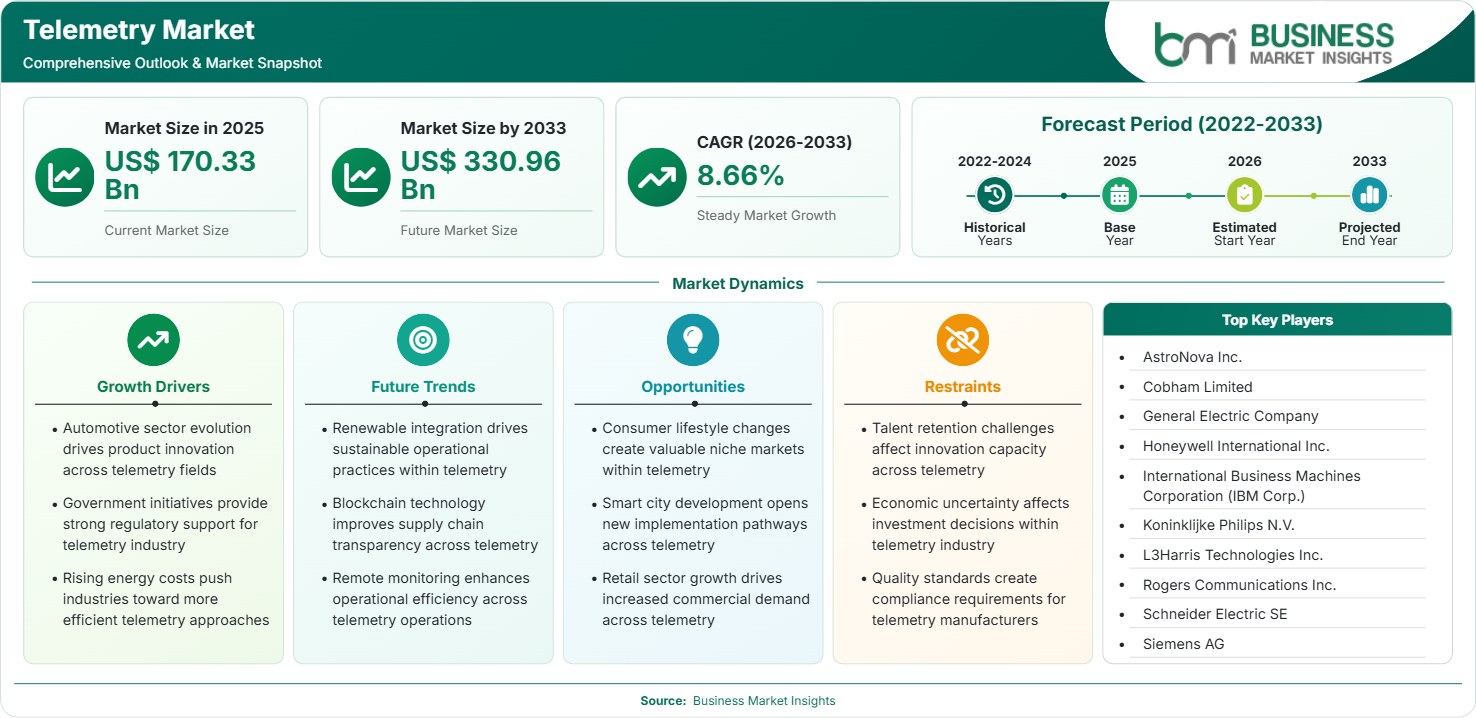
The Telemetry Market size was valued at US$ 170.33 billion in 2025 and is projected to reach US$ 330.96 billion by 2033, growing at a CAGR of 8.66% during 2026–2033, driven by connected monitoring adoption, aerospace digitization, healthcare automation, and increasing demand for real-time data transmission solutions across industrial environments.

Report Coverage
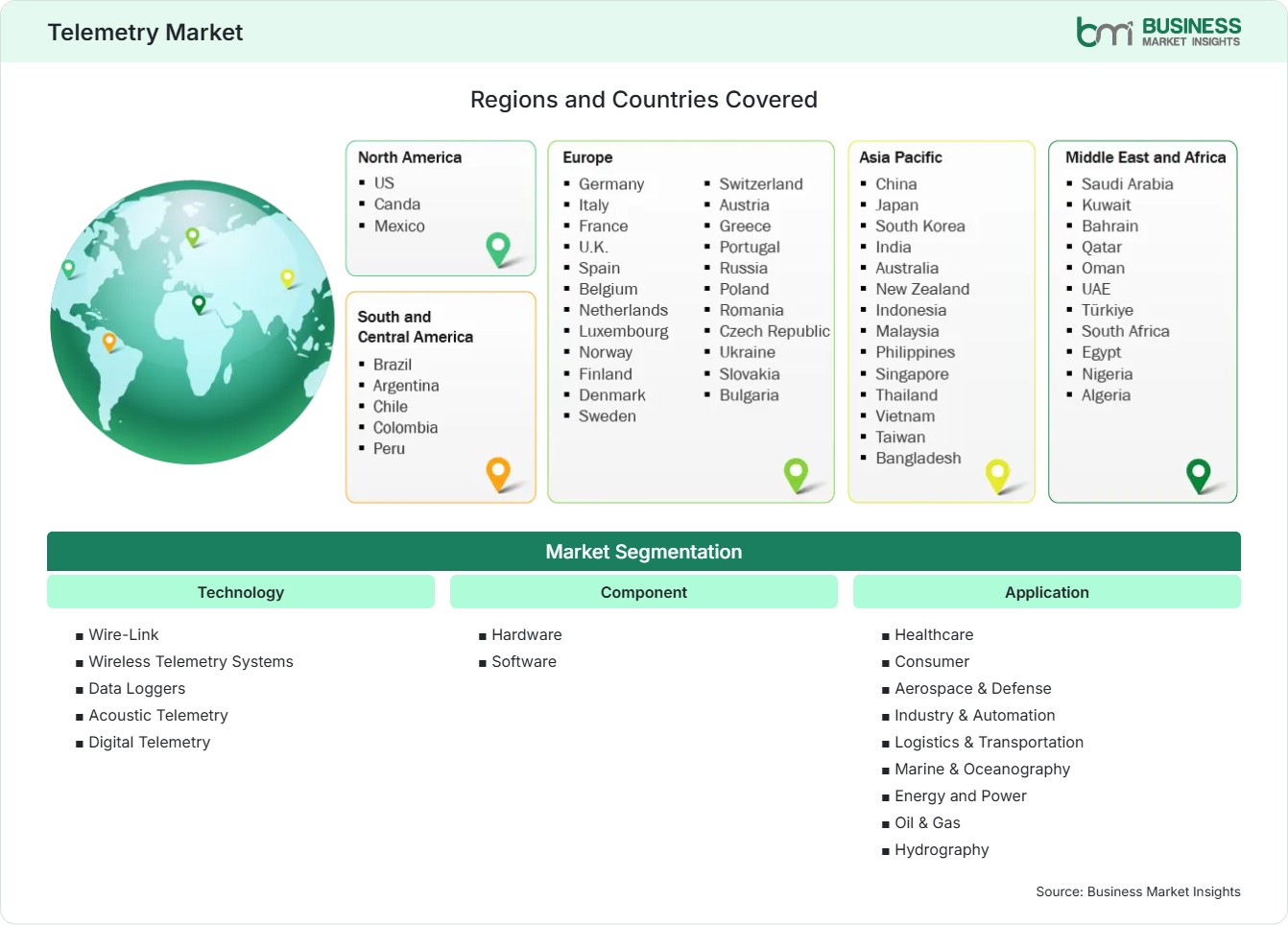
  • Technology: Wire-Link, Wireless Telemetry Systems, Data Loggers, Acoustic Telemetry, Digital Telemetry
  • Component: Hardware , Software
  • Application: Healthcare, Consumer, Aerospace & Defense, Industry & Automation, Logistics & Transportation, Marine & Oceanography, Energy and Power, Oil & Gas, Hydrography
US$ 170.33 Bn Market size in 2025
US$ 330.96 Bn Market Size by 2033
8.66% CAGR, 2026 - 2033
2026-2033 Forecast Period

01 AI Overview

Telemetry Market Summary

  • North America Region: North America accounted for 35%–38% of the global share in 2025 and is projected to grow at a CAGR of 8.8%–9.2% during 2026–2033. Growth is supported by advanced aerospace programs, Defense modernization, healthcare monitoring systems, industrial IoT deployment, and strong technology investments. The U.S. market is expected to expand at a 9.0% CAGR due to increasing adoption across aviation, Défense, healthcare, and industrial automation applications.
  • Fastest Growing Region: Asia Pacific held 28%–31% of the global market share in 2025 and is anticipated to register the highest growth with a CAGR of 9.4%–10.0% from 2026–2033. Expanding manufacturing ecosystems, smart infrastructure investments, healthcare digitization, and growing aerospace activities are driving telemetry adoption across emerging economies.
  • Leading Segment: The Hardware Component segment represented 55%–58% of the Telemetry Market share in 2025 and is forecast to grow at a CAGR of 8.2%–8.7% during 2026–2033. Rising demand for advanced sensors, transmitters, receivers, and reliable data acquisition systems is supporting market growth across aerospace, healthcare, transportation, and industrial monitoring applications.
  • High-Growth Segment: Wireless Telemetry Systems accounted for 24%–27% of the market share in 2025 and are projected to expand at a CAGR of 10.0%–10.6% during 2026–2033. Increasing wireless connectivity, reduced installation complexity, growing remote monitoring requirements, and IoT platform integration are accelerating adoption across diverse industries.
  • Key Market Opportunity: The integration of telemetry with artificial intelligence, edge computing, and predictive analytics is enabling organizations to convert real-time operational data into actionable insights. This trend is creating significant growth opportunities across aerospace, healthcare, energy, and industrial automation sectors.
  • Major Market Players: Leading companies operating in the market include CFM International SA, Honeywell International Inc., GE Aviation, Rolls-Royce Holdings plc, Safran SA, International Aero Engines AG, MTU Aero Engines AG, Textron Inc., and Pratt & Whitney.
02 Strategic Insights

Telemetry Market: Strategic Insights

Telemetry Market Strategic Framework
FREE PDF
Request your free sample
Request free sample
03 Stakeholder View

Key Takeaways

  • The ecosystem is shifting from standalone monitoring equipment toward integrated telemetry platforms combining sensors, communication networks, software analytics, and cloud connectivity, creating stronger value chain collaboration between component manufacturers and solution providers.
  • Aerospace, healthcare, and industrial automation applications represent major growth opportunities as organizations prioritize remote monitoring, operational visibility, predictive maintenance, and improved asset utilization through continuous data collection capabilities.
  • Innovation is moving toward compact sensors, wireless communication architectures, low-power devices, and AI-enabled analytics platforms that improve telemetry accuracy, reduce deployment costs, and support autonomous decision-making.
  • Asia Pacific provides a compelling regional opportunity due to manufacturing expansion, aerospace investments, smart city programs, and increasing adoption of industrial IoT technologies across China, India, Japan, and Southeast Asian economies.
  • Investment activity is focusing on technology integration, software capabilities, and specialized telemetry solutions, with companies pursuing partnerships and acquisitions to strengthen connected monitoring portfolios and expand application coverage.
  • The competitive environment is becoming more technology-driven as established aerospace suppliers and automation companies develop customized telemetry solutions aligned with sector-specific reliability and compliance requirements.
04 Geographic Outlook

Telemetry Market Regional Highlights

North America Telemetry Market

North America accounted for a 35%–38% share of the Telemetry Market in 2025 and is projected to expand at a 8.8%–9.2% CAGR during 2026–2033. The region benefits from aerospace testing programs, defense modernization, healthcare digitization, and industrial automation investments. The U.S. and Canada remain leading contributors due to established technology ecosystems, advanced manufacturing capabilities, and strong adoption of connected monitoring systems across critical industries.

  • Aerospace and defense modernization programs in the United States are accelerating telemetry adoption through advanced flight testing, engine monitoring, and mission-critical communication requirements across military and commercial aviation sectors.
  • Healthcare providers are increasing deployment of remote monitoring solutions, supported by digital health initiatives and demand for continuous patient data collection through connected medical devices and wireless systems.
  • Industrial automation investments are supporting telemetry integration across manufacturing facilities, enabling predictive maintenance, operational optimization, and improved asset visibility through real-time performance monitoring technologies.
  • Government investments in infrastructure resilience and energy management are encouraging deployment of telemetry-enabled monitoring platforms for utilities, transportation networks, and environmental applications.

US Telemetry Market

The U.S. represented a 29%–32% share of the market within North America in 2025, growing at a 9.0%–9.4% CAGR between 2026–2033. The country maintains leadership through aerospace innovation, defense expenditure, healthcare technology adoption, and industrial IoT implementation. Strong research capabilities, established suppliers, and regulatory focus on operational safety continue supporting domestic telemetry deployment across multiple end-use sectors.

  • Aviation manufacturers and engine producers are expanding telemetry applications for aircraft testing, performance evaluation, and predictive maintenance programs to improve reliability and operational efficiency.
  • Healthcare technology companies are developing advanced connected monitoring solutions that support remote diagnostics, chronic disease management, and continuous patient observation through wireless telemetry systems.
  • Industrial enterprises are adopting telemetry platforms to improve manufacturing productivity, reduce equipment failures, and integrate operational data with artificial intelligence-driven analytics systems.
  • Energy companies are increasing telemetry utilization for grid monitoring, asset management, and infrastructure optimization across renewable and conventional power generation facilities.

Europe Telemetry Market

Europe held a 25%–28% share of the Telemetry Market in 2025 and is expected to register a 8.1%–8.6% CAGR during 2026–2033. Germany, France, and the United Kingdom represent leading markets due to aerospace manufacturing strength, industrial automation expertise, and regulatory support for digital transformation. Germany demonstrates strong industrial adoption, while France and the U.K. benefit from aviation and defense technology investments.

  • Germany is strengthening telemetry deployment through Industry 4.0 initiatives, supporting smart manufacturing, connected machinery, and advanced production monitoring across automotive and industrial sectors.
  • France is benefiting from aerospace industry expansion, with telemetry systems supporting aircraft development, engine testing, and defense-related applications requiring accurate real-time data transmission.
  • The United Kingdom is increasing adoption through aerospace research, healthcare innovation, and energy infrastructure modernization initiatives focused on connected monitoring capabilities.
  • European sustainability regulations are encouraging telemetry adoption in energy systems by enabling improved resource management, emissions monitoring, and operational efficiency across industrial facilities.

Asia Pacific Telemetry Market

Asia Pacific accounted for a 28%–31% share of the Telemetry Market in 2025 and is projected to grow at a 9.4%–10.0% CAGR from 2026–2033. China, Japan, and India are major contributors, supported by manufacturing expansion, aerospace development, healthcare modernization, and smart infrastructure investments. India and Southeast Asian countries represent high-growth markets due to increasing industrial digitization and technology adoption.

  • China is expanding telemetry usage through aerospace programs, industrial automation investments, and large-scale manufacturing activities requiring efficient monitoring and communication systems.
  • Japan continues adopting advanced telemetry solutions through automotive innovation, robotics development, and precision manufacturing applications supported by strong engineering capabilities.
  • India is emerging as a high-growth market due to aerospace investments, healthcare infrastructure development, and increasing adoption of industrial IoT technologies.
  • Southeast Asian economies are attracting telemetry investments through manufacturing growth, logistics modernization, and smart infrastructure projects requiring connected monitoring solutions.

Rest of World Telemetry Market

Rest of World represented a 9%–12% share of the Telemetry Market in 2025 and is anticipated to expand at a 7.8%–8.4% CAGR between 2026–2033. South and Central America are witnessing increased adoption through energy, mining, and transportation applications. Middle East and Africa markets are developing through infrastructure investments, oil and gas modernization, and smart monitoring initiatives.

  • Brazil and Mexico are increasing telemetry adoption through industrial operations, energy management, and transportation infrastructure upgrades requiring improved operational monitoring capabilities.
  • Middle Eastern countries are deploying telemetry solutions in oil and gas, utilities, and aerospace sectors to enhance asset performance and support digital transformation strategies.
  • African economies are gradually adopting telemetry through telecommunications expansion, healthcare connectivity projects, and infrastructure monitoring requirements in developing regions.
  • Energy-rich countries are leveraging telemetry technologies for remote asset management, environmental monitoring, and operational optimization across geographically distributed facilities.
Global Market Geography
FREE PDF
Request your free sample
Request free sample
05 Segment Analysis

Telemetry Market Segmentation

Technology

Technology segment accounted for a 45%–48% share of the Telemetry Market in 2025 and is expected to grow at an 8.5%–9.0% CAGR during 2026–2033. Adoption is driven by increasing demand for reliable communication architectures, real-time monitoring capabilities, and integration of advanced data transmission technologies across aerospace, healthcare, and industrial applications.

  • Wire-Link: Wire-link telemetry remains important for high-reliability applications requiring stable connections, accurate transmission, and secure communication environments across industrial and aerospace testing operations.
  • Wireless Telemetry Systems: Wireless systems are gaining momentum through flexible installation, remote monitoring capabilities, IoT integration, and expanding demand across healthcare, logistics, and industrial automation environments.
  • Data Loggers: Data loggers support operational analysis by collecting, storing, and processing measurements from equipment, vehicles, and environmental monitoring systems requiring historical performance evaluation.
  • Acoustic Telemetry: Acoustic telemetry enables underwater and marine monitoring applications, supporting oceanographic research, fisheries management, and subsea equipment tracking through advanced communication methods.
  • Digital Telemetry: Digital telemetry adoption is increasing through improved data accuracy, software integration, and compatibility with modern analytics platforms supporting connected operations.

Component

Component segment represented a 52%–55% share of the Telemetry Market in 2025 and is forecast to achieve an 8.2%–8.7% CAGR from 2026–2033. Hardware and software integration is advancing due to demand for efficient data acquisition, processing capabilities, and scalable monitoring platforms across diverse industries.

  • Hardware: Hardware solutions remain essential for telemetry deployment, providing physical infrastructure required for accurate sensing, communication, signal processing, and reliable operational monitoring.
  • Transmitter: Transmitters enable efficient signal conversion and communication, supporting aerospace, industrial, and healthcare applications requiring continuous data transfer and remote monitoring capabilities.
  • Receiver: Receivers facilitate accurate data collection and processing, supporting telemetry networks where reliable communication and real-time information availability are critical.
  • Encoder: Encoders improve signal management by converting collected information into optimized formats suitable for transmission across complex telemetry systems.
  • Modulator: Modulators enhance communication efficiency by adapting signals for transmission, supporting reliable connectivity across demanding operational environments.
  • Antenna: Antennas enable wireless communication performance by improving signal strength, range, and connectivity across mobile and fixed telemetry installations.
  • Sensors: Sensors represent a critical component by capturing operational measurements used for monitoring, analytics, diagnostics, and automated decision-making.
  • Software: Software platforms are expanding through analytics integration, visualization tools, cloud connectivity, and artificial intelligence capabilities that improve telemetry data utilization.

Application

Application segment accounted for a 40%–43% share of the Telemetry Market in 2025 and is expected to grow at an 8.9%–9.4% CAGR during 2026–2033. Expanding digital monitoring requirements across industries are supporting adoption, particularly where operational visibility, safety compliance, and predictive insights are required.

  • Healthcare: Healthcare telemetry supports remote patient monitoring, medical device connectivity, and continuous health data collection, improving care delivery and clinical decision-making capabilities.
  • Consumer: Consumer applications utilize telemetry for connected devices, wearable technologies, and smart systems requiring continuous performance monitoring and personalized user experiences.
  • Aerospace & Defense: Aerospace and defense applications rely on telemetry for aircraft testing, mission monitoring, engine evaluation, and secure operational data transmission.
  • Industry & Automation: Industrial telemetry enables smart manufacturing, predictive maintenance, and process optimization through connected equipment monitoring and real-time analytics.
  • Logistics & Transportation: Logistics telemetry improves fleet management, asset tracking, route optimization, and operational visibility across transportation networks.
  • Marine & Oceanography: Marine telemetry supports underwater monitoring, environmental research, and tracking of ocean-based assets through specialized communication systems.
  • Energy and Power: Energy telemetry enables grid monitoring, renewable energy management, and infrastructure optimization through continuous operational data collection.
  • Oil & Gas: Oil and gas telemetry supports remote asset monitoring, production optimization, and safety management across complex operating environments.
  • Hydrography: Hydrography applications use telemetry for water measurement, marine surveying, and environmental monitoring activities requiring accurate field data collection.
06 Market Forces

Telemetry Market Dynamics

Key Market Drivers

Increasing Adoption of Connected Monitoring Systems

Market growth is supported by rising demand for connected monitoring solutions across aerospace, healthcare, transportation, and industrial sectors. Businesses have been integrating real-time data acquisition systems to gain better visibility, minimize downtime, and improve their predictive maintenance strategies. As reported by industrial bodies related to automation and manufacturing, the adoption of IIoT is continually rising. The Telemetry Market trends point towards growing usage of sensors, wireless technology, and analytics platforms operating on the cloud computing basis. The aerospace industry is using sophisticated telemetry solutions to test airplanes and engines, while healthcare organizations have started to apply telemetry technologies in remote patient monitoring.

Expansion of Aerospace and Defense Applications

Aerospace and defense modernization programs represent a major driver for telemetry adoption due to increasing requirements for flight testing, mission monitoring, and equipment performance analysis. Telemetry solutions are required by both the aircraft manufacturing firms and the engine developers to collect large amounts of data regarding operations during development, testing, and maintenance stages. Defense entities are implementing communication and surveillance systems to enhance the reliability of missions and the awareness of the operations. The increasing complexity in aircraft systems, unmanned systems, and defense systems necessitates accurate real-time data transfer capabilities.

Growth of Industrial Automation and Predictive Maintenance

Industrial automation growth is driving the rise in telemetry use, as manufacturers look to increase machine efficiency, reduce costs and increase reliability. Telemetry allows for the constant monitoring of machines to diagnose any problems before failures happen. AI and telemetry are starting to be used in production systems; telemetry also helps in supporting analysis and digital twins. This technology is used in energy, logistics, and heavy industries because it allows management of geographically dispersed assets. The Telemetry Market trends reflect a transition toward intelligent monitoring environments where real-time information supports faster decision-making and more efficient resource utilization.

Key Market Opportunities

Integration of Artificial Intelligence and Edge Analytics

Artificial intelligence and edge computing create significant opportunities by transforming telemetry data into actionable operational intelligence. Organizations are investing in systems capable of processing information closer to data sources, reducing latency and improving response times. The telemetry systems with the use of AI technology can help in the detection of anomalies, predict machine failures, and enable autonomous decision-making in various industrial settings. Some of the industries that will benefit from such technologies include the aerospace industry, the healthcare industry, and the energy sector. It is important for companies developing telemetry software products to incorporate the power of hardware along with predictive analysis and visualization using the cloud computing technology.

Expansion Across Emerging Industrial Economies

Developing nations offer great potential as government agencies and companies embark on projects related to manufacturing modernization, infrastructure development, and digitization initiatives. Many countries in Asia Pacific, Latin America, and the Middle East region are embracing the use of connected technology in their industries, transport networks, and energy systems. Increased spending in smart factories, renewable energy networks, and availability of health care facilities is opening up new avenues of demand for telemetry devices. The Telemetry Market Forecasts indicate increasing potential in developing regions where technology adoption is accelerating alongside economic and infrastructure growth.

Development of Wireless and Low-Power Telemetry Solutions

Wireless and low-power telemetry technologies are creating opportunities through simplified installation, flexible deployment, and improved accessibility across remote environments. Industries requiring mobile monitoring, distributed assets, and difficult-to-access locations are increasingly adopting wireless systems. The marine, logistics, agricultural, and energy industries would also be well served by technology that is able to function with very few infrastructure requirements. The improvements in communication, battery life, and sensor size are making it possible for more use cases to be supported. Companies that develop technology that supports reliable communications, cybersecurity, and wireless networks would be able to meet the increasing demand for low-cost monitoring.

Market Restraints and Challenges

High Implementation Costs and Integration Complexity

Factor: High initial investment requirements for advanced telemetry infrastructure and integration with existing operational systems can restrict adoption among cost-sensitive organizations.

Impact: Companies with limited technology budgets may delay deployment, reducing short-term Telemetry Market penetration in smaller industrial facilities and developing economies. The deployment of telemetry systems may require spending on sensors, communication technologies, software platforms, cybersecurity measures, and expertise in technical resources. The integration of these with older equipment may lead to extended times of deployment and difficulties in operation. Despite the fact that efficiency in the long run justifies the decision to adopt this technology, it is still an expensive process and therefore a hindrance for many firms.

Cybersecurity Risks and Data Management Challenges

Factor: Increasing connectivity of telemetry systems creates cybersecurity vulnerabilities and raises concerns regarding data protection, network security, and unauthorized access.

Impact: Security concerns could be high on the priority list for organizations that work with critical infrastructures; hence, connected telemetry solutions could take longer to adopt because of the need for enhanced security systems. The telemetry system produces large amounts of data, which need to be securely transported, stored, and processed. The security standards are high in industries like aerospace, defense, energy, and healthcare because of the sensitive nature of the collected data. It is important to develop more secure encryption algorithms and cybersecurity frameworks.

07 Company Analysis

Competitive Landscape

The Telemetry Market analysis highlights competition among aerospace manufacturers, technology providers, and industrial solution companies developing integrated monitoring platforms. Leading participants focus on hardware innovation, software capabilities, strategic partnerships, and sector-specific solutions to strengthen market positioning.

Company Name

Overview

Products and Services relevant to this market

CFM International SA

Aerospace engine manufacturer specializing in commercial aviation propulsion systems and advanced engine technologies supporting global aircraft programs.

Provides engine monitoring capabilities, aviation data solutions, and telemetry-related systems supporting aircraft performance analysis and maintenance optimization.

Honeywell International Inc.

Global technology company offering aerospace, industrial, and automation solutions with strong digital monitoring capabilities.

Develops aerospace telemetry systems, sensors, avionics technologies, connected platforms, and industrial monitoring solutions.

GE Aviation

Aerospace technology provider focused on aircraft engines, digital aviation, and advanced operational analytics.

Offers aircraft data monitoring, engine telemetry solutions, digital aviation platforms, and predictive maintenance technologies.

Rolls-Royce Holdings plc

Aerospace company specializing in aircraft propulsion systems and engineering solutions for commercial and defense applications.

Provides engine monitoring technologies, operational data platforms, and performance analytics solutions for aviation customers.

Safran SA

French aerospace and defense company delivering aircraft systems, engines, and advanced technology solutions.

Develops avionics systems, sensors, data acquisition technologies, and monitoring solutions for aerospace applications.

International Aero Engines AG

Aerospace consortium focused on aircraft engine development and propulsion technologies.

Supports engine performance monitoring, operational data collection, and aviation maintenance optimization solutions.

MTU Aero Engines AG

German aircraft engine manufacturer providing propulsion systems and maintenance services.

Offers engine diagnostics, monitoring technologies, and data-driven maintenance solutions for aviation applications.

Textron Inc.

Diversified industrial company operating across aviation, defense, and specialized technology markets.

Provides aviation systems, connected aircraft technologies, and monitoring solutions supporting operational performance.

Pratt & Whitney

Aerospace manufacturer specializing in aircraft engines and propulsion technologies.

Develops engine monitoring systems, digital maintenance platforms, and telemetry-enabled aviation performance solutions.

10 Trust & Transparency

Research Methodology

The market analysis combines proprietary research with secondary data from government agencies, company disclosures, regulatory filings, industry databases and expert interviews. Market estimates are validated through data triangulation, cross-market benchmarking and analyst review.

View Full Research Methodology

11 Questions Answered

Frequently Asked Questions

Why is telemetry important for aerospace applications?

The Telemetry Market Report highlights that Telemetry enables aircraft testing, engine monitoring, flight data collection, and maintenance optimization, helping manufacturers improve safety, reliability, and operational performance.

Which regions offer strong growth opportunities for telemetry providers?

Asia Pacific offers strong expansion potential due to manufacturing growth, aerospace investments, healthcare modernization, and increasing adoption of industrial digitalization initiatives.

What role does artificial intelligence play in telemetry solutions?

Artificial intelligence improves telemetry value by analyzing operational data, identifying anomalies, predicting failures, and supporting automated decisions across industrial and commercial applications.

How are wireless telemetry systems changing industrial operations?

Wireless telemetry reduces installation complexity, enables remote monitoring, supports mobile assets, and improves accessibility in locations where traditional wired systems are difficult to deploy.

What industries are driving Telemetry Market adoption?

Aerospace, healthcare, industrial automation, transportation, energy, and defense sectors are major adopters due to increasing requirements for real-time monitoring, predictive maintenance, operational efficiency, and connected asset management.

Access the Full Telemetry Market Report

Get segment-level forecasts, regional estimates, competitive benchmarking, company profiles and downloadable Excel datasets.

Access the full Telemetry Market Report
350 pages PDF & Excel | 2026-08-18