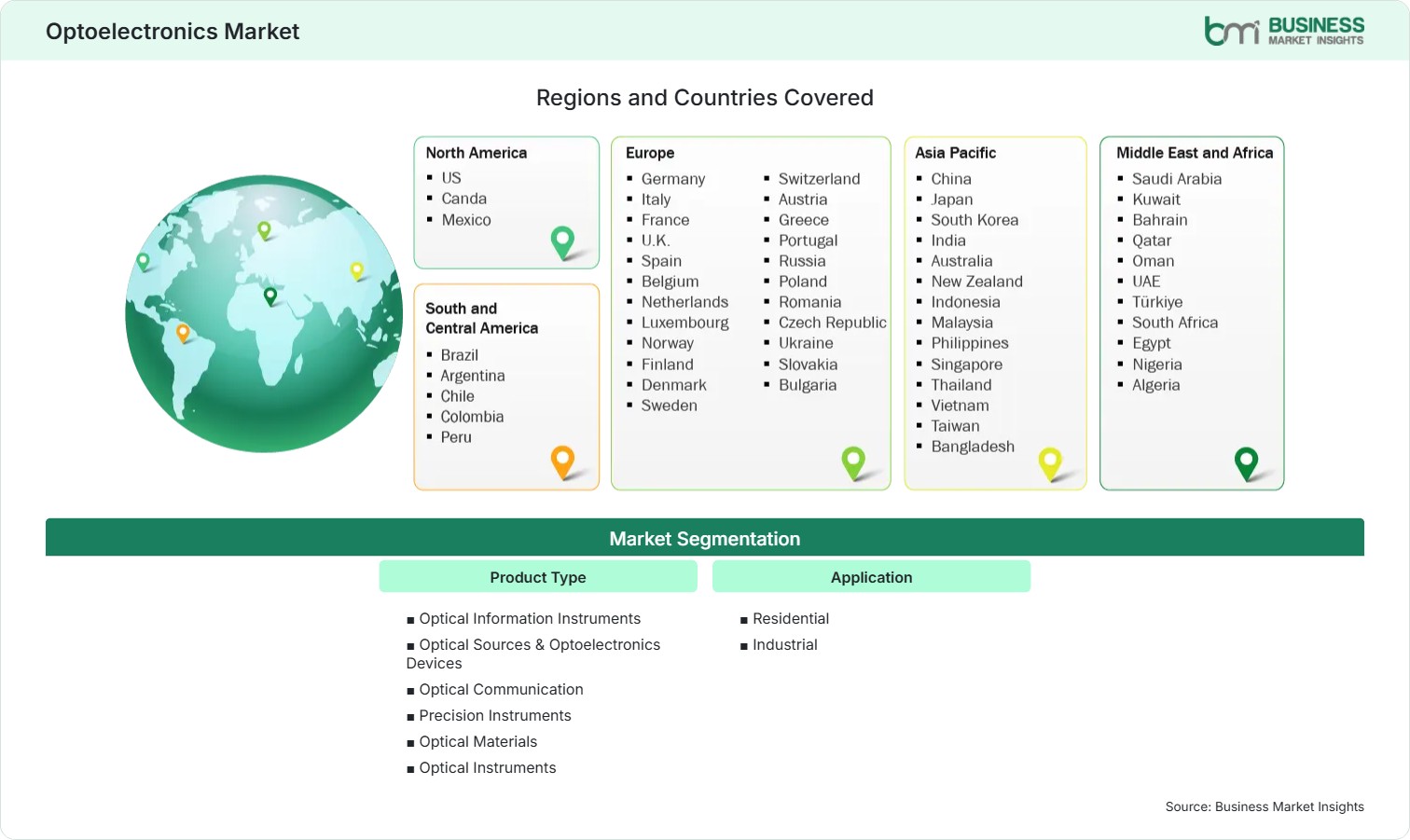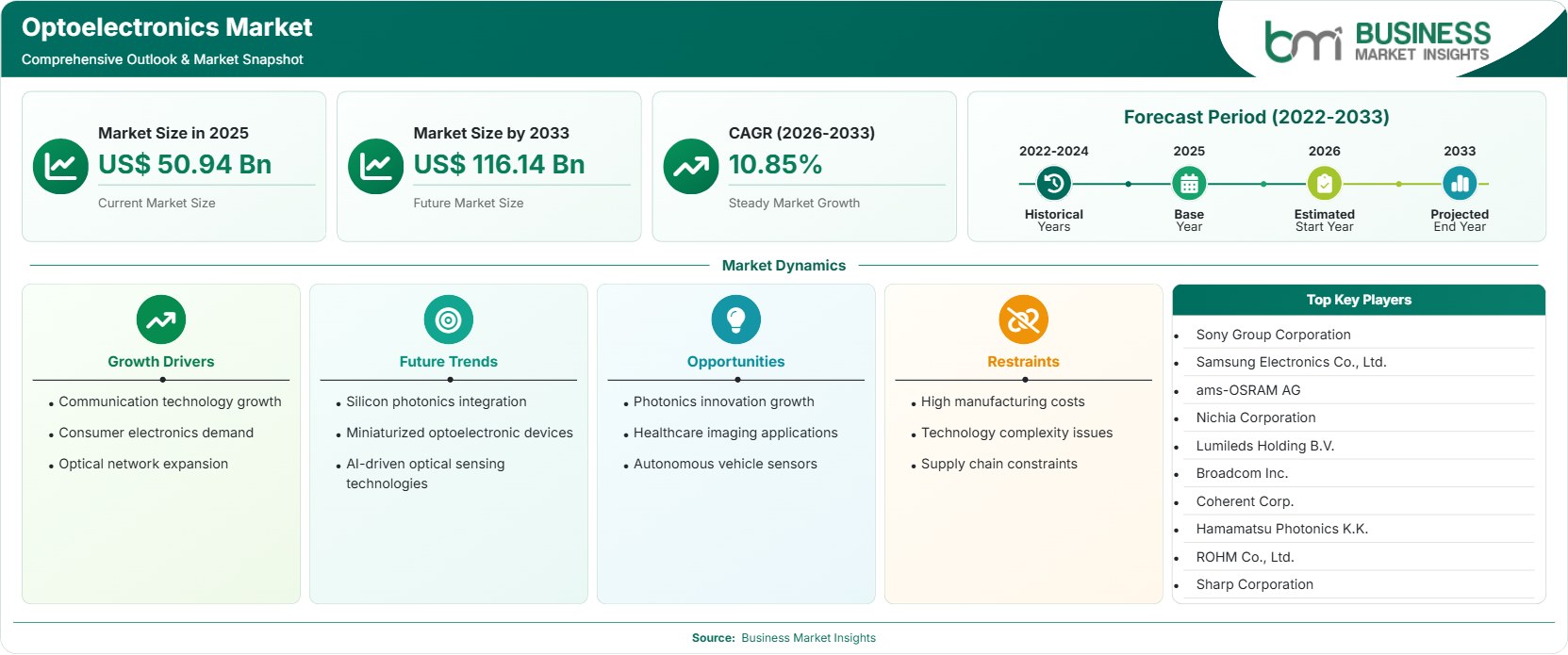
Optoelectronics Market Regional Highlights
North America Optoelectronics Market
North America accounted for approximately 32%–35% of the global market in 2025 and is projected to expand at a CAGR of 10.2%–10.7% through 2033. The Optoelectronics Market share in the region is supported by advanced semiconductor manufacturing capabilities, strong research infrastructure, defense technology adoption, healthcare imaging demand, and large-scale investments in optical communication networks. The United States remains the primary contributor due to established technology companies, data center expansion, and photonics innovation initiatives.
- Strong investments in artificial intelligence infrastructure and hyperscale data centers are increasing demand for optical transceivers, photonic components, and high-speed connectivity solutions across enterprise and telecommunications networks.
- Defense and aerospace applications continue adopting advanced optical sensors, imaging systems, laser technologies, and surveillance equipment requiring high precision, reliability, and enhanced operational performance.
- Healthcare technology providers are expanding adoption of optical imaging systems for diagnostics, medical analysis, and minimally invasive procedures, supporting demand for advanced photonic devices.
- Semiconductor research initiatives and government funding programs are strengthening domestic photonics capabilities while encouraging innovation in optical components, integrated circuits, and manufacturing processes.
- Industrial automation growth is increasing demand for optical sensors, machine vision systems, and precision measurement instruments across manufacturing and smart factory environments.
US Optoelectronics Market
The United States represented approximately 27%–30% of global revenue in 2025 and is expected to grow at a CAGR of 10.3%–10.8% during 2026–2033. The country maintains a strong position due to semiconductor expertise, advanced communication infrastructure, defense technology leadership, and increasing adoption of optical systems across healthcare and industrial applications. Expanding investments in artificial intelligence, cloud computing, and automation continue supporting long-term market development.
- Growing data center capacity is accelerating deployment of optical communication technologies designed to support higher bandwidth requirements and lower latency connectivity.
- Aerospace and defense modernization programs are increasing procurement of optical sensing, imaging, and laser-based technologies for surveillance and advanced mission applications.
- Healthcare providers are integrating optical diagnostic systems, spectroscopy solutions, and imaging technologies to improve disease detection and treatment accuracy.
- Collaboration between universities, technology companies, and government agencies supports development of advanced photonics technologies and next-generation optical semiconductor solutions.
Europe Optoelectronics Market
Europe held approximately 21%–24% market share in 2025 and is projected to register a CAGR of 10.0%–10.5% through 2033. Regional demand is supported by industrial automation, automotive innovation, renewable energy systems, healthcare imaging, and advanced manufacturing applications. Germany leads regional adoption, while the Netherlands demonstrates strong growth due to semiconductor technology development and photonics research capabilities.
- Automotive manufacturers are increasing integration of optical sensors, camera systems, and lighting technologies to support electric vehicles and autonomous driving capabilities.
- Industrial automation initiatives across Europe are accelerating adoption of optical inspection systems, sensors, and machine vision technologies for smart manufacturing environments.
- Photonics research programs and semiconductor investments strengthen regional capabilities in optical components, lasers, and advanced imaging technologies.
- Healthcare modernization is increasing demand for optical diagnostic equipment, medical imaging systems, and precision instruments across hospitals and research institutions.
- Sustainability initiatives are encouraging adoption of energy-efficient optical technologies, including advanced LED systems and low-power photonic devices.
Asia Pacific Optoelectronics Market
Asia Pacific accounted for approximately 38%–41% of global market share in 2025 and is expected to achieve the fastest growth rate with a CAGR of 11.4%–11.9% between 2026 and 2033. The region benefits from semiconductor manufacturing leadership, consumer electronics production, expanding communication infrastructure, and increasing technology investments. China represents the largest market, while India records strong growth due to digital infrastructure expansion and manufacturing initiatives.
- Consumer electronics production remains a major demand driver, with smartphones, displays, wearable devices, and smart appliances requiring advanced optical components.
- Semiconductor manufacturing expansion in China, Japan, South Korea, and Taiwan strengthens regional supply chains for optical devices and photonic technologies.
- Telecommunications infrastructure investments continue increasing demand for optical communication components supporting 5G networks, cloud services, and high-speed internet connectivity.
- Electric vehicle adoption is accelerating demand for optical sensors, LiDAR technologies, and advanced lighting systems across automotive applications.
- Government-supported technology programs are encouraging domestic production of semiconductor and photonics components while reducing dependence on imported technologies.
Rest of World Optoelectronics Market
The Rest of World region accounted for approximately 8%–11% market share in 2025 and is forecast to expand at a CAGR of 9.8%–10.3% through 2033. South America, the Middle East, and Africa are experiencing increasing adoption of optical technologies through telecommunications expansion, healthcare modernization, industrial development, and smart infrastructure projects.
South America is benefiting from digital connectivity initiatives and modernization of communication networks, while Middle Eastern economies are investing in smart cities, healthcare technologies, and advanced industrial systems. Africa continues developing telecommunications infrastructure, creating demand for optical communication and sensing technologies.
- Brazil remains a key regional market due to expanding telecommunications infrastructure, industrial automation adoption, and increasing healthcare technology investments.
- Middle Eastern countries are deploying optical technologies across smart city projects, defense systems, healthcare facilities, and advanced infrastructure developments.
- African telecommunications expansion is increasing demand for fiber-optic networks, optical components, and connectivity solutions supporting digital transformation initiatives.
- Industrial modernization programs across emerging economies are encouraging adoption of optical sensors, automation systems, and precision measurement technologies.
- Increasing investments from global technology providers are strengthening local distribution networks and improving access to advanced optoelectronic solutions.