
Microcontroller Market Outlook: Size, Share, Trends, Growth Analysis, Competitive Landscape & Forecast, 2022-2033

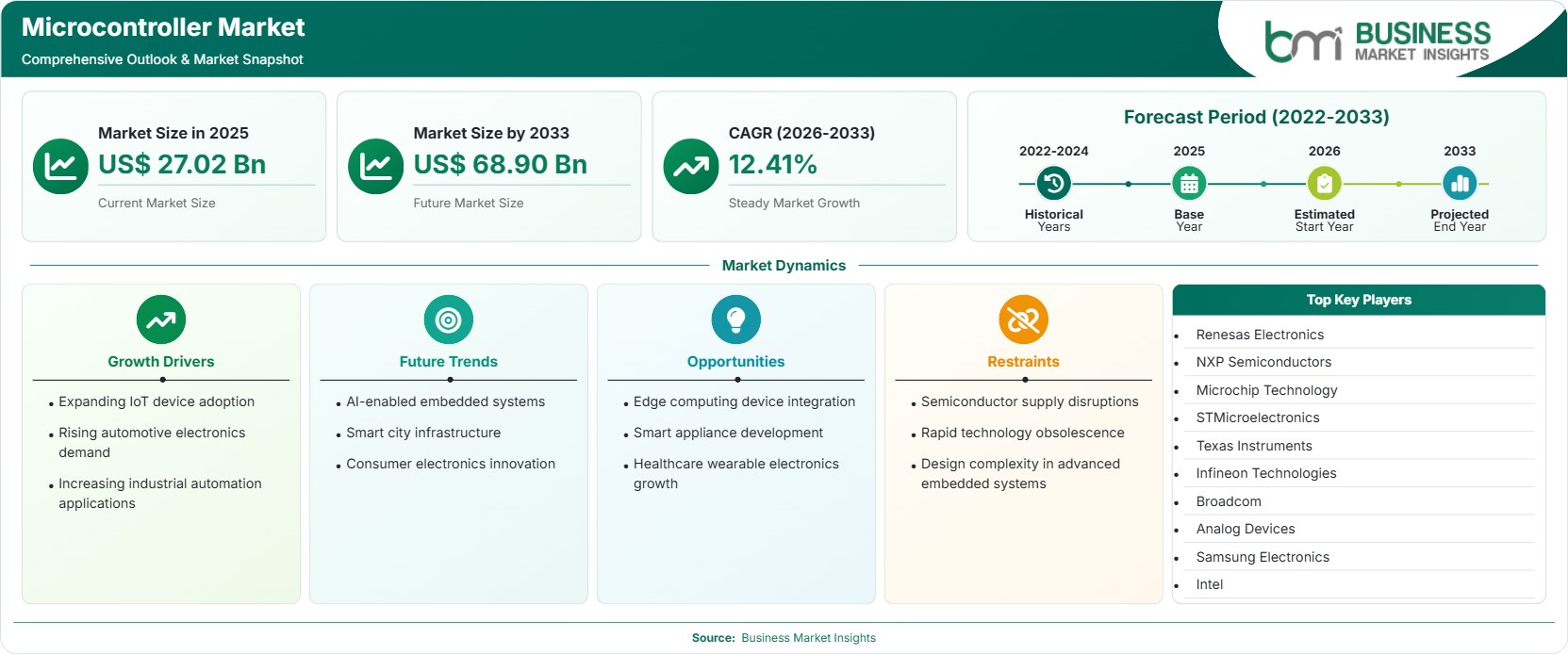
The Microcontroller Market size was valued at US$ 27.02 billion in 2025 and is projected to reach US$ 68.9 billion by 2033, growing at a CAGR of 12.41% during 2026–2033. Expanding IoT adoption, rising automotive electronics integration, increasing industrial automation, edge computing deployment, smart appliance innovation, and growing healthcare wearable electronics are accelerating demand for advanced microcontroller solutions.

Report Coverage
  • Product Type: 8-bit, 16-bit, 32-bit Microcontroller
  • Application: Networking & Communication, Automotive, Consumer Electronics, Industrial, Medical Devices, Military & Defense
US$ 27.02 Bn Market size in 2025
US$ 68.90 Bn Market Size by 2033
12.41% CAGR, 2026 - 2033
2026-2033 Forecast Period

AI Overview

Microcontroller Market Summary

  • North America Region: North America holds a market share of 29%–32% in 2025 and is projected to grow at a CAGR of 11.6%–12.2% during 2026–2033. Growth is supported by semiconductor innovation, strong automotive electronics demand, industrial automation, and expanding IoT infrastructure. The United States remains the regional leader with a CAGR of 11.8%–12.4%, driven by investments in AI-enabled embedded systems, defense electronics, and connected industrial applications.
  • Fastest Growing Region: Asia Pacific accounts for 40%–43% of global revenue in 2025 and is expected to register the fastest CAGR of 13.2%–13.9% through 2033. Growth is fueled by large-scale electronics manufacturing, automotive production, consumer device demand, expanding semiconductor fabrication capacity, and government support for domestic chip development.
  • Leading Segment: 32-bit Microcontroller represents the largest product segment with a share of 58%–62% in 2025 and is expected to grow at a CAGR of 12.8%–13.5% during 2026–2033. Growth is supported by higher processing performance, energy efficiency, advanced connectivity, and increasing deployment in automotive, industrial, and IoT applications.
  • High Growth Segment: Automotive represents the fastest-growing application segment with a share of 24%–28% in 2025 and is projected to expand at a CAGR of 13.5%–14.2% through 2033. Demand is driven by electric vehicles, ADAS implementation, vehicle electrification, and intelligent cockpit electronics.
  • Key Market Opportunity: Increasing deployment of edge computing devices, rapid development of smart home appliances, and growing adoption of wearable healthcare electronics are creating significant opportunities for advanced low-power microcontroller manufacturers.
  • Major Market Players: Renesas Electronics Corporation, NXP Semiconductors N.V., Microchip Technology Incorporated, STMicroelectronics N.V., Texas Instruments Incorporated, Infineon Technologies AG, Broadcom Inc., Analog Devices, Inc., Samsung Electronics Co., Ltd., Intel Corporation.
Strategic Insights

Microcontroller Market: Strategic Insights

Microcontroller Market Strategic Framework
FREE PDF
Request your free sample
Request free sample
Stakeholder View

Key Takeaways

  • The market ecosystem is becoming increasingly integrated as semiconductor manufacturers collaborate with software developers, automotive OEMs, industrial automation providers, and IoT platform companies to deliver complete embedded computing solutions.
  • Automotive electronics and industrial automation applications continue offering the strongest long-term revenue opportunities due to increasing electronic content in vehicles and rapid digitalization of manufacturing operations.
  • Product innovation is shifting toward AI-enabled microcontrollers, ultra-low-power architectures, enhanced cybersecurity, integrated wireless connectivity, and higher processing performance for edge computing applications.
  • Asia Pacific offers the most attractive investment environment owing to strong semiconductor manufacturing capabilities, expanding electronics production, supportive government initiatives, and growing domestic technology demand.
  • Strategic partnerships, semiconductor fabrication investments, and acquisitions of embedded software companies are strengthening competitive positioning among leading microcontroller manufacturers.
Geographic Outlook

Microcontroller Market Regional Highlights

North America Microcontroller Market

North America accounted for 29%–32% of global Microcontroller Market Share in 2025 and is projected to grow at a CAGR of 11.6%–12.2% during 2026–2033. The region benefits from strong semiconductor research capabilities, automotive electronics adoption, industrial automation investments, and growing IoT deployment. The United States remains the largest contributor due to demand from electric vehicles, defense systems, connected devices, and advanced manufacturing applications.

  • The United States leads regional demand through semiconductor innovation, automotive electronics integration, IoT infrastructure, and industrial automation deployment.
  • Automotive companies are increasing microcontroller adoption for electric vehicles, battery systems, advanced safety technologies, and connected mobility solutions.
  • Industrial manufacturers are implementing intelligent automation systems requiring efficient embedded control and real-time processing capabilities.
  • Defense and aerospace applications continue supporting demand for secure and reliable microcontroller technologies.

US Microcontroller Market

The United States Microcontroller Market Growth accounted for roughly 25%-28% of the worldwide market’s revenue share in 2025 and is anticipated to register a CAGR of 11.8%-12.4% between 2026 and 2033. Drivers for market growth include innovations in semiconductor technology, electric vehicles, Internet of Things implementation, healthcare technology development, and industry digitization. It maintains a strong position due to cutting-edge research and technology-related industries.

  • Electric vehicle production growth is increasing demand for automotive-grade microcontrollers supporting power management and vehicle electronics.
  • Technology companies are investing in edge computing, connected devices, and AI-enabled embedded platforms.
  • Healthcare digitization is supporting adoption of microcontrollers in wearable monitoring systems and medical devices.

Europe Microcontroller Market

Europe accounted for 22%–25% of Microcontroller Market revenue in 2025 and is estimated to grow at a CAGR of 10.8%–11.5% during 2026–2033. The region benefits from automotive manufacturing expertise, industrial automation adoption, and increasing demand for energy-efficient electronic systems. Germany, France, and the United Kingdom are key markets, supported by automotive innovation, industrial equipment production, and healthcare technology applications.

  • Germany remains the leading European market due to automotive electronics, robotics, and industrial automation capabilities.
  • France supports adoption through aerospace, transportation systems, and industrial technology applications.
  • The United Kingdom demonstrates growth through healthcare electronics, smart infrastructure, and connected device development.
  • European automotive manufacturers are integrating microcontrollers into electric vehicles and intelligent mobility platforms.

Asia Pacific Microcontroller Market

Asia Pacific accounts for 40%-43% of the world’s total revenue in 2025 and is expected to register the highest CAGR of 13.2%-13.9% during the period from 2026 to 2033. The region is characterized by a significant presence of electronics manufacturing facilities, auto-manufacturing facilities, investment in semiconductors, and growth in the IoT market. The countries contributing include China, Japan, South Korea, Taiwan, and India, which are major contributors, with increasing demand for advanced embedded systems across consumer and industrial applications.

  • China leads regional demand through electronics manufacturing, automotive production, and smart device deployment.
  • Japan maintains strong adoption through robotics, automotive systems, and advanced industrial applications.
  • South Korea and Taiwan support market expansion through semiconductor manufacturing capabilities.
  • India is experiencing increasing demand through electronics manufacturing growth, automotive electrification, and IoT adoption.
  • Regional companies are adopting advanced 32-bit microcontrollers for connected and intelligent applications.

Rest of World Microcontroller Market

The Rest of World segment accounted for 7%–10% of global Microcontroller Market revenue in 2025 and is expected to grow at a CAGR of 10.5%–11.2% through 2033. South America, the Middle East, and Africa are gradually adopting embedded technologies due to industrial modernization, telecommunications expansion, healthcare digitization, and infrastructure development. Increasing investment in smart systems is creating new opportunities for microcontroller suppliers.

Latin American nations are embracing embedded systems across automotive production, industrial automation, and advances in consumer electronics. Middle Eastern nations are also looking to invest in smart cities, digital infrastructure, and technologies that will require embedded processing solutions.

  • Brazil represents a key market due to automotive production and industrial electronics demand.
  • Middle Eastern countries are expanding adoption through smart infrastructure and connected systems.
  • African markets are gradually integrating embedded technologies through telecommunications and digital transformation initiatives.
  • Healthcare modernization is supporting demand for connected medical devices and monitoring systems.
  • Industrial development projects are increasing opportunities for automation equipment using microcontrollers.
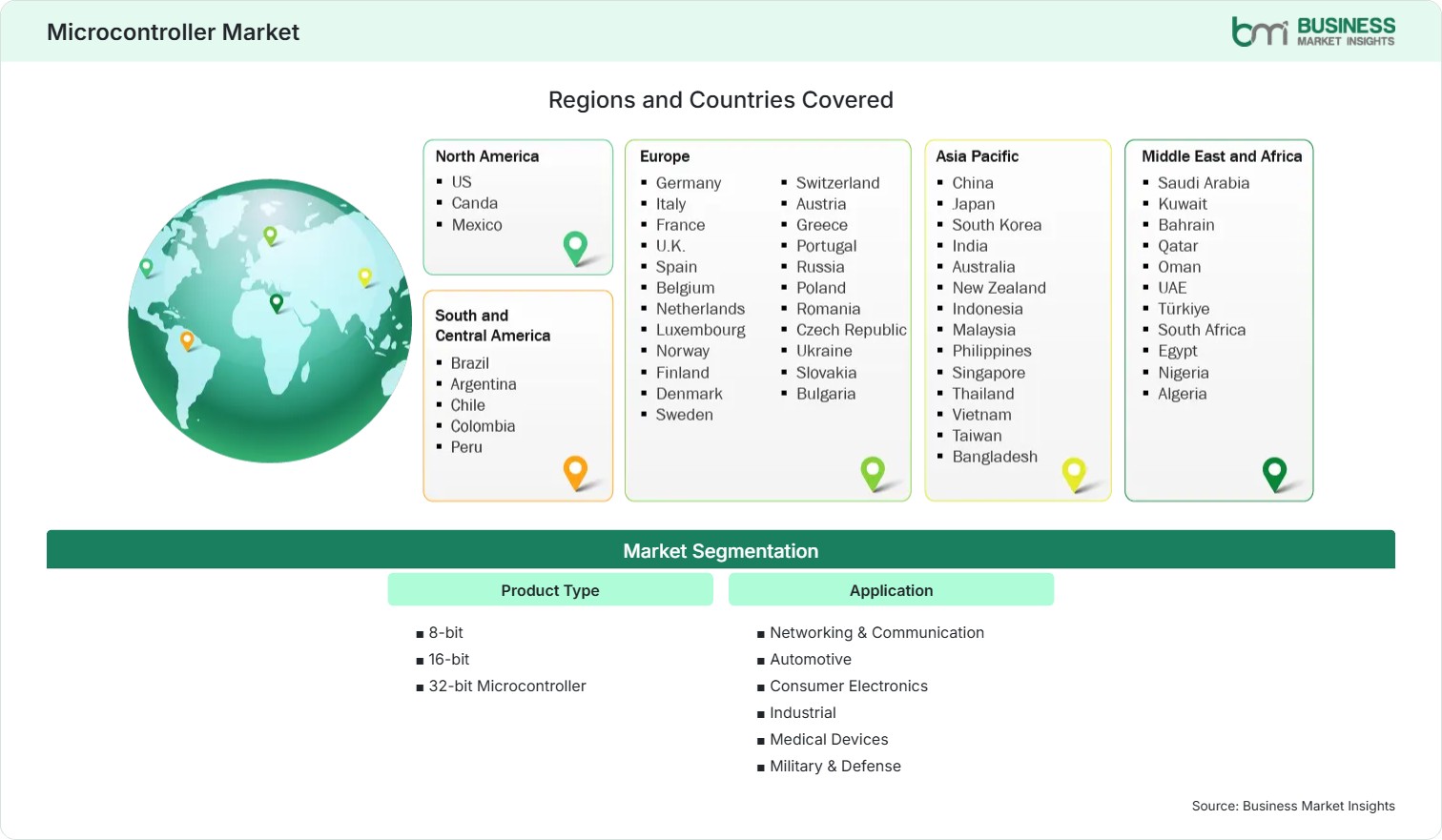
Global Market Geography
FREE PDF
Request your free sample
Request free sample
Segment Analysis

Microcontroller Market Segmentation

Product Type

The product type segment serves as the technology pillar of the Microcontroller Market, providing computing capabilities in the automotive, industrial, medical, and consumer sectors. The product type segment had 100% market share in 2025 and is expected to register a CAGR of 12.0%–12.8% from 2026–2033. There has been a rising demand driven by an emphasis on processing capability, low power consumption, built-in security, and wireless connectivity. Advancements in semiconductor manufacturing and embedded software continue to provide greater opportunities for utilization within intelligent electronics.

  • 8-bit: Continues serving cost-sensitive embedded applications including household appliances, basic industrial controllers, simple consumer electronics, and low-power sensing devices where affordability and reliability remain key purchasing factors.
  • 16-bit: Supports medium-performance applications such as motor control, industrial automation equipment, smart meters, healthcare devices, and automotive subsystems requiring balanced computing capability and energy efficiency.
  • 32-bit Microcontroller: Dominates the market owing to superior processing performance, integrated communication interfaces, enhanced security, and compatibility with AI, IoT, automotive electronics, and industrial automation platforms.

Application

The application segment demonstrates broad adoption across multiple end-use industries as embedded intelligence becomes essential for connected products and automated systems. The segment is projected to expand at a CAGR of 12.2%–12.9% during the microcontroller market forecast period, supported by digital transformation, vehicle electrification, Industry 4.0 initiatives, and healthcare digitization. Growing demand for intelligent electronic systems is encouraging manufacturers to develop application-specific microcontroller platforms with enhanced computing capability, cybersecurity, and energy-efficient operation.

  • Networking & Communication: Increasing deployment of 5G infrastructure, IoT gateways, routers, wireless modules, and communication equipment is driving demand for reliable embedded controllers with advanced connectivity capabilities.
  • Automotive: Represents the fastest-growing application due to electric vehicle production, battery management systems, advanced driver assistance systems, infotainment platforms, and software-defined vehicle architectures.
  • Consumer Electronics: Maintains strong adoption across smartphones, smart appliances, wearable devices, gaming equipment, and home automation systems requiring efficient embedded processing.
  • Industrial: Benefits from increasing automation, robotics, predictive maintenance, intelligent manufacturing, programmable controllers, and connected factory infrastructure supporting Industry 4.0 implementation.
  • Medical Devices: Expands steadily through portable diagnostic equipment, wearable health monitoring systems, connected medical devices, and advanced patient monitoring technologies.
  • Military & Defense: Supports mission-critical applications including secure communications, surveillance systems, unmanned platforms, radar equipment, and rugged embedded electronics requiring high reliability.
Market Forces

Microcontroller Market Dynamics

Key Market Drivers

Expanding IoT device adoption

The rapid expansion of Internet of Things ecosystems continues to accelerate Microcontroller Market trends and demand across consumer, commercial, and industrial environments. Billions of connected devices require compact, energy-efficient embedded controllers to manage sensors, communicate wirelessly, perform analytics, and process data securely. Smart homes, manufacturing plants, smart agriculture, medical wearable technologies, and smart cities become more dependent on microcontrollers to achieve intelligent operation. Manufacturers react to this tendency by adding wireless connectivity, AI acceleration, and better cybersecurity to their products, making it possible to do processing at the edge with low energy consumption.

Rising automotive electronics demand

The automotive electrification trend is significantly boosting the use of microcontrollers within modern automobiles. Electric drive trains, autonomous driving aids, batteries, infotainment, digital cockpits, lighting systems, and vehicular networks require powerful embedded control units. Moreover, software-defined architectures in vehicles are increasing the amount of semiconductors used in cars while demanding functional safety features and secure communication. The automakers are reinforcing their collaboration with semiconductor suppliers to ensure reliable availability of parts and to develop increasingly sophisticated electronic platforms for automobiles.

Increasing industrial automation applications

Industry 4.0 projects are driving increased adoption of microcontrollers in intelligent manufacturing scenarios. Machines are adopting microcontrollers as part of their design to facilitate automation processes such as robotics, PLCs, machine vision, predictive maintenance, and remote monitoring. Companies are developing smart factories to improve efficiency, increase uptime, and optimize manufacturing quality. The microcontrollers enable real-time control of machines, sensor interfacing, and communication, and they also offer scalable automation frameworks that adapt to the changing needs of manufacturing.

Key Market Opportunities

Edge computing device integration

The growing adoption of edge computing presents numerous opportunities for microcontroller manufacturers that produce high-performance, low-power embedded processors. Instead of sending all data to the central cloud, edge devices perform local processing, making the system faster and more efficient. Modern intelligent manufacturing devices, self-driving cars, smart surveillance systems, medical devices, and industrial Internet of Things platforms require microcontrollers capable of performing artificial intelligence tasks locally. Companies investing in AI-enabled embedded architectures are well positioned to benefit from the accelerating adoption of edge computing across numerous industries.

Smart appliance development

The proliferation of connected home solutions is driving a continuous need for smart microcontrollers for use in the manufacturing of smart appliances. Connected fridges, washers, ovens, air-conditioning systems, safety equipment, and energy solutions have embedded controllers that allow wireless communications, monitoring, predictive maintenance, and energy optimization. The changing preferences of consumers who value convenience, automation, and sustainability are driving the integration of processing capabilities into everyday appliances, creating opportunities for chip makers focused on embedded control solutions.

Healthcare wearable electronics growth

The development of wearable devices for healthcare applications is gaining momentum as consumers and healthcare professionals are becoming more involved in remote patient monitoring and digital health technologies. Devices such as smartwatches, biosensors, portable diagnostic instruments, fitness-tracking devices, and medical monitoring systems need ultra-low-power microcontrollers that enable them to operate nonstop with secure data processing and wireless communication capabilities. Progress in miniaturization and battery consumption is enabling the development of more complex wearable medical devices.

Market Restraints and Challenges

Semiconductor supply disruptions

Factor: The microcontroller industry depends on complex global semiconductor manufacturing networks, advanced fabrication facilities, specialized raw materials, and international logistics systems. Capacity limitations, geopolitical uncertainty, natural disasters, and supply chain disruptions can significantly affect production availability. Impact: Component shortages may delay product launches, increase manufacturing costs, extend lead times, and disrupt production schedules across automotive, consumer electronics, industrial automation, and medical device industries. Companies continue strengthening supply chain resilience through supplier diversification, regional manufacturing expansion, and long-term procurement agreements.

Rapid technology obsolescence

Factor: Continuous advancements in semiconductor architectures, communication standards, cybersecurity requirements, artificial intelligence capabilities, and embedded software ecosystems are shortening product life cycles across the microcontroller industry. Impact: Manufacturers face increasing research and development investments, accelerated product refresh cycles, inventory management challenges, and greater pressure to maintain compatibility with evolving customer requirements. Companies that fail to innovate rapidly risk losing competitiveness as customers migrate toward higher-performance, software-enabled embedded computing platforms.

Company Analysis

Competitive Landscape

The competitive landscape is defined by a commitment to invest in process technology advancements, secure embedded architecture, edge computing through artificial intelligence, automotive systems, and a software ecosystem. Microcontroller Market analysis suggests that the major players are building their market strength through innovation, alliances, production capacity, and long-term supplier agreements with the automobile, industrial, healthcare, and consumer electronics industries.

Company Name

Overview

Products and Services Relevant to this Market

Renesas Electronics Corporation

Global semiconductor manufacturer with strong positions in automotive, industrial, and IoT embedded solutions through extensive MCU portfolios and integrated software ecosystems.

8-bit, 16-bit, and 32-bit microcontrollers, automotive MCUs, embedded processors, development tools, connectivity solutions, and reference platforms.

NXP Semiconductors N.V.

Leading supplier of secure embedded processing technologies serving automotive, industrial automation, communications infrastructure, and smart IoT applications worldwide.

Automotive microcontrollers, secure processors, wireless connectivity ICs, edge computing solutions, embedded software, and security platforms.

Microchip Technology Incorporated

Major embedded semiconductor provider recognized for comprehensive MCU families, analog products, memory technologies, and extensive developer support ecosystems.

PIC and AVR microcontrollers, ARM-based MCUs, development boards, analog devices, embedded security, and industrial connectivity solutions.

STMicroelectronics N.V.

Diversified semiconductor company serving industrial, automotive, consumer, and healthcare sectors with advanced embedded processing technologies and integrated development platforms.

STM32 microcontrollers, automotive MCUs, sensors, power management ICs, wireless connectivity chips, and embedded software tools.

Texas Instruments Incorporated

Established analog and embedded processing leader delivering highly reliable semiconductor solutions for automotive, industrial, healthcare, and communications applications globally.

MSP430 and ARM-based microcontrollers, embedded processors, analog ICs, power management solutions, and industrial automation products.

Infineon Technologies AG

Leading supplier of automotive, industrial, and security semiconductors with strong expertise in embedded control, power electronics, and cybersecurity technologies.

AURIX automotive microcontrollers, industrial MCUs, security controllers, power semiconductors, embedded software, and functional safety platforms.

Broadcom Inc.

Global semiconductor company providing connectivity, networking, broadband, and infrastructure technologies supporting embedded communication systems across multiple industries.

Embedded networking processors, wireless connectivity solutions, communication chipsets, broadband devices, and industrial networking components.

Analog Devices, Inc.

High-performance analog semiconductor company integrating embedded processing with sensing, measurement, and intelligent industrial control technologies.

Embedded processors, mixed-signal ICs, industrial controllers, precision sensing devices, healthcare electronics, and automation platforms.

Samsung Electronics Co., Ltd.

Diversified technology manufacturer investing in semiconductor innovation supporting consumer electronics, automotive systems, and intelligent connected devices.

Embedded processors, semiconductor memory, system-on-chip solutions, consumer electronics semiconductors, and IoT processing platforms.

Intel Corporation

Global semiconductor company expanding embedded computing capabilities through edge AI, industrial computing, automotive technologies, and intelligent connected infrastructure.

Embedded processors, edge AI platforms, industrial computing solutions, programmable technologies, networking processors, and software development tools.

Industry Activity

Recent Developments

May 2026

Renesas Electronics Corporation completed the acquisition of Irida Labs, expanding its Vision AI software capabilities and accelerating the development of system-level AI solutions for industrial, automotive, and embedded microcontroller applications.

March 2026

Infineon Technologies AG announced that it strengthened its leadership in the global microcontroller market by increasing its market share to 23.2% in 2025, supported by continuous innovation in automotive microcontrollers, embedded security, and software-defined vehicle solutions.

March 2026

Renesas Electronics Corporation expanded its automotive microcontroller portfolio with the introduction of the 28nm RH850/U2C microcontrollers, designed for vehicle control, functional safety, and next-generation software-defined vehicle architectures.

December 2024

STMicroelectronics N.V. launched the STM32N6 series Edge AI microcontrollers, integrating an AI accelerator to enable high-performance machine learning, computer vision, and real-time edge intelligence for industrial and consumer embedded applications.

Trust & Transparency

Research Methodology

The market analysis combines proprietary research with secondary data from government agencies, company disclosures, regulatory filings, industry databases and expert interviews. Market estimates are validated through data triangulation, cross-market benchmarking and analyst review.

View Full Research Methodology

Questions Answered

Frequently Asked Questions

What competitive strategies are shaping the industry?

Leading companies are investing in advanced semiconductor manufacturing, embedded software ecosystems, AI-enabled edge computing, cybersecurity, functional safety, strategic acquisitions, long-term supply agreements, and partnerships with automotive and industrial equipment manufacturers to strengthen their market positions.

Which application is projected to register the fastest growth?

Automotive applications are projected to record the highest growth, supported by increasing semiconductor content per vehicle, battery management systems, advanced driver assistance systems, software-defined vehicle architectures, intelligent cockpit electronics, and continued global electric vehicle adoption.

Which product segment offers the strongest growth potential?

The 32-bit microcontroller segment offers the strongest long-term potential because of its superior processing capability, integrated security, connectivity features, and suitability for automotive electronics, industrial automation, robotics, AI-enabled edge devices, and advanced consumer products.

Which region is expected to remain the largest market through 2033?

Asia Pacific is expected to maintain the leading position due to its extensive electronics manufacturing ecosystem, expanding semiconductor fabrication capacity, growing electric vehicle production, and strong government support for domestic chip manufacturing and advanced electronics exports.

What factors are driving long-term demand in the Microcontroller Market Report?

The Market Report highlights rising adoption of electric vehicles, industrial automation, IoT devices, smart consumer electronics, and connected healthcare equipment as major demand drivers. Increasing edge AI integration, energy-efficient embedded computing, and government support for semiconductor manufacturing further strengthen long-term market expansion.

Access the Full Microcontroller Market Report

Get segment-level forecasts, regional estimates, competitive benchmarking, company profiles and downloadable Excel datasets.

Access the full Microcontroller Market Report
350 pages PDF & Excel | 2026-07-29