
Chiplets Market Outlook: Size, Share, Trends, Growth Analysis, Competitive Landscape & Forecast, 2026-2033

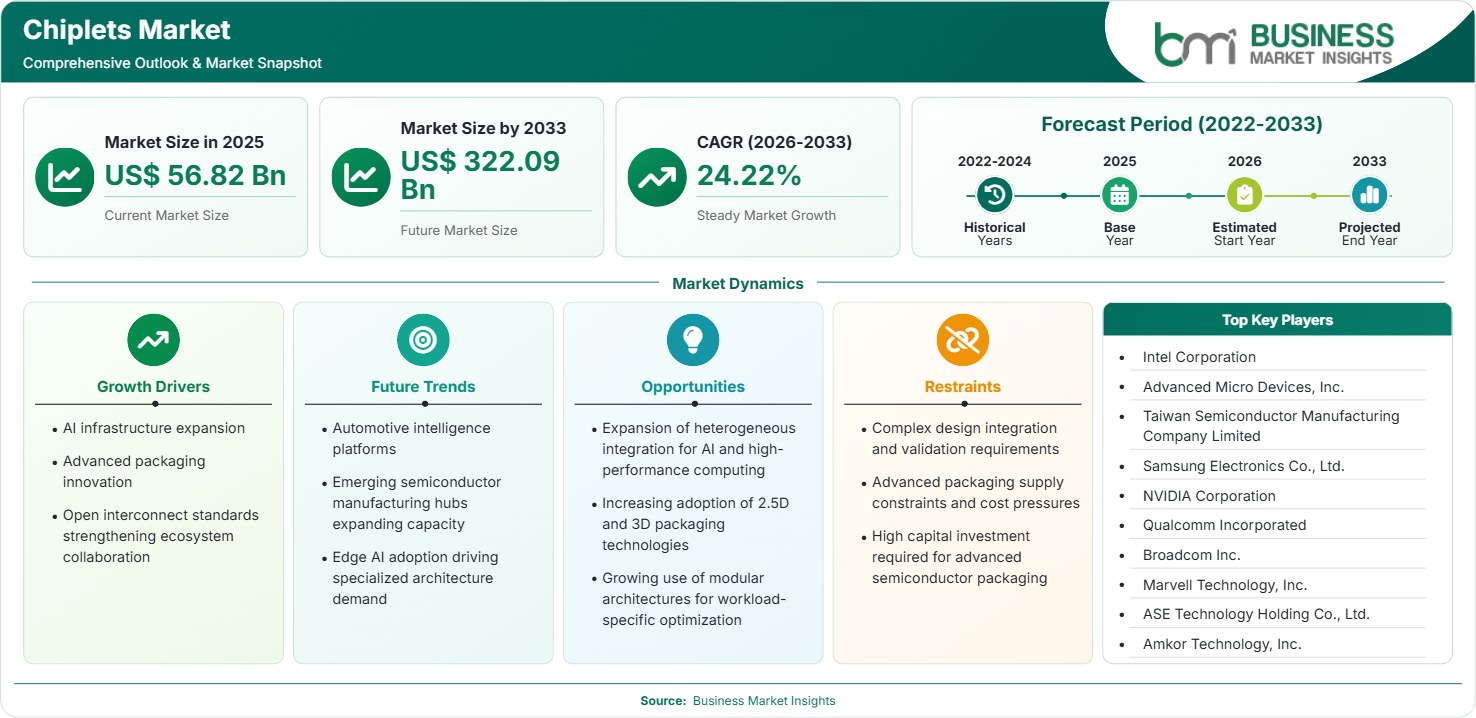
The Chiplets Market size was valued at US$ 56.82 Billion in 2025 and is projected to reach US$ 322.09 Billion by 2033, growing at a CAGR of 24.22% during 2026–2033, driven by AI computing demand, advanced packaging adoption, heterogeneous integration, datacenter expansion, automotive electronics, and rising semiconductor performance requirements.

Report Coverage
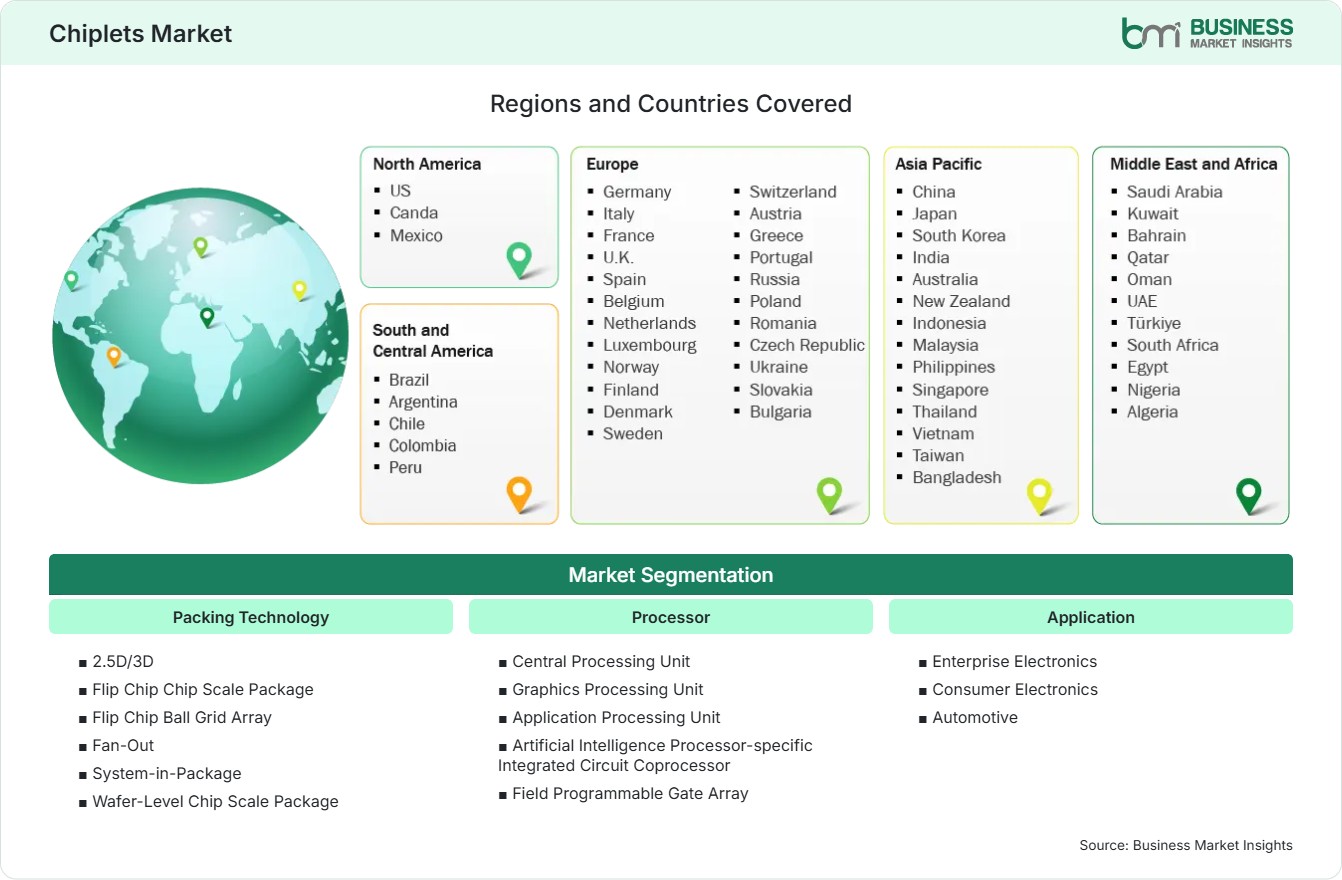
  • Packing Technology: 2.5D/3D, Flip Chip Chip Scale Package, Flip Chip Ball Grid Array, Fan-Out, System-in-Package, Wafer-Level Chip Scale Package
  • Processor: Central Processing Unit, Graphics Processing Unit, Application Processing Unit, Artificial Intelligence Processor-specific Integrated Circuit Coprocessor, Field Programmable Gate Array
  • Application: Enterprise Electronics, Consumer Electronics, Automotive
US$ 56.82 Bn Market size in 2025
US$ 322.09 Bn Market Size by 2033
24.22% CAGR, 2026 - 2033
2026-2033 Forecast Period

AI Overview

Chiplets Market Summary

  • North America Region: North America holds a market share of 34%–37% in 2025, growing with a CAGR of 22%–24% during 2026–2033. Growth is supported by AI accelerator deployment, high-performance computing investment, advanced packaging ecosystems, semiconductor incentives, hyperscale cloud expansion, processor innovation, collaborative design frameworks, increasing research spending, resilient supply-chain modernization initiatives, and growing demand across defense and enterprise infrastructure applications globally. The U.S. commands most regional demand through advanced semiconductor design leadership and AI infrastructure expansion, growing at 22%–24%.
  • Fastest Growing Region: Asia Pacific holds a market share of 29%–32% in 2025 and advances at a CAGR of 26%–28% during 2026–2033. Key drivers include foundry leadership, packaging capacity additions, AI manufacturing investments, electronics exports, government semiconductor programs, automotive electronics growth, domestic innovation incentives, memory integration demand, advanced node commercialization, and expanding regional semiconductor ecosystems supporting heterogeneous computing architectures globally.
  • Leading Segment: Central Processing Unit (CPU) accounts for 30%–33% share in 2025 and records a CAGR of 22%–24%. Adoption is supported by server modernization, cloud infrastructure scaling, enterprise computing requirements, energy-efficient architectures, higher core-density strategies, modular processor development, advanced package integration, software ecosystem compatibility, improved manufacturing yields, and growing demand for scalable computing platforms worldwide.
  • High Growth Segment: Artificial Intelligence Processor-specific Integrated Circuit (AI ASIC) Coprocessor represents 16%–19% share in 2025 while expanding at 28%–30% CAGR. Demand stems from generative AI workloads, inference optimization, lower power consumption, specialized acceleration, datacenter investments, edge intelligence deployment, faster model execution, custom silicon strategies, heterogeneous architectures, and increasing enterprise adoption of dedicated AI processing solutions.
  • Key Market Opportunity: Expanding adoption of open chiplet interconnect standards enables cross-vendor integration, reduces development costs, accelerates product launches, supports customized architectures, strengthens ecosystem collaboration, and unlocks scalable semiconductor innovation opportunities globally.
  • Major Market Players: Intel Corporation, Advanced Micro Devices, Inc., Taiwan Semiconductor Manufacturing Company Limited, Samsung Electronics Co., Ltd., NVIDIA Corporation, Qualcomm Incorporated, Broadcom Inc., Marvell Technology, Inc., ASE Technology Holding Co., Ltd., Amkor Technology, Inc.
Strategic Insights

Chiplets Market: Strategic Insights

Chiplets Market Strategic Framework
FREE PDF
Request your free sample
Request free sample
Stakeholder View

Key Takeaways

  • The value chain increasingly depends on close collaboration among foundries, OSAT providers, substrate suppliers, EDA vendors, and processor developers, making ecosystem partnerships a decisive competitive advantage.
  • AI ASIC coprocessors and advanced automotive computing platforms present the strongest upside potential as manufacturers seek specialized architectures delivering higher efficiency and workload-specific performance.
  • Innovation is shifting toward heterogeneous integration, UCIe-enabled interoperability, advanced thermal management, and 3D stacking technologies that improve scalability beyond conventional node shrink economics.
  • Asia Pacific offers a compelling investment case due to packaging capacity expansion, strong electronics manufacturing bases, government incentives, and leadership in advanced semiconductor fabrication.
  • Strategic investments, packaging facility expansion, and technology alliances among foundries, chip designers, and assembly providers indicate increasing consolidation around advanced integration capabilities.
  • Sustainability objectives are encouraging modular architectures that improve yield efficiency, reduce wafer waste, and extend product lifecycle flexibility across multiple semiconductor applications.
Geographic Outlook

Chiplets Market Regional Highlights

North America Chiplets Market

North America accounts for 34%–37% of global revenue in 2025 and is projected to expand at a CAGR of 22%–24% through 2033. The region benefits from strong datacenter investments, semiconductor design leadership, AI accelerator demand, and advanced packaging innovation. Significant public funding encourages domestic manufacturing resilience. Chiplets Market share remains supported by hyperscale cloud operators and enterprise technology spending. Strong intellectual property ecosystems, research institutions, and processor development capabilities continue creating commercial advantages across computing, networking, aerospace, and defense end-use sectors.

  • Growing hyperscale datacenter deployments support demand for modular architectures capable of delivering higher bandwidth, lower latency, and enhanced workload optimization for AI and cloud computing environments.
  • Government semiconductor initiatives encourage local fabrication, advanced packaging development, and strategic ecosystem investments to strengthen technology competitiveness and supply-chain resilience.
  • Strong concentration of processor designers accelerates commercialization of heterogeneous integration solutions across enterprise computing, networking infrastructure, and emerging AI applications.
  • Defense and aerospace programs increasingly require high-performance computing solutions, supporting deployment of advanced packaging technologies and specialized semiconductor architectures.

US Chiplets Market

The United States represents approximately 78%–82% of regional revenue and advances at a CAGR of 22%–24% through 2033. Demand is fueled by cloud infrastructure expansion, AI model training requirements, and advanced semiconductor design activities. Large technology companies continue investing in custom accelerators and heterogeneous computing platforms. Research collaboration among industry participants, universities, and federal agencies strengthens innovation capacity. Growth remains supported by manufacturing incentives, packaging investments, and increasing adoption across enterprise and government sectors.

  • Major cloud providers continue deploying custom processors and accelerators, creating sustained requirements for multi-die integration and advanced packaging capabilities.
  • Domestic semiconductor support programs encourage expansion of manufacturing, research facilities, and advanced assembly technologies throughout the supply chain.
  • AI infrastructure investments generate substantial demand for high-bandwidth, power-efficient architectures optimized for training and inference workloads.
  • National security requirements drive adoption of advanced computing platforms requiring strong reliability, scalability, and performance characteristics.

Europe Chiplets Market

Europe captures 21%–24% of global Chiplets Market revenue in 2025 and is expected to record a CAGR of 21%–23% through 2033. Regional development is supported by industrial automation, automotive semiconductor demand, and digital sovereignty initiatives. Germany leads regional adoption due to automotive and industrial electronics strength, while the Netherlands demonstrates high-growth momentum with CAGR estimates near 23%–25%. Collaborative R&D programs and semiconductor policy initiatives encourage investment in advanced integration technologies, packaging capabilities, and strategic supply-chain capabilities.

  • Automotive electrification increases requirements for efficient computing platforms capable of supporting ADAS, connectivity, and vehicle intelligence applications.
  • European semiconductor initiatives encourage domestic research, manufacturing expansion, and packaging innovation capabilities.
  • Germany remains the leading country due to strong industrial ecosystems and advanced automotive technology requirements.
  • The Netherlands demonstrates rapid adoption through semiconductor equipment expertise, collaborative innovation, and digital infrastructure investments.
  • Industrial IoT deployment supports demand for compact, energy-efficient heterogeneous integration solutions.

Asia Pacific Chiplets Market

Asia Pacific holds 29%–32% of global revenue in 2025 and delivers the fastest expansion with a CAGR of 26%–28% through 2033. The region benefits from foundry leadership, electronics manufacturing scale, advanced packaging capacity, and government-backed semiconductor strategies. Taiwan remains the largest contributor due to fabrication leadership, while India emerges as a rapidly growing market with CAGR near 29%–31%. Chiplets Market share continues increasing as AI hardware production, consumer electronics manufacturing, and automotive semiconductor innovation accelerate across regional economies.

  • Taiwan remains central to advanced packaging and fabrication ecosystems, supporting large-scale commercialization of heterogeneous integration technologies.
  • South Korea strengthens regional competitiveness through memory innovation, packaging investments, and AI infrastructure development.
  • China expands domestic semiconductor capabilities through localization programs and technology investment initiatives.
  • India demonstrates strong growth potential supported by electronics manufacturing incentives and semiconductor ecosystem development.
  • Regional consumer electronics leadership creates substantial demand for advanced processing architectures and efficient packaging technologies.

Rest of World Chiplets Market

Rest of World contributes 10%–13% of global revenue in 2025 and is forecast to expand at a CAGR of 18%–20% through 2033. South and Central America benefit from expanding electronics demand and digital infrastructure projects. The Middle East and Africa gain momentum through smart city investments, datacenter developments, and technology diversification initiatives. Brazil leads demand across Latin America, while the United Arab Emirates demonstrates the strongest growth trajectory. Strategic technology investments continue supporting semiconductor ecosystem development across emerging economies.

  • Brazil benefits from consumer electronics demand and digital transformation initiatives supporting advanced computing adoption.
  • Mexico strengthens regional opportunities through manufacturing integration and technology supply-chain participation.
  • Gulf countries increasingly invest in AI infrastructure, cloud computing, and advanced technology ecosystems.
  • The United Arab Emirates demonstrates strong momentum through national technology strategies and datacenter investments.
  • Expanding connectivity infrastructure increases demand for efficient processing solutions across telecommunications and enterprise environments.
Global Market Geography
FREE PDF
Request your free sample
Request free sample
Segment Analysis

Chiplets Market Segmentation

Packing Technology

Packaging technology represents approximately 38%–41% market share in 2025 and is expected to expand at a CAGR of 25%–27% through the forecast period. The Chiplets Market scope continues widening as manufacturers adopt advanced integration techniques enabling higher performance, improved yield management, and cost-effective heterogeneous architectures across AI, networking, and automotive applications.

  • 2.5D/3D: Supports high-bandwidth integration between logic and memory components, enabling advanced AI accelerators, HPC platforms, and performance-intensive computing solutions requiring compact package architectures.
  • Flip Chip Chip Scale Package (FCCSP): Widely adopted in mobile and consumer electronics due to compact footprints, cost efficiency, and compatibility with high-volume manufacturing environments.
  • Flip Chip Ball Grid Array (FCBGA): Preferred for servers and networking processors where higher input-output density, thermal performance, and scalability remain critical operational requirements.
  • Fan-Out (FO): Enhances package thinness and electrical performance, enabling advanced mobile devices, wearable electronics, and emerging edge AI applications.
  • System-in-Package (SiP): Combines multiple functional elements within a single package, supporting miniaturization, connectivity integration, and product flexibility across end markets.
  • Wafer-Level Chip Scale Package WLCSP): Delivers compact form factors and lower power consumption, making it suitable for sensors, portable electronics, and connected devices.

Processor

Processor technologies account for approximately 44%–47% share in 2025 and are projected to advance at a CAGR of 24%–26%. Growing requirements for workload-specific optimization, scalable architectures, and energy efficiency continue accelerating adoption of multi-die processor designs across datacenter, enterprise, and intelligent edge deployments.

  • Central Processing Unit (CPU): Maintains leadership through widespread usage in servers, enterprise computing, and cloud infrastructure requiring scalable, modular architecture approaches.
  • Graphics Processing Unit (GPU): Benefits from AI model training, visualization, and parallel processing demand across datacenter and high-performance computing environments.
  • Application Processing Unit (APU): Integrates graphics and compute functionality, supporting power-efficient designs in client computing and embedded systems applications.
  • Artificial Intelligence Processor-specific Integrated Circuit (AI ASIC) Coprocessor: Gains traction through customized acceleration capabilities optimized for machine learning inference and training workloads.
  • Field Programmable Gate Array (FPGA): Offers design flexibility, rapid programmability, and adaptability for networking, telecommunications, and specialized computing use cases.

Application

Application deployment contributes approximately 100% of end-use demand, with enterprise electronics retaining 36%–39% share in 2025 and expanding at a CAGR of 24%–26%. Chiplets Market trends indicate rising adoption across multiple sectors as organizations seek higher performance, lower power consumption, and scalable semiconductor architectures.

  • Enterprise Electronics: Benefits from cloud expansion, AI workloads, and server modernization efforts requiring flexible and high-performance processor platforms.
  • Consumer Electronics: Adoption is supported by advanced smartphones, gaming systems, wearable devices, and connected product innovation strategies.
  • Automotive: Demand increases through electrification trends, autonomous functionality, advanced driver-assistance systems, and intelligent vehicle computing requirements.
Market Forces

Chiplets Market Dynamics

Key Market Drivers

AI Infrastructure Expansion Accelerating Advanced Integration Demand

Deployment of artificial intelligence continues to be a key driver in the growth of the industry. Clusters used to train AI will need high-bandwidth memory, high-bandwidth connections, and scalability in terms of processing power. Packaging strategies enable manufacturers to work around reticle restrictions while maintaining efficiency. Growth in the industry, based on major foundries, will involve CoWoS, EMIB, and Foveros-like technology. Chiplets Market growth is driven by the cycles of hyperscaling investments, enterprise artificial intelligence deployments, and complexity in processing. These requirements keep adding pressure for market demand to evolve into a modular architecture that will be able to integrate special computational, memory, and networking capabilities in a single package.

Advanced Packaging Innovation Enhancing Performance Economics

Semiconductor manufacturers increasingly rely on heterogeneous integration to improve yield outcomes and development economics. Rather than building larger monolithic dies, designers combine multiple functional elements within a single package. This method minimizes the risk of production involved in scaling the node while allowing for customization based on application requirements. Increased use of 2.5D, 3D, and fan-out technology helps improve the bandwidth density and energy efficiency. More access to packaging platforms available from foundries and OSATs makes it easier for the product to reach the market. These advantages keep driving the adoption of packaging technologies in different sectors.

Open Interconnect Standards Strengthening Ecosystem Collaboration

The trend towards open connectivity solutions has sped up the process of interoperability among semiconductor providers. Standardized solutions allow for seamless integration of the processor, memory devices, accelerators, and input/output components designed by various companies. This helps to keep down the complexity of the design and encourages innovation on the part of the specialized vendors. Chiplets Market trends increasingly reflect ecosystem-driven innovation rather than isolated product development. As interoperability expands, enterprises gain access to customized architectures optimized for specific workloads, enhancing adoption across AI, networking, industrial automation, and emerging intelligent-edge applications.

Key Market Opportunities

Automotive Intelligence Platforms Creating New Revenue Streams

Autonomous vehicles need software that requires complex computing infrastructure for autonomy, sensor fusion, connectivity, and advanced driver assistance systems. Modular integration technologies provide automotive semiconductor manufacturers an advantage over monolithic architectures in balancing cost, performance, and scalability considerations. The increasing manufacturing of electric vehicles adds up to the need for high-performance computing. Long product life cycles of automotive products make use of reusability of the architecture an advantage. Chiplets Market Forecasts show that there is potential for suppliers who can meet reliability, functional safety, and thermal management needs. These changes will ensure revenue diversification outside of the datacenter and consumer electronics market segments.

Emerging Semiconductor Manufacturing Hubs Expanding Capacity

Governments worldwide are investing heavily in semiconductor resilience initiatives, creating opportunities for packaging providers, equipment suppliers, and processor developers. The new facilities established in Asia, North America, Europe, and select Middle Eastern markets ensure that the global supply chain is diversified and that risks of concentration are minimized. The upgrade in advanced packaging helps to ensure that the commercialization of heterogeneous integration products is fast. Development of the local ecosystem ensures that there is workforce development and collaboration in research. Organizations that create strategic relationships in new ecosystems will enjoy incentive schemes.

Edge AI Adoption Driving Specialized Architecture Demand

Growing deployment of AI capabilities in industrial systems, healthcare equipment, smart cities, and connected devices creates demand for power-efficient processing solutions. Edge systems need optimal performance with respect to heat and energy limitations. With modular architecture, the integration of functions that are application specific can be made without any cost incurred for extensive redesigning. This helps achieve quick differentiation in products in vertical segments. The increasing requirement of local intelligence lowers the need for centralized processing and increases the possibilities of deploying semiconductors. Companies offering a scalable and effective compute platform are well poised to capitalize on these opportunities.

Market Restraints and Challenges

Complex Design Integration and Validation Requirements

Factor: Multi-die architectures introduce significant integration complexity involving thermal behavior, interconnect reliability, package design optimization, and software compatibility. Impact: The development cycles may be extended as businesses build validation tools and work on ecosystem integration. Even though the use of modular architecture provides many performance benefits, it is not easy to implement seamless interoperability between several dies. It is necessary to take care of power management and latency optimization, as well as packaging issues, at the same time. Smaller firms often face resource constraints when pursuing sophisticated integration approaches.

Advanced Packaging Supply Constraints and Cost Pressures

Factor: Global availability of advanced packaging capacity, substrates, and specialized manufacturing resources remains constrained by rapid demand growth. Impact: Bottlenecks in supplies could result in increased lead times, increase costs of production, and slow down commercialization process. There is no shortage of industry reports about the importance of packaging in the AI hardware production process. Increased size of the facility calls for significant financial investment, know-how, and economies of scale. Those that depend on sophisticated integration platforms face difficulty in securing supplies during times of high demand. Supply chain dependency on chosen locations poses an additional risk.

Company Analysis

Competitive Landscape

Chiplets Market analysis indicates competition is centered on advanced packaging capability, heterogeneous integration expertise, processor innovation, ecosystem partnerships, and manufacturing scale.

Company Name

Overview

Products and Services relevant to this market

Intel Corporation

Leading semiconductor company with extensive processor, foundry, and advanced packaging capabilities supporting diverse computing applications.

Foveros, EMIB, Xeon processors, foundry services, advanced packaging platforms, AI computing solutions.

Advanced Micro Devices, Inc.

Pioneer in commercial chiplet-based CPUs and accelerators for datacenter and enterprise workloads.

EPYC processors, Ryzen CPUs, Instinct accelerators, chiplet architectures, AI computing platforms.

Taiwan Semiconductor Manufacturing Company Limited

World's leading foundry providing advanced fabrication and packaging technologies.

CoWoS, SoIC, InFO packaging, fabrication services, heterogeneous integration solutions.

Samsung Electronics Co., Ltd.

Global semiconductor manufacturer with advanced memory and packaging expertise.

Advanced packaging solutions, memory integration, foundry services, AI-oriented semiconductor platforms.

NVIDIA Corporation

Dominant AI accelerator provider leveraging advanced multi-die integration technologies.

AI GPUs, datacenter accelerators, networking platforms, advanced packaging-enabled architectures.

Qualcomm Incorporated

Major semiconductor designer focused on mobile, edge, and intelligent computing systems.

Snapdragon processors, AI engines, connectivity platforms, advanced heterogeneous computing solutions.

Broadcom Inc.

Diversified semiconductor supplier serving networking, broadband, and enterprise infrastructure markets.

Custom accelerators, networking silicon, ASIC solutions, advanced integration technologies.

Marvell Technology, Inc.

Provides infrastructure semiconductor solutions supporting cloud and networking applications.

Datacenter processors, networking chips, custom silicon platforms, advanced packaging solutions.

ASE Technology Holding Co., Ltd.

Leading outsourced semiconductor assembly and testing provider with advanced packaging expertise.

Advanced packaging, testing services, heterogeneous integration, system-in-package technologies.

Amkor Technology, Inc.

Global OSAT provider supporting semiconductor packaging and assembly requirements.

Advanced packaging services, flip-chip solutions, wafer-level packaging, integration technologies.

Trust & Transparency

Research Methodology

The market analysis combines proprietary research with secondary data from government agencies, company disclosures, regulatory filings, industry databases and expert interviews. Market estimates are validated through data triangulation, cross-market benchmarking and analyst review.

View Full Research Methodology

Questions Answered

Frequently Asked Questions

What role do open interconnect standards play?

Open interconnect standards improve interoperability between semiconductor components from different vendors, reducing development complexity and encouraging broader ecosystem collaboration and innovation.

How does the Chiplets Market Report help stakeholders?

The Chiplets Market Report provides insights into technology adoption, competitive positioning, regional opportunities, investment activity, packaging developments, and segment-level growth prospects for strategic decision-making.

Why are advanced packaging technologies important?

Advanced packaging enables faster communication among processing elements, memory, and accelerators while improving power efficiency, reducing latency, and supporting highly complex heterogeneous semiconductor architectures.

Which industries are driving demand most aggressively?

AI datacenters, cloud computing providers, automotive electronics manufacturers, enterprise infrastructure operators, telecommunications firms, and advanced consumer electronics companies currently represent the most influential demand sources.

What makes chiplet architecture different from traditional monolithic chips?

Chiplet architectures divide functionality into multiple specialized dies integrated within a package, improving design flexibility, manufacturing yield, scalability, and performance optimization compared with large monolithic semiconductor designs.

Access the Full Chiplets Market Report

Get segment-level forecasts, regional estimates, competitive benchmarking, company profiles and downloadable Excel datasets.

Access the full Chiplets Market Report
350 pages PDF & Excel | 2026-08-27