
Electrical Label Market Outlook: Size, Share, Trends, Growth Analysis, Competitive Landscape & Forecast, 2026-2033

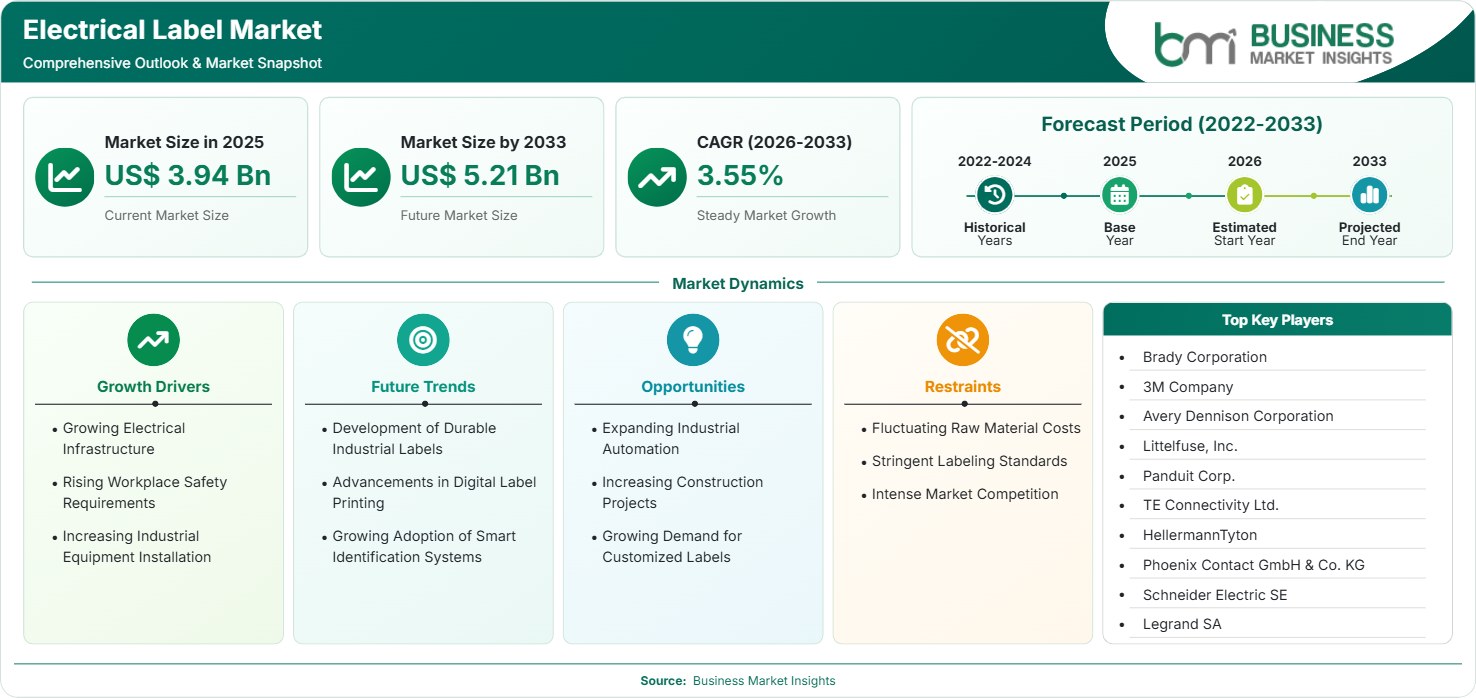
The Electrical Label Market size was valued at US$ 3.94 Billion in 2025 and is projected to reach US$ 5.21 Billion by 2033, growing at a CAGR of 3.55% during 2026–2033, supported by electrical infrastructure expansion, safety requirements, industrial automation, customized identification, and durable labeling demand.

Report Coverage
  • Product type: Plastic Label, Paper Label, Metal Label
  • Application: Electrical and Electronic, Automobile Industry, Pharmaceutical, Other
US$ 3.94 Bn Market size in 2025
US$ 5.21 Bn Market Size by 2033
3.55% CAGR, 2026 - 2033
2026-2033 Forecast Period

01 AI Overview

Electrical Label Market Summary

  • North America Region: North America holds market share of 31%–35% in 2025, growing with a CAGR of 3.20%–3.60% during 2026–2033, influenced by industrial modernization, infrastructure renewal, workplace safety, automation investment, durable identification requirements, and recurring equipment replacement. The US remains the regional demand center, with a 3.25%–3.65% CAGR through 2033, supported by manufacturing modernization and electrical infrastructure upgrades.
  • Fastest Growing Region: Asia Pacific holds market share of 27%–31% in 2025, growing with a CAGR of 4.10%–4.60% during 2026–2033, supported by electronics manufacturing, automotive production, industrial automation, construction activity, electrical equipment localization, expanding factories, infrastructure investment, and increasing component traceability requirements.
  • Leading Segment: Plastic Label holds market share of 52%–56% in 2025, growing with a CAGR of 3.40%–3.80% during 2026–2033, supported by flexibility, moisture resistance, durable printing, economical conversion, equipment identification, cable marking, panel labeling, and broad adoption across industrial electrical applications.
  • High Growth Segment: Automobile Industry holds application share of 22%–26% in 2025, growing with a CAGR of 4.00%–4.50% during 2026–2033, supported by vehicle electrification, wiring complexity, component traceability, thermal exposure, vibration resistance, service identification, and increasing electronic content.
  • Key Market Opportunity: Customized identification for automated facilities can raise supplier value through variable information, serialized tracking, durable substrates, machine-readable codes, application-specific adhesives, short-run production, and integrated equipment identification programs.
  • Major Market Players: Brady Corporation, 3M Company, Avery Dennison Corporation, Littelfuse, Inc., Panduit Corp., TE Connectivity Ltd., HellermannTyton, Phoenix Contact GmbH & Co. KG, Schneider Electric SE, and Legrand SA.
02 Strategic Insights

Electrical Label Market: Strategic Insights

Electrical Label Market Strategic Framework
FREE PDF
Request your free sample
Request free sample
03 Stakeholder View

Key Takeaways

  • The value chain increasingly depends on substrate formulation, adhesive chemistry, printing technology, converting precision, distribution, and application engineering. Suppliers integrating several capabilities can improve consistency and reduce procurement complexity.
  • Plastic Label and Automobile Industry applications offer attractive upside because both require durable identification under demanding environmental and operating conditions. Customized formats can command greater value than standardized commodity labels.
  • Product innovation is moving toward thinner, durable constructions capable of maintaining legibility through heat, chemicals, vibration, moisture, and abrasion. Digital printing supports variable information and shorter production requirements.
  • Asia Pacific provides the strongest incremental investment case because electronics, automotive, industrial equipment, construction, and electrical manufacturing reinforce one another. Local conversion and technical service can improve competitiveness.
  • Investment priorities increasingly favor digital conversion equipment, specialty materials, adhesive development, customized production, and application-engineering capabilities. Strategic relationships with equipment manufacturers can strengthen recurring demand.
04 Geographic Outlook

Electrical Label Market Regional Highlights

North America Electrical Label Market

North America holds a 31%–35% share in 2025 and records a 3.20%–3.60% CAGR through 2033. Demand is supported by mature industrial infrastructure, electrical equipment replacement, manufacturing modernization, workplace safety, and automation. The Electrical Label Market share remains concentrated around the US, while Canada and Mexico contribute through industrial and infrastructure applications. Buyers increasingly prioritize durability, print permanence, adhesive reliability, and standardized identification. Demand therefore reflects installed equipment complexity and recurring maintenance requirements rather than rapid expansion in label volumes alone.

  • Industrial automation increases identification requirements across control cabinets, sensors, wiring, terminals, and electrical equipment, supporting durable products designed for repeated servicing and demanding operating environments.
  • Infrastructure renewal supports labels for distribution systems, panels, cables, switchgear, and electrical equipment, creating recurring demand for products capable of maintaining legibility during inspection and maintenance.
  • Manufacturing customers increasingly standardize identification across facilities, creating opportunities for suppliers offering consistent materials, customized printing, rapid replenishment, and centralized labeling programs.

US Electrical Label Market

The US represents a 20%–23% share in 2025 and expands at a 3.25%–3.65% CAGR through 2033. Industrial facilities, commercial buildings, utilities, transportation systems, and equipment manufacturers generate broad demand. The market favors engineered labels capable of resisting heat, abrasion, moisture, chemicals, and repeated maintenance. Automation increases label density across control systems and wiring. Infrastructure renewal also supports replacement requirements. Demand therefore combines new installations with recurring maintenance, retrofit, equipment modification, and standardized identification programs.

  • Factory modernization increases requirements for panel, cable, terminal, sensor, and component identification, particularly where equipment undergoes frequent cleaning, vibration, thermal cycling, and maintenance.
  • Electrical infrastructure renewal creates demand for durable identification across distribution systems, power equipment, cables, cabinets, and service points requiring consistent information.
  • Automotive and transportation manufacturing requires compact labels that maintain readability despite fluids, vibration, heat, abrasion, and prolonged operating exposure.

Europe Electrical Label Market

Europe holds a 24%–28% share in 2025 and grows at a 3.00%–3.40% CAGR through 2033. Germany leads through machinery, automotive, electrical equipment, and industrial automation, while France and Italy provide diversified demand. Poland and the Czech Republic offer comparatively faster opportunities through manufacturing localization. Regional buyers emphasize engineering specifications, durability, documentation, and compact identification formats. Demand is therefore strongly influenced by equipment complexity, manufacturing standards, and lifecycle performance rather than simple label consumption.

  • Germany benefits from dense automation and machinery manufacturing, supporting demand for panel, terminal, cable, component, and safety identification.
  • France and Italy provide opportunities across transportation, industrial equipment, electrical systems, machinery, and commercial infrastructure requiring customized identification.
  • Poland and the Czech Republic benefit from expanding manufacturing capacity, increasing requirements for standardized labeling across automotive, electronics, and industrial production facilities.

Asia Pacific Electrical Label Market

Asia Pacific holds a 27%–31% share in 2025 and records a 4.10%–4.60% CAGR through 2033. China remains a major demand center, while Japan and South Korea support sophisticated electronics and industrial applications. India, Vietnam, Thailand, and Indonesia provide faster opportunities as manufacturing and electrical infrastructure expand. The region combines new equipment installations with rising automation density, making it the strongest incremental growth geography. The Electrical Label Market growth is increasingly linked to electronics, automotive, industrial equipment, construction, and localized production.

  • China supports substantial demand through electronics, automotive, machinery, electrical equipment, control systems, panels, cables, and industrial production assets.
  • India offers opportunities across manufacturing, infrastructure, automotive, rail, commercial construction, and electrical equipment, supporting localized conversion and technical service.
  • Vietnam, Thailand, and Indonesia benefit from manufacturing diversification, particularly electronics and automotive supply chains requiring standardized component and equipment identification.

Rest of World Electrical Label Market

South and Central America hold a 7%–10% share in 2025 and expand at a 3.40%–3.90% CAGR through 2033. Brazil provides the largest regional industrial base, while Chile and Colombia contribute infrastructure-led demand. Middle East and Africa provide opportunities across energy, industrial construction, utilities, mining, manufacturing, and commercial facilities. Heat, dust, moisture, and demanding field conditions increase the value of durable materials. The combined region therefore favors engineered identification products over low-cost formats in technically demanding installations.

  • Brazil supports applications across industrial equipment, automotive production, utilities, construction, and electrical infrastructure, creating demand for durable identification.
  • Gulf economies create project-driven opportunities across power systems, industrial facilities, construction, and energy infrastructure exposed to heat and dust.
  • South Africa combines mining, utilities, manufacturing, and infrastructure requirements, supporting durable identification for equipment servicing and safety communication.
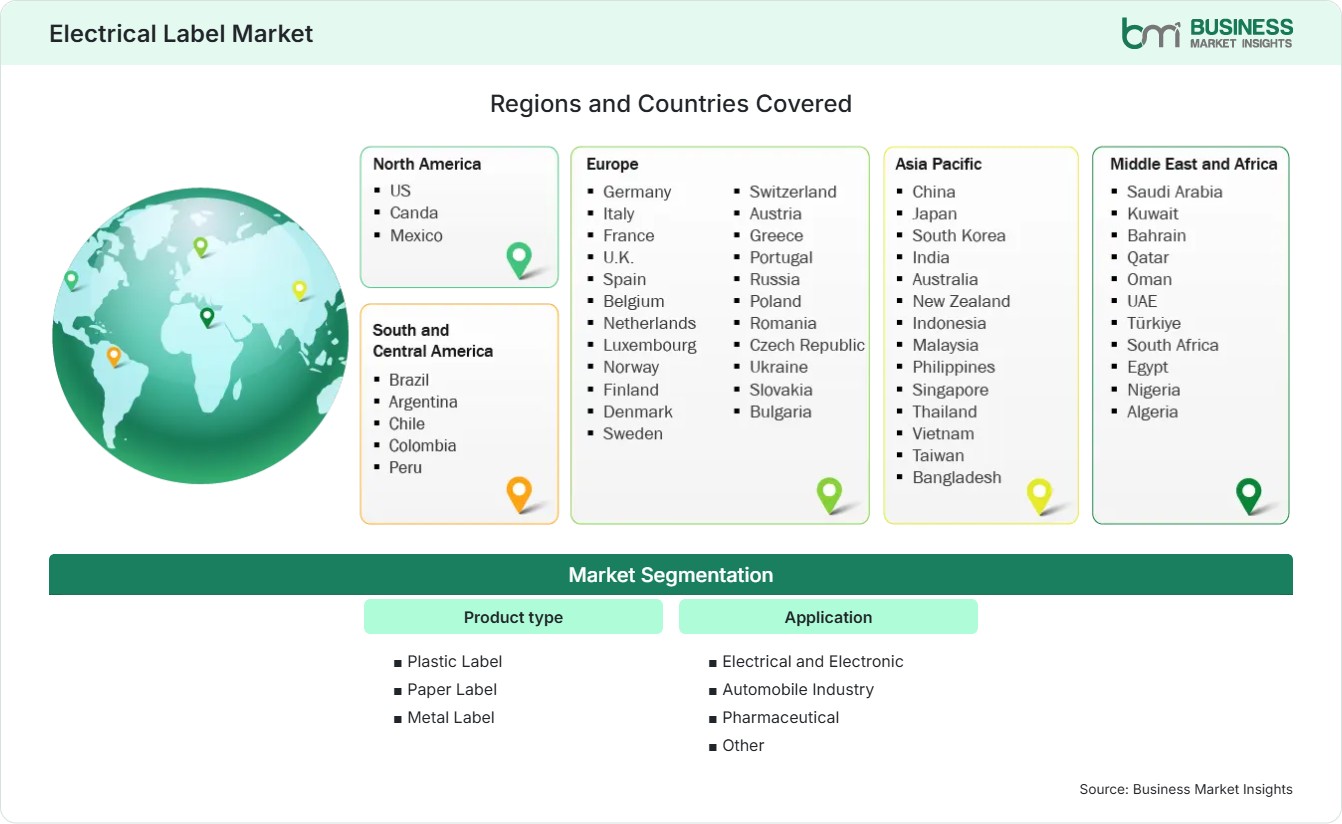
Global Market Geography
FREE PDF
Request your free sample
Request free sample
05 Segment Analysis

Electrical Label Market Segmentation

Product type

Plastic Label leads with a 52%–56% share in 2025 and a 3.40%–3.80% CAGR through 2034, supported by flexibility, moisture resistance, durability, and broad industrial adoption. The Electrical Label Market scope increasingly reflects material selection based on exposure, adhesive compatibility, print permanence, and installation conditions.

  • Plastic Label: Flexible and durable constructions support panels, cables, components, and equipment exposed to moisture, chemicals, abrasion, and temperature variation.
  • Paper Label: Cost-efficient formats serve controlled indoor environments, temporary identification, inventory coding, and documentation where exposure remains limited.
  • Metal Label: High-durability formats support industrial equipment requiring long-term identification, environmental resistance, and stable information retention.

Application

Electrical and Electronic leads applications with a 38%–42% share in 2025 and a 3.30%–3.70% CAGR through 2034, supported by component density, wiring complexity, automation, and traceability. Automobile Industry follows with strong requirements for durable identification, while pharmaceutical applications emphasize cleanliness, documentation, and process control.

  • Electrical and Electronic: Dense components, wiring, equipment, and control systems require compact, legible identification for assembly, servicing, inspection, and asset documentation.
  • Automobile Industry: Wiring, electronics, power systems, and components require labels resisting heat, fluids, vibration, abrasion, and prolonged operating exposure.
  • Pharmaceutical: Production environments require clear equipment, cable, process, and storage identification where legibility, cleanliness, and documentation consistency support operational reliability.
06 Market Forces

Electrical Label Market Dynamics

Key Market Drivers

Growing Electrical Infrastructure

Expansion of distribution networks, industrial facilities, commercial buildings, and connected equipment increases the number of assets requiring permanent identification. Electrical labeling assumes greater significance when the equipment involves increasingly complex wiring, control, sensor, and servicing connections. Electrical Label Market growth depends not only on capital expenditure but also on increasing equipment density. Utility companies and industries need to ensure that the labels can be read even after the process of maintenance and exposure to the environment. The demand is distributed across original equipment manufacturing, installation, maintenance, retrofit, and equipment modification, creating several purchasing points within the electrical equipment value chain.

Rising Workplace Safety Requirements

Safety standards in the workplace require that there be increased clarity regarding what equipment, circuits, cables, control panels, and services are energized. Tags help the maintenance crew differentiate between the equipment and read system arrangements in case of inspection and repairs. The Electrical Label Market trends have increased emphasis on contrast, high-quality printing, standardization of symbols and labels, and strong adhesives. The industrial clients are also interested in standardized identification in order to reduce confusion when dealing with changes in equipment. The safety-oriented demand is applicable in manufacturing companies, utilities companies, transport and even commercial establishments.

Increasing Industrial Equipment Installation

New machinery installations increase label requirements across motors, drives, sensors, control cabinets, terminal blocks, cables, and machine interfaces. Automation further increases this problem as each cell of production is filled with many individual items to be identified. Manufacturers use labels for assembly processes rather than just as identification at the end of the process. Machine manufacturers prefer a consistent way of identification due to the service personnel required for machines at several sites. The more modular industrial facilities become, the more they require labels that fit various enclosures in diverse environmental conditions.

Key Market Opportunities

Expanding Industrial Automation

Industrial automation creates an opportunity to connect physical identification with equipment data, maintenance records, and production workflows. Variable printing, serial coding, machine readable data, and robust media can add value to standard labels. The Electrical Label Market will expand with factory connections of physical assets to digital maintenance systems. Suppliers can realize value through devices that work with automation and machine vision systems. Customized kits specifically designed for control panels and machinery manufacturers can save installation costs while providing a consistent solution.

Increasing Construction Projects

Construction projects create opportunities across commercial buildings, industrial facilities, data infrastructure, utilities, transportation assets, and institutional projects. Each facility need to be equipped with electrical panels, cabling, distribution systems, equipment rooms, and service points that will require labeling at the time of installation and maintenance. Labeling packages tailored for each individual project will allow for standardization of the nomenclature, safety information, asset coding, and informational format for the contractors involved. Suppliers will be able to create ready-to-use solutions for electrical contractors, speeding up the installation process and avoiding inconsistencies on-site.

Growing Demand for Customized Labels

Customization permits customers to set specifications for dimensions, layout of data, coding formats, material, adhesive, and durability requirements depending on the equipment condition. The serial number, asset reference, and machine readable information can all be achieved through variable data printing without large quantities of printed stocks. Consequently, the Electrical Label Market Forecast is affected by the shift from commodities to engineered label solutions. Short-run digital printing serves small equipment manufacturers yet still provides fast service. Larger clients can benefit from central specification but regional production. Companies that are able to create application databases, substrate inventories, and qualification processes will be able to shorten the time required for customization of the orders.

Market Restraints and Challenges

Fluctuating Raw Material Costs

Factor: Changes in polymer films, specialty papers, metals, adhesives, inks, and release liners can alter manufacturing economics and procurement planning. Impact: Converter margins will experience pressure in cases where there is no room for price change due to terms set by customers. The variability of materials will make the process of inventories challenging since customers will have to weigh consistency against increased cost of inputs. Converter companies that diversify their sources of materials and have the capacity to substitute inputs will mitigate risks associated with the situation.

Stringent Labeling Standards

Factor: Electrical, industrial, transportation, and pharmaceutical applications may require precise information, durability, legibility, and documentation aligned with application-specific requirements. Impact: Qualification processes will delay approvals and increase testing and engineering costs for vendors entering specification-intensive business environments. The customers might want proof that the materials can withstand high temperatures, chemicals, water, abrasions, or multiple washings while retaining legibility. This is an advantage for vendors who have technical documentation and application history, but poses challenges for small converters.

07 Company Analysis

Competitive Landscape

The Electrical Label Market analysis indicates competition is shaped by material science, adhesive technology, printing precision, customization, distribution reach, and relationships with electrical equipment manufacturers.

Company Name

Overview

Products and Services relevant to this market

Brady Corporation

Identification specialist serving industrial, electrical, safety, and asset-management applications.

Industrial labels, cable markers, safety labels, printers, software, and durable identification materials.

3M Company

Diversified technology company with extensive adhesive, material, and industrial identification capabilities.

Adhesive-backed labels, printable materials, specialty films, industrial marking, and identification technologies.

Avery Dennison Corporation

Materials and labeling specialist focused on pressure-sensitive products, substrates, adhesives, and converting.

Durable films, pressure-sensitive labels, specialty adhesives, printable materials, and customized identification.

Littelfuse, Inc.

Electrical protection and control specialist serving industrial, automotive, and electronics applications.

Component identification, electrical marking, equipment identification, and application-oriented solutions.

Panduit Corp.

Infrastructure and connectivity specialist integrating identification with electrical installation systems.

Wire markers, cable labels, panel identification, printers, and installation identification products.

TE Connectivity Ltd.

Connectivity and sensor company supporting complex electrical and transportation systems.

Cable identification, heat-shrink markers, component labels, sleeves, and engineered marking solutions.

HellermannTyton

Cable management and identification specialist serving electrical, automotive, industrial, and telecommunications customers.

Cable markers, wire identification, adhesive labels, heat-shrink identification, and printing systems.

Phoenix Contact GmbH & Co. KG

Industrial automation and electrical connectivity supplier with integrated identification capabilities.

Terminal marking, device labeling, cable identification, printers, materials, and software.

Schneider Electric SE

Energy management and automation company serving electrical distribution and industrial systems.

Equipment identification, panel marking, component documentation, and electrical system support.

Legrand SA

Electrical and digital infrastructure supplier serving commercial, industrial, residential, and data applications.

Electrical equipment identification, panel labeling, cable marking, and installation identification solutions.

10 Trust & Transparency

Research Methodology

The market analysis combines proprietary research with secondary data from government agencies, company disclosures, regulatory filings, industry databases and expert interviews. Market estimates are validated through data triangulation, cross-market benchmarking and analyst review.

View Full Research Methodology

11 Questions Answered

Frequently Asked Questions

How should buyers evaluate an Electrical Label Market Report?

The report should distinguish material type, application exposure, regional demand, customization requirements, supplier capabilities, and lifecycle economics. Buyers should assess whether the analysis reflects electrical equipment complexity rather than only label volumes.

What role does digital printing play in the sector?

Digital printing supports variable information, short production runs, rapid revisions, serialization, and customized layouts. It reduces dependence on large inventories of preprinted formats and supports application-specific identification programs.

Why are automotive applications gaining importance?

Vehicle systems contain increasingly dense wiring, electronics, sensors, and power-management components. These conditions create demand for compact identification that remains readable despite vibration, fluids, heat, and prolonged service exposure.

How does customization affect purchasing decisions?

Customization allows buyers to match dimensions, information layouts, coding formats, adhesives, and durability requirements to specific equipment. It can reduce installation errors by standardizing identification across production sites.

What factors determine electrical label material selection?

Material selection depends on temperature, moisture, abrasion, chemicals, surface energy, expected service life, printing method, and adhesive compatibility. Plastic formats generally suit demanding environments, while paper remains useful for controlled indoor applications.

Access the Full Electrical Label Market Report

Get segment-level forecasts, regional estimates, competitive benchmarking, company profiles and downloadable Excel datasets.

Access the full Electrical Label Market Report
350 pages PDF & Excel | 2026-08-19