Market Summary
Executive Summary and Global Market Analysis
The Laser Cutting and Engraving Machines Market refers to the industry focused on the development, manufacturing, and deployment of laser-based systems used for precision cutting, marking, engraving, etching, and surface modification across a wide range of materials, including metals, plastics, wood, glass, textiles, ceramics, composites, and paper. These machines utilize various laser technologies such as fiber lasers, CO₂ lasers, diode lasers, and solid-state lasers to deliver high-precision, non-contact processing solutions. Laser cutting and engraving equipment is widely used across industries including automotive, aerospace, electronics, industrial manufacturing, packaging, advertising, jewelry, medical devices, and consumer goods production.
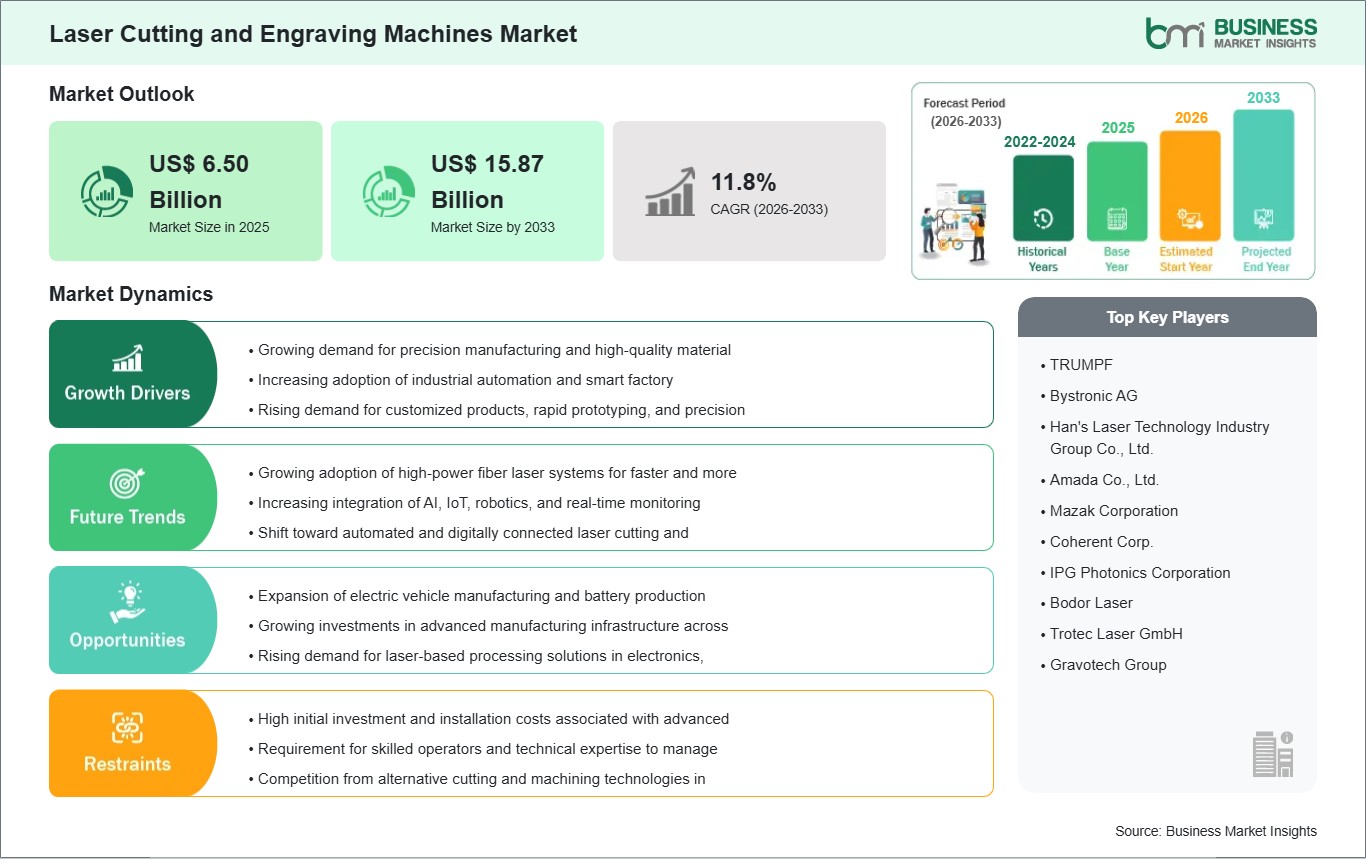
The market is experiencing robust growth driven by increasing demand for precision manufacturing, industrial automation, and customization across multiple end-use industries. Manufacturers are increasingly adopting laser cutting and engraving technologies due to their superior accuracy, high processing speed, minimal material wastage, and ability to handle complex designs with consistent quality. The growing adoption of smart manufacturing practices and Industry 4.0 technologies is further accelerating demand, as laser systems can be seamlessly integrated with automated production lines, robotics, and digital control platforms. Additionally, rising demand for personalized products, rapid prototyping, and advanced fabrication techniques is supporting market expansion worldwide.
However, the market faces several challenges, including the high initial investment costs associated with advanced laser systems and maintenance requirements for sophisticated optical components. Small and medium-sized enterprises may face budget constraints when adopting high-power industrial laser equipment. Furthermore, the need for skilled operators and technical expertise to manage laser processing systems can create operational barriers. Fluctuations in raw material prices, supply chain disruptions, and increasing competition from alternative cutting technologies in certain applications may also impact market growth.
Despite these challenges, the laser cutting and engraving machines market offers substantial long-term growth opportunities driven by continuous technological advancements and expanding industrial applications. Innovations such as high-power fiber lasers, ultrafast laser processing, AI-enabled machine control systems, real-time monitoring solutions, and automated material handling technologies are significantly enhancing productivity, precision, and operational efficiency. Furthermore, increasing investments in advanced manufacturing infrastructure, growing adoption of electric vehicle production, expansion of electronics manufacturing, and rising demand for customized products are expected to create new growth avenues. Collectively, these factors position laser cutting and engraving machines as essential tools in modern manufacturing, precision engineering, and industrial automation ecosystems.
Segment Analysis
Laser Cutting and Engraving Machines Market Segmentation
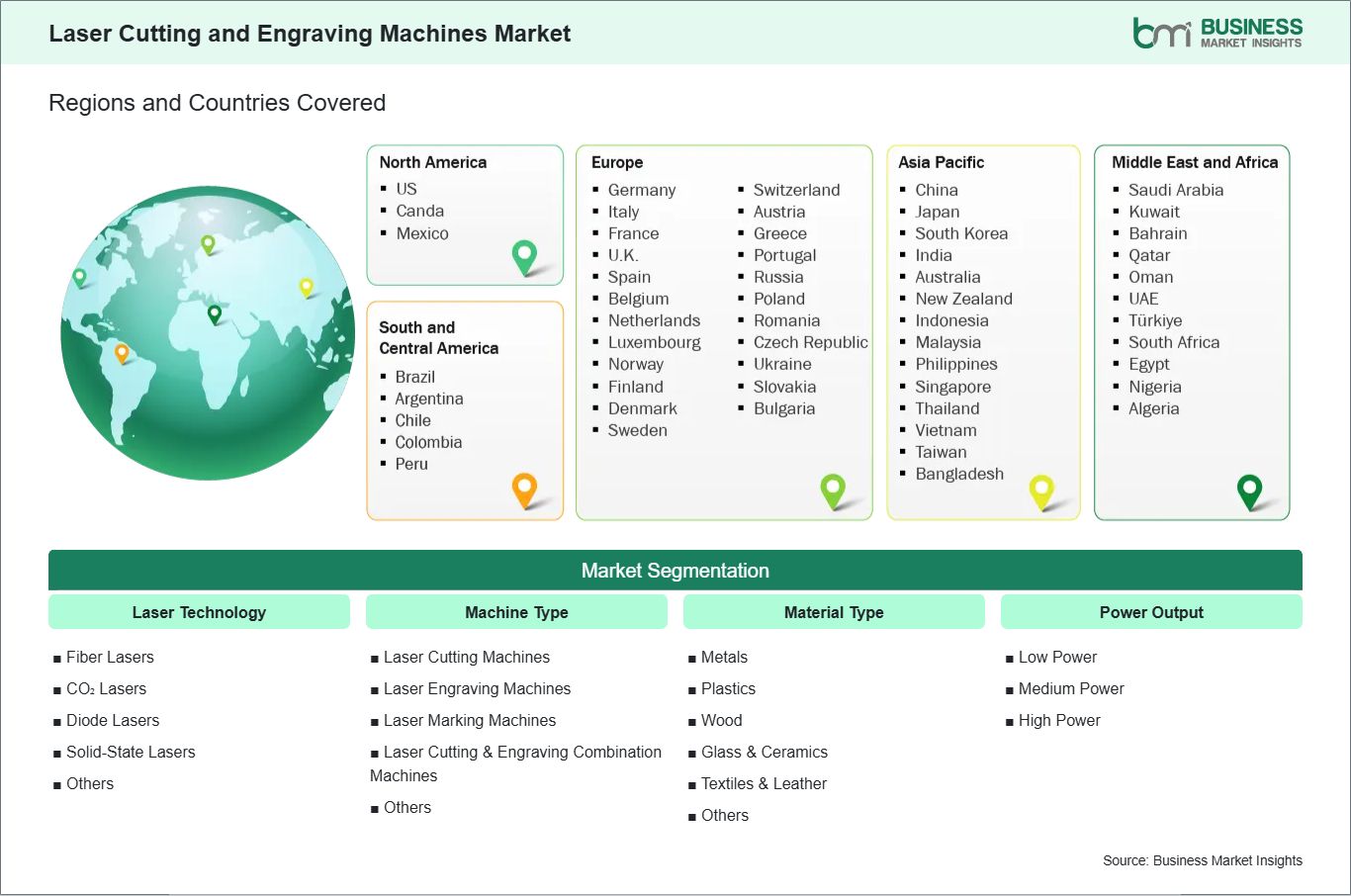
The Laser Cutting and Engraving Machines Market is segmented based on laser technology, machine type, material type, power output, and end user, reflecting the diverse range of laser processing solutions utilized across industrial manufacturing, customization, and precision engineering applications.
By Laser Technology
- Fiber Lasers: High-efficiency laser systems primarily used for precision metal cutting, engraving, and marking applications.
- CO₂ Lasers: Widely adopted for processing non-metallic materials such as wood, acrylic, plastics, leather, textiles, and glass.
- Diode Lasers: Compact and cost-effective laser systems suitable for light industrial engraving and marking applications.
- Solid-State Lasers: Includes Nd:YAG and similar technologies used for high-precision engraving, micro-machining, and specialty manufacturing.
- Others: Includes ultrafast lasers, green lasers, UV lasers, and hybrid laser technologies for advanced processing requirements.
By Machine Type
- Laser Cutting Machines: Dedicated systems designed for precision cutting of metals, plastics, composites, and other industrial materials.
- Laser Engraving Machines: Equipment used for engraving, etching, personalization, and decorative surface processing.
- Laser Marking Machines: Specialized machines for permanent identification, coding, serial numbering, and traceability applications.
- Laser Cutting & Engraving Combination Machines: Multi-functional systems capable of performing both cutting and engraving operations.
- Others: Includes customized and application-specific laser processing equipment.
By Material Type
- Metals: Includes steel, stainless steel, aluminum, copper, brass, titanium, and other industrial alloys.
- Plastics: Used for precision processing of plastic sheets, molded parts, and packaging materials.
- Wood: Includes plywood, MDF, hardwood, and engineered wood products used in furniture and decorative applications.
- Glass & Ceramics: Used for engraving, etching, and decorative processing applications.
- Textiles & Leather: Supports cutting and engraving for apparel, footwear, upholstery, and fashion products.
- Others: Includes rubber, paper, acrylic, composites, and specialty materials.
By Power Output
- Low Power (Up to 100W): Primarily used for engraving, marking, prototyping, and small-scale manufacturing applications.
- Medium Power (100W–500W): Suitable for light industrial cutting and engraving operations across multiple materials.
- High Power (Above 500W): Used for heavy-duty industrial metal cutting, large-scale fabrication, and high-volume production environments.
By End User
- Automotive: Utilized for manufacturing vehicle components, body structures, battery components, and precision parts.
- Aerospace & Defense: Requires high-precision cutting and engraving solutions for aircraft, spacecraft, and defense equipment manufacturing.
- Electronics & Semiconductor: Used for circuit board processing, component marking, micro-machining, and electronics manufacturing.
- Industrial Manufacturing & Metal Fabrication: Supports machinery production, sheet metal processing, tool manufacturing, and general fabrication activities.
- Healthcare & Medical Devices: Utilized for manufacturing and marking surgical instruments, implants, and medical equipment.
- Jewelry & Luxury Goods: Enables intricate engraving, personalization, and precision cutting of precious metals and gemstones.
- Advertising, Signage & Printing: Used for customized signage, promotional displays, branding materials, and decorative products.
- Furniture & Woodworking: Supports precision cutting and engraving of furniture components and decorative wood products.
- Textile & Apparel: Used for fabric cutting, pattern creation, leather processing, and garment manufacturing.
- Others: Includes packaging, education, research institutions, handicrafts, and consumer goods.
Market Forces
Laser Cutting and Engraving Machines Market Drivers and Opportunities
Growing Demand for Precision Manufacturing and Industrial Automation Driving Market Growth
The Laser Cutting and Engraving Machines Market is primarily driven by the increasing demand for precision manufacturing, high-quality product finishing, and industrial automation across various sectors. As manufacturers seek to improve productivity, reduce material wastage, and achieve greater accuracy in production processes, laser cutting and engraving technologies have emerged as preferred solutions due to their ability to deliver precise, repeatable, and high-speed material processing. Compared to conventional cutting methods, laser systems offer superior flexibility, minimal tool wear, and the capability to process complex geometries with exceptional precision.
The growing adoption of Industry 4.0 and smart manufacturing practices is further accelerating market growth. Manufacturers are increasingly integrating laser cutting and engraving systems with robotics, computer numerical control (CNC) platforms, artificial intelligence, and automated production lines to enhance operational efficiency and reduce production costs. Additionally, rising demand for customized products, personalized consumer goods, and rapid prototyping services is encouraging businesses to invest in advanced laser processing technologies. Expanding applications across automotive, aerospace, electronics, medical device manufacturing, and metal fabrication industries continue to strengthen market demand globally.
Technological Advancements, Expanding Industrial Applications, and Smart Manufacturing Creating Strong Growth Opportunities
Opportunities in the Laser Cutting and Engraving Machines Market are expanding significantly due to continuous technological advancements in laser sources, machine intelligence, and automation capabilities. The development of high-power fiber lasers, ultrafast lasers, and energy-efficient laser systems is enabling faster processing speeds, improved cutting quality, and enhanced operational reliability. These innovations are expanding the range of materials and applications that can be efficiently processed using laser technologies.
The rapid growth of electric vehicle manufacturing, electronics production, and advanced industrial fabrication is creating substantial opportunities for laser cutting and engraving equipment suppliers. Laser systems play a critical role in battery component manufacturing, lightweight material processing, semiconductor production, and precision engineering applications, making them increasingly important in next-generation manufacturing environments.
Furthermore, increasing adoption of digital manufacturing technologies is enhancing growth prospects across the market. The integration of IoT-enabled monitoring systems, predictive maintenance solutions, real-time process analytics, cloud-based production management platforms, and AI-driven machine optimization is improving productivity, reducing downtime, and increasing operational visibility. These advancements are enabling manufacturers to achieve higher levels of efficiency and process control.
Size and Share Analysis
Laser Cutting and Engraving Machines Market Size and Share Analysis
The laser cutting and engraving machines marketis projected to grow from US$ 15.87 billion by 2033 from US$ 6.50 billion in 2025. The market is estimated to record a CAGR of 11.8% from 2026 to 2033.
By laser technology, fiber lasers hold the largest market share owing to their superior energy efficiency, high processing speeds, low maintenance requirements, and extensive use in metal cutting and engraving applications. CO₂ lasers also account for a significant share due to their widespread adoption in non-metal material processing, including wood, acrylic, plastics, textiles, and glass. Solid-state lasers maintain a notable presence in precision marking and micro-machining applications, while ultrafast and specialty lasers are witnessing increasing adoption in advanced manufacturing environments requiring exceptional precision and minimal thermal impact.
By machine type, laser cutting machines dominate the market due to strong demand from industrial manufacturing, metal fabrication, and automotive production sectors. Laser engraving machines represent a substantial segment, supported by growing demand for product customization, branding, decorative applications, and personalized consumer products. Laser marking machines continue to gain traction as manufacturers increasingly prioritize product traceability, identification, and compliance requirements. Additionally, combination laser cutting and engraving systems are experiencing steady growth due to their versatility and ability to perform multiple operations within a single platform.
Report Coverage
Laser Cutting and Engraving Machines Market Report Coverage and Deliverables
The "Laser Cutting and Engraving Machines Market Size and Forecast (2022-2033)" report provides a detailed analysis of the market covering below areas:
- Market size and forecast at global, regional, and country levels for all market segments covered under the scope
- Market trends, as well as drivers, restraints, and opportunities
- Market analysis covering key trends, global and regional framework, major players, regulations, and recent developments
- Industry landscape and competition analysis covering market concentration, heat map analysis, prominent players, and recent developments for the market
- Detailed company profiles, including SWOT analysis
Geographic Insights
Laser Cutting and Engraving Machines Market Geographic Insights
The Laser Cutting and Engraving Machines Market demonstrates significant regional variation, influenced by factors such as industrial automation adoption, manufacturing output, technological advancement, investment in smart factories, availability of skilled labor, and demand for precision processing solutions across key end-use industries. Regional growth patterns are closely tied to the development of automotive, aerospace, electronics, healthcare, and industrial manufacturing sectors, which increasingly rely on laser-based processing technologies for high-precision production.
North America holds a significant share of the laser cutting and engraving machines market due to its strong presence in advanced manufacturing, aerospace, automotive, medical device production, and industrial automation. The United States dominates the regional market, supported by high investments in smart manufacturing technologies, widespread adoption of Industry 4.0 practices, and strong demand for precision fabrication solutions. Manufacturers across the region increasingly utilize fiber laser systems, automated laser cutting equipment, and digitally integrated production platforms to enhance efficiency and competitiveness. Canada also contributes steadily through growth in metal fabrication, industrial machinery manufacturing, and customized product production.
Asia Pacific is the fastest-growing regional market, driven by rapid industrialization, expanding manufacturing activities, and increasing investments in automation technologies. China, Japan, India, and South Korea are the primary contributors to regional growth. China dominates the market owing to its extensive manufacturing base, strong electronics and automotive production sectors, and growing adoption of industrial laser technologies. India is witnessing significant growth due to expanding metal fabrication, automotive manufacturing, electronics production, and government initiatives supporting industrial modernization. Japan and South Korea continue to drive innovation in precision manufacturing, semiconductor production, and advanced laser processing applications. The region’s growing focus on export-oriented manufacturing and smart factory implementation is further accelerating market expansion.
Overall, the Laser Cutting and Engraving Machines Market remains globally interconnected, with North America and Europe leading in technological sophistication and automation adoption, Asia Pacific driving the strongest growth momentum through manufacturing expansion, and emerging regions gradually increasing investments in advanced laser processing solutions and industrial modernization initiatives.
Industry Activity
Recent Developments
The laser cutting and engraving machines market is evaluated by gathering qualitative and quantitative data post primary and secondary research, which includes important corporate publications, association data, and databases. Recent developments and news in the market include:
- In May 2026, Monport brings advanced laser machine with the new Mega S and UV Laser Technology in Germany.
- In March 2026, GCC announces the launch of the newest member of the Piolas series — the GCC LaserPro Piolas 280. Building on the exceptional legacy of the Piolas 400, the Piolas 280 combines a more compact footprint with unparalleled operational flexibility, setting a new standard for mid-sized laser engraving machines. This high-end solution delivers space-efficient performance tailored for professional designers and manufacturers alike.
Trust & Transparency
Research Methodology
The market analysis combines proprietary research with secondary data from government agencies, company disclosures, regulatory filings, industry databases and expert interviews. Market estimates are validated through data triangulation, cross-market benchmarking and analyst
review.
View Full Research Methodology
Key Sources Referred:
World Bank - Global Trade IndicatorsWorld Trade Organization (WTO)(International Monetary Fund )IMFInternational Trade Administration (ITA)Company websiteCompany annual reportsCompany investor presentations