
IoT Connected Machines Market Outlook: Size, Share, Trends, Growth Analysis, Competitive Landscape & Forecast, 2026-2033

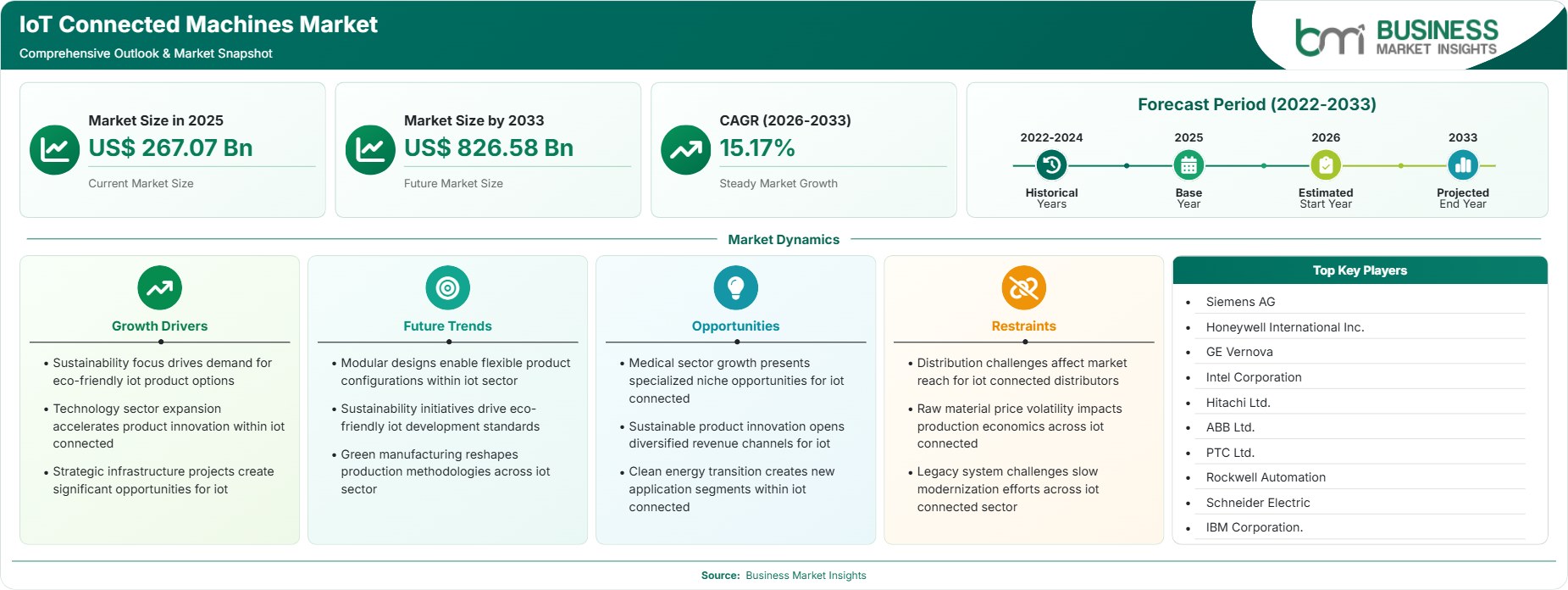
The IoT Connected Machines Market size was valued at US$ 267.07 Billion in 2025 and is projected to reach US$ 826.58 Billion by 2033, growing at a CAGR of 15.17% during 2026–2033. Increasing industrial automation, rising adoption of Industry 4.0 technologies, growing demand for predictive maintenance, expansion of smart manufacturing, and integration of artificial intelligence with industrial Internet of Things (IIoT) platforms are driving market growth. Organizations across manufacturing, automotive, healthcare, energy, logistics, and utilities are increasingly deploying connected machines to improve operational efficiency, reduce downtime, and enable real-time decision-making.

Report Coverage
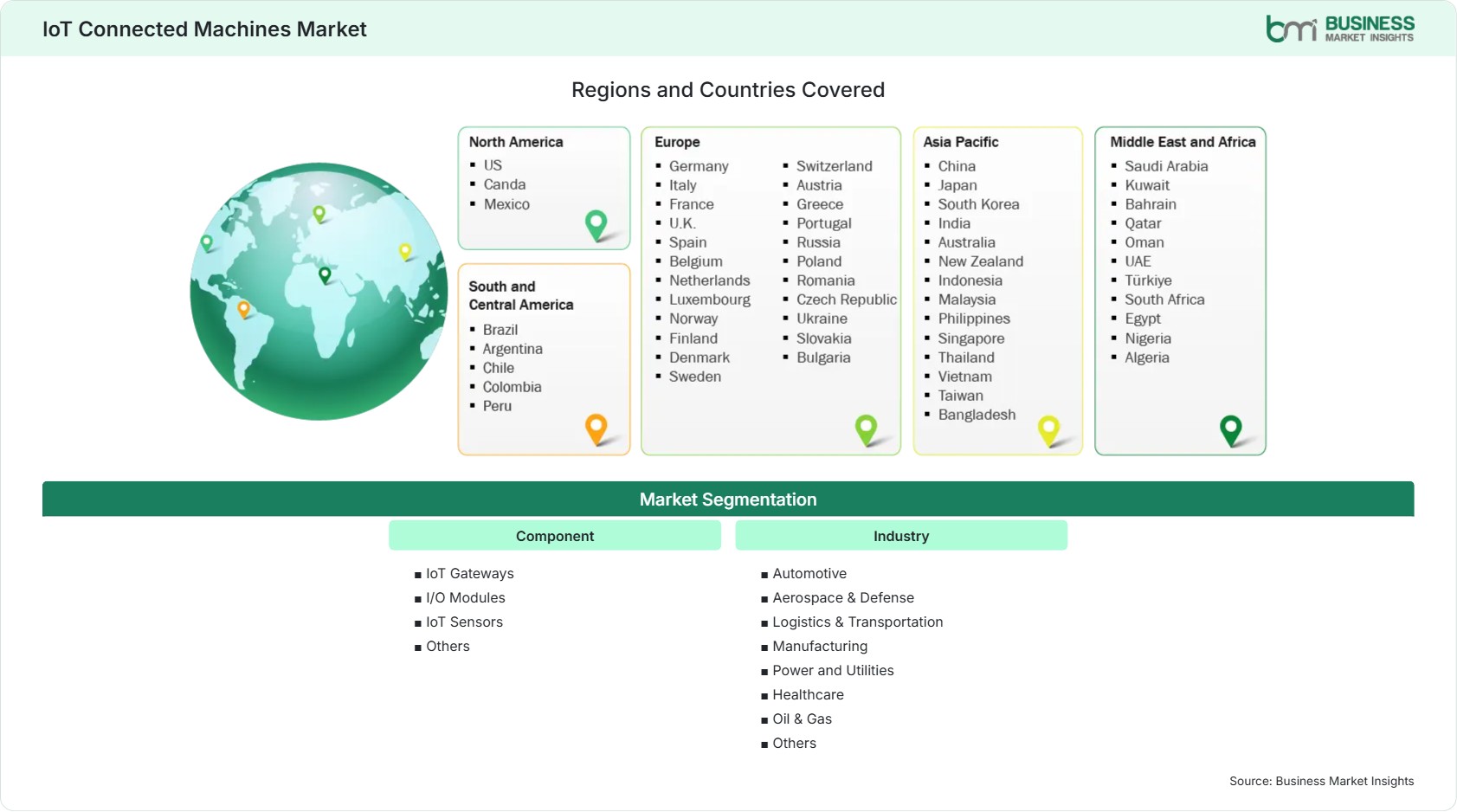
  • Component: IoT Gateways, I/O Modules, IoT Sensors, Others
  • Industry: Automotive, Aerospace & Defense, Logistics & Transportation, Manufacturing, Power and Utilities, Healthcare, Oil & Gas, Others
US$ 267.07 Bn Market size in 2025
US$ 826.58 Bn Market Size by 2033
15.17% CAGR, 2026 - 2033
2026-2033 Forecast Period

AI Overview

IoT Connected Machines Market Summary

  • North America Region: North America holds 32%–35% market share in 2025 and is projected to grow at a CAGR of 14.6%–15.2% during 2026–2033. Strong adoption of industrial automation, advanced manufacturing infrastructure, widespread cloud computing integration, and increasing investments in smart factory technologies continue supporting regional leadership. The United States remains the dominant contributor due to strong industrial digitization initiatives, advanced IoT ecosystems, and presence of leading technology providers.
  • Fastest Growing Region: Asia Pacific accounts for 28%–31% market share in 2025 and is expected to expand at a CAGR of 16.2%–16.9%. Rapid industrialization, expanding manufacturing capabilities, government-backed digital transformation programs, and increasing adoption of automation technologies are accelerating regional growth.
  • Leading Segment: IoT Sensors represent 38%–42% market share in 2025 and are projected to grow at a CAGR of 15.5%–16.2%. Increasing demand for real-time monitoring, machine performance tracking, and predictive maintenance solutions continues driving sensor adoption across industries.
  • High Growth Segment: Manufacturing Industry accounts for 24%–28% market share in 2025 and is forecast to register a CAGR of 15.8%–16.5%. Rising Industry 4.0 adoption, smart factory development, automation investments, and demand for operational optimization are accelerating connected machine deployment.
  • Key Market Opportunity: Artificial intelligence-powered predictive maintenance, digital twins, autonomous industrial systems, edge computing integration, smart factories, and connected infrastructure development present significant growth opportunities for market participants.
  • Major Market Players: Siemens AG, Honeywell International Inc., General Electric Company, Intel Corporation, Hitachi Ltd., ABB Ltd., PTC Ltd., Rockwell Automation, Schneider Electric, and IBM Corporation.
Strategic Insights

IoT Connected Machines Market: Strategic Insights

IoT Connected Machines Market Strategic Framework
FREE PDF
Request your free sample
Request free sample
Stakeholder View

Key Takeaways

  • The market ecosystem includes IoT hardware manufacturers, sensor providers, industrial automation companies, cloud service providers, software developers, system integrators, and end-user industries working together to develop connected industrial solutions.
  • IoT sensors represent the core technology segment due to their ability to collect operational data, monitor machine conditions, and support predictive maintenance applications across multiple industries.
  • Manufacturing remains the leading adoption area as industries increasingly implement smart factories, robotics, automated production lines, and digital monitoring systems to improve efficiency.
  • Asia Pacific represents a major growth opportunity due to expanding industrial production, government-supported digitalization programs, and increasing investments in automation infrastructure.
  • Artificial intelligence, machine learning, edge computing, and digital twin technologies are transforming connected machine capabilities by enabling advanced analytics and autonomous operational decisions.
  • Strategic partnerships between industrial automation companies and technology providers are accelerating innovation, improving interoperability, and expanding IoT-connected machine applications across global industries.
  • Companies investing in cybersecurity, scalable IoT platforms, advanced analytics, and energy-efficient connected solutions are expected to strengthen their competitive position in the evolving industrial technology landscape.
Geographic Outlook

IoT Connected Machines Market Regional Highlights

North America IoT Connected Machines Market

North America accounts for 32%–35% of the IoT Connected Machines Market share in 2025 and is projected to grow at a CAGR of 14.6%–15.2% through 2033. The region maintains a strong position due to early adoption of industrial automation, advanced manufacturing infrastructure, widespread cloud technology deployment, and strong presence of leading IoT solution providers. The increasing implementation of smart factories, predictive maintenance systems, and connected industrial assets continues accelerating market expansion across manufacturing, energy, healthcare, and transportation sectors.

  • The United States dominates regional demand due to advanced industrial digitization initiatives, strong technology ecosystems, and high adoption of Industry 4.0 solutions.
  • Manufacturing companies are increasingly deploying connected machines to improve production efficiency, reduce operational costs, and enhance asset management.
  • Cloud computing, edge analytics, and artificial intelligence integration are strengthening industrial IoT capabilities across enterprises.
  • Strong cybersecurity investments are supporting secure deployment of connected industrial systems.

US IoT Connected Machines Market

The United States contributes 85%–89% of the North American IoT Connected Machines Market and is forecast to register a CAGR of 14.8%–15.4% during 2026–2033. The country benefits from strong industrial automation adoption, advanced manufacturing capabilities, and significant investments in digital transformation. Leading technology companies, industrial automation providers, and manufacturers are accelerating the deployment of connected machine solutions across multiple industries.

  • Automotive and aerospace manufacturers are increasing adoption of IoT-enabled production systems to improve operational efficiency.
  • Industrial enterprises are investing in predictive maintenance technologies to minimize equipment downtime.
  • Government initiatives supporting advanced manufacturing and digital infrastructure are strengthening market growth.
  • Growing adoption of artificial intelligence and edge computing is improving real-time industrial decision-making.

Europe IoT Connected Machines Market

Europe holds 25%–28% IoT Connected Machines Market share in 2025 and is projected to expand at a CAGR of 14.9%–15.5% through 2033. The region benefits from strong industrial automation capabilities, advanced manufacturing ecosystems, and increasing adoption of smart factory technologies. Germany remains the leading market due to its strong industrial base, while countries such as France, the United Kingdom, and Italy continue expanding connected machine adoption.

  • Germany leads regional adoption through advanced manufacturing facilities and strong Industry 4.0 implementation.
  • European automotive manufacturers are investing heavily in connected production systems and automated manufacturing processes.
  • Government sustainability initiatives encourage energy-efficient industrial technologies and intelligent asset monitoring.
  • Increasing adoption of industrial analytics platforms supports operational optimization across enterprises.
  • Industrial cybersecurity investments are rising due to growing connectivity between machines and digital platforms.

Asia Pacific IoT Connected Machines Market

Asia Pacific represents 28%–31% IoT Connected Machines Market share in 2025 and is expected to record the fastest CAGR of 16.2%–16.9% during 2026–2033. Rapid industrialization, expanding manufacturing activities, increasing automation investments, and government-supported digital transformation programs are driving regional growth. China, Japan, South Korea, and India are emerging as major markets due to growing adoption of smart manufacturing and connected industrial infrastructure.

  • China dominates regional demand through large-scale manufacturing operations and government-backed industrial digitalization initiatives.
  • Japan continues advancing smart factories through robotics integration, automation technologies, and intelligent manufacturing systems.
  • South Korea invests in advanced semiconductor, electronics, and automotive manufacturing automation.
  • India experiences increasing adoption through industrial modernization programs and expanding manufacturing capabilities.
  • Southeast Asian countries are adopting connected machine technologies through foreign investments and industrial expansion.

Rest of World IoT Connected Machines Market

The Rest of World region accounts for 10%–13% market share in 2025 and is anticipated to grow at a CAGR of 15.2%–15.8% through 2033. Growth across Latin America, the Middle East, and Africa is supported by industrial modernization, infrastructure development, and increasing adoption of automation technologies. Organizations are investing in connected equipment to improve productivity, optimize resources, and enhance operational visibility.

  • Brazil leads Latin American adoption through industrial automation investments and manufacturing modernization.
  • Mexico experiences growth due to expanding automotive production and industrial connectivity initiatives.
  • Middle Eastern countries are adopting IoT-connected systems across energy, utilities, and infrastructure projects.
  • South Africa continues investing in industrial technology modernization and smart infrastructure development.
  • Increasing foreign investments in emerging economies are supporting deployment of advanced industrial IoT solutions.
Global Market Geography
FREE PDF
Request your free sample
Request free sample
Segment Analysis

IoT Connected Machines Market Segmentation

Component

The Component segment accounted for 38%–42% market share in 2025 and is projected to register a CAGR of 15.5%–16.2% through 2033. The IoT Connected Machines Market scope continues expanding as industries increasingly require real-time machine monitoring, operational analytics, and automated maintenance solutions.

  • IoT Sensors: Lead market adoption due to their critical role in collecting machine performance data, monitoring operational conditions, and enabling predictive maintenance. Sensors measure parameters such as temperature, vibration, pressure, and equipment performance.
  • IoT Gateways: Support secure communication between industrial machines, sensors, and cloud platforms by enabling data aggregation, protocol conversion, and edge processing.
  • I/O Modules: Enable efficient data exchange between industrial equipment and automation systems, improving connectivity and machine control capabilities.
  • Others: Include communication modules, industrial controllers, software platforms, and supporting hardware components that enhance connected machine functionality.

Industry

The Industry segment continues expanding as businesses across multiple sectors adopt connected machines to improve productivity, operational efficiency, and asset management.

  • Manufacturing: Represents the leading industry segment due to widespread adoption of smart factories, robotics, automation systems, and predictive maintenance solutions.
  • Automotive: Increasingly deploys connected machines for automated production lines, quality monitoring, and efficient supply chain operations.
  • Aerospace & Defense: Uses connected equipment for precision manufacturing, asset monitoring, and operational reliability improvement.
  • Logistics & Transportation: Adopts IoT-connected machines for fleet management, warehouse automation, and equipment tracking.
  • Power and Utilities: Implements connected systems for infrastructure monitoring, energy optimization, and predictive maintenance.
  • Healthcare: Utilizes connected machines for medical equipment monitoring, operational efficiency, and improved patient care services.
  • Oil & Gas: Deploys connected technologies for remote monitoring, equipment safety, and operational optimization in challenging environments.
  • Others: Includes agriculture, construction, mining, and commercial industries adopting connected machine solutions for improved efficiency and automation.
Market Forces

IoT Connected Machines Market Dynamics

Key Market Drivers

Increasing Adoption of Industry 4.0 and Smart Manufacturing Technologies

The rapid transition toward Industry 4.0 is one of the major factors driving the adoption of connected machine technologies worldwide. Manufacturing organizations are increasingly integrating IoT sensors, automation platforms, artificial intelligence, and cloud-based analytics to create intelligent production environments. IoT Connected Machines Market growth is supported by the need for improved operational efficiency, real-time visibility, reduced production errors, and optimized resource utilization. Smart factories enable manufacturers to monitor equipment performance continuously, automate workflows, and make data-driven decisions. The growing emphasis on digital transformation across industrial sectors is accelerating investments in connected machinery solutions.

Rising Demand for Predictive Maintenance Solutions

Organizations are increasingly adopting IoT-connected machines to shift from traditional reactive maintenance approaches toward predictive maintenance strategies. Connected sensors continuously collect machine performance data, enabling companies to identify potential equipment failures before breakdowns occur. This helps reduce downtime, lower maintenance costs, and improve asset lifecycle management. Advanced analytics, artificial intelligence, and machine learning algorithms are enhancing predictive capabilities by identifying operational patterns and generating maintenance recommendations. Industries such as manufacturing, energy, transportation, and oil & gas are increasingly deploying connected machine solutions to improve reliability and operational continuity.

Growth of Industrial Automation and Real-Time Data Analytics

Increasing industrial automation is creating strong demand for IoT-enabled machines capable of collecting, processing, and analyzing operational data in real time. Businesses are adopting connected systems to enhance productivity, improve quality control, and optimize manufacturing processes. Integration of edge computing allows faster data processing closer to machines, reducing latency and enabling immediate operational responses. Real-time analytics provide valuable insights into production performance, energy consumption, and equipment efficiency. The combination of automation, connectivity, and analytics is transforming industrial operations and strengthening adoption across multiple sectors.

Key Market Opportunities

Integration of Artificial Intelligence and Digital Twin Technologies

The integration of artificial intelligence, machine learning, and digital twin technologies presents significant growth opportunities for connected machine providers. Digital twins create virtual representations of physical machines, allowing organizations to simulate performance, predict failures, and optimize operations. IoT Connected Machines Market Forecasts indicate increasing demand for AI-powered industrial platforms that provide advanced analytics and autonomous decision-making capabilities. Companies investing in intelligent automation solutions can help industries achieve higher productivity, improved equipment performance, and enhanced operational flexibility.

Expansion of Edge Computing-Based Industrial IoT Solutions

The growing need for faster data processing and reduced network dependency is increasing adoption of edge computing within connected machine ecosystems. Edge-enabled IoT solutions allow industrial organizations to process critical machine data closer to the source, improving response times and operational efficiency. These systems are particularly valuable in manufacturing plants, energy facilities, and remote industrial locations where real-time decision-making is essential. The combination of edge computing, industrial gateways, and advanced analytics creates new opportunities for scalable and reliable connected machine deployments.

Growing Adoption Across Emerging Industrial Markets

Emerging economies are creating substantial opportunities for connected machine technology providers due to rapid industrialization, expanding manufacturing sectors, and increasing automation investments. Countries across the Asia Pacific, Latin America, and the Middle East are modernizing industrial infrastructure and adopting smart manufacturing solutions to improve competitiveness. Current IoT Connected Machines Market Trends highlights that Government initiatives supporting digital transformation and industrial automation are encouraging enterprises to invest in IoT-enabled equipment. Companies expanding regional partnerships, localized solutions, and affordable connected machine platforms can capture significant growth opportunities in developing markets.

Market Restraints and Challenges

High Implementation Costs and Infrastructure Requirements

Factor: Deployment of IoT-connected machines requires significant investments in sensors, communication infrastructure, software platforms, cybersecurity systems, and skilled technical resources.

Impact: High initial costs may limit adoption among small and medium-sized enterprises with limited technology budgets. Organizations may face challenges related to system integration, upgrading legacy equipment, and managing complex connected ecosystems. The requirement for specialized expertise can further slow implementation. Companies must develop cost-effective solutions, flexible deployment models, and scalable platforms to improve accessibility and encourage broader adoption across different industrial segments.

Cybersecurity and Data Privacy Concerns

Factor: Increasing connectivity between industrial machines, cloud platforms, and enterprise networks creates potential cybersecurity vulnerabilities and data protection challenges.

Impact: Cyberattacks targeting connected industrial systems can disrupt operations, compromise sensitive information, and create significant financial losses. Organizations require advanced security frameworks, encryption technologies, authentication systems, and continuous monitoring solutions to protect connected machine environments. Growing cybersecurity concerns may influence adoption decisions, particularly among critical infrastructure industries such as power utilities, healthcare, aerospace, and defense. Addressing security risks remains essential for ensuring trust and long-term adoption of IoT-connected machine technologies.

Company Analysis

Competitive Landscape

The global IoT connected machines industry is highly competitive, with major technology and industrial automation companies focusing on smart manufacturing solutions, industrial connectivity platforms, artificial intelligence integration, and edge computing capabilities. IoT Connected Machines Market analysis indicates that leading players are investing in advanced sensors, industrial IoT gateways, cloud-based platforms, predictive analytics, and cybersecurity solutions to improve machine intelligence and support digital transformation across industries.

Company Name

Overview

Products and Services Relevant to this Market

Siemens AG

Global industrial technology company providing automation, digitalization, and industrial IoT solutions for manufacturing and infrastructure sectors worldwide.

Industrial IoT platforms, smart factory solutions, connected machines, automation systems, industrial sensors, digital twins, and analytics software.

Honeywell International Inc.

Diversified technology company delivering industrial automation, control systems, and connected solutions across manufacturing, energy, and aerospace industries.

Industrial IoT solutions, connected sensors, automation platforms, predictive maintenance systems, process control technologies, and analytics solutions.

General Electric Company

Global industrial technology provider specializing in digital industrial solutions, automation technologies, and connected asset management systems.

Industrial IoT platforms, machine monitoring solutions, digital twins, predictive analytics, connected equipment solutions, and industrial software.

Intel Corporation

Semiconductor and computing technology company enabling industrial IoT through processors, edge computing solutions, and connectivity technologies.

IoT processors, edge computing platforms, industrial gateways, AI hardware, connectivity solutions, and embedded technologies.

Hitachi Ltd.

Japanese technology company offering digital transformation solutions combining industrial expertise, IoT platforms, and data analytics capabilities.

Industrial IoT systems, connected infrastructure solutions, digital platforms, predictive maintenance technologies, and industrial analytics.

ABB Ltd.

Global automation and electrification company providing intelligent industrial solutions for manufacturing, utilities, and infrastructure applications.

Industrial sensors, automation systems, IoT platforms, connected equipment solutions, robotics, energy management, and analytics technologies.

PTC Ltd.

Technology company specializing in industrial software platforms that enable IoT connectivity, analytics, and digital transformation.

Industrial IoT platforms, asset monitoring software, augmented reality solutions, digital twins, and connected machine management tools.

Rockwell Automation

Industrial automation company providing smart manufacturing technologies, control systems, and connected industrial solutions.

Industrial automation systems, IoT platforms, connected machine solutions, sensors, analytics software, and manufacturing intelligence technologies.

Schneider Electric

Energy management and industrial automation company focused on digital transformation and connected infrastructure solutions.

Industrial IoT platforms, smart factory solutions, automation systems, connected devices, energy monitoring, and operational analytics.

IBM Corporation

Technology company delivering cloud computing, artificial intelligence, and industrial IoT solutions for enterprise digital transformation.

Industrial IoT platforms, AI analytics, cloud solutions, predictive maintenance tools, asset management software, and connected enterprise solutions.

Trust & Transparency

Research Methodology

The market analysis combines proprietary research with secondary data from government agencies, company disclosures, regulatory filings, industry databases and expert interviews. Market estimates are validated through data triangulation, cross-market benchmarking and analyst review.

View Full Research Methodology

Questions Answered

Frequently Asked Questions

How does this IoT Connected Machines Market Report support business decisions?

The report provides detailed insights into market size, growth trends, technological advancements, competitive strategies, regional opportunities, and investment areas to support strategic planning and decision-making.

Which region offers the strongest growth opportunities?

Asia Pacific presents significant growth opportunities due to rapid industrialization, expanding manufacturing activities, government-backed digital transformation initiatives, and increasing automation investments.

Why is manufacturing the largest industry segment?

Manufacturing leads adoption due to increasing smart factory investments, automation requirements, production optimization needs, and growing demand for connected industrial equipment.

Which component segment dominates the market?

IoT Sensors represent the leading component segment due to their critical role in collecting machine performance data, enabling predictive maintenance, and supporting real-time industrial monitoring.

What factors are driving the IoT Connected Machines Market growth?

Increasing Industry 4.0 adoption, industrial automation expansion, predictive maintenance demand, smart factory development, artificial intelligence integration, and real-time machine monitoring requirements are driving market growth.

Access the Full IoT Connected Machines Market Report

Get segment-level forecasts, regional estimates, competitive benchmarking, company profiles and downloadable Excel datasets.

Access the full IoT Connected Machines Market Report
350 pages PDF & Excel | 2026-08-31
Similar Research

Related Market Reports