
IoT Chipset Market Outlook: Size, Share, Trends, Growth Analysis, Competitive Landscape & Forecast, 2026-2033

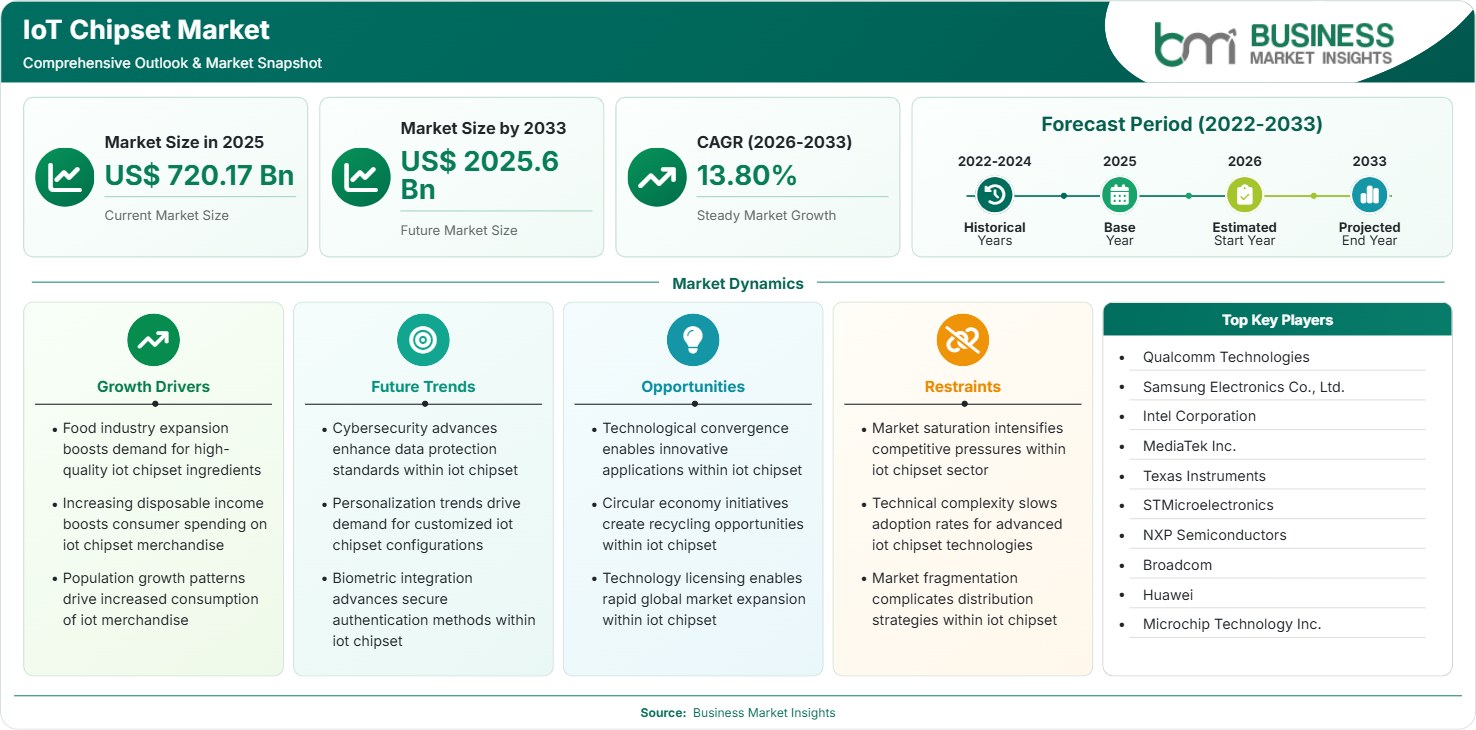
The IoT Chipset Market size was valued at US$ 720.17 Billion in 2025 and is projected to reach US$ 2025.6 Billion by 2033, growing at a CAGR of 13.80% during 2026–2033. Rising adoption of connected devices, expanding industrial automation, rapid deployment of 5G-enabled IoT infrastructure, increasing AI integration at the edge, and growing investments in smart healthcare, automotive, and smart city initiatives continue to create strong opportunities for chipset manufacturers worldwide.

Report Coverage
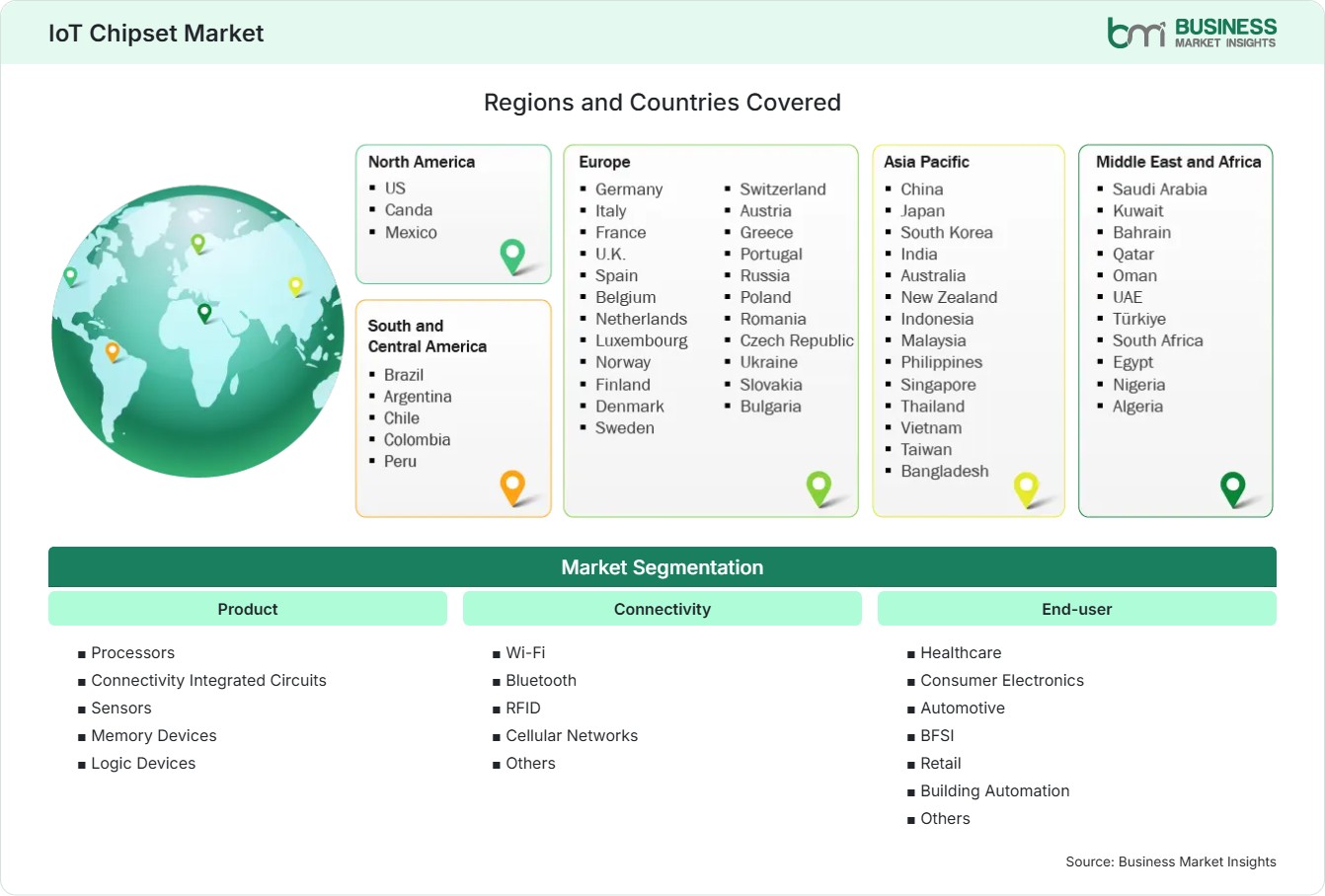
  • Product: Processors, Connectivity Integrated Circuits, Sensors, Memory Devices, Logic Devices
  • Connectivity: Wi-Fi, Bluetooth, RFID, Cellular Networks, Others
  • End-user: Healthcare, Consumer Electronics, Automotive, BFSI, Retail, Building Automation, Others
US$ 720.17 Bn Market size in 2025
US$ 2025.6 Bn Market Size by 2033
13.80% CAGR, 2026 - 2033
2026-2033 Forecast Period

AI Overview

IoT Chipset Market Summary

  • North America Region: North America holds a market share of 34%–37% in 2025, growing with a CAGR of 12.8%–13.5% during 2026–2033. Strong semiconductor innovation, industrial digitalization, expanding edge AI deployments, increasing smart manufacturing investments, and favorable government funding accelerate demand across enterprise, automotive, healthcare, telecommunications, and defense applications throughout the regional ecosystem.
  • U.S. Market: The United States dominates regional demand through advanced semiconductor manufacturing, hyperscale cloud investments, and AI-driven IoT adoption, expanding at a CAGR of 13.0%–13.7%.
  • Fastest Growing Region: Asia Pacific accounts for 29%–32% market share in 2025 and is projected to grow at a CAGR of 15.3%–16.1% during 2026–2033. Rapid industrial automation, smart city investments, electronics manufacturing expansion, affordable connectivity, government digital initiatives, and increasing deployment of intelligent consumer devices strengthen long-term regional demand.
  • Leading Segment: Processors account for 30%–33% of revenue in 2025 and are expected to register a CAGR of 13.4%–14.0% through 2026–2033. Increasing edge computing workloads, AI-enabled processing, industrial automation, connected vehicles, and intelligent consumer electronics continue driving sustained processor integration across diverse IoT ecosystems globally.
  • High Growth Segment: Healthcare represents 15%–18% market share in 2025 while advancing at a CAGR of 15.8%–16.6% during 2026–2033. Remote patient monitoring, wearable medical devices, connected diagnostics, AI-assisted healthcare infrastructure, hospital digital transformation, and expanding telemedicine services accelerate semiconductor deployment across healthcare environments.
  • Key Market Opportunity: AI-enabled edge computing combined with ultra-low-power semiconductor architectures enables intelligent real-time analytics, reducing latency while supporting autonomous industrial equipment, connected healthcare, smart transportation, environmental monitoring, and next-generation smart infrastructure deployments worldwide.
  • Major Market Players: Qualcomm Technologies, Inc.; Samsung Electronics Co., Ltd.; Intel Corporation; MediaTek Inc.; Texas Instruments Incorporated; STMicroelectronics N.V.; NXP Semiconductors N.V.; Broadcom Inc.; Huawei Technologies Co., Ltd.; Microchip Technology Incorporated.
Strategic Insights

IoT Chipset Market: Strategic Insights

IoT Chipset Market Strategic Framework
FREE PDF
Request your free sample
Request free sample
Stakeholder View

Key Takeaways

  • Semiconductor value chains are becoming increasingly integrated as chipset manufacturers collaborate with cloud providers, telecom operators, embedded software developers, and original equipment manufacturers to deliver complete IoT hardware platforms rather than standalone semiconductor products.
  • Healthcare, industrial automation, and connected mobility represent the strongest long-term commercial opportunities because these sectors increasingly require intelligent edge computing, secure connectivity, predictive analytics, and energy-efficient semiconductor solutions supporting mission-critical operations.
  • Artificial intelligence integration within embedded processors is shifting competitive differentiation from hardware performance alone toward intelligent workload optimization, autonomous decision-making capabilities, enhanced cybersecurity, and lower power consumption across connected devices.
  • Asia Pacific offers one of the strongest investment environments owing to expanding semiconductor manufacturing capacity, electronics exports, government-backed digital infrastructure initiatives, and rapidly increasing enterprise adoption of industrial IoT technologies.
  • Strategic acquisitions, long-term foundry partnerships, intellectual property licensing, and collaborative research initiatives are becoming preferred growth strategies as semiconductor companies strengthen product portfolios and accelerate innovation in wireless connectivity, AI processing, and secure embedded computing.
  • Future competitiveness will increasingly depend on developing scalable chip architectures supporting multiple wireless standards, embedded AI, secure edge computing, and efficient power management to address evolving enterprise and consumer IoT requirements.
Geographic Outlook

IoT Chipset Market Regional Highlights

North America IoT Chipset Market

North America accounts for 34%–37% of global revenue in 2025 and is projected to expand at a CAGR of 12.8%–13.5% through 2033. The region maintains leadership due to strong semiconductor R&D capabilities, widespread deployment of private 5G networks, growing industrial automation, and increasing adoption of AI-enabled edge devices. The IoT Chipset Market share remains the highest globally as enterprises continue digital transformation initiatives across manufacturing, healthcare, transportation, and utilities. Government investments in semiconductor manufacturing and secure supply chains further reinforce regional competitiveness.

  • Major semiconductor manufacturers continue expanding advanced chipset development for AI-powered industrial automation, enabling intelligent edge processing, predictive maintenance, lower latency, and secure connectivity across manufacturing plants, logistics operations, and critical infrastructure.
  • Rapid deployment of smart healthcare infrastructure supports demand for processors, wireless communication ICs, and low-power semiconductor platforms capable of supporting remote diagnostics, wearable devices, connected hospitals, and real-time patient monitoring.
  • Increasing investment in connected transportation and autonomous mobility accelerates integration of advanced processors, embedded security modules, and high-performance connectivity solutions across passenger vehicles, commercial fleets, and intelligent traffic management systems.
  • Cloud providers and telecom operators increasingly collaborate with semiconductor vendors to optimize edge computing platforms, creating strong commercial opportunities for integrated chipsets supporting enterprise IoT deployments and industrial digital transformation.
  • Government incentives promoting domestic semiconductor production improve manufacturing resilience, encourage advanced packaging technologies, and strengthen long-term innovation across the regional semiconductor ecosystem.

US IoT Chipset Market

The United States contributes approximately 72%–75% of North American IoT Chipset Market revenue in 2025 while advancing at a CAGR of 13.0%–13.7% during 2026–2033. The country benefits from advanced semiconductor research, strong venture capital funding, AI innovation, and rapid enterprise digitalization. Demand continues expanding across smart factories, connected healthcare systems, autonomous mobility, aerospace, and cloud computing infrastructure, supported by investments in semiconductor manufacturing and national technology initiatives.

  • Federal initiatives supporting domestic semiconductor manufacturing strengthen supply chain resilience while encouraging innovation in AI processors, embedded security technologies, advanced packaging, and energy-efficient semiconductor architectures.
  • Hyperscale cloud providers continue deploying edge computing infrastructure requiring highly integrated chipsets capable of supporting low-latency processing, secure communication, and scalable industrial IoT applications.
  • Automotive manufacturers accelerate adoption of connected vehicle platforms, increasing demand for processors, connectivity ICs, and embedded controllers supporting autonomous driving and vehicle-to-everything communication technologies.
  • Expanding healthcare digitization drives adoption of connected medical devices requiring secure, low-power semiconductor solutions supporting remote diagnostics, wearable monitoring systems, and intelligent clinical equipment.

Europe IoT Chipset Market

Europe represents 24%–27% of global IoT Chipset Market revenue in 2025 and is forecast to register a CAGR of 12.5%–13.2% through 2033. The region benefits from industrial automation leadership, automotive innovation, and strong regulatory frameworks supporting digital infrastructure and cybersecurity. Germany leads regional adoption through advanced manufacturing investments, while Eastern European economies demonstrate faster expansion with CAGR ranging between 13.8%–14.5% as electronics manufacturing and industrial digitalization continue accelerating.

  • Automotive manufacturers increasingly integrate intelligent semiconductor platforms supporting connected vehicles, predictive diagnostics, electrification, and advanced driver assistance systems across European production facilities.
  • Industry 4.0 initiatives encourage deployment of AI-enabled industrial sensors, processors, and connectivity solutions improving manufacturing productivity, predictive maintenance, and factory automation efficiency.
  • Government-backed digital transformation programs encourage secure IoT infrastructure deployment across utilities, transportation networks, healthcare systems, and smart public infrastructure throughout European economies.
  • Sustainability objectives accelerate demand for energy-efficient semiconductor technologies supporting intelligent energy management, renewable power integration, and connected environmental monitoring systems.
  • Research partnerships between semiconductor firms, universities, and industrial organizations strengthen innovation in embedded AI, advanced wireless communication technologies, and secure IoT architectures.

Asia Pacific IoT Chipset Market

Asia Pacific holds 29%–32% of worldwide revenue in 2025 and is anticipated to expand at the fastest CAGR of 15.3%–16.1% during the forecast period. China remains the largest regional contributor owing to extensive electronics manufacturing, while India and Southeast Asian countries emerge as the fastest-growing IoT Chipset Markets with CAGR between 16.2%–17.0%. Rising digitalization, government smart city programs, expanding consumer electronics production, and increasing industrial automation continue strengthening regional semiconductor demand.

  • Electronics manufacturing expansion increases consumption of processors, memory devices, sensors, and wireless communication integrated circuits across consumer electronics, industrial equipment, and connected appliances.
  • Government initiatives supporting digital infrastructure, 5G deployment, and semiconductor manufacturing create favorable investment conditions for domestic and international technology companies.
  • Rapid urbanization drives deployment of intelligent transportation systems, connected buildings, and smart utility infrastructure requiring advanced semiconductor platforms with integrated AI capabilities.
  • Manufacturing industries increasingly adopt industrial IoT solutions supporting predictive maintenance, automated quality inspection, and real-time production monitoring through intelligent edge computing.
  • Expanding startup ecosystems accelerate innovation in embedded AI, wireless communication modules, and cost-efficient semiconductor technologies tailored for regional IoT applications.

Rest of World IoT Chipset Market

The Rest of the World accounts for 10%–13% of global IoT Chipset Market revenue in 2025 and is expected to record a CAGR of 13.6%–14.3% through 2033. South & Central America witness growing investments in industrial connectivity and precision agriculture, while the Middle East & Africa benefit from smart city development, energy infrastructure modernization, and expanding digital transformation initiatives. Brazil leads South & Central America, whereas the UAE and Saudi Arabia demonstrate the strongest regional growth supported by national digital economy strategies.

  • Smart city projects across Gulf economies accelerate deployment of connected infrastructure requiring secure wireless chipsets, embedded processors, and intelligent sensing technologies supporting transportation, utilities, and public safety.
  • Precision agriculture applications increase semiconductor demand across South America through connected irrigation systems, environmental monitoring platforms, autonomous farming equipment, and livestock management technologies.
  • Oil and gas operators increasingly implement industrial IoT solutions requiring rugged semiconductor platforms capable of supporting predictive maintenance, remote asset monitoring, and operational efficiency improvements.
  • Telecommunications investments strengthen IoT connectivity infrastructure, enabling wider adoption of connected enterprise applications across logistics, healthcare, manufacturing, and public services.
  • Government digital transformation initiatives improve long-term investment opportunities by encouraging technology innovation, semiconductor adoption, and expansion of connected infrastructure throughout emerging economies.
Global Market Geography
FREE PDF
Request your free sample
Request free sample
Segment Analysis

IoT Chipset Market Segmentation

Product

The Product segment accounted for approximately 100% of the market by definition, with Processors emerging as the largest revenue contributor, holding 30%–33% share in 2025 and registering a CAGR of 13.4%–14.0% through 2033. The IoT Chipset Market scope continues expanding as manufacturers integrate AI acceleration, enhanced security, and low-power architectures into advanced semiconductor platforms supporting industrial automation, healthcare, automotive, and consumer electronics applications.

  • Processors: Widely adopted for edge computing, artificial intelligence inference, industrial automation, and connected consumer devices. Continuous performance improvements and energy-efficient architectures strengthen adoption across intelligent IoT deployments worldwide.
  • Connectivity Integrated Circuits: Enable seamless communication through multiple wireless standards while supporting secure data transmission, reduced latency, and reliable connectivity for smart homes, industrial systems, healthcare equipment, and connected infrastructure.
  • Sensors: Increasing deployment across environmental monitoring, predictive maintenance, smart factories, and wearable technologies drives sustained demand for compact, energy-efficient sensing solutions capable of delivering accurate real-time operational data.
  • Memory Devices: Essential for storing application code, firmware updates, and operational data while supporting higher processing efficiency, improved reliability, and faster response times in connected embedded systems.
  • Logic Devices: Provide programmable computing capabilities supporting customized industrial automation, networking equipment, automotive electronics, and intelligent edge devices requiring flexible hardware acceleration and optimized system performance.

Connectivity

Connectivity technologies remain fundamental to intelligent device communication, with Wi-Fi maintaining the largest adoption across enterprise and consumer applications. The segment benefits from increasing deployment of 5G infrastructure, edge computing, industrial automation, and secure wireless communication, supporting a IoT Chipset Market share exceeding 27%–30% for Wi-Fi in 2025 while the overall connectivity segment continues expanding at 13.9%–14.6% CAGR through 2033.

  • Wi-Fi: Dominates residential, enterprise, healthcare, and industrial deployments through high-speed communication, reliable networking, broad ecosystem compatibility, and continuous advancement under Wi-Fi 6 and Wi-Fi 7 technologies.
  • Bluetooth: Supports wearable devices, consumer electronics, asset tracking, and healthcare applications through low-power wireless connectivity, simplified device pairing, and cost-effective implementation across compact IoT devices.
  • RFID: Widely implemented for inventory management, logistics, warehouse automation, supply chain visibility, and retail asset tracking where real-time identification and operational efficiency remain critical priorities.
  • Cellular Networks: Increasingly adopted for connected vehicles, smart cities, industrial monitoring, and remote infrastructure because they provide reliable long-distance communication supported by expanding 5G network availability.

End-user

The end-user landscape continues diversifying as connected technologies become essential across multiple industries. Consumer Electronics maintains the largest market share of approximately 26%–29% in 2025, while Healthcare represents the fastest-growing segment with a CAGR of 15.8%–16.6% through 2033. The IoT Chipset Market trends increasingly reflect demand for intelligent edge devices, AI-enabled connectivity, enhanced cybersecurity, and energy-efficient semiconductor platforms across both consumer and enterprise environments.

  • Healthcare: Connected medical equipment, wearable monitoring systems, remote diagnostics, and intelligent hospital infrastructure continue increasing semiconductor adoption through secure, low-power, and high-performance embedded computing platforms.
  • Consumer Electronics: Smart televisions, home automation products, wearable devices, gaming systems, and connected appliances remain major demand contributors owing to continuous innovation and expanding smart home adoption.
  • Automotive: Connected vehicles increasingly utilize processors, connectivity integrated circuits, memory devices, and sensors supporting advanced driver assistance, vehicle diagnostics, infotainment, and autonomous mobility technologies.
  • BFSI: Financial institutions deploy connected security devices, intelligent surveillance systems, biometric authentication hardware, and branch automation technologies to strengthen operational security and customer experience.
  • Retail: Smart shelves, digital payment terminals, inventory monitoring, customer analytics, and automated checkout technologies increase semiconductor integration across modern retail ecosystems.
  • Building Automation: Intelligent lighting, HVAC management, occupancy sensing, energy optimization, and security systems continue driving deployment of connected semiconductor platforms supporting sustainable smart building operations.
Market Forces

IoT Chipset Market Dynamics

Key Market Drivers

Expansion of AI-Enabled Edge Computing Across Connected Devices

Artificial intelligence is becoming an integral component of edge computing, driving demand for advanced semiconductor architectures capable of processing data locally without relying entirely on cloud infrastructure. According to industry estimates, more than half of newly deployed enterprise IoT endpoints are expected to support edge intelligence before the end of the decade, reducing latency and improving operational efficiency. The IoT Chipset Market growth gets stimulated through an increase in the application of AI-empowered processors in manufacturing, health care, transportation, and retail sectors where there is a requirement for instant decision-making. The semiconductor companies are embedding neural processing unit, AI accelerator, and improved memory architecture in the chipset to allow for predictive maintenance, intelligent automation, and computer vision. Such technology boosts energy efficiency in performing complex tasks.

Growing Deployment of Industrial IoT and Smart Manufacturing

The field of industrial automation is continuing its revolutionizing effect on manufacturing by means of interconnections between machinery, smart sensors, and predictive maintenance solutions that are highly dependent on reliable semiconductors. The global market for manufacturers is spending tremendous amounts of money on Industry 4.0 in order to increase efficiency and quality in manufacturing processes by means of interconnected devices. Increasing adoption of private 5G networks further enhances industrial communication by supporting ultra-low latency and high device density. Semiconductor makers have been developing tough, low power consumption chipsets which can work in difficult industrial settings and provide the needed security, processing performance, and long service life demanded by such factory automation applications.

Increasing Adoption of Connected Healthcare Technologies

Healthcare providers continue expanding digital care delivery through wearable devices, connected diagnostic equipment, and remote patient monitoring solutions that rely on highly integrated semiconductor platforms. Growing prevalence of chronic diseases, aging populations, and expanding telemedicine services encourage hospitals to invest in intelligent connected medical infrastructure. The need for modern medical devices that have processors with capacity to support artificial intelligence, secured wireless communication, and efficient energy usage in order to provide consistent monitoring and accurate diagnosis creates numerous opportunities for the development of chips by the semiconductor industry. Governments and providers of health services have been making substantial investments in the development of digital health solutions, thereby providing continuous opportunities for the semiconductor industry to make secure and efficient chips.

Key Market Opportunities

Emergence of Private 5G Networks for Enterprise Applications

Private 5G installations are generating many opportunities for investment in semiconductor firms that make processors, wireless communication ICs, and security technologies for enterprise communications. Factories, logistics centers, ports, airports, and mines are installing dedicated wireless networks to enhance their reliability and support smart automation systems. IoT Chipset Market Forecasts indicate growing enterprise requirements for chipsets that can support advanced wireless technologies, edge intelligence, and ultra-low latency communication. With evolving digital infrastructure needs of enterprises, semiconductor companies can position themselves through integrated solutions that include connectivity, AI acceleration, embedded security, and power efficiency. Opportunities for the longer term would be derived from software-defined networking and cloud-based industrial solutions.

Expansion of Smart Cities and Intelligent Infrastructure

Governments worldwide continue allocating substantial investments toward smart city development, intelligent transportation systems, connected public utilities, and digital public services. Such programs would necessitate massive deployment of processing devices, communication devices, environmental sensors, and embedded control systems that facilitate constant data gathering and automated decision making processes. The semiconductor industry has potential in manufacturing application-specific chips that are tailored for traffic management, smart lighting, environmental monitoring, waste management, and public safety systems. Population growth in urban areas will further cement the need for connected infrastructure that can optimize resource management. Companies providing secure, energy efficient, and AI-driven semiconductor products can capitalize on such programs.

Rapid Growth of Connected Automotive Ecosystems

The automotive industry continues evolving toward connected, autonomous, and software-defined vehicles requiring increasingly sophisticated semiconductor content. High-performance processors and secure communication chipsets are critical in enabling ADAS, V2X communications, predictive diagnostics, infotainment, battery management systems, and autonomous driving technology. Automotive companies are enhancing collaboration with semiconductor providers to ensure that they get components that will sustain their innovations and be available in the future. With more electric vehicles on the market, the demand arises for more sophisticated semiconductor technology to optimize batteries and to allow for real-time analytics and communication. Those companies which will be able to comply with automotive requirements will forge strategic partnerships with leading automobile manufacturers.

Market Restraints and Challenges

Semiconductor Supply Chain Disruptions and Component Shortages

Factor: Global semiconductor manufacturing remains vulnerable to geopolitical tensions, raw material constraints, advanced fabrication capacity limitations, and logistics disruptions.

Impact: These challenges extend lead times, increase production costs, and reduce component availability for device manufacturers. Being dependent on sophisticated fabrication facilities and customized packaging factories also presents some more risks during times of imbalance in supply. IoT companies are often faced with delays in product launches owing to the lack of availability of their crucial processor chips, memory chips, and communication circuits. While efforts to diversify the supply chain are being made constantly, semiconductor companies still need to develop sustainable sourcing strategies and maintain geographically diverse production capabilities.

Cybersecurity and Data Privacy Concerns in Connected Devices

Factor: The rapid expansion of connected devices significantly increases the attack surface for cyber threats, unauthorized access, firmware vulnerabilities, and data breaches.

Impact: Enterprises increasingly prioritize secure semiconductor architectures supporting hardware-based encryption, secure boot mechanisms, trusted execution environments, and continuous firmware updates. Furthermore, adhering to the changing nature of cybersecurity requirements will increase the cost of developing products and also slow down their qualification process. Organizations responsible for managing critical infrastructure tend to be wary of implementing wide-scale IoT solutions if hardware security is not built into the chipsets that are being used. As cyber threats advance, vendors need to make significant investments in hardware security technology.

Company Analysis

Competitive Landscape

The competitive environment is characterized by continuous product innovation, strategic partnerships, AI-enabled semiconductor development, and investments in advanced manufacturing technologies. The IoT Chipset Market analysis indicates that leading companies are strengthening their portfolios through integrated processors, wireless connectivity solutions, embedded security, and energy-efficient architectures to address growing demand across industrial, healthcare, automotive, and consumer electronics applications.

Company Name

Overview

Products and Services Relevant to this Market

Qualcomm Technologies, Inc.

A leading fabless semiconductor company focused on wireless communication, AI computing, and advanced mobile technologies serving global enterprise and consumer markets.

Snapdragon processors, IoT processors, Wi-Fi solutions, Bluetooth chipsets, edge AI platforms, cellular IoT modules, and embedded connectivity technologies.

Samsung Electronics Co., Ltd.

Global electronics and semiconductor manufacturer with strong expertise in memory, processors, foundry services, and connected device technologies.

Exynos processors, memory devices, embedded storage, connectivity solutions, AI processors, semiconductor manufacturing, and IoT platform technologies.

Intel Corporation

Major semiconductor manufacturer delivering high-performance processors and intelligent computing platforms for enterprise, industrial, and cloud applications.

Edge processors, industrial IoT platforms, AI accelerators, networking chipsets, embedded processors, and intelligent automation solutions.

MediaTek Inc.

Leading chipset designer specializing in wireless connectivity, smart consumer electronics, and energy-efficient semiconductor platforms.

IoT processors, Wi-Fi chipsets, Bluetooth solutions, AI-enabled SoCs, connectivity ICs, and smart device semiconductor platforms.

Texas Instruments Incorporated

Global analog and embedded processing leader serving industrial automation, automotive, healthcare, and communications industries.

Embedded processors, microcontrollers, connectivity ICs, analog semiconductors, sensors, power management, and industrial automation chipsets.

STMicroelectronics N.V.

International semiconductor manufacturer providing secure, low-power solutions for industrial, automotive, and consumer applications.

MEMS sensors, microcontrollers, connectivity chipsets, embedded processors, power management ICs, and AI-enabled semiconductor solutions.

NXP Semiconductors N.V.

Leading provider of secure connectivity and automotive semiconductor technologies supporting intelligent connected systems.

Automotive processors, secure microcontrollers, NFC solutions, industrial processors, wireless connectivity ICs, and embedded security platforms.

Broadcom Inc.

Global technology company delivering networking, broadband, wireless communication, and enterprise semiconductor solutions.

Wi-Fi chipsets, Bluetooth ICs, Ethernet controllers, networking processors, broadband semiconductors, and enterprise connectivity solutions.

Huawei Technologies Co., Ltd.

Global technology provider developing intelligent communication infrastructure and semiconductor technologies for connected ecosystems.

Connectivity chipsets, AI processors, communication modules, networking solutions, smart infrastructure technologies, and enterprise IoT platforms.

Microchip Technology Incorporated

Semiconductor company specializing in embedded control, microcontrollers, analog devices, and secure connectivity solutions.

Microcontrollers, embedded processors, wireless modules, memory devices, security ICs, analog semiconductors, and industrial IoT solutions.

Trust & Transparency

Research Methodology

The market analysis combines proprietary research with secondary data from government agencies, company disclosures, regulatory filings, industry databases and expert interviews. Market estimates are validated through data triangulation, cross-market benchmarking and analyst review.

View Full Research Methodology

Questions Answered

Frequently Asked Questions

What does the IoT Chipset Market Report help businesses understand?

The IoT Chipset Market Report provides insights into competitive positioning, technology trends, regional opportunities, segmentation, investment priorities, emerging applications, growth strategies, and the evolving semiconductor ecosystem to support informed strategic decision-making.

Which connectivity technology holds the largest market presence?

Wi-Fi continues to maintain the largest adoption because of its widespread use across smart homes, enterprises, industrial facilities, healthcare environments, and consumer electronics while benefiting from advancements including Wi-Fi 6 and Wi-Fi 7 technologies.

Which end-user industry is expected to grow the fastest?

Healthcare is projected to experience the fastest expansion owing to increasing adoption of wearable medical devices, remote patient monitoring systems, connected diagnostics, telemedicine platforms, and AI-enabled healthcare infrastructure requiring advanced semiconductor solutions.

Which region leads the global IoT chipset industry?

North America currently leads due to strong semiconductor innovation, advanced manufacturing capabilities, high enterprise digitalization, robust cloud infrastructure, and significant investments in AI, industrial automation, and connected technologies across multiple industries.

What is driving demand for IoT chipsets worldwide?

Demand is primarily driven by expanding industrial automation, AI-enabled edge computing, connected healthcare, smart cities, autonomous vehicles, and widespread deployment of 5G networks. Enterprises increasingly require intelligent semiconductor platforms capable of secure, low-latency, and energy-efficient data processing.

Access the Full IoT Chipset Market Report

Get segment-level forecasts, regional estimates, competitive benchmarking, company profiles and downloadable Excel datasets.

Access the full IoT Chipset Market Report
350 pages PDF & Excel | 2026-08-18
Similar Research

Related Market Reports