IoT Sensors Market Regional Highlights
North America IoT Sensors Market
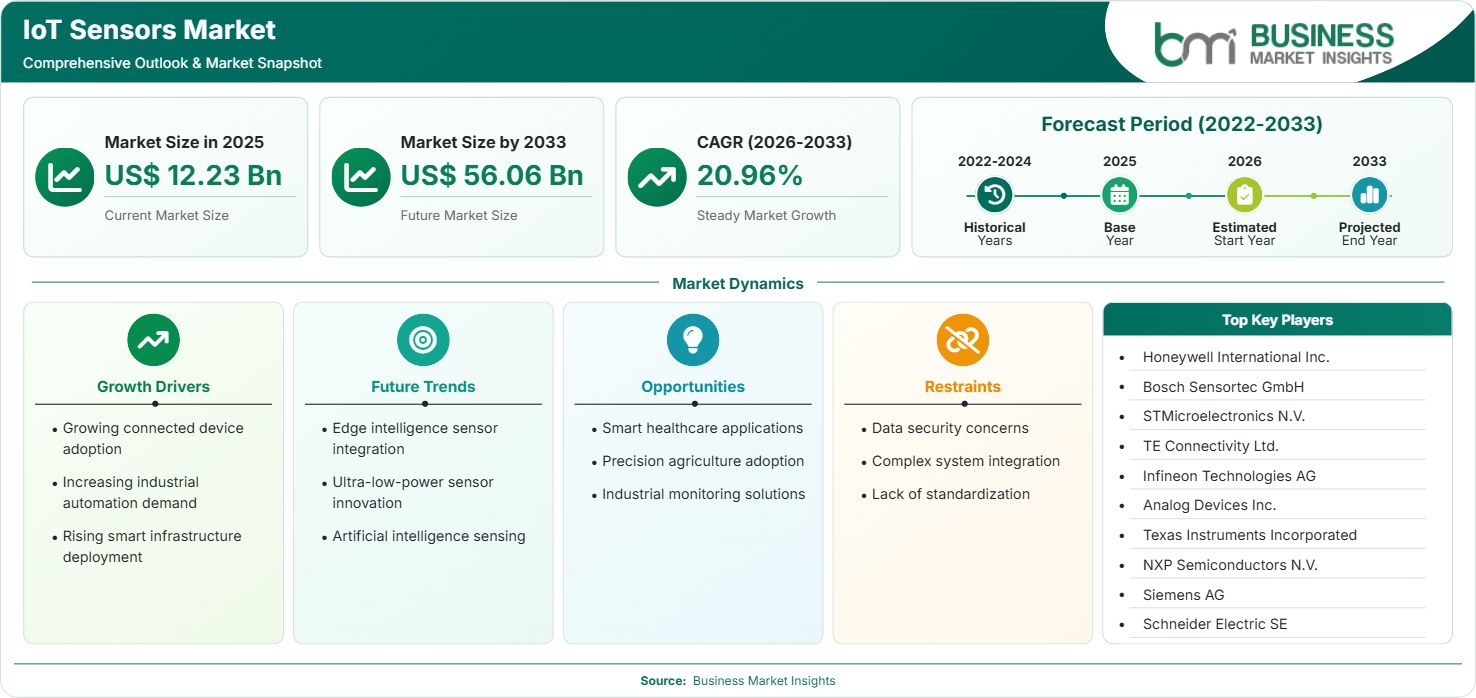
North America accounted for 35%–38% of the global IoT Sensors Market share in 2025 and is projected to expand at a CAGR of 19.2%–20.1% during 2026–2033. Advanced semiconductor manufacturing, industrial automation, IoT infrastructure through the cloud, and digitalization in enterprises have all kept on backing the regional dominance. The global market share of IoT Sensors is at its peak because of the increased use of sensors in industries to enhance efficiency and decision making.
- Smart buildings continue adopting intelligent environmental monitoring, occupancy detection, and energy optimization technologies, driving demand for advanced sensing platforms integrated with building management systems.
- Healthcare providers increasingly deploy wearable monitoring devices, connected diagnostic equipment, and remote patient management solutions, expanding demand for reliable, highly accurate medical-grade sensing technologies.
- Government investments supporting smart infrastructure modernization, transportation digitalization, and critical utility monitoring continue creating favorable commercial opportunities for connected sensing solution providers.
US IoT Sensors Market
The United States represents the largest national market within North America, contributing approximately 27%–30% of global revenue in 2025 while advancing at a CAGR of 19.5%–20.3% through 2026–2033. Strong investments in industrial automation, semiconductor innovation, defense technologies, connected healthcare, and intelligent transportation systems continue strengthening domestic market expansion.
- Industrial enterprises continue investing in predictive maintenance platforms utilizing connected sensors to reduce downtime, improve manufacturing productivity, and optimize equipment lifecycle management.
- Consumer electronics manufacturers integrate advanced MEMS sensors into smartphones, wearable devices, augmented reality products, and connected home ecosystems to enhance user experiences.
- Healthcare organizations increasingly deploy connected medical devices supporting continuous patient monitoring, chronic disease management, and telemedicine applications across hospitals and home healthcare environments.
Europe IoT Sensors Market
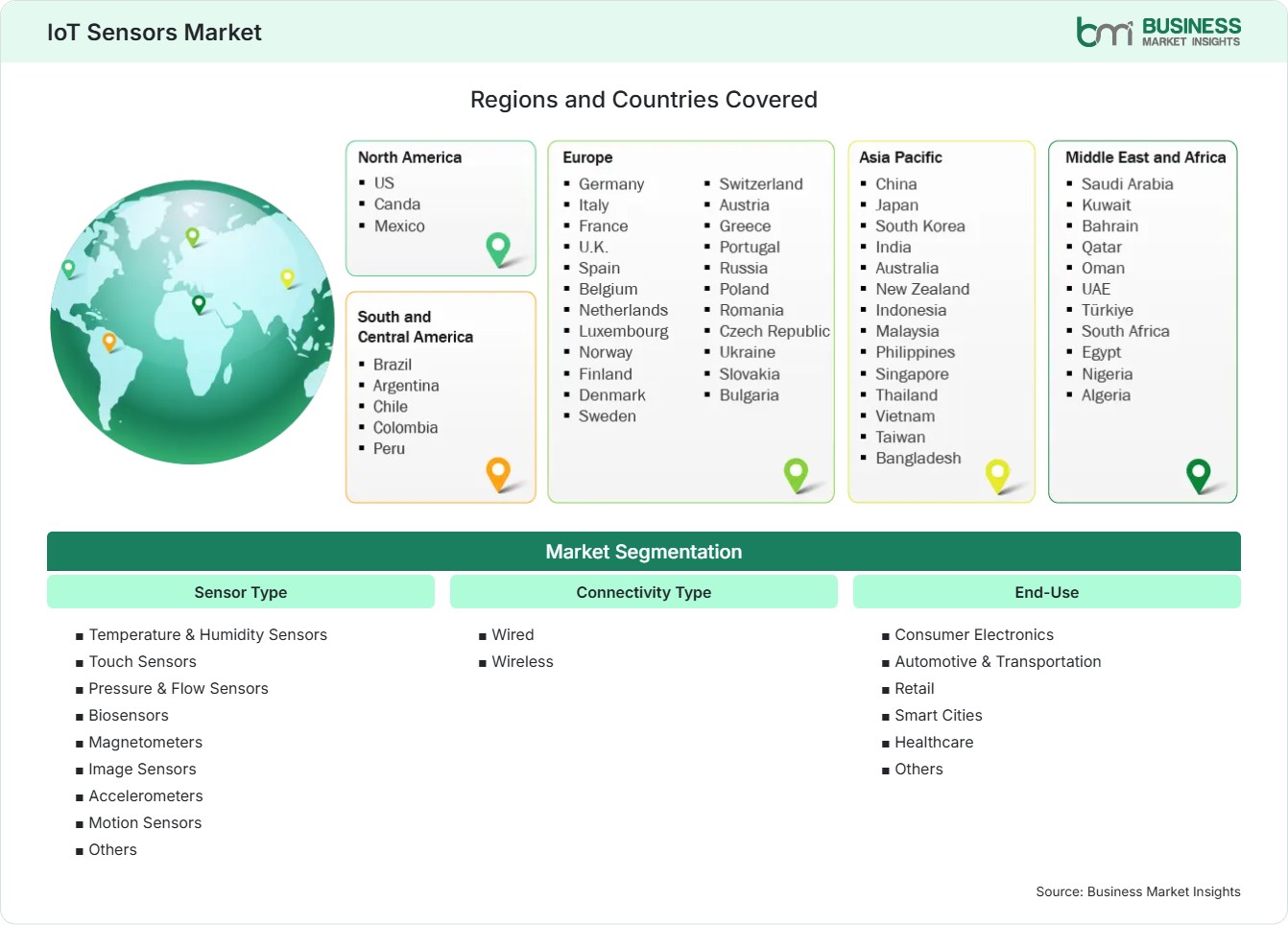
Europe captured approximately 24%–27% of global revenue in 2025 and is forecast to register a CAGR of 20.0%–20.8% during 2026–2033. Industrial automation, environment-friendly practices, and intelligent manufacturing systems still fuel regional growth. Germany remains the key market in the region, while Poland is the one that will show the highest increase thanks to rising production of electronics and industrial digitalization.
- Germany remains the largest regional market through advanced automotive manufacturing, industrial automation leadership, and extensive deployment of intelligent factory technologies.
- Poland records one of Europe's fastest growth trajectories, supported by increasing investments in electronics production, industrial modernization, and expanding digital manufacturing infrastructure.
- Growing investment in industrial cybersecurity and cloud-based analytics enhances the effectiveness and reliability of connected sensing deployments.
Asia Pacific IoT Sensors Market
Asia Pacific represented 29%–32% of global revenue in 2025 and is anticipated to grow at a CAGR of 22.4%–23.5% through 2026–2033, making it the fastest-growing regional market. The IoT Sensors Market growth is supported by expanding electronics manufacturing, rapid urbanization, industrial automation, smart city initiatives, and increasing production of connected consumer devices. China leads regional revenue while India records the highest projected growth.
- China continues dominating regional demand through large-scale electronics manufacturing, industrial automation deployment, and extensive investments in smart manufacturing technologies.
- India is projected to register a CAGR of 23.8%–24.7%, supported by expanding electronics production, digital transformation programs, semiconductor investments, and increasing adoption of connected industrial solutions.
- Japan and South Korea continue strengthening innovation through advanced semiconductor research, robotics development, automotive electronics, and high-value industrial sensing technologies.
- Growing investment in AI-enabled industrial automation creates strong long-term opportunities for advanced sensing technologies integrated with cloud and edge computing platforms.
Rest of World IoT Sensors Market
The Rest of World region accounted for approximately 8%–10% of global market revenue in 2025 and is projected to expand at a CAGR of 20.8%–21.7% during 2026–2033. The South & Central America region enjoys advantages through its growth in automation, mining technology, and agriculture technology, whereas Middle East & Africa regions witness increased spending on infrastructure, energy optimization, and utility management. Brazil is leading in demand for the region, whereas the United Arab Emirates is leading in growth projections.
- Brazil continues expanding deployment of connected sensing technologies across agriculture, mining, manufacturing, and energy sectors to improve productivity and operational efficiency.
- The United Arab Emirates is expected to record a CAGR of 22.1%–22.9%, driven by smart city investments, digital infrastructure expansion, and intelligent building management initiatives.
- Oil and gas operators increasingly deploy industrial sensing technologies for predictive maintenance, pipeline monitoring, worker safety, and environmental compliance across large operational assets.
- Smart agriculture applications continue expanding across emerging economies through connected soil monitoring, weather sensing, irrigation optimization, and livestock management technologies.
- Infrastructure modernization and public utility digitalization continue supporting long-term demand for intelligent sensing solutions across transportation, water management, and energy distribution networks.