
3D Sensors Market Outlook: Size, Share, Trends, Growth Analysis, Competitive Landscape & Forecast, 2026-2033

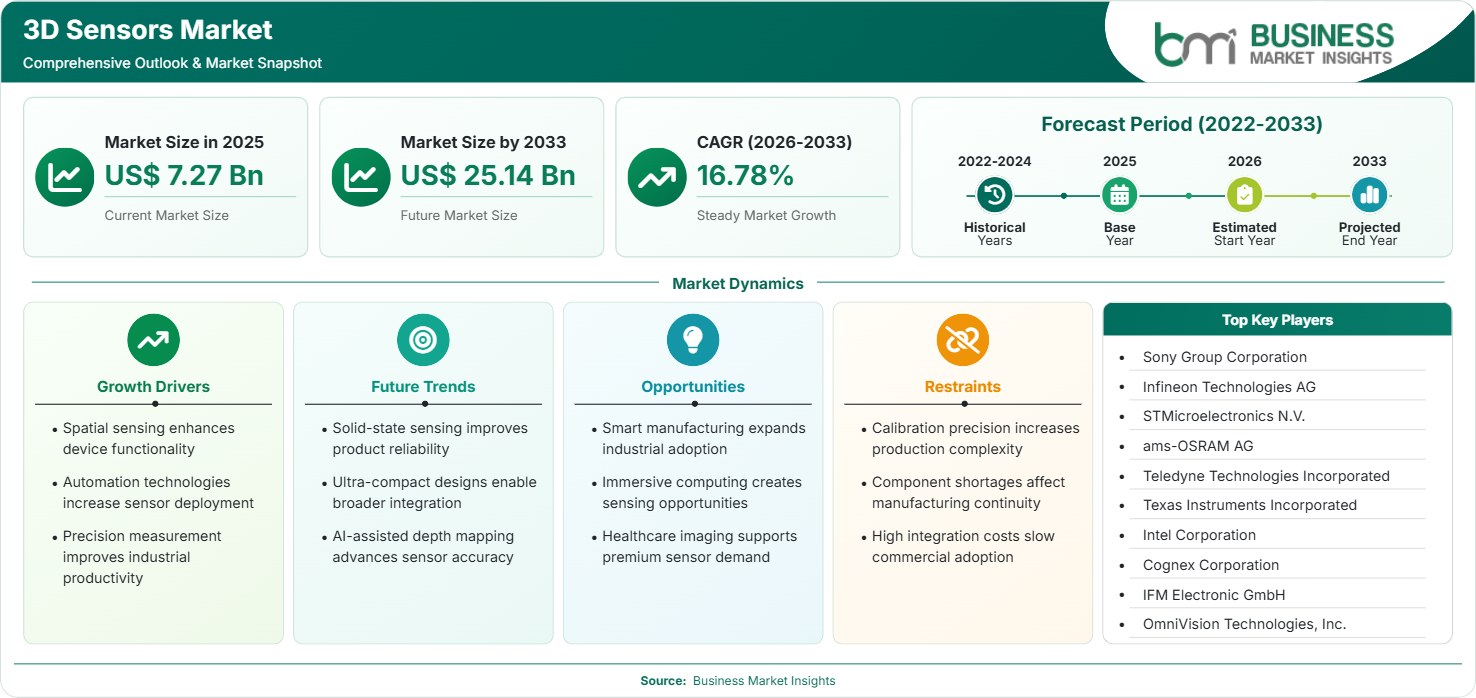
The 3D Sensors Market size was valued at US$ 7.27 billion in 2025 and is projected to reach US$ 25.14 billion by 2033, growing at a CAGR of 16.78% during 2026–2033. Rising adoption of intelligent sensing technologies, expanding industrial automation, and increasing deployment across consumer electronics and healthcare are accelerating demand while creating new commercial opportunities for advanced three-dimensional sensing solutions.

Report Coverage
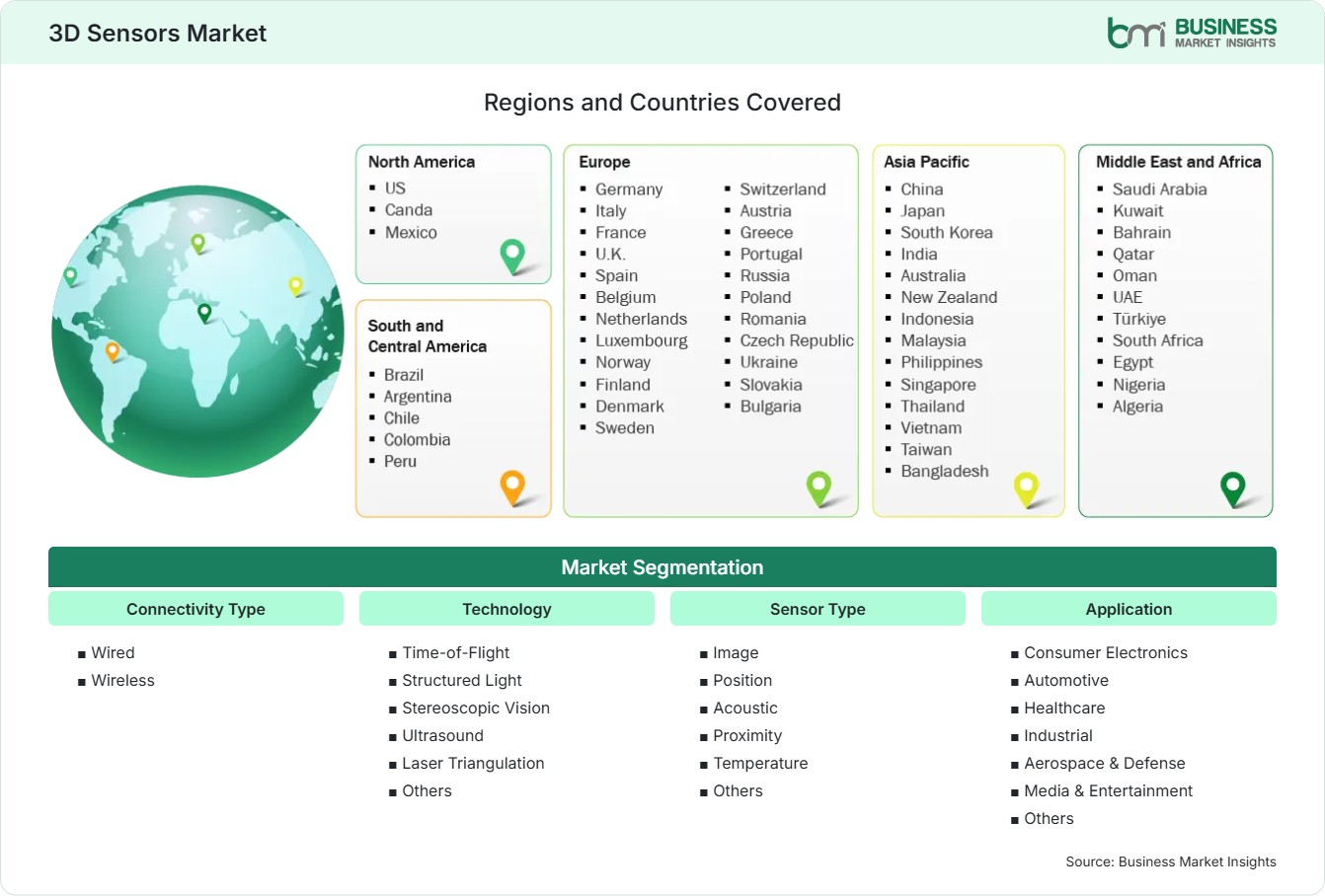
  • Connectivity Type: Wired, Wireless
  • Technology: Time-of-Flight , Structured Light, Stereoscopic Vision, Ultrasound, Laser Triangulation, Others
  • Sensor Type: Image, Position, Acoustic, Proximity, Temperature, Others
  • Application: Consumer Electronics, Automotive, Healthcare, Industrial, Aerospace & Defense, Media & Entertainment, Others
US$ 7.27 Bn Market size in 2025
US$ 25.14 Bn Market Size by 2033
16.78% CAGR, 2026 - 2033
2026-2033 Forecast Period

AI Overview

3D Sensors Market Summary

  • North America Region: North America holds 34%–37% market share in 2025 and is projected to grow at a CAGR of 15.8%–16.4% during 2026–2033. Strong semiconductor innovation, autonomous technologies, and industrial automation continue supporting regional expansion. The U.S. remains the largest contributor with a CAGR of 16.0%–16.6%, supported by investments in robotics, defense electronics, and smart manufacturing.
  • Fastest Growing Region: Asia Pacific accounts for 29%–32% market share in 2025 and is expected to register a CAGR of 18.1%–18.8%, driven by expanding electronics manufacturing, automation projects, automotive production, and increasing demand for consumer devices equipped with advanced sensing capabilities.
  • Leading Segment: Time-of-Flight (ToF) represents 28%–31% market share in 2025 and is projected to expand at a CAGR of 17.2%–17.8%, supported by rising adoption in smartphones, industrial automation, robotics, and automotive applications.
  • High Growth Segment: Consumer Electronics captures 30%–33% market share in 2025 and is expected to record a CAGR of 17.6%–18.3%, driven by facial recognition, augmented reality, gesture control, and intelligent imaging technologies.
  • Key Market Opportunity: Increasing deployment of AI-enabled sensing platforms, industrial robotics, autonomous systems, and advanced healthcare imaging technologies continues creating long-term commercial opportunities for sensor manufacturers worldwide.
  • Major Market Players: Sony Group Corporation, Infineon Technologies AG, STMicroelectronics N.V., ams-OSRAM AG, Teledyne Technologies Incorporated, Texas Instruments Incorporated, Intel Corporation, Cognex Corporation, IFM Electronic GmbH, and OmniVision Technologies, Inc.
Strategic Insights

3D Sensors Market: Strategic Insights

3D Sensors Market Strategic Framework
FREE PDF
Request your free sample
Request free sample
Stakeholder View

Key Takeaways

  • The value chain is becoming increasingly integrated as semiconductor manufacturers collaborate with software developers, device manufacturers, and automation providers to deliver complete sensing solutions.
  • Consumer electronics and industrial automation remain the most attractive application areas, supported by growing demand for precision sensing, machine vision, and intelligent automation technologies.
  • Research investments are shifting toward AI-enabled sensing, miniaturization, and low-power architectures capable of improving accuracy while supporting next-generation connected devices.
  • Asia Pacific presents the strongest investment opportunity due to expanding semiconductor manufacturing, electronics production, government incentives, and increasing adoption of smart industrial technologies.
  • Strategic acquisitions, technology partnerships, and capacity expansion initiatives continue strengthening competition among global semiconductor manufacturers and industrial sensing solution providers.
  • Integration of advanced sensing with artificial intelligence, robotics, and autonomous platforms is creating long-term revenue opportunities across multiple end-use industries.
Geographic Outlook

3D Sensors Market Regional Highlights

North America 3D Sensors Market

North America accounts for **34%–37% 3D Sensors Market share in 2025 and is expected to register a CAGR of 15.8%–16.4% during 2026–2033. Strong demand from industrial automation, aerospace, healthcare, automotive electronics, and consumer devices supports sustained market expansion. Continuous investment in semiconductor innovation, robotics, and intelligent manufacturing strengthens regional competitiveness while encouraging adoption of high-performance sensing technologies.

  • Semiconductor companies continue investing in advanced sensor technologies supporting AI-enabled industrial automation and autonomous systems.
  • Automotive manufacturers increasingly integrate three-dimensional sensing into advanced driver assistance and autonomous vehicle platforms.
  • Healthcare providers expand adoption of precision imaging and minimally invasive diagnostic technologies utilizing advanced sensing capabilities.
  • Industrial automation projects continue increasing deployment of machine vision and precision measurement systems across manufacturing facilities.

US 3D Sensors Market

The United States contributes 82%–85% of North American revenue and is projected to grow at a CAGR of 16.0%–16.6% through the forecast period. Strong investments in semiconductor research, robotics, aerospace innovation, and defense modernization continue supporting domestic market expansion.

  • Advanced semiconductor manufacturing strengthens production of next-generation sensing technologies.
  • Robotics adoption across logistics, healthcare, and manufacturing continues increasing sensor demand.
  • Defense modernization programs support deployment of precision imaging and navigation technologies.
  • Consumer electronics innovation continues driving adoption of facial recognition and gesture sensing systems.

Europe 3D Sensors Market

Europe represents 24%–27% market share in 2025 and is projected to expand at a CAGR of 15.2%–15.9% through 2026–2033. Growing adoption of Industry 4.0 technologies, automotive automation, and advanced healthcare equipment supports regional growth. Germany leads regional demand, while Poland records the fastest expansion through increasing industrial automation and electronics manufacturing investments.

  • Automotive manufacturers continue integrating advanced sensing into electric and autonomous vehicle platforms.
  • Smart factory investments increase deployment of machine vision and industrial inspection technologies.
  • Medical imaging innovation supports demand for high-precision sensing components.
  • Industrial digitalization initiatives continue accelerating sensor deployment across manufacturing facilities.

Asia Pacific 3D Sensors Market

Asia Pacific holds 29%–32% market share in 2025 and is expected to register the fastest CAGR of 18.1%–18.8% during the forecast period. Expanding semiconductor production, electronics manufacturing, industrial robotics, and consumer device demand continue supporting strong regional development. China remains the largest market, while India records the fastest growth through increasing investments in electronics manufacturing and industrial automation.

  • Consumer electronics manufacturers continue integrating advanced sensing into smartphones and wearable devices.
  • Government initiatives encourage semiconductor manufacturing and domestic technology development.
  • Industrial automation investments expand adoption of precision sensing across production facilities.
  • Automotive manufacturers increasingly deploy intelligent sensing technologies within advanced vehicle platforms.

Rest of World 3D Sensors Market

The Rest of World region accounts for 8%–11% market share in 2025 and is projected to expand at a CAGR of 15.7%–16.3% during 2026–2033. Industrial modernization, digital healthcare investments, and expanding aerospace activities continue supporting demand across Latin America, the Middle East, and Africa.

  • Brazil leads regional adoption through growing industrial automation and electronics manufacturing activities.
  • GCC countries continue investing in smart manufacturing and digital infrastructure projects.
  • Healthcare modernization programs increase deployment of advanced diagnostic imaging technologies.
  • Aerospace and defense investments continue supporting adoption of precision sensing solutions across strategic applications.
Global Market Geography
FREE PDF
Request your free sample
Request free sample
Segment Analysis

3D Sensors Market Segmentation

Connectivity Type

Connectivity plays a critical role in determining deployment flexibility, communication speed, and system reliability across industrial and commercial sensing applications. This segment accounted for 58%–61% market share in 2025 and is projected to register a CAGR of 16.2%–16.8% during 2026–2033. Expanding adoption of smart factories, connected devices, and intelligent automation continues broadening the 3D Sensors Market scope across manufacturing, healthcare, automotive, and consumer electronics.

  • Wired: Remains the dominant connectivity option because it provides stable data transmission, low latency, high bandwidth, and dependable performance for industrial automation, robotics, aerospace, and precision manufacturing environments.
  • Wireless: Gains strong momentum with increasing deployment of IoT-enabled devices, smart buildings, wearable electronics, autonomous systems, and remote monitoring applications requiring flexible installation and real-time communication.

Technology

Technology selection depends on measurement accuracy, sensing range, operating environment, processing speed, and application-specific performance requirements. The segment represented 28%–31% market share in 2025 and is expected to expand at a CAGR of 17.2%–17.8% during 2026–2033. Current 3D Sensors Market trends indicate growing investments in compact sensing platforms capable of delivering high-speed, high-resolution, and energy-efficient three-dimensional imaging.

  • Time-of-Flight (ToF): Leads the segment through extensive use in smartphones, industrial robotics, automotive safety systems, and facial recognition applications requiring accurate depth measurement and rapid image acquisition.
  • Structured Light: Supports high-precision three-dimensional scanning for medical imaging, quality inspection, biometric authentication, and industrial metrology where detailed object reconstruction is essential.
  • Stereoscopic Vision: Widely adopted in autonomous vehicles, robotics, and machine vision applications requiring depth perception through synchronized dual-camera image processing techniques.
  • Ultrasound: Provides reliable non-contact distance measurement and object detection across healthcare equipment, industrial automation, and robotic navigation systems operating under challenging environmental conditions.
  • Laser Triangulation: Delivers exceptional measurement accuracy for industrial inspection, semiconductor manufacturing, dimensional analysis, and precision quality control processes requiring micron-level resolution.

Sensor Type

Sensor selection varies according to application requirements, measurement parameters, and operating conditions. This segment continues expanding with increasing adoption of intelligent sensing across industrial automation, automotive electronics, and medical technologies. It accounted for 25%–28% market share in 2025 and is projected to register a CAGR of 16.8%–17.4% during the forecast period.

  • Image: Dominates applications requiring high-resolution object recognition, facial authentication, augmented reality, and machine vision systems across consumer electronics and industrial automation.
  • Position: Enables accurate movement tracking, robotic navigation, and precision manufacturing operations through continuous monitoring of component position and spatial orientation.
  • Acoustic: Supports obstacle detection, industrial inspection, medical diagnostics, and smart infrastructure through sound wave-based sensing technologies offering dependable environmental awareness.
  • Proximity: Plays a vital role in smartphones, automotive electronics, industrial safety systems, and contactless sensing applications requiring rapid object detection and positioning.
  • Temperature: Improves operational safety and equipment reliability by monitoring thermal conditions in manufacturing equipment, healthcare devices, automotive systems, and industrial machinery.

Application

Application diversity continues expanding as intelligent sensing technologies become increasingly integrated into connected devices, automation systems, and advanced industrial equipment. This segment accounted for 30%–33% market share in 2025 and is expected to register the highest CAGR of 17.6%–18.3% during 2026–2033. Growing adoption across consumer electronics, healthcare, industrial automation, and transportation continues strengthening overall market demand.

  • Consumer Electronics: Represents the largest application owing to increasing integration of facial recognition, gesture control, augmented reality, smartphone cameras, tablets, gaming devices, and wearable electronics.
  • Automotive: Supports advanced driver assistance systems, autonomous driving technologies, occupant monitoring, parking assistance, collision avoidance, and intelligent vehicle safety functions.
  • Healthcare: Expands through medical imaging, surgical navigation, patient monitoring, rehabilitation technologies, and diagnostic equipment requiring accurate three-dimensional sensing capabilities.
  • Industrial: Continues generating strong demand for robotics, automated inspection, quality control, warehouse automation, machine vision, and smart manufacturing applications requiring precision measurement.
  • Aerospace & Defense: Utilizes advanced sensing technologies for navigation, surveillance, terrain mapping, target identification, unmanned systems, and mission-critical defense applications.
  • Media & Entertainment: Increasingly adopts three-dimensional sensing for virtual production, gaming, animation, motion capture, immersive content creation, and augmented reality experiences.
Market Forces

3D Sensors Market Dynamics

Key Market Drivers

Spatial sensing enhances device functionality

The three-dimensional sensing technology is having a positive impact on the functionality of various electronic gadgets such as smartphones, tablets, wearables, gaming consoles, and smart home devices. These companies have begun to incorporate sophisticated sensors that will allow the devices to conduct facial recognition, gesture recognition, augmented reality, and depth detection through improved user experience. Improved semiconductors have increased the accuracy and efficiency of these sensors. Growing demand for intelligent consumer products continues supporting 3D Sensors Market growth, as OEMs increasingly prioritize compact, high-performance sensing solutions that deliver superior imaging and environmental awareness.

Automation technologies increase sensor deployment

Automation within industries is rapidly increasing the need for three-dimensional sensors in manufacturing, warehousing, logistics, and robots. Advanced sensor technology is utilized by manufacturing industries for automated inspections, robot control and guidance, object detection, dimensioning, and quality control procedures. Machine vision technology, combined with AI, is being used in smart factories to enhance production efficiency and minimize errors in the process. With growing investments in industry 4.0 technology in developed as well as emerging economies, more focus is being paid to the usage of precise sensor technologies within automated manufacturing setups.

Precision measurement improves industrial productivity

Micron-accurate applications have seen an increase in reliance on sophisticated three-dimensional sensors for inspection, calibration, process verification, and optimization of processes. Companies like those in the automotive industry, semiconductor industry, aerospace and electronics have begun using sensors for maintaining high-quality production of their products without wasting resources or producing faulty items. Continuous innovation in optical sensing technologies continues influencing 3D Sensors Market trends, encouraging wider adoption of high-accuracy measurement systems across industrial applications.

Key Market Opportunities

Smart manufacturing expands industrial adoption

Shifts towards intelligent manufacturing have opened up many opportunities for three-dimensional sensor technology. Intelligent factories need precise sensors for automation, maintenance, digital twins, inspections, and quality management. The manufacturers are building intelligent manufacturing facilities that can monitor and make decisions independently. 3D Sensors Market Forecasts indicate that continued expansion of industrial automation and digital manufacturing infrastructure will significantly increase demand for high-performance sensing platforms capable of supporting next-generation production systems.

Immersive computing creates sensing opportunities

Rapid adoption of augmented reality, virtual reality, mixed reality, and spatial computing platforms is expanding commercial opportunities for advanced sensing technologies. 3D sensors provide the capability of accurately measuring the environment for purposes of mapping, motion capture, gesture recognition, and real-time depth perception necessary for creating immersive digital experiences. Companies that produce consumer electronics, develop software, and create industrial solutions keep on making investments in spatial computing platforms that combine smart sensing capabilities with artificial intelligence. This is bound to drive more demand from several sectors.

Healthcare imaging supports premium sensor demand

Healthcare professionals are increasingly deploying sophisticated three-dimensional sensing technologies for applications such as diagnostic imaging, robotic surgery, patient monitoring, rehabilitation technology, and medical visualizing systems. Advances in imaging accuracy and real-time data acquisition are helping boost accuracy and better patient results. Medical device companies are continuing to develop small, high-quality sensing technologies that help make minimally invasive surgeries and diagnostics possible. The growing digitization of the healthcare industry and rising adoption of smart medical devices are anticipated to provide ongoing growth opportunities for premium sensor makers.

Market Restraints and Challenges

Calibration precision increases production complexity

Three-dimensional sensors require highly accurate calibration procedures to ensure reliable performance across industrial, automotive, healthcare, and consumer electronics applications. Factor: Complex calibration requirements increase manufacturing time, engineering effort, and quality control costs during production. Impact: Higher production complexity may extend product development cycles, increase operational expenses, and delay commercialization of advanced sensing technologies, particularly for manufacturers introducing next-generation high-resolution sensor platforms.

Component shortages affect manufacturing continuity

Global semiconductor supply fluctuations continue influencing production schedules for advanced sensing technologies. Factor: Limited availability of imaging chips, optical components, and specialized semiconductor materials disrupts procurement and manufacturing operations. Impact: Production delays, increased component costs, and longer customer lead times may temporarily affect supply chain efficiency and reduce the ability of manufacturers to meet rapidly growing demand across automotive, consumer electronics, industrial automation, and healthcare markets.

Company Analysis

Competitive Landscape

Competition is driven by continuous semiconductor innovation, sensor miniaturization, AI integration, and strategic investments in machine vision and industrial automation technologies. 3D Sensors Market analysis shows that leading companies are expanding their product portfolios through advanced imaging technologies, high-performance sensing platforms, and partnerships with consumer electronics, automotive, healthcare, and industrial equipment manufacturers.

Company Name

Overview

Products and Services Relevant to this Market

Sony Group Corporation

Global technology leader recognized for advanced imaging technologies and semiconductor innovation serving consumer and industrial markets.

CMOS image sensors, ToF sensors, imaging solutions, semiconductor devices, automotive sensing technologies, and machine vision components.

Infineon Technologies AG

Leading semiconductor manufacturer supplying intelligent sensing and power solutions across multiple industries.

3D image sensors, radar sensors, MEMS technologies, automotive sensing solutions, industrial sensors, and semiconductor components.

STMicroelectronics N.V.

Global semiconductor company specializing in MEMS, imaging, and advanced sensing technologies.

Time-of-Flight sensors, MEMS sensors, industrial sensing devices, automotive electronics, and consumer imaging solutions.

ams-OSRAM AG

Develops optical sensing technologies for consumer electronics, automotive, healthcare, and industrial applications.

Optical sensors, proximity sensors, ambient light sensors, 3D sensing modules, and imaging technologies.

Teledyne Technologies Incorporated

Provides advanced digital imaging and industrial sensing technologies for mission-critical applications.

Industrial cameras, machine vision systems, infrared imaging, aerospace sensors, and precision measurement solutions.

Texas Instruments Incorporated

Semiconductor company delivering analog and embedded processing technologies supporting intelligent sensing applications.

Signal processing chips, proximity sensors, embedded processors, industrial sensing components, and automotive semiconductor solutions.

Intel Corporation

Global computing company investing in AI, machine vision, and advanced sensing technologies for intelligent systems.

Vision processors, AI platforms, depth sensing technologies, autonomous system solutions, and edge computing hardware.

Cognex Corporation

Industrial automation specialist focused on machine vision and precision inspection technologies.

Vision sensors, barcode readers, industrial cameras, inspection systems, and factory automation sensing solutions.

IFM Electronic GmbH

Manufacturer of industrial automation products supporting smart manufacturing and process monitoring.

Position sensors, proximity sensors, industrial vision systems, process automation devices, and smart factory sensing solutions.

OmniVision Technologies, Inc.

Semiconductor company specializing in compact imaging solutions for consumer, automotive, and medical markets.

CMOS image sensors, medical imaging sensors, automotive cameras, ToF imaging solutions, and machine vision technologies.

Trust & Transparency

Research Methodology

The market analysis combines proprietary research with secondary data from government agencies, company disclosures, regulatory filings, industry databases and expert interviews. Market estimates are validated through data triangulation, cross-market benchmarking and analyst review.

View Full Research Methodology

Questions Answered

Frequently Asked Questions

What does the 3D Sensors Market Report include?

The Market Report provides detailed insights into market dynamics, segmentation, regional performance, competitive landscape, technology developments, investment opportunities, emerging applications, and long-term industry outlook.

Which application generates the highest demand for 3D sensors?

Consumer electronics remains the largest application due to widespread integration of facial recognition, augmented reality, gesture control, advanced camera systems, and wearable smart devices requiring compact sensing technologies.

Why is Asia Pacific expected to witness the fastest growth?

Asia Pacific benefits from expanding semiconductor manufacturing, increasing consumer electronics production, government support for industrial automation, and strong investments in automotive, robotics, and smart manufacturing technologies.

Which technology segment leads the market?

Time-of-Flight (ToF) technology holds the leading position because it delivers fast, accurate depth measurement for smartphones, robotics, automotive safety systems, industrial automation, and facial recognition applications.

What is driving the growth of the 3D Sensors Market?

The market is expanding due to increasing adoption of industrial automation, smart consumer electronics, autonomous vehicles, healthcare imaging systems, and AI-enabled machine vision technologies requiring accurate three-dimensional sensing capabilities.

Access the Full 3D Sensors Market Report

Get segment-level forecasts, regional estimates, competitive benchmarking, company profiles and downloadable Excel datasets.

Access the full 3D Sensors Market Report
350 pages PDF & Excel | 2026-08-25
Similar Research

Related Market Reports