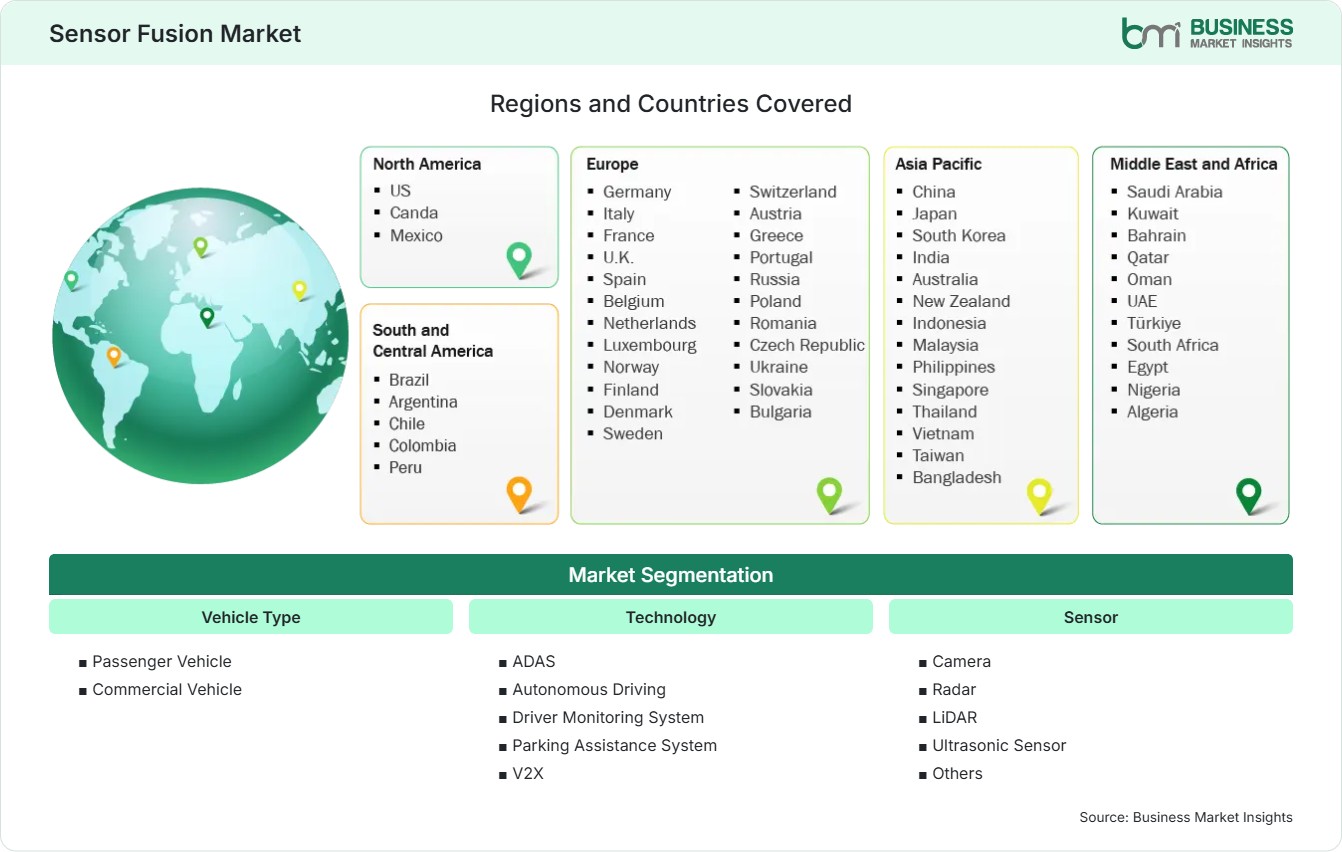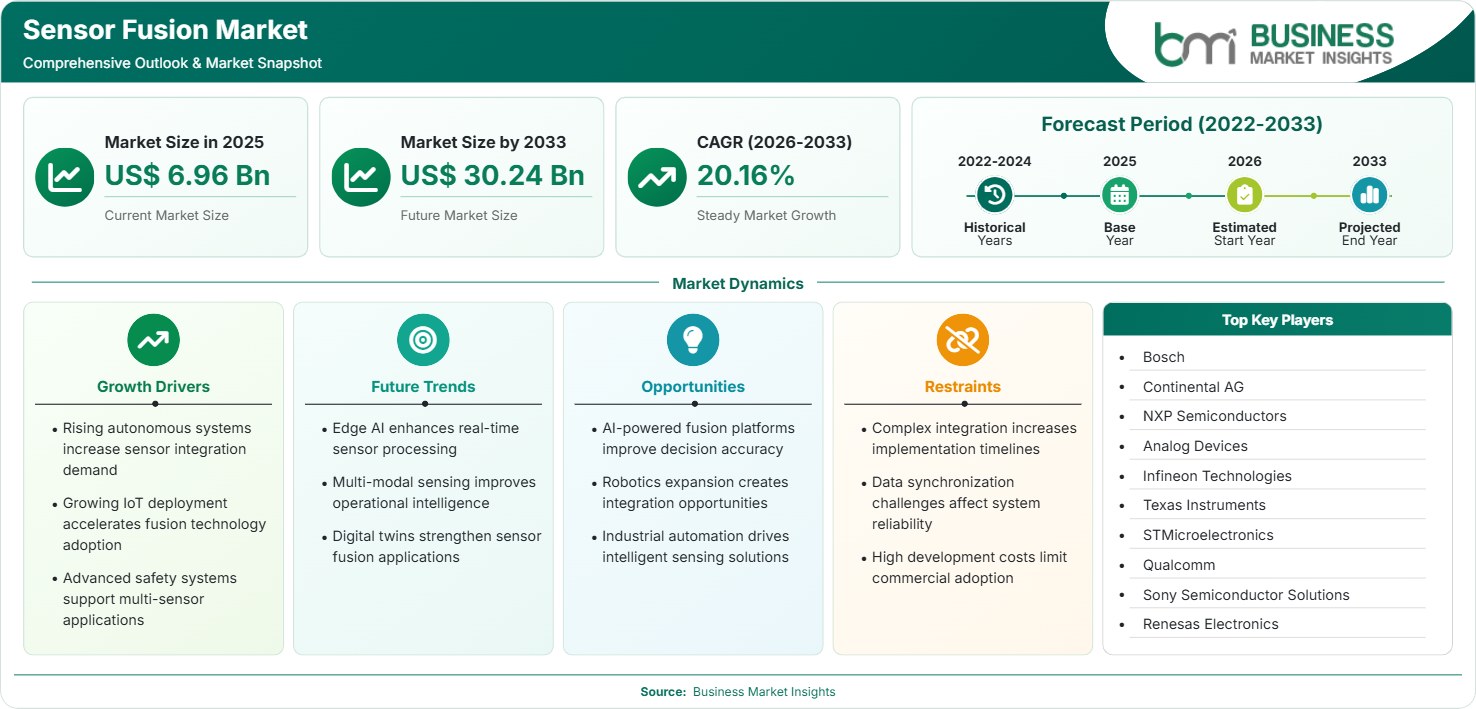
Sensor Fusion Market Regional Highlights
North America Sensor Fusion Market
North America accounts for 34%–37% Sensor Fusion Market share in 2025 and is expected to register a CAGR of 19.2%–19.8% during 2026–2033. The region benefits from advanced semiconductor manufacturing, autonomous vehicle testing programs, defense modernization, and significant investments in artificial intelligence research. Strong collaboration between automotive manufacturers, technology developers, and research institutions continues strengthening innovation across intelligent sensing applications.
- Automotive manufacturers continue integrating advanced sensor fusion platforms into premium vehicle models to improve safety and automated driving performance.
- Semiconductor companies invest in high-performance processors supporting real-time multi-sensor data processing across automotive and industrial applications.
- Government-backed intelligent transportation initiatives continue accelerating connected mobility infrastructure development.
- Defense modernization programs increase deployment of advanced sensing technologies across surveillance, navigation, and autonomous systems.
US Sensor Fusion Market
The United States contributes 82%–85% of North American revenue and is projected to expand at a CAGR of 19.3%–19.9% during the forecast period. Continued innovation in autonomous driving technologies, robotics, aerospace, and semiconductor design supports sustained market expansion.
- Technology companies continue investing heavily in artificial intelligence and perception software development.
- Autonomous vehicle pilot programs accelerate commercialization of advanced sensing technologies.
- Defense and aerospace applications strengthen demand for highly reliable multi-sensor integration platforms.
- Research partnerships support continuous improvements in perception algorithms and real-time data processing.
Europe Sensor Fusion Market
Europe represents 26%–29% market share in 2025 and is anticipated to expand at a CAGR of 19.0%–19.6% through 2033. Strong automotive manufacturing capabilities, vehicle safety regulations, and industrial automation initiatives continue driving adoption of intelligent sensing technologies. Germany remains the leading regional market, while Sweden demonstrates the fastest growth due to increasing investments in autonomous mobility and smart industrial systems.
- Automotive OEMs continue strengthening investments in ADAS and autonomous vehicle technologies.
- European semiconductor manufacturers expand development of advanced automotive sensing solutions.
- Industrial automation projects increase deployment of intelligent robotics and machine vision systems.
- Regulatory emphasis on vehicle safety supports integration of advanced perception technologies.
Asia Pacific Sensor Fusion Market
Asia Pacific holds 29%–32% market share in 2025 and is projected to register the fastest 21.4%–22.1% CAGR through 2033. Rapid expansion of automotive manufacturing, semiconductor production, industrial automation, and robotics deployment continues supporting regional demand. China leads overall market size, while India records the fastest growth through expanding electronics manufacturing, intelligent mobility initiatives, and increasing investments in advanced automotive technologies.
- Growing electric vehicle production increases deployment of integrated sensing platforms.
- Semiconductor manufacturing investments strengthen regional technology capabilities.
- Smart factory development accelerates adoption of industrial sensor fusion technologies.
- Government support for intelligent transportation expands connected mobility infrastructure.
Rest of World Sensor Fusion Market
The Rest of World region accounts for 8%–10% market share in 2025 and is expected to register a CAGR of 19.5%–20.1% during the forecast period. Investments in transportation modernization, industrial automation, mining technologies, and defense modernization continue supporting market expansion across Latin America, the Middle East, and Africa.
- Brazil strengthens adoption through increasing automotive manufacturing and industrial digitalization.
- GCC countries invest in smart mobility, autonomous transportation, and intelligent infrastructure projects.
- Mining and logistics industries expand implementation of intelligent sensing technologies.
- Public sector investments continue supporting smart city and connected transportation initiatives.