
Marine Sensors Market Outlook: Size, Share, Trends, Growth Analysis, Competitive Landscape & Forecast, 2026-2033

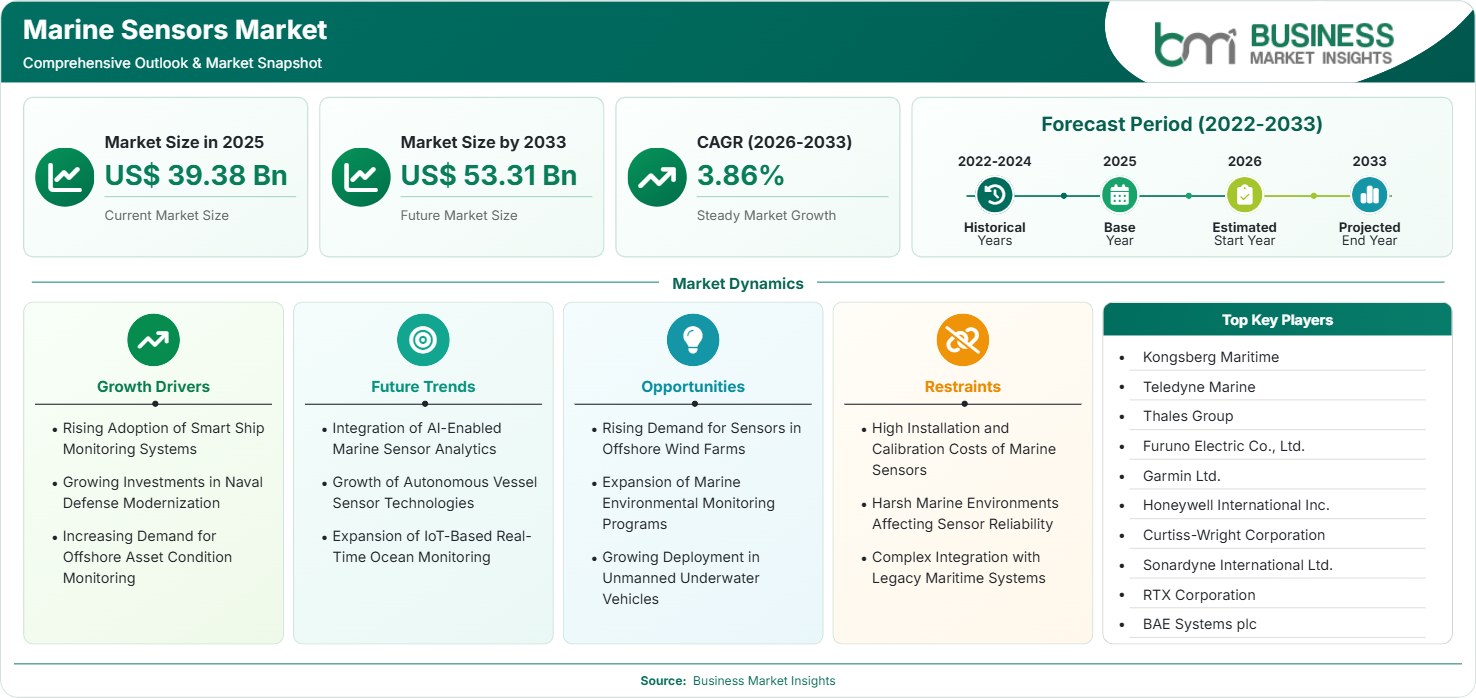
The Marine Sensors Market size was valued at US$ 39.38 Billion in 2025 and is projected to reach US$ 53.31 Billion by 2033, growing at a CAGR of 3.86% during 2026–2033. Rising naval modernization programs, expanding offshore energy exploration, increasing maritime surveillance requirements, and growing adoption of autonomous marine systems continue creating growth opportunities across defense and commercial marine industries.

Report Coverage
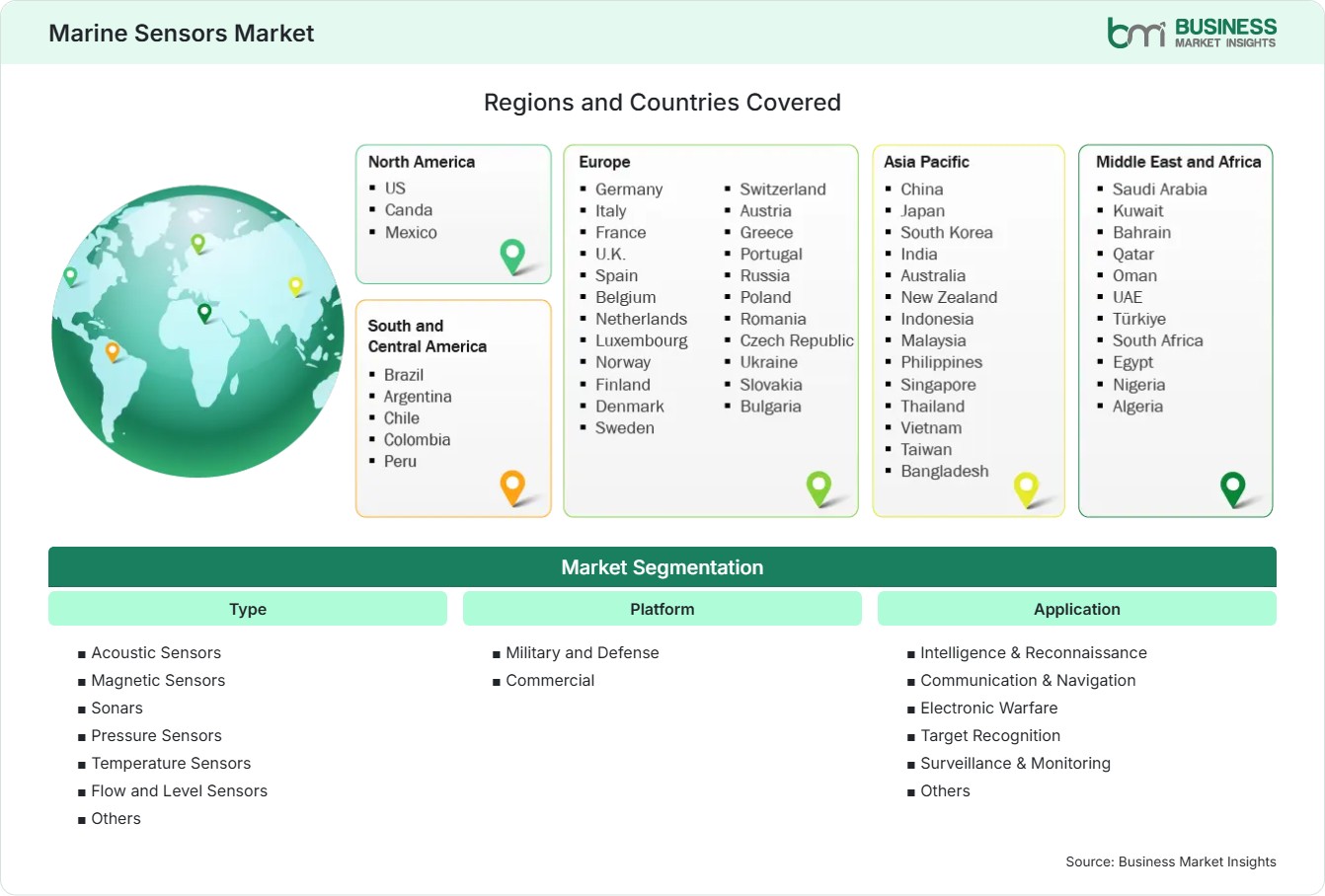
  • Type: Acoustic Sensors, Magnetic Sensors, Sonars, Pressure Sensors, Temperature Sensors, Flow and Level Sensors, Others
  • Platform: Military and Defense, Commercial
  • Application: Intelligence & Reconnaissance, Communication & Navigation, Electronic Warfare, Target Recognition, Surveillance & Monitoring, Others
US$ 39.38 Bn Market size in 2025
US$ 53.31 Bn Market Size by 2033
3.86% CAGR, 2026 - 2033
2026-2033 Forecast Period

AI Overview

Marine Sensors Market Summary

  • North America Region: North America holds 34%–37% marine sensors market share in 2025 and is projected to expand at a CAGR of 3.6%–4.0% during 2026–2033. Strong naval modernization, offshore energy investments, maritime security initiatives, advanced defense technologies, and autonomous vessel deployment continue supporting regional market growth.
  • Fastest Growing Region: Asia Pacific accounts for 28%–31% of the market in 2025 and is anticipated to grow at a CAGR of 4.4%–4.8%. Expanding naval modernization, commercial shipbuilding, offshore energy development, and maritime infrastructure investments continue accelerating regional demand.
  • Leading Segment: Military and Defense accounts for 61%–64% market share in 2025 while expanding at a CAGR of 3.9%–4.3%. Increasing investments in naval surveillance, underwater warfare, maritime intelligence, and fleet modernization continue driving segment leadership.
  • High Growth Segment: Surveillance & Monitoring represents 22%–25% market share in 2025 and is projected to register a CAGR of 4.8%–5.2%. Rising maritime domain awareness initiatives, offshore asset monitoring, and autonomous marine platforms continue supporting strong growth.
  • Key Market Opportunity: Increasing deployment of autonomous underwater vehicles, smart ports, digital maritime operations, and integrated sensor fusion technologies is creating significant long-term opportunities for advanced marine sensing solutions.
  • Major Market Players: Kongsberg Maritime, Teledyne Marine, Thales Group, Furuno Electric Co., Ltd., Garmin Ltd., Honeywell International Inc., Curtiss-Wright Corporation, Sonardyne International Ltd., RTX Corporation, and BAE Systems plc.
Strategic Insights

Marine Sensors Market: Strategic Insights

Marine Sensors Market Strategic Framework
FREE PDF
Request your free sample
Request free sample
Stakeholder View

Key Takeaways

  • The marine sensing system is beginning to include many defense firms, navigational technology firms, sonar makers, offshore companies, and autonomous vessel technology firms.
  • The surveillance market, navigational market, offshore energy market, and autonomous marine market remain the best growth prospects for the long run.
  • Development tends to center around AI sensor fusion, autonomous underwater vehicles, edge computing, and maritime monitoring systems.
  • Asia Pacific provides strong investment opportunities because of increased naval spending, ship building efforts, and offshore construction.
  • The creation of partnerships between naval contractors, marine electronics firms, and autonomous technology firms is driving innovation.
  • Firms investing in digital marine systems and intelligent sensing technologies should see increased competitiveness.
Geographic Outlook

Marine Sensors Market Regional Highlights

North America Marine Sensors Market

North America accounted for approximately 34%–37% of global revenue during 2025 and is projected to expand at a CAGR of 3.6%–4.0% through 2033. Strong naval investments, offshore energy infrastructure, and advanced maritime technologies continue supporting regional leadership. The Marine Sensors Market share remains supported by defense modernization, autonomous vessel development, and increasing deployment of intelligent maritime monitoring systems.

  • Navy modernization initiatives see a growing number of high-technology sensors related to sonar, acoustics, navigation, and surveillance incorporated into future maritime platforms.
  • Sensor technologies are more commonly used in offshore oil and gas production projects and renewable energy plants.
  • The use of unmanned maritime vessels is associated with an increased demand for navigation, positioning, and obstacle avoidance sensors.
  • Maritime cybersecurity and fleet management technologies receive significant investments.

US Marine Sensors Market

The United States represents approximately 86%–89% of North American demand and is projected to register a CAGR of 3.7%–4.1% during the forecast period. Extensive naval procurement, advanced defense programs, and strong marine technology innovation continue driving sustained marine sensors marine sensors market growth.

  • U.S. naval modernization programs continue supporting procurement of integrated sensor suites for submarines, surface combatants, and unmanned vessels.
  • Offshore energy operators increasingly adopt digital monitoring systems to improve operational reliability and safety.
  • Advanced marine electronics manufacturers continue investing in intelligent navigation and surveillance technologies.
  • Federal investments in maritime security strengthen long-term demand for high-performance sensing platforms.

Europe Marine Sensors Market

Europe accounted for approximately 24%–27% of global revenue during 2025 and is anticipated to grow at a CAGR of 3.5%–3.9% through 2033. Strong maritime industries, naval modernization, and offshore wind development continue supporting regional demand. The United Kingdom leads regional adoption, while Norway records one of the fastest growth rates through offshore technology investments.

  • The United Kingdom continues expanding naval modernization and maritime surveillance capabilities.
  • Norway strengthens demand through offshore energy development and advanced marine technology innovation.
  • Offshore wind projects increasingly deploy marine monitoring sensors for environmental and structural assessments.
  • Maritime safety regulations encourage wider adoption of intelligent navigation and monitoring systems.

Asia Pacific Marine Sensors Market

Asia Pacific represented approximately 28%–31% of global revenue during 2025 and is forecast to grow at a CAGR of 4.4%–4.8% through 2033, making it the fastest-growing regional market. Rising naval procurement, commercial shipbuilding, and maritime infrastructure investments continue driving demand. China leads regional revenue, while India records the fastest growth.

  • China continues investing in naval expansion, commercial shipping, and offshore infrastructure projects requiring advanced marine sensing technologies.
  • India experiences strong growth through naval modernization, coastal surveillance, and indigenous defense manufacturing initiatives.
  • Japan and South Korea continue advancing smart ship technologies and marine electronics innovation.
  • Southeast Asian nations expand maritime security investments and port modernization projects supporting sensor adoption.

Rest of World Marine Sensors Market

The Rest of World region accounted for approximately 8%–10% of global marine sensors market revenue during 2025 and is projected to grow at a CAGR of 4.0%–4.4% through 2033. South & Central America continue investing in offshore energy projects, while the Middle East and Africa strengthen maritime security and port infrastructure. Brazil leads Latin America, whereas Saudi Arabia records the fastest regional growth.

  • Brazil continues expanding offshore oil and gas exploration requiring advanced subsea sensing technologies.
  • Saudi Arabia strengthens investments in smart ports, coastal surveillance, and maritime infrastructure modernization.
  • Environmental monitoring initiatives increase deployment of oceanographic sensing systems.
  • Commercial shipping modernization supports broader adoption of intelligent navigation and communication sensors.
Global Market Geography
FREE PDF
Request your free sample
Request free sample
Segment Analysis

Marine Sensors Market Segmentation

Type

The Type segment accounted for approximately 34%–37% of the market in 2025 and is projected to expand at a CAGR of 3.9%–4.3% during 2026–2033. Growing investments in intelligent navigation, underwater surveillance, offshore monitoring, and autonomous marine platforms continue driving adoption of advanced sensing technologies. The Marine Sensors Market scope continues expanding as defense agencies and commercial operators increasingly deploy integrated marine sensing solutions for real-time operational awareness.

  • Acoustic Sensors: Acoustic sensors are extensively used for underwater communication, submarine detection, marine life monitoring, and oceanographic research, providing reliable long-range sensing capabilities in challenging underwater environments.
  • Magnetic Sensors: Magnetic sensors detect variations in magnetic fields to support submarine detection, underwater navigation, mine countermeasure operations, and maritime security applications requiring precise object identification.
  • Sonars: Sonar systems remain essential for underwater mapping, obstacle detection, seabed imaging, navigation, surveillance, anti-submarine warfare, and autonomous underwater vehicle operations across defense and commercial sectors.
  • Pressure Sensors: Pressure sensors monitor underwater depth, vessel systems, ballast operations, hydraulic equipment, and offshore installations while ensuring operational safety and equipment reliability.
  • Temperature Sensors: Temperature sensors support engine monitoring, environmental observation, cargo management, cooling systems, and oceanographic research through continuous thermal measurement capabilities.
  • Flow and Level Sensors: Flow and level sensors optimize ballast systems, fuel management, liquid storage monitoring, cooling circuits, and offshore processing operations through accurate fluid measurement.
  • Others: Additional marine sensors include humidity, vibration, motion, inertial, chemical, optical, and environmental sensors supporting specialized navigation, safety, and monitoring applications.

Platform

Platform-based demand continues expanding with increasing investments across defense fleets and commercial maritime operations. This segment represented approximately 61%–64% of the market in 2025 and is projected to register a CAGR of 3.9%–4.3% through 2033. The Marine Sensors Market trends indicate growing deployment of integrated sensing technologies across diverse marine platforms.

  • Military and Defense: Naval vessels, submarines, unmanned surface vessels, and underwater platforms increasingly utilize advanced sensor systems for surveillance, navigation, electronic warfare, reconnaissance, and mission-critical operations.
  • Commercial: Commercial ships, offshore platforms, fishing vessels, cruise ships, and port infrastructure increasingly adopt intelligent marine sensors to improve operational efficiency, safety, predictive maintenance, and regulatory compliance.

Application

Application diversity continues expanding as intelligent marine technologies become central to modern maritime operations. The segment accounted for approximately 22%–25% of the market in 2025 and is anticipated to expand at a CAGR of 4.8%–5.2% through 2033. Increasing digitalization and autonomous operations continue strengthening demand across multiple marine applications.

  • Intelligence & Reconnaissance: Advanced sensing technologies support maritime intelligence gathering, underwater reconnaissance, coastal monitoring, and strategic naval operations through continuous situational awareness.
  • Communication & Navigation: Marine sensors enhance vessel positioning, collision avoidance, route optimization, communication reliability, and integrated bridge systems for safe maritime transportation.
  • Electronic Warfare: Defense organizations deploy sophisticated sensors to detect, identify, monitor, and respond to electronic threats across increasingly complex maritime operational environments.
  • Target Recognition: Intelligent sensing systems enable accurate object classification, underwater target detection, threat assessment, and autonomous engagement support for naval defense missions.
  • Surveillance & Monitoring: Continuous monitoring solutions strengthen maritime security, offshore asset protection, environmental observation, and vessel traffic management through real-time data acquisition.
  • Others: Additional applications include fisheries management, marine scientific research, offshore renewable energy monitoring, underwater inspection, search and rescue, and disaster response operations.
Market Forces

Marine Sensors Market Dynamics

Key Market Drivers

Rising Adoption of Smart Ship Monitoring Systems

Smart ship technologies with marine sensors, artificial intelligence, connectivity to the cloud, and prediction are being used by more shipping companies to enhance operational efficiency and the safety of ships. The constant monitoring of ship's propulsion system, fuel efficiency, ship's hull, cargo, and equipment ensures that maintenance is carried out proactively while reducing operational downtime. The Marine Sensors Market growth is supported by digitalization trends in the commercial shipping industry, stringent maritime safety laws, and the the rising adoption of connected fleet management solutions that provide real-time operational insights into ships.

Growing Investments in Naval Defense Modernization

Defense budgets in various parts of the world are being increased for upgrading naval forces with state-of-the-art technology for surveillance, sonar, navigation, and electronic warfare. Future generation submarines, frigates, destroyers, unmanned surface vehicles, and underwater autonomous systems need sensors that can support them in carrying out intricate naval operations. Defense organizations are giving importance to technology like integrated situation awareness, underwater threat detection, and intelligence gathering to secure their countries from any type of danger. This is why future purchases of state-of-the-art naval systems will contribute to marine sensors market.

Increasing Demand for Offshore Asset Condition Monitoring

Offshore oil and gas platforms, subsea pipeline systems, offshore wind farms, and marine structures depend more and more on intelligent sensors for the purposes of structural integrity, equipment monitoring, environmental monitoring, and overall safety. The application of real-time monitoring results in less failures of the equipment, better preventive maintenance, reduced downtime, and compliance with regulations. The growing number of investments into offshore renewables and digital asset management helps to support implementation of connected sensors.

Key Market Opportunities

Rising Demand for Sensors in Offshore Wind Farms

There has been a rise in the installation of offshore wind energy projects, which has led to an increase in the demand for advanced marine sensing systems that can help monitor the structural health of facilities, subsea cable testing, environmental analysis, and predictive maintenance. Pressure, vibration, acoustic, and environmental sensors have become common among offshore operators in order to enhance the reliability of their assets and scheduling of maintenance. Marine Sensors Market Forecasts appear positive as governments continue to invest in renewable energy facilities and offshore wind farms.

Expansion of Marine Environmental Monitoring Programs

Governments, research organizations, and environment-related organizations are continuously enhancing marine monitoring programs to assess the condition of the ocean regarding its overall health, biodiversity, water quality, effects of climate change, and ecosystems in the coastal areas. Modern technology in marine sensors allows for continuous gathering of environmental information for scientific research, fishery management, pollution control, and disaster prevention purposes. Sustainable ocean resources management has become a popular area of attention from an international point of view, thus offering business prospects.

Growing Deployment in Unmanned Underwater Vehicles

Unmanned underwater vehicles are increasingly deployed across defense, offshore energy, marine research, seabed mapping, and underwater inspection applications. These platforms require compact, high-performance sensors supporting navigation, obstacle detection, communication, environmental monitoring, and mission execution in complex underwater environments. Growing investments in autonomous marine technologies by naval organizations, offshore operators, and scientific institutions continue creating long-term opportunities for sensor manufacturers developing reliable, low-power, and highly integrated underwater sensing solutions.

Market Restraints and Challenges

High Installation and Calibration Costs of Marine Sensors

Factor: Advanced marine sensing systems require specialized installation procedures, precision calibration, vessel integration, underwater testing, and regular maintenance performed by highly skilled technical personnel.

Impact: High implementation costs increase capital expenditure for ship operators, offshore energy companies, and defense organizations, particularly during fleet modernization and retrofit projects. Smaller commercial operators may delay adoption because of budget limitations and extended return-on-investment periods. Manufacturers continue improving modular sensor architectures, automated calibration technologies, and simplified installation methods to reduce deployment costs and improve accessibility.

Harsh Marine Environments Affecting Sensor Reliability

Factor: Marine sensors operate under extreme conditions including saltwater corrosion, biofouling, high pressure, temperature fluctuations, underwater vibrations, and prolonged exposure to moisture and harsh weather.

Impact: Challenging operating environments can reduce sensor accuracy, shorten equipment lifespan, increase maintenance frequency, and elevate operational costs. Reliability concerns are particularly critical for offshore energy facilities, naval operations, and autonomous marine platforms requiring uninterrupted performance. Manufacturers increasingly invest in corrosion-resistant materials, advanced protective coatings, ruggedized designs, and self-diagnostic capabilities to improve long-term operational reliability in demanding marine environments.

Company Analysis

Competitive Landscape

The Marine Sensors Market analysis is characterized by competition among marine electronics manufacturers, defense contractors, sonar technology developers, and navigation system providers. Companies are focusing on intelligent sensor fusion, autonomous maritime technologies, underwater communication systems, and AI-enabled monitoring platforms to strengthen their competitive positions. Strategic collaborations with naval agencies, offshore energy companies, and shipbuilders continue accelerating innovation and commercial deployment.

Company Name

Overview

Products and Services Relevant to this Market

Kongsberg Maritime

Kongsberg Maritime develops advanced marine technologies supporting commercial shipping, offshore operations, autonomous vessels, and naval defense applications worldwide.

Sonar systems, navigation sensors, autonomous vessel technologies, positioning systems, marine automation, and offshore monitoring solutions.

Teledyne Marine

Teledyne Marine provides integrated marine instrumentation and sensing technologies for defense, offshore energy, oceanographic research, and autonomous underwater operations.

Acoustic sensors, sonar systems, underwater imaging, marine navigation equipment, oceanographic instruments, and autonomous vehicle sensors.

Thales Group

Thales Group supplies advanced naval electronics and underwater sensing technologies supporting maritime surveillance, anti-submarine warfare, and naval modernization programs.

Sonar systems, underwater surveillance sensors, electronic warfare technologies, communication systems, and integrated naval mission solutions.

Furuno Electric Co., Ltd.

Furuno Electric Co., Ltd. manufactures marine electronics for commercial and recreational vessels with strong expertise in navigation and communication technologies.

Radar systems, fish finders, sonar equipment, GPS navigation, marine sensors, communication systems, and bridge electronics.

Garmin Ltd.

Garmin Ltd. develops navigation and marine electronics solutions serving recreational boating, commercial vessels, and marine safety applications globally.

Marine GPS systems, sonar technologies, chartplotters, navigation sensors, fish finders, and integrated marine electronics.

Honeywell International Inc.

Honeywell International Inc. supplies industrial sensing technologies and automation systems supporting marine, defense, and offshore industrial operations.

Pressure sensors, temperature sensors, navigation technologies, industrial automation, monitoring systems, and marine sensing solutions.

Curtiss-Wright Corporation

Curtiss-Wright Corporation provides advanced defense technologies, naval electronics, and rugged sensing solutions for mission-critical maritime applications.

Defense sensors, underwater electronics, navigation systems, embedded technologies, ruggedized electronics, and naval monitoring equipment.

Sonardyne International Ltd.

Sonardyne International Ltd. specializes in underwater positioning, acoustic communication, and subsea sensing technologies for offshore and defense industries.

Acoustic positioning systems, underwater communication, subsea monitoring sensors, navigation technologies, and offshore tracking solutions.

RTX Corporation

RTX Corporation develops advanced defense technologies supporting naval surveillance, maritime intelligence, integrated sensing, and electronic warfare capabilities.

Maritime surveillance systems, defense sensors, sonar technologies, electronic warfare solutions, navigation systems, and mission-critical electronics.

BAE Systems plc

BAE Systems plc designs advanced naval defense systems integrating intelligent sensing, surveillance, underwater warfare, and maritime security technologies.

Naval sensors, underwater detection systems, surveillance technologies, electronic warfare solutions, combat systems, and maritime mission equipment.

Trust & Transparency

Research Methodology

The market analysis combines proprietary research with secondary data from government agencies, company disclosures, regulatory filings, industry databases and expert interviews. Market estimates are validated through data triangulation, cross-market benchmarking and analyst review.

View Full Research Methodology

Questions Answered

Frequently Asked Questions

What does a Marine Sensors Market Report typically include?

A comprehensive report includes market size, regional outlook, segmentation analysis, competitive landscape, technology trends, application insights, regulatory developments, company strategies, and long-term market forecasts.

Which region is expected to experience the fastest growth?

Asia Pacific is projected to record the highest growth due to expanding naval modernization programs, increasing commercial shipbuilding, offshore energy investments, smart port development, and strengthening maritime security initiatives.

Why are sonar systems important in marine operations?

Sonar systems enable underwater navigation, obstacle detection, seabed mapping, target identification, submarine tracking, offshore inspections, and autonomous underwater vehicle operations, making them essential for defense and commercial applications.

Which platform accounts for the largest market share?

The military and defense platform leads the market due to continuous naval modernization, increasing investments in maritime surveillance, anti-submarine warfare, autonomous naval systems, and coastal security initiatives.

What are marine sensors primarily used for?

Marine sensors are used for navigation, underwater communication, environmental monitoring, surveillance, sonar operations, offshore asset management, and vessel safety across commercial, scientific, and defense maritime applications.

Access the Full Marine Sensors Market Report

Get segment-level forecasts, regional estimates, competitive benchmarking, company profiles and downloadable Excel datasets.

Access the full Marine Sensors Market Report
350 pages PDF & Excel | 2026-08-07
Similar Research

Related Market Reports