Market Summary
Executive Summary and Global Market Analysis
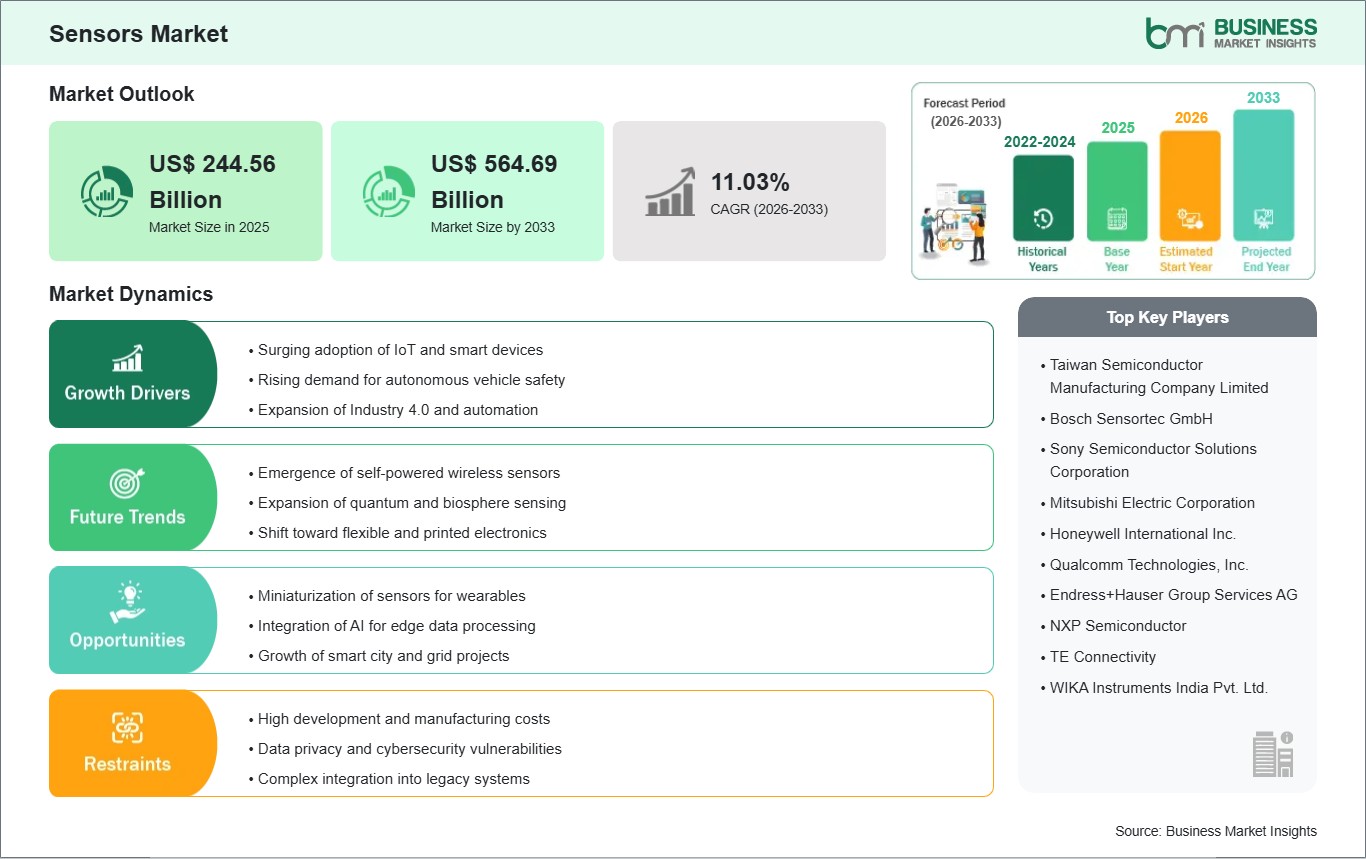
Sensors serve as the primary source of real-time data in the digital world by detecting and converting physical inputs such as motion, pressure, temperature, and light into measurable signals. These devices are integral to major technological advancements, including industrial automation (Industry 4.0), autonomous vehicles, connected healthcare, and consumer electronics. Sensors offer advantages, including enabling real-time condition monitoring, enhancing process efficiency, and significantly improving safety across all application sectors. The market is being fueled by the ubiquitous proliferation of the Internet of Things (IoT) and connected devices, the escalating demand for Advanced Driver Assistance Systems (ADAS) and electric vehicles (EVs), and the increasing global adoption of factory and process automation. Additionally, the continuous innovation in MEMS (Micro-Electro-Mechanical Systems) technology is driving miniaturization, cost-effectiveness, and superior integration capabilities.
However, several challenges can restrain market growth: the high cost and manufacturing complexity associated with advanced, high-precision sensors (e.g., LiDAR), which can limit widespread adoption, particularly in cost-sensitive industrial segments. The lack of uniform communication standards across diverse IoT and industrial platforms also presents integration hurdles for end-users. Furthermore, the industry faces constraints due to the scarcity of skilled professionals required to configure, integrate, and maintain complex sensor networks. Despite these hurdles, the market holds immense opportunities due to stringent government safety and environmental regulations (boosting demand for automotive emissions and safety sensors), the expansion of smart city infrastructure, and the growing use of biosensors in advanced healthcare diagnostics and remote patient monitoring.
Segment Analysis
Sensors Market Segmentation
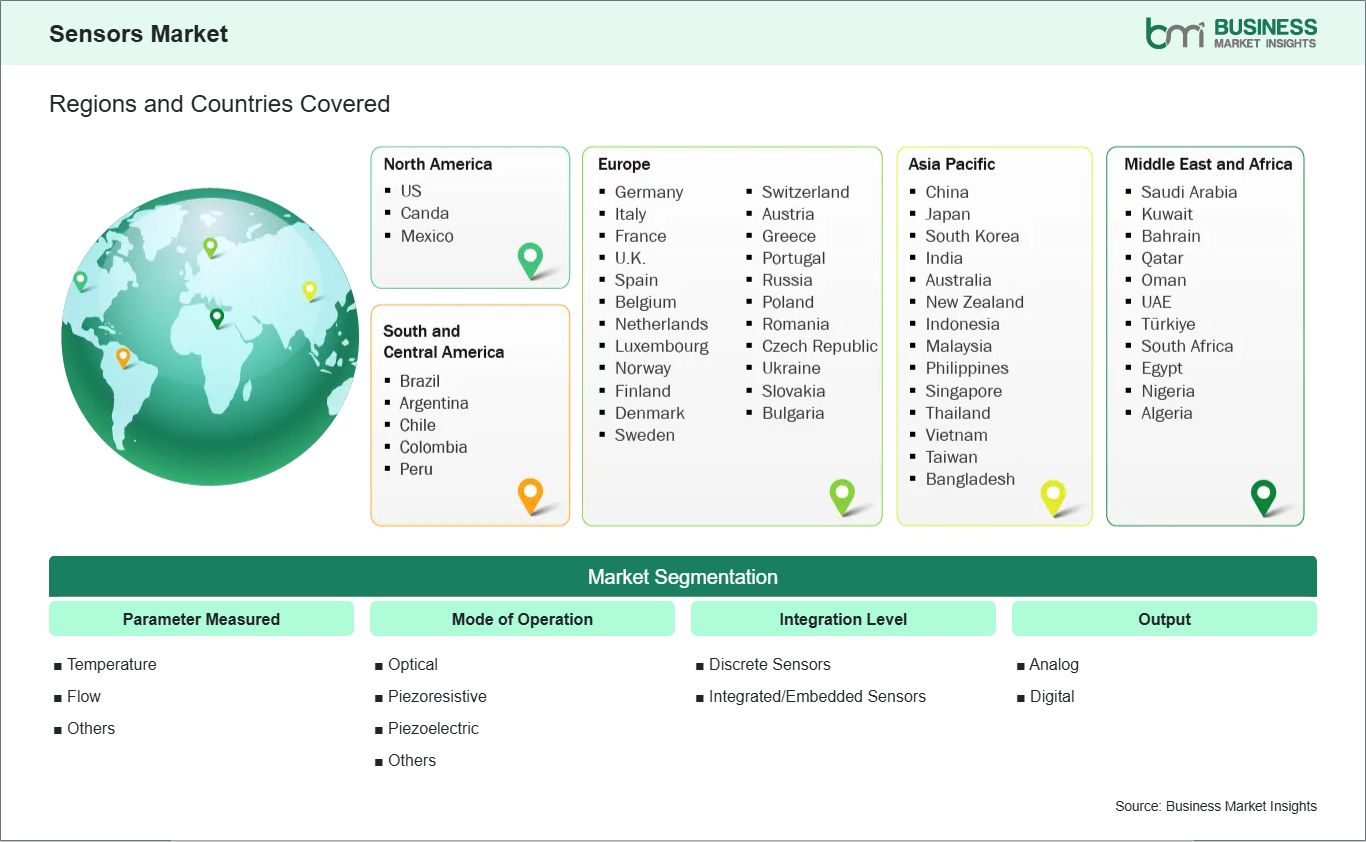
Key segments that contributed to the derivation of the Sensors market analysis are parameter measured, mode of operation, integration level, and output.
- By Parameter Measured, the market is segmented into Temperature, Flow, and Others.
- By Mode of Operation, the market is segmented into Optical, Piezoresistive, Piezoelectric, and Others.
- By Integration Level, the market is segmented into Discrete Sensors and Integrated/Embedded Sensors.
- By Output, the market is segmented into Analog and Digital.
Market Forces
Sensors Market Drivers and Opportunities
Proliferation of IoT and Smart Devices
The core catalyst for the Sensors Market is the explosive growth of the Internet of Things (IoT) ecosystem and the subsequent demand for intelligence in nearly every electronic device. Every connected device, from simple smart home appliances and wearable technology to complex industrial machinery, requires multiple sensors to gather data about its environment and operational status. This fundamental requirement has created a massive, constant demand for new and varied sensor types (e.g., temperature, motion, pressure, and chemical sensors). The goal of IoT is to enable real-time monitoring, remote control, and data-driven decision-making across all sectors. As billions of devices come online in homes, cities, and businesses, the need for these miniature, low-power components to translate the physical world into digital data remains the primary propellant for market expansion.
Autonomous Systems and Predictive Maintenance
The most significant growth opportunities for the sensors market are in the accelerated development of autonomous systems and the integration of sensors for predictive maintenance in industrial settings. Autonomous systems, most prominently in the form of Advanced Driver Assistance Systems (ADAS) and self-driving vehicles, rely on sophisticated sensor fusion techniques to navigate safely. This drives demand for high-value components such as LiDAR, RADAR, and high-resolution image sensors. In the industrial sector, the adoption of Industry 4.0 principles is creating immense demand for sensors that monitor machine health in real time. These sensors track parameters such as vibration, temperature, and current draw, enabling predictive maintenance programs. By using sensor data to anticipate equipment failures, companies can avoid costly unplanned downtime and significantly enhance operational efficiency, turning sensors into key strategic assets.
Size and Share Analysis
Sensors Market Size and Share Analysis
The Sensors market demonstrates steady growth, with size and share analysis revealing evolving trends and competitive positioning among key players. The report further examines subsegments categorized within parameter measured, mode of operation, integration level, and output, offering insights into their contribution to overall market performance.
For instance, based on parameter measured, the temperature and flow subsegments hold a significant share of the market. These parameters are often measured by utilizing Piezoresistive or Piezoelectric sensors. These sensors are widely deployed in the automotive and industrial sectors for engine management and process control. The integration of Digital interfaces in these sensors is a growing trend, as it allows for direct communication with industrial IoT gateways and simplifies the calibration process in complex manufacturing environments.
Report Coverage
Sensors Market Report Coverage and Deliverables
The "Sensors Market Size and Forecast (2022 - 2033)" report provides a detailed analysis of the market covering below areas:
- Sensors market size and forecast at global, regional, and country levels for all the key market segments covered under the scope
- Sensors market trends, as well as market dynamics such as drivers, restraints, and key opportunities
- Sensors market analysis covering key market trends, global and regional framework, major players, regulations, and recent market developments
- Industry landscape and competition analysis covering market concentration, heat map analysis, prominent players, and recent developments for the Sensors market
- Detailed company profiles, including SWOT analysis
Geographic Insights
Sensors Market Geographic Insights
The geographical scope of the Sensors market report is divided into five regions: North America, Asia Pacific, Europe, Middle East & Africa, and South & Central America.
The Asia-Pacific Sensors Market is segmented into China, Japan, South Korea, India, Australia, New Zealand, Indonesia, Malaysia, the Philippines, Singapore, Thailand, Vietnam, Taiwan, Bangladesh, and the Rest of Asia. The market is primarily driven by the region's dominance as a global electronics manufacturing hub and the rapid adoption of Industry 4.0 and IoT technologies.
Growth is further accelerated by the booming automotive sector, particularly the transition to Electric Vehicles (EVs) and Autonomous Driving, which require a high density of image, radar, and LiDAR sensors. The presence of major semiconductor foundries and government-backed initiatives for digital transformation and smart agriculture solidifies Asia-Pacific as a hub for sensor innovation and demand.
Industry Activity
Recent Developments
The Sensors market is evaluated by gathering qualitative and quantitative data post primary and secondary research, which includes important corporate publications, association data, and databases. A few of the key developments in the Sensors market are:
- In November 2024, Sony Semiconductor Solutions Corporation (SSS) announced the upcoming release of the IMX925 stacked CMOS image sensor with back-illuminated pixel structure and global shutter. This new product offers 394 fps high-speed processing and a high, 24.55-effective-megapixel count and is optimized for industrial equipment imaging.
- In October 2024, Mitsubishi Electric announced the upcoming launch of a new MelDIR-brand 80×60-pixel thermal-diode infrared sensor (MIR8060C1) with a 100°×73° field of view, more than double that of the company's existing thermal-diode infrared sensors, to accurately and efficiently identify people and objects. The expanded field of view will reduce the number of sensors required to effectively monitor large areas, contributing to the safety, security, and convenience of solutions for monitoring elderly care facilities and building air-conditioning systems, counting people, and measuring body temperatures.
Trust & Transparency
Research Methodology
The market analysis combines proprietary research with secondary data from government agencies, company disclosures, regulatory filings, industry databases and expert interviews. Market estimates are validated through data triangulation, cross-market benchmarking and analyst
review.
View Full Research Methodology
Key Sources Referred:
World Bank - Global Trade IndicatorsWorld Trade Organization (WTO)International Monetary Fund (IMF)International Trade Administration (ITA)Company WebsitesCompany Annual ReportsCompany Investor Presentations