
Torque Sensors Market Outlook: Size, Share, Trends, Growth Analysis, Competitive Landscape & Forecast, 2026-2033

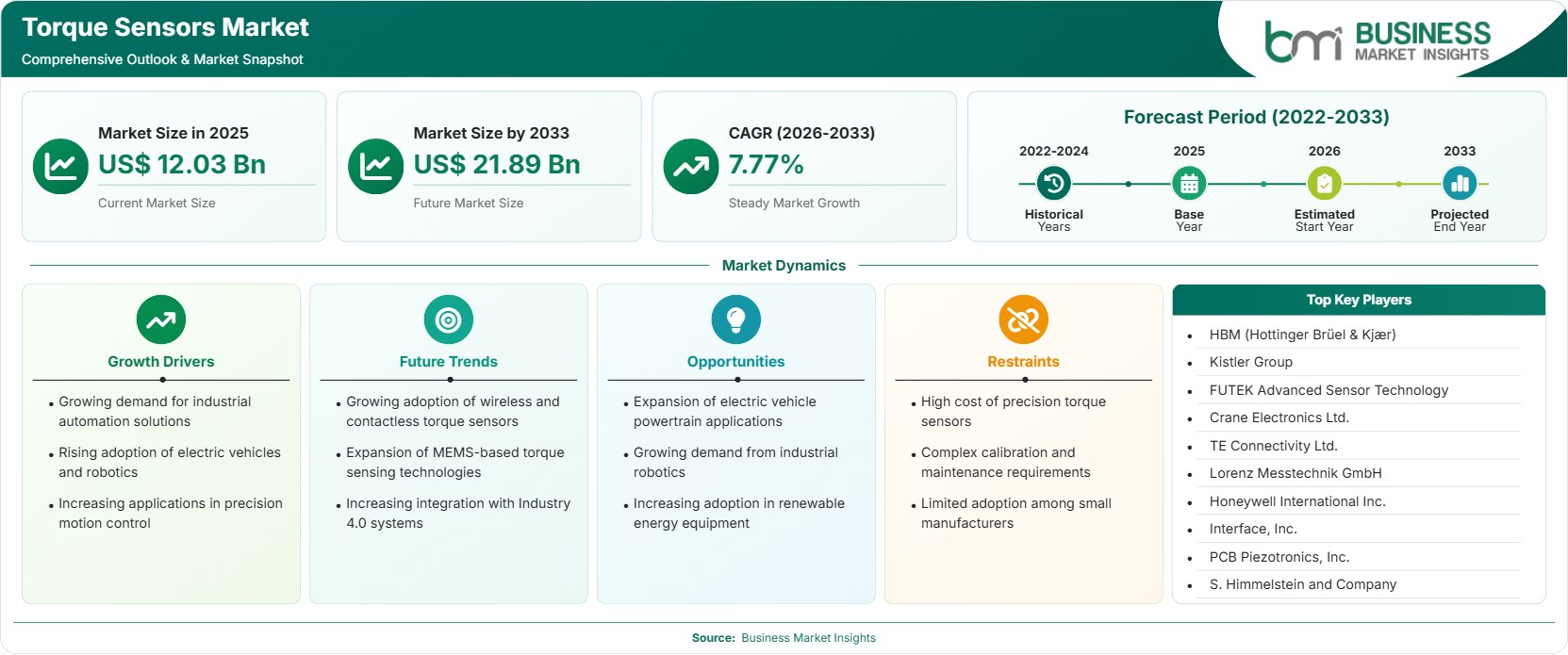
The Torque Sensors Market size was valued at US$ 12.03 Billion in 2025 and is projected to reach US$ 21.89 Billion by 2033, growing at a CAGR of 7.77% from 2026 to 2033. Market expansion is driven by increasing demand for industrial automation solutions, rising adoption of electric vehicles and robotics, growing applications in precision motion control systems, and increasing utilization of advanced sensing technologies across automotive, aerospace, manufacturing, and healthcare industries.

Report Coverage
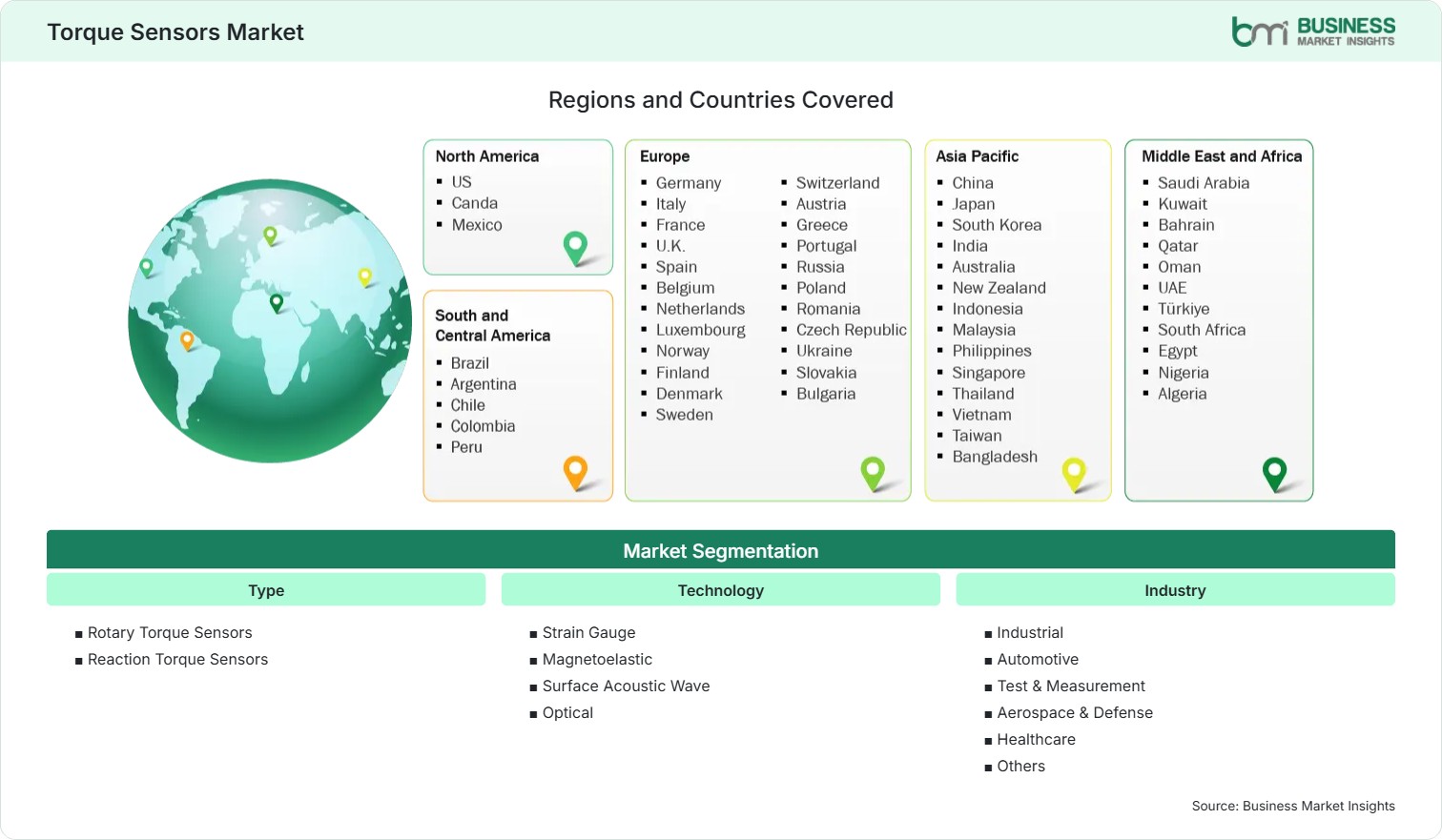
  • Type: Rotary Torque Sensors, Reaction Torque Sensors
  • Technology: Strain Gauge, Magnetoelastic, Surface Acoustic Wave, Optical
  • Industry: Industrial, Automotive, Test & Measurement, Aerospace & Defense, Healthcare, Others
US$ 12.03 Bn Market size in 2025
US$ 21.89 Bn Market Size by 2033
7.77% CAGR, 2026 - 2033
2026-2033 Forecast Period

AI Overview

Torque Sensors Market Summary

  • North America Region: North America accounted for 34%–37% share in 2025 and is projected to grow at a CAGR of 7.40%–8.00% during 2026–2033. Growth is supported by advanced manufacturing infrastructure, strong automotive technology adoption, increasing automation investments, and demand for high-precision measurement solutions. The United States remains the leading regional contributor due to expanding electric vehicle production and industrial robotics deployment.
  • Fastest Growing Region: Asia Pacific accounted for 31%–34% share in 2025 and is expected to grow at a CAGR of 8.20%–8.80% during 2026–2033. The region benefits from rapid industrialization, increasing automotive manufacturing, expanding robotics adoption, and rising investments in smart factory technologies.
  • Leading Segment: Rotary Torque Sensors represented 56%–59% share in 2025 and are expected to grow at a CAGR of 7.50%–8.00% through 2033 due to increasing usage in rotating machinery, automotive powertrains, robotics, and industrial equipment testing.
  • High Growth Segment: Magnetoelastic Technology is projected to grow at a CAGR of 8.10%–8.70% during the forecast period due to advantages such as non-contact measurement capabilities, durability, and suitability for harsh industrial environments.
  • Key Market Opportunity: Expansion of electric vehicle powertrain applications, increasing deployment of industrial robotics, and growing adoption of torque measurement solutions in renewable energy equipment are creating new opportunities for manufacturers.
  • Major Market Players: HBM (Hottinger Brüel & Kjær), Kistler Group, FUTEK Advanced Sensor Technology, Crane Electronics Ltd., TE Connectivity Ltd., Lorenz Messtechnik GmbH, Honeywell International Inc., Interface, Inc., PCB Piezotronics, Inc., and S. Himmelstein and Company.
Strategic Insights

Torque Sensors Market: Strategic Insights

Torque Sensors Market Strategic Framework
FREE PDF
Request your free sample
Request free sample
Stakeholder View

Key Takeaways

  • The market ecosystem includes sensor manufacturers, automation companies, automotive suppliers, testing equipment providers, and industrial technology developers.
  • Increasing adoption of electric vehicles is creating strong demand for torque sensors used in motor testing, drivetrain optimization, and performance monitoring.
  • Industrial automation and robotics applications are expanding rapidly as manufacturers seek improved accuracy, efficiency, and predictive maintenance capabilities.
  • Asia Pacific represents a major growth opportunity due to expanding manufacturing activities, increasing automation investments, and rising adoption of smart factory technologies.
  • Technological advancements in magnetoelastic, optical, and wireless torque sensing solutions are improving measurement accuracy and application flexibility.
  • Strategic partnerships between sensor manufacturers and automotive or industrial equipment companies are supporting product innovation and market expansion.
Geographic Outlook

Torque Sensors Market Regional Highlights

North America Torque Sensors Market

North America accounted for 34%–37% share in 2025 and is projected to grow at a CAGR of 7.40%–8.00% during 2026–2033. The region remains a significant market due to strong adoption of industrial automation, advanced automotive manufacturing, and precision testing technologies. The Torque Sensors Market share is supported by increasing electric vehicle production, robotics implementation, and demand for accurate measurement systems across manufacturing facilities.

  • The United States continues driving regional demand through automotive innovation and advanced manufacturing investments.
  • Industrial companies are increasing adoption of torque measurement solutions for automation and equipment monitoring.
  • Aerospace manufacturers are using high-precision torque sensors for testing and validation applications.
  • Healthcare equipment manufacturers are adopting compact sensing technologies for advanced medical devices.

US Torque Sensors Market

The United States accounted for 29%–32% share of North America in 2025 and is expected to grow at a CAGR of 7.60%–8.20% during 2026–2033. The country remains a key market due to strong demand from automotive, aerospace, robotics, and industrial automation sectors in Torque Sensors Market. Increasing electric vehicle manufacturing and investments in smart manufacturing technologies are creating new opportunities for torque sensor providers.

  • Electric vehicle manufacturers are increasing demand for accurate drivetrain testing solutions.
  • Robotics companies are integrating torque sensors for improved motion control and operational safety.
  • Research institutions are adopting advanced torque measurement systems for testing applications.
  • Manufacturers are focusing on compact and high-accuracy sensor technologies.

Europe Torque Sensors Market

Europe accounted for 24%–27% share in 2025 and is projected to grow at a CAGR of 7.20%–7.80% during 2026–2033. The region is witnessing increasing demand for torque sensors due to strong automotive manufacturing capabilities, growing electric vehicle production, and expanding industrial automation initiatives. Germany, France, the United Kingdom, and Italy represent major contributors to regional growth. The adoption of Industry 4.0 technologies and increasing focus on energy-efficient manufacturing systems are further supporting Torque Sensors market expansion.

  • Germany remains a leading contributor due to its advanced automotive sector, robotics adoption, and precision engineering capabilities.
  • European automotive manufacturers are increasing investments in electric vehicle testing and powertrain development.
  • Industrial automation initiatives are encouraging adoption of advanced torque measurement solutions.
  • Aerospace and defense companies are utilizing high-accuracy sensors for testing and performance evaluation applications.

Asia Pacific Torque Sensors Market

Asia Pacific accounted for 31%–34% share in 2025 and is expected to grow at a CAGR of 8.20%–8.80% during 2026–2033. The region represents the fastest-growing market due to rapid industrialization, increasing manufacturing activities, rising adoption of robotics, and expanding electric vehicle production. China, Japan, South Korea, and India are key markets contributing to regional Torque Sensors Market growth. Government initiatives supporting smart manufacturing and automation are creating favorable conditions for torque sensor adoption.

  • China continues expanding industrial automation and electric vehicle manufacturing capabilities.
  • Japan maintains strong demand through robotics, automotive technology, and precision engineering industries.
  • South Korea is increasing adoption of torque sensors in automotive electronics and industrial applications.
  • India is witnessing growing demand due to manufacturing expansion, automation investments, and electric mobility initiatives.

Rest of World Torque Sensors Market

Rest of World accounted for 7%–10% share in 2025 and is projected to grow at a CAGR of 6.80%–7.40% during 2026–2033. Latin America, the Middle East, and Africa are gradually adopting torque sensing technologies due to increasing industrial development, renewable energy investments, and modernization of manufacturing infrastructure. Brazil, Mexico, and Middle Eastern countries are contributing to regional growth through automotive, energy, and industrial projects in Torque Sensors Market.

  • Latin American countries are adopting torque sensors in automotive manufacturing and industrial equipment applications.
  • Middle Eastern markets are increasing demand through renewable energy and infrastructure development projects.
  • African industries are gradually implementing automation technologies to improve operational efficiency.
  • Growing investment in industrial modernization is supporting adoption of precision measurement solutions.
Global Market Geography
FREE PDF
Request your free sample
Request free sample
Segment Analysis

Torque Sensors Market Segmentation

Type

The Type segment includes Rotary Torque Sensors and Reaction Torque Sensors. Rotary Torque Sensors accounted for the largest market share in 2025 due to their widespread application in rotating machinery, automotive powertrains, robotics, and industrial equipment testing. The segment is projected to grow at a CAGR of 7.50%–8.00% during 2026–2033 as industries increasingly require accurate rotational force measurement in Torque Sensors Market forecasts.

  • Rotary Torque Sensors: Rotary torque sensors are widely used for measuring torque in rotating systems, including motors, engines, gearboxes, and robotic mechanisms. Their ability to provide real-time performance data supports applications in automotive testing, manufacturing, and research environments.
  • Reaction Torque Sensors: Reaction torque sensors are used in applications where rotational movement is restricted, including motor testing, fastening systems, and industrial machinery monitoring. Increasing demand for precision testing equipment is supporting segment growth.

Technology

The Technology segment includes Strain Gauge, Magnetoelastic, Surface Acoustic Wave, and Optical technologies. Strain Gauge technology currently represents a significant Torque Sensors market share due to its established adoption, accuracy, and cost-effectiveness across industrial and testing applications. However, Magnetoelastic technology is witnessing faster growth due to non-contact measurement advantages and improved durability.

  • Strain Gauge: Strain gauge torque sensors remain widely adopted due to reliable performance, high accuracy, and suitability for industrial testing, automotive, and manufacturing applications.
  • Magnetoelastic: Magnetoelastic sensors are gaining importance due to their ability to perform non-contact torque measurement, reduced maintenance requirements, and suitability for harsh environments.
  • Surface Acoustic Wave: Surface Acoustic Wave technology offers wireless sensing capabilities and compact designs, supporting applications requiring remote measurement and space-efficient solutions.
  • Optical: Optical torque sensors provide high precision and immunity to electromagnetic interference, making them suitable for advanced industrial and research applications.

Industry

The Industry segment includes Industrial, Automotive, Test & Measurement, Aerospace & Defense, Healthcare, and Others. Industrial applications represented the leading segment in 2025 for Torque Sensors Market due to increasing automation, robotics deployment, and demand for predictive maintenance systems. The automotive sector is expected to experience strong growth due to expanding electric vehicle production and advanced drivetrain testing requirements.

  • Industrial: Industrial applications drive demand through robotics, machinery monitoring, automation systems, and manufacturing process optimization.
  • Automotive: Automotive adoption is increasing due to electric vehicle motors, powertrain testing, vehicle development, and performance validation requirements.
  • Test & Measurement: Test and measurement applications utilize torque sensors for research, calibration, equipment validation, and product development.
  • Aerospace & Defense: Aerospace and defense industries require high-precision torque sensors for aircraft systems, engine testing, and advanced equipment evaluation.
  • Healthcare: Healthcare applications use torque sensing technologies in medical equipment, rehabilitation devices, and robotic-assisted systems.
Market Forces

Torque Sensors Market Dynamics

Key Market Drivers

Growing demand for industrial automation solutions

The growing demand for industrial automation solutions is a major factor accelerating adoption of torque sensors across manufacturing and processing industries. Companies are increasingly implementing automated production systems, robotic machinery, and intelligent equipment that require accurate torque measurement for improved performance monitoring and operational control. Torque sensors enable real-time measurement of mechanical forces, helping manufacturers optimize machine efficiency, reduce downtime, and improve product quality. The growth is supported by increasing investments in smart factories, Industry 4.0 technologies, and automated manufacturing processes. The Torque Sensors Market trends indicate rising adoption of advanced sensing solutions that provide higher accuracy, faster response times, and improved integration with industrial control systems.

Rising adoption of electric vehicles and robotics

The increasing adoption of electric vehicles and robotics is significantly driving demand for advanced torque sensing technologies. Electric vehicle manufacturers require precise torque measurement solutions for motor testing, drivetrain optimization, efficiency analysis, and performance validation. Similarly, robotics applications depend on torque sensors to improve motion control, enhance safety, and enable accurate force feedback during automated operations. As automotive manufacturers and industrial companies continue investing in electrification and automation, demand for compact, reliable, and high-performance torque sensors is increasing. Advancements in sensor miniaturization, wireless connectivity, and digital signal processing are further supporting broader deployment across next-generation mobility and robotic systems.

Increasing applications in precision motion control

Growing applications in precision motion control systems are creating significant demand for torque sensors across robotics, aerospace, manufacturing, and healthcare industries. Modern automated systems require accurate force measurement to achieve smooth movement, improved positioning accuracy, and enhanced operational reliability. Torque sensors enable advanced control algorithms by providing real-time feedback regarding mechanical loads and system performance. The increasing complexity of robotic systems, medical devices, and automated machinery is encouraging manufacturers to integrate advanced torque measurement solutions. Continuous innovation in sensor technologies is expected to improve accuracy, reduce size, and expand application possibilities across precision engineering industries.

Key Market Opportunities

Expansion of electric vehicle powertrain applications

The expansion of electric vehicle powertrain applications represents a major opportunity for torque sensor manufacturers. Electric vehicles require accurate torque monitoring for electric motors, transmissions, battery systems, and drivetrain components to improve efficiency and performance. Automotive manufacturers are investing heavily in electric mobility development, increasing demand for reliable testing and validation equipment. Torque sensors play an important role in evaluating motor efficiency, thermal performance, and power delivery characteristics. As electric vehicle production continues expanding globally, sensor providers have opportunities to develop specialized solutions designed for high-voltage powertrain testing and next-generation vehicle platforms.

Growing demand from industrial robotics

Increasing adoption of industrial robotics is creating new opportunities for torque sensor companies as manufacturers seek improved automation accuracy and operational flexibility. Robotic systems require torque measurement capabilities for force control, assembly operations, quality inspection, and collaborative robot applications. Growing deployment of robots in automotive, electronics, logistics, and manufacturing industries is increasing demand for compact and reliable sensing technologies. Companies developing advanced torque sensors with improved sensitivity, durability, and integration capabilities can benefit from expanding robotics applications. The transition toward intelligent factories and automated production environments is expected to further strengthen demand.

Increasing adoption in renewable energy equipment

The increasing adoption of torque sensors in renewable energy equipment is creating additional growth opportunities. Wind turbines, solar tracking systems, and energy generation equipment require accurate torque monitoring to improve efficiency, optimize performance, and support predictive maintenance. Torque sensors help operators evaluate mechanical loads, detect equipment issues, and improve reliability of renewable energy systems. Growing investments in clean energy infrastructure and increasing focus on operational efficiency are encouraging deployment of advanced measurement technologies. Manufacturers offering durable sensors capable of operating in challenging environmental conditions are expected to benefit from expanding renewable energy applications.

Market Restraints and Challenges

High cost of precision torque sensors

Factor: Precision torque sensors require advanced manufacturing processes, high-quality materials, specialized calibration procedures, and sophisticated electronic components to achieve accurate measurement performance. Technologies such as optical and magnetoelastic sensors often involve complex designs and higher production expenses compared with conventional sensing solutions.

Impact: High costs may limit adoption among small and medium-sized enterprises and price-sensitive industries. Companies with limited automation budgets may delay investments in advanced torque measurement systems, affecting market penetration. Manufacturers are addressing this challenge by improving production efficiency, developing cost-effective sensor designs, and offering scalable solutions that balance accuracy with affordability.

Complex calibration and maintenance requirements

Factor: Torque sensors require regular calibration, precise installation, and periodic maintenance to ensure measurement accuracy and long-term reliability. Environmental factors, mechanical stress, temperature variations, and improper handling can affect sensor performance. Industries using high-precision equipment must maintain strict calibration procedures to avoid inaccurate measurements and operational issues.

Impact: Complex maintenance requirements can increase operating costs and create challenges for end users lacking specialized technical expertise. Longer installation processes and calibration requirements may slow adoption in certain industries. Sensor manufacturers are focusing on self-calibrating technologies, improved durability, and user-friendly designs to reduce maintenance complexity and enhance overall product reliability.

Company Analysis

Competitive Landscape

The Torque Sensors Market analysis is characterized by competition among global sensor manufacturers, measurement technology providers, and industrial automation companies. Leading players are focusing on product innovation, sensor miniaturization, wireless connectivity, and improved measurement accuracy to strengthen their market position. Companies are expanding applications across electric vehicles, industrial robotics, aerospace systems, and renewable energy equipment by developing advanced torque measurement solutions. Strategic partnerships with automotive manufacturers, research organizations, and industrial equipment providers are supporting technology development and market expansion.

Company Name

Overview

Products and Services relevant to this market

HBM (Hottinger Brüel & Kjær)

Global measurement technology company specializing in sensors and data acquisition solutions for industrial and research applications.

Provides torque sensors, force measurement systems, testing solutions, and precision measurement technologies.

Kistler Group

International manufacturer of dynamic measurement technology solutions for automotive, industrial, and research sectors.

Offers torque sensors, force sensors, testing systems, and measurement solutions for engine, drivetrain, and manufacturing applications.

FUTEK Advanced Sensor Technology

Sensor technology company focused on precision measurement solutions for industrial and engineering applications.

Develops torque sensors, load cells, force measurement systems, and customized sensing solutions.

Crane Electronics Ltd.

Company specializing in torque measurement and fastening control solutions for manufacturing industries.

Provides torque analyzers, torque sensors, transducers, and quality control measurement systems.

TE Connectivity Ltd.

Global technology company providing sensors and connectivity solutions across automotive, industrial, and transportation markets.

Offers torque sensing technologies, industrial sensors, automotive measurement solutions, and connected sensor systems.

Lorenz Messtechnik GmbH

German measurement technology company focused on precision torque and force sensing products.

Manufactures rotary torque sensors, reaction torque sensors, test systems, and customized measurement solutions.

Honeywell International Inc.

Diversified technology company providing sensing and automation solutions across multiple industries.

Supplies advanced sensors, aerospace measurement solutions, industrial monitoring technologies, and control systems.

Interface, Inc.

Measurement technology company specializing in force, torque, and load measurement solutions.

Provides torque transducers, load cells, calibration equipment, and precision measurement products.

PCB Piezotronics, Inc.

Sensor manufacturer focused on vibration, force, pressure, and acoustic measurement technologies.

Offers torque sensors, dynamic measurement systems, industrial testing solutions, and data acquisition products.

S. Himmelstein and Company

Specialized manufacturer of torque measurement instruments and testing equipment.

Develops rotary torque sensors, torque meters, dynamometers, and precision measurement systems.

Trust & Transparency

Research Methodology

The market analysis combines proprietary research with secondary data from government agencies, company disclosures, regulatory filings, industry databases and expert interviews. Market estimates are validated through data triangulation, cross-market benchmarking and analyst review.

View Full Research Methodology

Questions Answered

Frequently Asked Questions

How can stakeholders use the Torque Sensors Market Report?

The Torque Sensors Report helps manufacturers, investors, automotive companies, industrial automation providers, and technology suppliers evaluate market opportunities, regional trends, competitive positioning, technology developments, and future growth strategies.

How are technological advancements improving torque sensors?

Advancements in magnetoelastic sensing, wireless connectivity, digital signal processing, and sensor miniaturization are improving measurement accuracy, reducing maintenance requirements, and enabling integration into compact and intelligent systems across various industries.

Which torque sensor type holds a significant market share?

Rotary Torque Sensors represent a leading segment due to their extensive usage in rotating machinery, automotive systems, motors, gearboxes, robotics, and industrial testing applications where continuous torque measurement is required.

Why are torque sensors important for electric vehicle applications?

Torque sensors help measure and analyze motor performance, drivetrain efficiency, and power transmission characteristics in electric vehicles. They support vehicle development, testing, optimization, and validation processes by providing accurate torque data required for improving performance and energy efficiency.

What factors are driving growth in the Torque Sensors Market?

The market is growing due to increasing industrial automation, rising adoption of electric vehicles, expanding robotics applications, and growing demand for precision motion control systems. The need for accurate measurement, predictive maintenance, and improved operational efficiency is encouraging industries to adopt advanced torque sensing technologies.

Access the Full Torque Sensors Market Report

Get segment-level forecasts, regional estimates, competitive benchmarking, company profiles and downloadable Excel datasets.

Access the full Torque Sensors Market Report
350 pages PDF & Excel | 2026-08-25