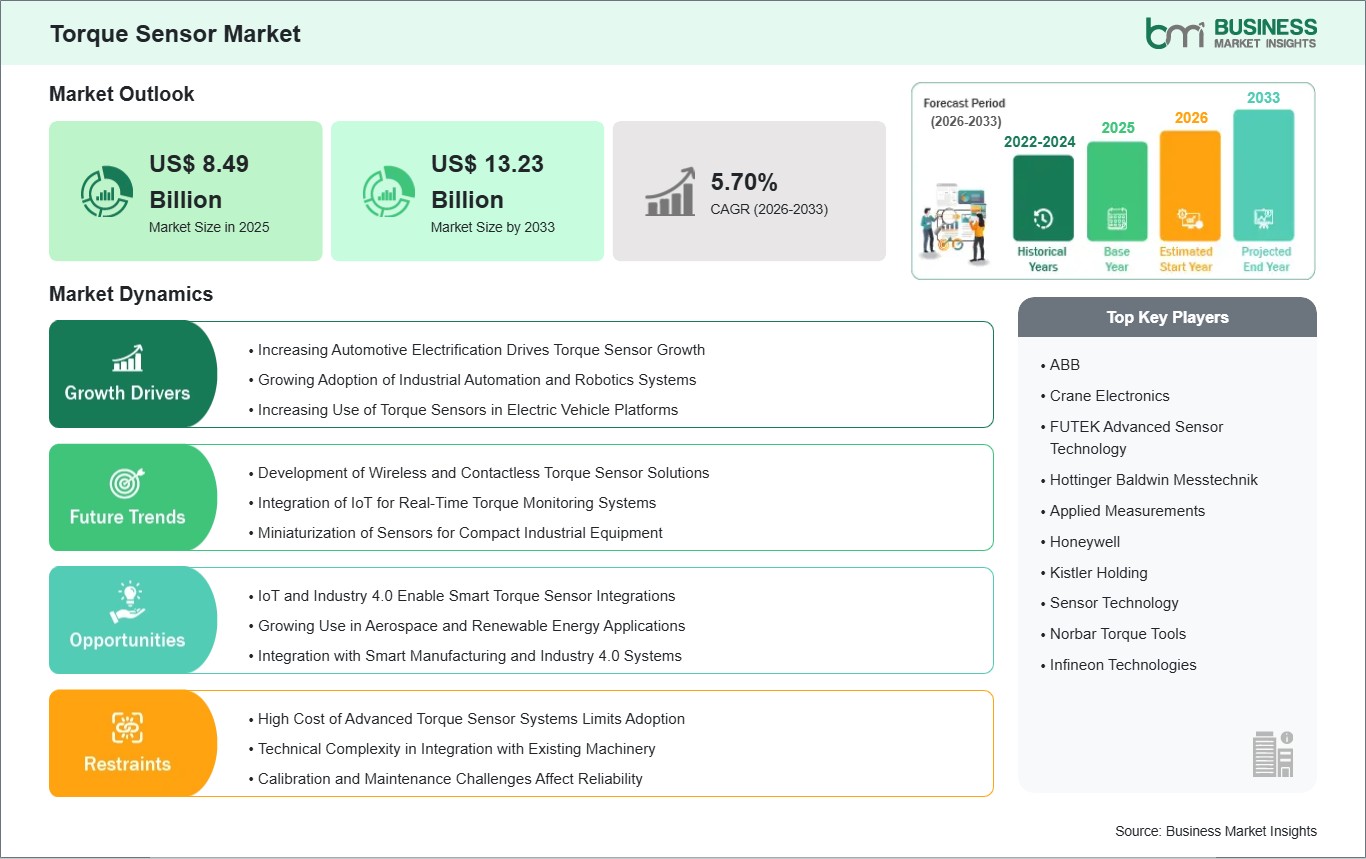
The Torque Sensor Market size is expected to reach US$ 13.23 billion by 2033 from US$ 8.49 billion in 2025. The market is estimated to record a CAGR of 5.70% from 2026 to 2033.
The global Torque Sensor Market is experiencing strong demand as industries require precise measurement and control of torque in complex systems. Torque sensors, also known as torque transducers, play a vital role in monitoring and optimizing torque in systems such as powertrains in automobiles, industrial machinery, robots, aircraft propulsion systems, and renewable power systems. The use of advanced manufacturing techniques and the adoption of predictive maintenance strategies have made torque sensors extremely important in quality assurance programs.
A major factor contributing to the overall market growth in the global market is the increasing rate of adoption of Industry 4.0 and smart factories, where the use of torque sensors is critical in the overall process. In the automotive and EV industry, the use of torque sensing is critical in calibrating the drivetrain, testing the transmission, and evaluating the performance of the electric motor. This has increased the demand for torque sensing in the overall process, especially in OEM and Tier-1 supplier industries that are focusing on integrating the sensor to meet the overall performance requirements. Furthermore, the increasing rate of automation in various industries has increased the use of high-precision torque sensors in robotics. Inspite of this strong market momentum, there are some key constraints in the market.
A major constraint in the market is that high-precision torque sensor technology can prove to be costly, which may not favor small businesses or cost-sensitive markets. In addition to this, the integration of high-precision torque sensor technology into existing systems can prove to be a major constraint. A second constraint in the market relates to environmental stresses that may affect the life and precision of torque sensor technology.Theglobal torque sensor market is poised to grow at a strong rate in the coming years, as various industries across the globe are focusing on improving their performance measurement, efficiency, and automated systems.

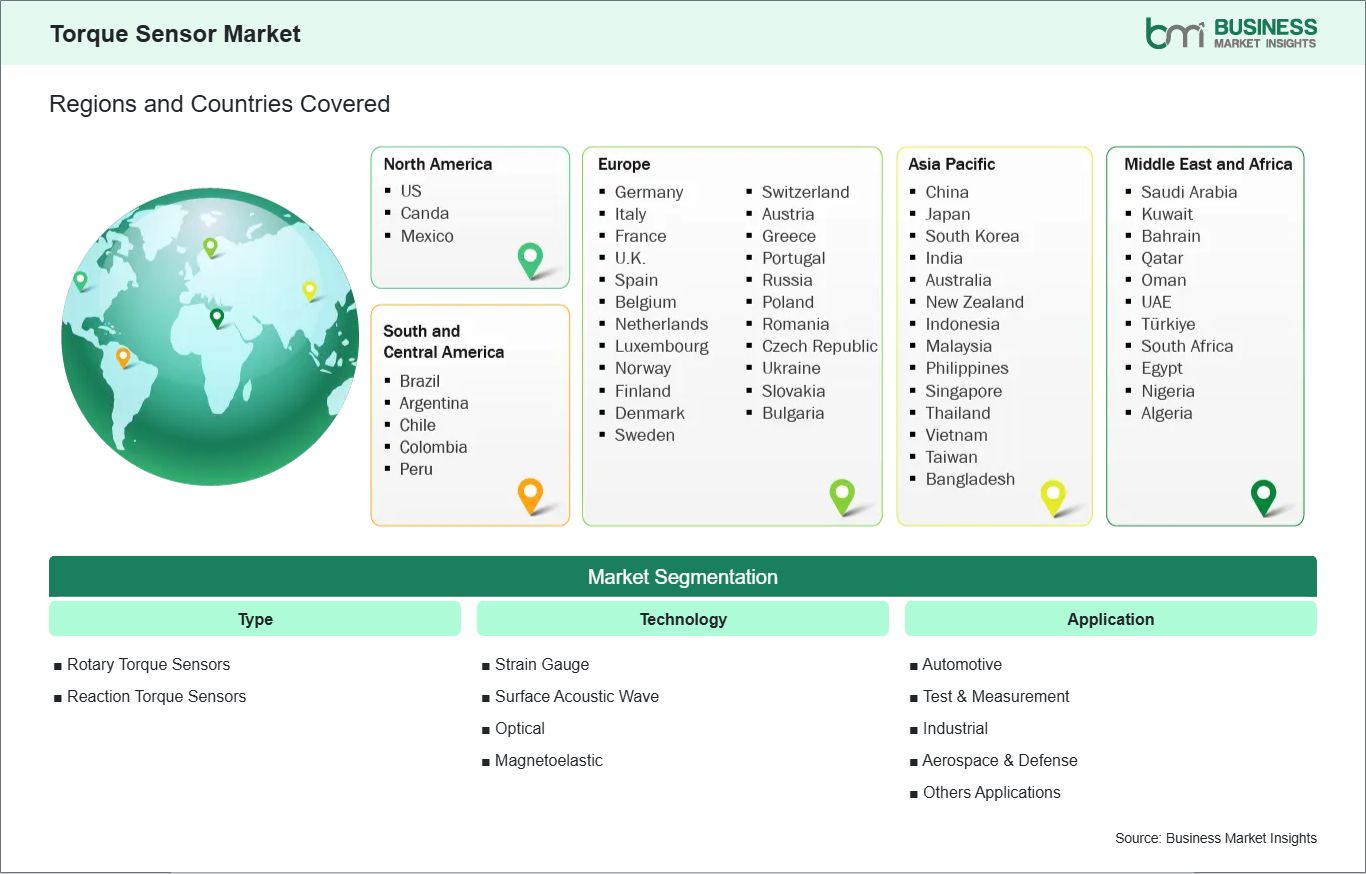
Key segments that contributed to the derivation of the torque sensor market analysis are type, technology and application.
The global torque sensor market is being strongly fueled by the accelerating shift toward automotive electrification. Electric vehicles (EVs) and hybrid models are gaining rapid market share worldwide, driving demand for torque sensors in critical components such as electric motors, e‑axles, and regenerative braking systems. Torque sensors are vital for monitoring rotational force and providing real-time feedback, enabling precise motor control, improved energy efficiency, and enhanced safety. In addition, advanced applications like electric power steering (EPS) and traction control increasingly rely on torque measurement to optimize vehicle performance. Analysts estimate that the proportion of EV powertrains integrating torque sensors will rise significantly over the next decade, reflecting their indispensable role in next-generation mobility. Beyond EVs, internal combustion engine (ICE) vehicles are also contributing to market growth, as torque sensors are integrated into hybrid systems and advanced driver assistance features. These applications enhance vehicle stability, fuel efficiency, and safety compliance, particularly in regions with strict automotive standards. North America and Europe, driven by stringent emissions and safety regulations, are pushing adoption of torque sensors in both conventional and electrified vehicles. Meanwhile, Asia-Pacific dominates production and consumption, with large automotive hubs in China, Japan, and India accelerating sensor integration. Collectively, the global automotive electrification trend is cementing torque sensors as a key growth driver for the market.
The adoption of Industry 4.0 and IoT-enabled smart manufacturing is transforming the global torque sensor market. Modern torque sensors are increasingly integrated with digital interfaces, wireless connectivity, and cloud-based analytics, allowing real-time monitoring and predictive maintenance across industrial operations. Connected sensors provide continuous feedback on machine performance, enabling manufacturers to detect anomalies, reduce downtime, and optimize production efficiency. In highly automated environments such as robotics, CNC machining, and precision assembly, these smart torque sensors enhance process control by delivering accurate, actionable data. In addition, torque sensors with IoT capabilities are being used to improve quality assurance and operational safety. By feeding live data to centralized monitoring systems, manufacturers can adjust force application, detect mechanical stress early, and maintain consistent product standards. The global push for digitalized industrial processes has increased demand for sensors that combine high precision with connectivity, opening opportunities in sectors such as aerospace, renewable energy, and medical robotics. Analysts project that over the next decade, smart torque sensor deployment will grow alongside the rise of connected factories, further embedding torque sensing into the fabric of global industrial automation.
The torque sensor market demonstrates steady growth, with size and share analysis highlighting evolving trends and competitive dynamics among key players. The report examines subsegments categorized within type, technology and application, offering insights into their contribution to overall market performance.
By type, the rotary torque sensors subsegment dominated the market in 2025, driven by their ability to provide continuous and accurate torque measurement in rotating systems across automotive and industrial applications.
Based on technology, the strain guage subsegment dominated the market in 2025, driven by its high accuracy, reliability, cost-effectiveness, and broad applicability across automotive, industrial, and aerospace sectors.
Based on application, the automotive subsegment dominated the market in 2025, driven by the growing adoption of electric power steering, EV drivetrains, and engine dynamometer testing, which rely heavily on torque sensors.
| Report Attribute | Details |
|---|---|
| Market size in 2025 | US$ 8.49 Billion |
| Market Size by 2033 | US$ 13.23 Billion |
| Global CAGR (2026 - 2033) | 5.70% |
| Historical Data | 2022-2024 |
| Forecast period | 2026-2033 |
| Segments Covered | By Type
|
|
Regions and Countries Covered
| |
| North America | US, Canada, Mexico |
| Europe | Belgium, Austria, Finland, Denmark, Greece, Poland, Romania, Russia, Ukraine, Czech Republic, Slovakia, Bulgaria, Italy, Luxembourg, Germany, Switzerland, France, Netherlands, Norway, Portugal, Spain, Sweden, United Kingdom |
| Asia-Pacific | Australia, China, India, Japan, South Korea, Indonesia, Malaysia, Philippines, Singapore, Thailand, Vietnam, Bangladesh, New Zealand, Taiwan |
| South and Central America | Brazil, Argentina, Peru, Chile, Colombia |
| Middle East and Africa | Bahrain, Kuwait, Oman, Qatar, Saudi Arabia, United Arab Emirates, Turkiye, South Africa, Egypt, Algeria, Nigeria |
| Market leaders and key company profiles |
|
The "Torque Sensor Market Size and Forecast (2022 - 2033)" report provides a detailed analysis of the market covering below areas:
The geographical scope of the Torque Sensor Market report is divided into North America, Asia Pacific, Europe, Middle East & Africa, and South & Central America. North America held the largest share in 2025.
North America is the most significant region in terms of market share for the global torque sensor market due to the presence of major automobile OEMs, industrial infrastructure, and the adoption of electric and hybrid vehicles. The United States and Canada are significant contributors to this market. With many manufacturers using torque sensors in electric vehicles, automated testing equipment, and robotics, North America is home to robust R&D centers and stringent regulations for automobile manufacturers.
Europe is another significant contributor to this market, with countries such as Germany, France, and the U.K. being major contributors. With a strong focus on industrial and automobile production in Europe, this region is home to many aerospace companies demanding high-precision torque sensors for electric vehicles, industrial automation, and aerospace testing. With rapid industrialization in this region, including countries such as China, Japan, India, and South Korea, and a strong focus on adopting electric vehicles and smart manufacturing solutions, this region is one of the fastest-growing in terms of market share.
The Middle East & Africa region indicates a moderate growth rate, mainly driven by industrial automation, renewable energy, and increasing infrastructure development, particularly in the UAE and Saudi Arabia, for torque sensors used in oil & gas, manufacturing, and heavy machinery industries.
The South & Central America region indicates an emerging market for torque sensors, as countries such as Brazil and Mexico are developing automotive electrification, industrialization, and energy-efficient systems. Overall, all the regions have seen growth, although at a lower rate, as the trend towards Industry 4.0, IoT, and connected automotive systems is increasing the need for smart torque sensors, which can provide real-time information for predictive maintenance.
Overall, while the North American region is leading due to technological maturity and high adoption rates in automotive and industrial segments, all other regions are experiencing growth due to electrification, automation, and digitalization initiatives, making the global torque sensor market highly competitive and innovation-driven.

The Torque Sensor Market is evaluated by gathering qualitative and quantitative data post primary and secondary research, which includes important corporate publications, association data, and databases. A few of the key developments in the torque sensor market are:
The Torque Sensor Market is valued at US$ 8.49 Billion in 2025, it is projected to reach US$ 13.23 Billion by 2033.
As per our report Torque Sensor Market, the market size is valued at US$ 8.49 Billion in 2025, projecting it to reach US$ 13.23 Billion by 2033. This translates to a CAGR of approximately 5.70% during the forecast period.
The Torque Sensor Market report typically cover these key segments-
The historic period, base year, and forecast period can vary slightly depending on the specific market research report. However, for the Torque Sensor Market report:
The Torque Sensor Market is populated by several key players, each contributing to its growth and innovation. Some of the major players include:
The Torque Sensor Market report is valuable for diverse stakeholders, including:
Essentially, anyone involved in or considering involvement in the Torque Sensor Market value chain can benefit from the information contained in a comprehensive market report.
Please tell us your area of interest
(Market Segments/ Regions and Countries/ Companies)