
pH Sensors Market Outlook: Size, Share, Trends, Growth Analysis, Competitive Landscape & Forecast, 2026–2033

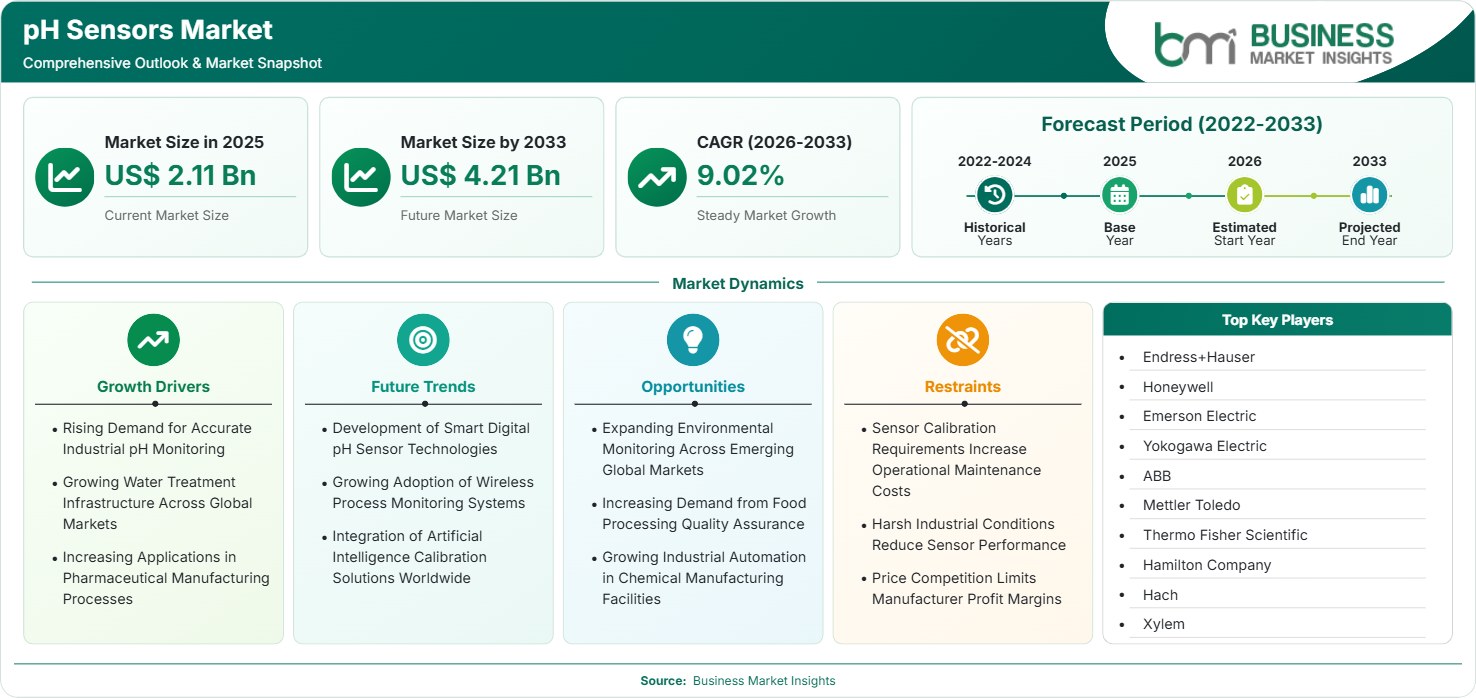
The pH Sensors Market size was valued at US$ 2.11 billion in 2025 and is projected to reach US$ 4.21 billion by 2033, growing at a CAGR of 9.02% during 2026–2033. Increasing industrial process monitoring needs, expanding water treatment activities, pharmaceutical manufacturing requirements, and automation adoption are driving market opportunities.

Report Coverage
  • Type: Combination pH Sensors, Differential pH Sensors, Laboratory pH Sensors, Process pH Sensors, Others
  • Application: Agriculture, Food & Beverage, Water Treatment, Pharmaceuticals, Others
US$ 2.11 Bn Market size in 2025
US$ 4.21 Bn Market Size by 2033
9.02% CAGR, 2026 - 2033
2026-2033 Forecast Period

01 AI Overview

pH Sensors Market Summary

  • North America Region: North America holds a market share of 34%–38% in 2025 and is expected to grow at a CAGR of 8.5%–9.5% during 2026–2033. Regional demand is supported by advanced water management infrastructure, pharmaceutical production, food processing quality requirements, and industrial automation adoption. The United States remains a major contributor due to established industrial facilities, environmental monitoring programs, and process control adoption, growing at a CAGR of 8.7%–9.7%.
  • Fastest Growing Region: Asia Pacific accounts for a market share of 30%–34% in 2025 and is projected to expand at a CAGR of 10.0%–11.0% during 2026–2033. Growth is driven by industrial expansion, wastewater treatment investments, pharmaceutical manufacturing growth, and increasing adoption of automated monitoring systems.
  • Leading Segment: Process pH Sensors represent a market share of 35%–39% in 2025 and are expected to grow at a CAGR of 9.0%–10.0% during 2026–2033. Demand is supported by continuous industrial monitoring requirements, automation integration, and process optimization needs.
  • High Growth Segment: Differential pH Sensors are expected to grow at a CAGR of 10.0%–11.0% during 2026–2033 due to increasing demand for reliable measurements in challenging industrial environments and advanced water treatment applications.
  • Key Market Opportunity: Rising environmental monitoring requirements, industrial automation adoption, pharmaceutical quality control, and expanding water treatment infrastructure are creating opportunities for advanced pH sensor solutions.
  • Major Market Players: Endress+Hauser, Honeywell, Emerson Electric, Yokogawa Electric, ABB, Mettler Toledo, Thermo Fisher Scientific, Hamilton Company, Hach, Xylem.
02 Strategic Insights

pH Sensors Market: Strategic Insights

pH Sensors Market Strategic Framework
FREE PDF
Request your free sample
Request free sample
03 Stakeholder View

Key Takeaways

  • The pH Sensors Market ecosystem includes sensor manufacturers, industrial automation providers, water treatment companies, pharmaceutical organizations, food processors, and laboratory equipment suppliers supporting measurement requirements.
  • Growth opportunities are concentrated in process industries, wastewater management, pharmaceutical production, and automated monitoring systems requiring accurate and continuous pH measurement.
  • Innovation is shifting toward digital sensors, wireless connectivity, predictive maintenance capabilities, improved electrode durability, and integration with industrial control platforms.
  • Asia Pacific provides strong investment opportunities due to industrial expansion, growing water treatment requirements, pharmaceutical manufacturing development, and automation adoption.
  • Companies are strengthening market positions through technology upgrades, strategic collaborations, product diversification, and expansion into emerging industrial applications.
  • Future competitiveness will depend on developing sensors with higher reliability, reduced maintenance requirements, and compatibility with advanced industrial monitoring systems. The pH Sensors Market report highlights that manufacturers focusing on innovation, application-specific solutions, and customer-oriented technologies can strengthen their long-term market positioning.
04 Geographic Outlook

pH Sensors Market Regional Highlights

North America pH Sensors Market

North America represents 34%–38% of global demand in 2025 and is expected to grow at a CAGR of 8.5%–9.5% through 2033. The region benefits from established industrial infrastructure, strict environmental monitoring standards, advanced manufacturing capabilities, and high adoption of automation technologies. The United States remains the leading contributor due to strong demand from water treatment, pharmaceutical, food processing, and chemical industries.

  • Water treatment modernization is increasing demand for accurate pH measurement systems across municipal and industrial facilities.
  • Pharmaceutical manufacturers are adopting advanced monitoring solutions to maintain process quality and regulatory compliance.
  • Industrial automation investments are supporting integration of intelligent sensor technologies.
  • Food processing companies are increasing adoption of sensors for quality control and production consistency.
  • Environmental regulations are encouraging continuous monitoring of water and chemical parameters.

US pH Sensors Market

The United States holds a significant position within North America due to advanced industrial capabilities, strong regulatory frameworks, and widespread automation adoption. Demand is supported by wastewater treatment expansion, pharmaceutical manufacturing, food safety requirements, and chemical processing applications. Companies are increasingly adopting advanced sensors to improve operational efficiency and maintain accurate process monitoring across industries.

  • Water infrastructure investments are supporting increased deployment of monitoring technologies.
  • Pharmaceutical facilities are adopting precise measurement systems for manufacturing quality control.
  • Industrial facilities are integrating digital sensors into automated process environments.
  • Environmental monitoring initiatives are increasing demand for reliable measurement equipment.

Europe pH Sensors Market

Europe accounts for 22%–26% of global demand in 2025 and is projected to grow at a CAGR of 8.0%–9.0% through 2033. Germany, the United Kingdom, France, and other industrial economies are supporting growth through advanced manufacturing, environmental sustainability initiatives, and strict quality standards. Regional adoption is strengthened by demand from pharmaceuticals, chemicals, food processing, and wastewater management industries.

  • Environmental regulations are encouraging adoption of advanced water monitoring solutions.
  • Pharmaceutical production facilities are increasing demand for precise process measurement systems.
  • Industrial automation adoption is improving sensor integration across manufacturing operations.
  • Food and beverage companies are using pH sensors for quality assurance processes.
  • Chemical manufacturers are adopting durable sensors for challenging applications.

Asia Pacific pH Sensors Market

Asia Pacific represents 30%–34% of global demand in 2025 and is expected to grow at a CAGR of 10.0%–11.0% through 2033. China, Japan, India, and South Korea are major contributors due to industrial expansion, pharmaceutical manufacturing growth, water treatment investments, and increasing automation adoption. The region provides strong opportunities as industries modernize production processes and improve monitoring capabilities.

  • Industrial development is increasing demand for process monitoring technologies.
  • Wastewater treatment investments are supporting sensor deployment across multiple sectors.
  • Pharmaceutical manufacturing expansion is creating additional measurement requirements.
  • Automation adoption is encouraging digital sensor integration.
  • Food processing growth is increasing demand for quality monitoring solutions.

Rest of World pH Sensors Market

The Rest of World region accounts for 8%–12% of global demand in 2025 and is expected to grow at a CAGR of 7.0%–8.0% through 2033. Latin America, Middle East, and Africa are gradually adopting pH sensor technologies due to industrial development, water management requirements, and increasing environmental monitoring activities.

Latin American markets are experiencing increased demand from agriculture, food processing, and water treatment sectors. Middle Eastern and African countries are investing in industrial infrastructure and water management systems, creating opportunities for reliable measurement technologies.

  • Water scarcity concerns are increasing demand for monitoring solutions in developing regions.
  • Industrial expansion is supporting adoption of process control technologies.
  • Food and beverage production is creating additional quality monitoring requirements.
  • Environmental programs are encouraging improved chemical measurement capabilities.
  • Infrastructure development is supporting adoption across emerging applications.
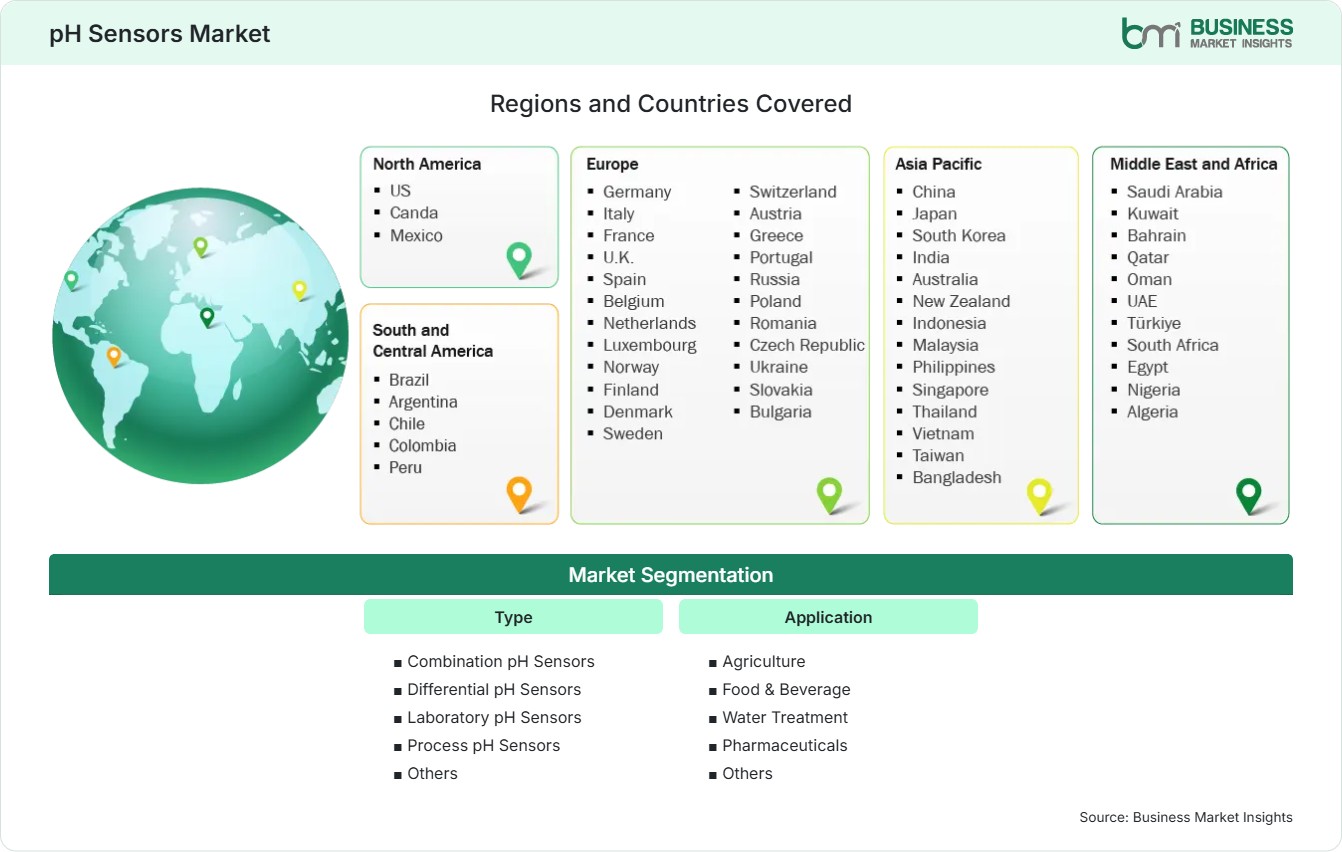
Global Market Geography
FREE PDF
Request your free sample
Request free sample
05 Segment Analysis

pH Sensors Market Segmentation

Type

The type segment is driven by increasing demand for accurate chemical measurement across industrial, laboratory, and environmental applications. Process pH sensors maintain strong adoption due to continuous monitoring requirements, while differential and combination sensors are gaining importance in advanced applications. The pH Sensors Market scope is expanding with rising automation and demand for reliable measurement solutions.

  • Combination pH Sensors: Combination pH sensors offer integrated measurement capabilities and are widely used for general laboratory, industrial, and water analysis applications.
  • Differential pH Sensors: Differential pH sensors provide improved stability and reliability in demanding environments requiring accurate measurements under challenging operating conditions.
  • Laboratory pH Sensors: Laboratory pH sensors support research, testing, and quality analysis applications requiring precise measurements and controlled environments.
  • Process pH Sensors: Process pH sensors enable continuous industrial monitoring and are extensively used in manufacturing, water treatment, and chemical processing operations.

Application

The application segment is expanding due to growing requirements for quality control, environmental compliance, and process optimization across industries. Water treatment remains a major application area, while pharmaceuticals, food processing, and agriculture are increasing adoption through stricter quality standards. The pH Sensors Market trend reflects rising demand for accurate monitoring systems integrated with automated industrial operations.

  • Agriculture: Agriculture applications use pH sensors for soil analysis, nutrient management, irrigation optimization, and improving crop productivity through accurate monitoring.
  • Food & Beverage: Food and beverage industries utilize pH sensors for quality control, fermentation monitoring, product consistency, and compliance with safety requirements.
  • Water Treatment: Water treatment applications rely on pH sensors for chemical balancing, wastewater management, purification processes, and environmental monitoring activities.
  • Pharmaceuticals: Pharmaceutical manufacturers use pH sensors for process validation, formulation control, laboratory analysis, and maintaining production quality standards.
  • Others: Other applications include chemical processing, research facilities, industrial manufacturing, and specialized monitoring requirements.
06 Market Forces

pH Sensors Market Dynamics

Key Market Drivers

Rising Demand for Accurate Industrial pH Monitoring

With rising demand in the industry for precise chemical measurements, the use of pH sensors is becoming more common across industrial applications. There is a growing need across industries for pH measurement to ensure quality, increase efficiency, and comply with regulations. Modern sensors offer enhanced reliability, faster response times, and greater compatibility with automated systems. The pH Sensors Market growth is fueled by an increased emphasis on process efficiency and accuracy. Modern manufacturers are offering digital and rugged sensors to cope with industrial conditions. The rising demand in the chemical, food processing, and water treatment industries is fueling adoption.

Growing Water Treatment Infrastructure Across Global Markets

The expansion of water treatment infrastructure is driving robust demand for pH sensors used in wastewater treatment and purification applications. Governments and businesses are investing more in water quality management due to the need for greater sustainability. pH sensors help maintain precise chemical balance and optimize treatment while meeting the requisite water quality parameters. The growing construction of water treatment plants is aiding further sensor deployment. Developing nations are offering new avenues through infrastructure upgrades and environmental projects. pH sensor manufacturers are focusing on designing rugged sensors that can operate under harsh water treatment conditions.

Increasing Applications in Pharmaceutical Manufacturing Processes

Use of pH sensors in pharmaceutical production has been increasing due to process control specifications and the need for precision in quality monitoring. Measurement of pH is significant for formulations, production uniformity, testing, and regulatory compliance. Improved sensors enable pharmaceutical firms to create controlled environments during production. Expansion in the pharmaceutical production capacity in various parts of the world has contributed to the rise in demand for monitoring technologies. Manufacturers have made efforts to develop more accurate, chemical-resistant sensors compatible with automation. Investments in the pharmaceutical industry are driving the use of pH sensors in various environments.

Key Market Opportunities

Expanding Environmental Monitoring Across Emerging Global Markets

More environmental monitoring efforts are being made in emerging markets, presenting opportunities for pH sensor producers. The focus of government authorities and businesses is on water and pollution management and sustainable resource use, resulting in high demand for monitoring instruments. Environmental monitoring involves measuring the chemical composition of water sources using sensors. With growing awareness of environmental protection among regulators, more monitoring equipment is being used. Manufacturers can capitalize on this opportunity by producing cost-effective, robust equipment for emerging markets. Cooperation with environmental agencies and infrastructure providers would also increase the market penetration of their products.

Increasing Demand from Food Processing Quality Assurance

The food processing industry is incorporating pH sensors to ensure product quality and consistency and to comply with safety regulations. pH measurements play a crucial role in processes such as fermentation, preservation, beverage manufacturing, and quality control. The increasing consumer demand for food safety and consistency is pushing the food industry to adopt more effective monitoring methods. Automated pH monitoring systems reduce process variation and enhance process efficiency. The rising popularity of processed food industries in emerging countries will provide further avenues for growth in demand. pH sensor manufacturers that specialize in hygienic, effective, and easy-to-integrate sensors will gain an edge in the food industry.

Growing Industrial Automation in Chemical Manufacturing Facilities

The automation of industrial manufacturing processes in chemical plants presents opportunities to use pH sensors, which can be integrated with digital control systems. Chemical firms need measurement devices that ensure efficient reactions, safety, and consistent production results. Automated measurement device technology enables real-time monitoring while minimizing manual involvement. Industrial companies are designing connected sensors with enhanced diagnostic capabilities and compatibility with industrial software applications. The development of intelligent manufacturing systems is prompting chemical companies to upgrade their existing monitoring systems. There is a high demand for measurement systems as more industries emphasize process optimization.

Market Restraints and Challenges

Sensor Calibration Requirements Increase Operational Maintenance Costs

Factor: It is necessary to regularly calibrate the pH sensors to ensure they provide accurate results. Impact: There will be additional work required, as many maintenance operations must be performed at high frequency. Such operations require people who are well-versed in the process, and regular checks are also necessary to ensure accuracy. Industries that use many such sensors will face challenges in their maintenance processes. The manufacturers are trying to address the problem by developing advanced sensors that require less calibration and are self-monitoring. Accuracy maintenance, on the other hand, will remain critical to maintaining user credibility. Organizations that use automated calibration technologies can reduce maintenance needs and improve efficiency. Lifecycle management will remain critical to ensuring sensor effectiveness.

Harsh Industrial Conditions Reduce Sensor Performance

Factor: Exposure to extreme temperatures, corrosive chemicals, and challenging industrial environments can reduce sensor durability. Impact: Reduced performance may increase replacement requirements and affect measurement reliability during critical operations. Industries such as chemical processing, wastewater treatment, and manufacturing often require sensors capable of operating under demanding conditions. Manufacturers are investing in improved materials, protective coatings, and advanced designs to enhance durability. However, maintaining performance while controlling production costs remains a challenge. Organizations must select suitable sensor technologies based on operating environments to ensure long-term reliability. Continuous innovation in sensor materials and engineering approaches will be important for improving performance in harsh industrial applications.

07 Company Analysis

Competitive Landscape

The pH Sensors Market analysis highlights a competitive environment driven by sensor innovation, automation integration, industrial monitoring requirements, and expansion across water treatment, pharmaceutical, food processing, and chemical applications. Leading companies are focusing on developing durable sensors, improving digital connectivity, enhancing measurement accuracy, and strengthening service capabilities to address evolving customer requirements.

Company Name

Overview

Products and Services relevant to this market

Endress+Hauser

Global measurement and automation technology provider offering industrial process monitoring solutions.

Industrial pH sensors, analytical measurement systems, liquid analysis solutions, and process instrumentation technologies.

Honeywell

Technology company providing automation, sensing, and industrial control solutions across multiple sectors.

pH measurement systems, process analytical instruments, industrial monitoring solutions, and automation platforms.

Emerson Electric

Industrial technology company specializing in automation and process management solutions.

Rosemount pH sensors, analytical instruments, process monitoring systems, and industrial automation solutions.

Yokogawa Electric

Measurement and control technology provider serving industrial and process industries globally.

pH analyzers, liquid analysis systems, process sensors, and advanced industrial measurement solutions.

ABB

Technology company focused on electrification, automation, and industrial digitalization solutions.

pH sensors, analytical measurement equipment, process automation systems, and monitoring technologies.

Mettler Toledo

Precision measurement company providing laboratory and industrial analytical instruments.

pH electrodes, process pH sensors, laboratory measurement systems, and analytical solutions.

Thermo Fisher Scientific

Scientific equipment company supporting laboratory, healthcare, and industrial research applications.

Laboratory pH meters, electrodes, analytical instruments, and measurement solutions.

Hamilton Company

Technology provider specializing in analytical instruments and precision measurement solutions.

pH sensors, process analytical systems, laboratory sensors, and automated measurement technologies.

Hach

Water analysis company providing monitoring and testing solutions for environmental applications.

pH sensors, water quality monitoring instruments, wastewater analysis solutions, and analytical equipment.

Xylem

Water technology company focused on water management and analytical monitoring solutions.

pH measurement instruments, water monitoring systems, treatment analytics, and environmental sensing solutions.

10 Trust & Transparency

Research Methodology

The market analysis combines proprietary research with secondary data from government agencies, company disclosures, regulatory filings, industry databases and expert interviews. Market estimates are validated through data triangulation, cross-market benchmarking and analyst review.

View Full Research Methodology

11 Questions Answered

Frequently Asked Questions

What does the pH Sensors Market forecast indicate about future competition?

The forecast indicates that competition will focus on sensor durability, digital integration, automation compatibility, and application-specific solutions. Companies improving accuracy, reducing maintenance requirements, and expanding industrial partnerships are expected to strengthen their competitive positioning.

Why are pharmaceutical applications creating new opportunities for pH sensor solutions?

Pharmaceutical applications require strict process control, formulation accuracy, and regulatory compliance. pH sensors help manufacturers maintain consistent production quality by supporting precise monitoring during development, testing, and manufacturing operations.

How are digital technologies influencing pH sensor adoption?

Digital technologies are improving adoption through wireless connectivity, automated diagnostics, predictive maintenance capabilities, and integration with industrial control platforms. These advancements enable real-time monitoring, improve operational visibility, and help industries optimize measurement processes.

Which applications present the strongest opportunity in the market?

Water treatment, pharmaceuticals, food and beverage processing, chemical manufacturing, and agriculture represent strong opportunities. These applications require accurate chemical monitoring, improved process control, and reliable measurement systems to maintain quality standards and operational efficiency.

What factors are improving pH Sensors Market return on investment?

Increasing demand for industrial automation, water quality monitoring, pharmaceutical process control, and laboratory testing solutions is improving return on investment. pH sensors support operational efficiency by enabling accurate measurement, reducing process errors, improving quality control, and supporting regulatory compliance across multiple industries.

Access the Full pH Sensors Market Report

Get segment-level forecasts, regional estimates, competitive benchmarking, company profiles and downloadable Excel datasets.

Access the full pH Sensors Market Report
350 pages PDF & Excel | 2026-08-20