
Image Sensor Market Outlook: Size, Share, Trends, Growth Analysis, Competitive Landscape & Forecast, 2026-2033

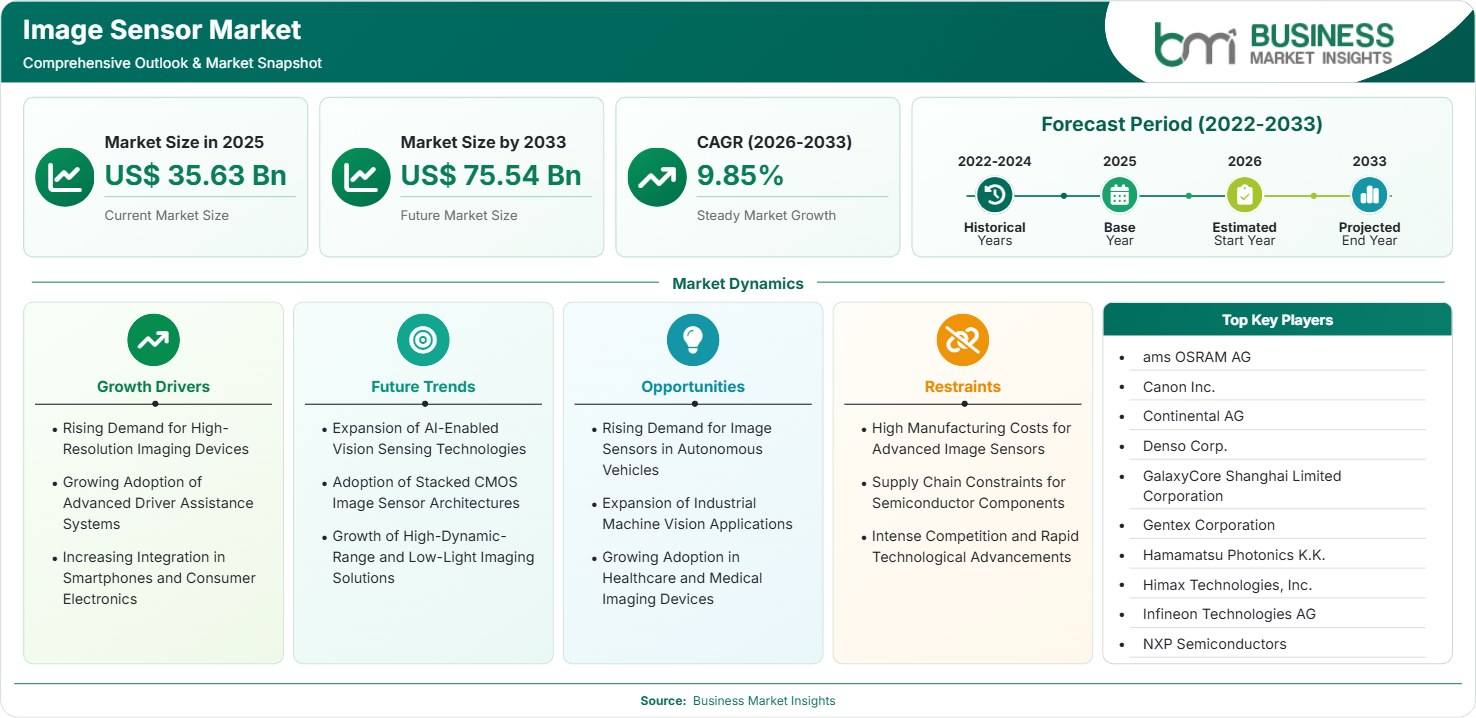
The Image Sensor Market size was valued at US$ 35.63 Billion in 2025 and is projected to reach US$ 75.54 Billion by 2033, growing at a CAGR of 9.85% during 2026–2033. Rising adoption of advanced imaging technologies, increasing smartphone penetration, growing demand for ADAS-equipped vehicles, and expanding utilization of machine vision systems are supporting market growth globally.

Report Coverage
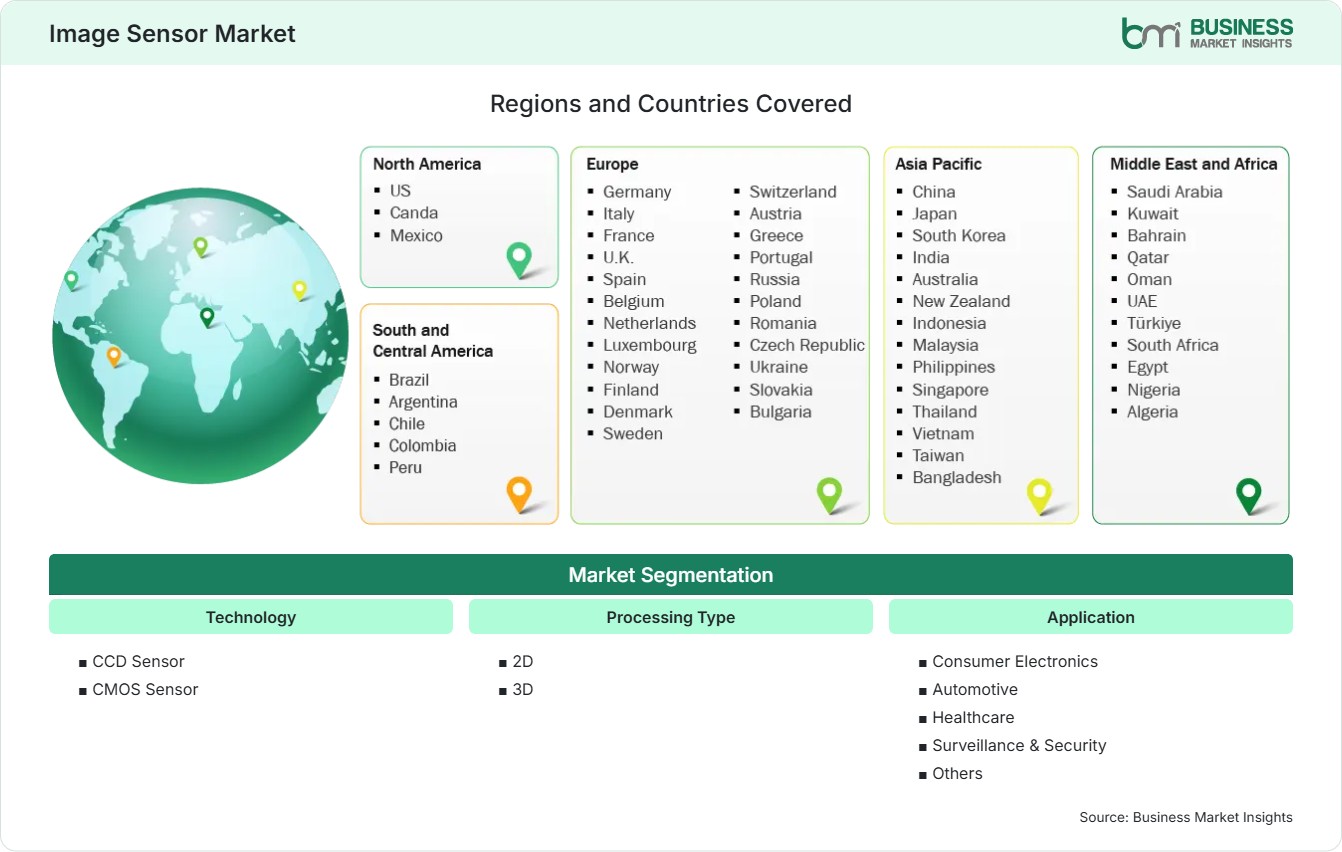
  • Technology: CCD Sensor, CMOS Sensor
  • Processing Type: 2D, 3D
  • Application: Consumer Electronics, Automotive, Healthcare, Surveillance & Security, Others
US$ 35.63 Bn Market size in 2025
US$ 75.54 Bn Market Size by 2033
9.85% CAGR, 2026 - 2033
2026-2033 Forecast Period

AI Overview

Image Sensor Market Summary

  • North America Region: North America holds a image sensor market share of 34%–37% in 2025, growing with a CAGR of 9.2%–9.9% during 2026–2033. Strong demand from automotive, security, healthcare, and consumer electronics sectors continues supporting regional leadership. The U.S. market is expected to register a CAGR of 9.4%–10.1%.
  • Fastest Growing Region: Asia Pacific accounts for 31%–34% share in 2025 and is projected to grow at a CAGR of 10.4%–11.1% through 2033. Expanding electronics manufacturing, increasing smartphone production, and growing adoption of automotive imaging technologies continue driving regional growth.
  • Leading Segment: CMOS Sensor represents 82%–85% share in 2025 and is expected to grow at a CAGR of 10.0%–10.7% through 2033. Superior power efficiency, integration capabilities, and cost-effectiveness continue supporting segment dominance.
  • High Growth Segment: Consumer Electronics accounts for 39%–42% share in 2025 and is forecast to grow at a CAGR of 10.6%–11.3% during 2026–2033. Growing demand for smartphones, tablets, wearable devices, and smart home products continues accelerating segment growth.
  • Key Market Opportunity: Expansion of autonomous driving technologies, AI-enabled imaging applications, advanced surveillance systems, and 3D sensing technologies is creating substantial growth opportunities.
  • Major Market Players: ams OSRAM AG, Canon Inc., Continental AG, Denso Corp., GalaxyCore Shanghai Limited Corporation, Gentex Corporation, Hamamatsu Photonics K.K., Himax Technologies, Inc., Infineon Technologies AG, and NXP Semiconductors.
Strategic Insights

Image Sensor Market: Strategic Insights

Image Sensor Market Strategic Framework
FREE PDF
Request your free sample
Request free sample
Stakeholder View

Key Takeaways

  • Image sensors remain essential components across consumer, automotive, industrial, and healthcare applications.
  • CMOS sensors dominate the image sensor market due to superior efficiency and scalability advantages.
  • Consumer electronics remains the leading application segment supported by strong smartphone demand.
  • Automotive imaging systems are creating significant opportunities through ADAS and autonomous vehicle adoption.
  • AI-powered vision technologies are expanding image sensor use cases.
  • North America remains the leading market due to technology innovation and strong end-user demand.
  • Asia Pacific is projected to witness the fastest growth owing to large-scale electronics manufacturing activities.
  • 3D imaging and machine vision technologies are expected to create substantial future opportunities.
Geographic Outlook

Image Sensor Market Regional Highlights

North America Image Sensor Market

North America accounts for 34%–37% Image Sensor Market share in 2025 and is projected to grow at a CAGR of 9.2%–9.9% through 2033. The region benefits from strong consumer electronics demand, increasing automotive technology adoption, growing healthcare digitization, and extensive investments in AI-enabled imaging solutions. Rising utilization of image sensors across industrial automation, security, and advanced mobility applications continues supporting regional market leadership.

  • Automotive manufacturers are increasingly integrating image sensors into ADAS, driver monitoring systems, parking assistance technologies, and autonomous vehicle development programs.
  • Consumer electronics companies continue driving demand for high-performance sensors capable of delivering enhanced image quality, low-light performance, and advanced video capabilities.
  • The healthcare sector is increasingly utilizing image sensor technologies in diagnostic imaging equipment, minimally invasive procedures, and patient monitoring systems.
  • Security and surveillance deployments continue expanding across public infrastructure, commercial facilities, and smart city projects, supporting strong sensor demand.
  • Industrial automation initiatives are encouraging wider adoption of machine vision systems for inspection, quality control, and manufacturing optimization applications.
  • Ongoing investments in AI, robotics, and intelligent vision technologies continue strengthening long-term market opportunities.

US Image Sensor Market

The United States contributes approximately 86%–90% of North American revenue and is expected to register a CAGR of 9.4%–10.1% through 2033. The country remains a leading market due to strong technological innovation, growing deployment of intelligent imaging systems, and extensive demand from consumer electronics, automotive, industrial, and healthcare sectors. Expanding AI adoption and increasing investments in advanced mobility technologies continue supporting image sensor market growth.

  • Smartphone manufacturers and technology companies continue incorporating advanced imaging capabilities to enhance consumer experiences and device functionality.
  • Automotive technology developers are driving demand for image sensors used in safety systems, autonomous driving platforms, and next-generation mobility solutions.
  • Increasing deployment of intelligent surveillance systems is supporting growth across public safety and commercial security applications.
  • Healthcare providers continue investing in imaging technologies to improve diagnostics, treatment accuracy, and patient outcomes.
  • Research and development activities remain strong across AI-enabled machine vision and imaging technologies.

Europe Image Sensor Market

Europe represents 23%–26% of global revenue in 2025 and is anticipated to expand at a CAGR of 9.6%–10.3% through 2033. Strong automotive manufacturing capabilities, increasing industrial automation, and growing adoption of advanced imaging technologies continue supporting regional growth. Germany remains the leading image sensor market while Poland demonstrates stronger growth momentum.

  • Germany continues leading regional demand through advanced automotive manufacturing, industrial automation investments, and extensive technology innovation activities.
  • Poland is among the fastest-growing markets and is estimated to register a CAGR of 10.5%–11.2% during the forecast period, supported by increasing electronics production and industrial modernization initiatives.
  • Automotive manufacturers continue adopting image sensors for driver assistance systems, vehicle safety enhancement, and autonomous mobility applications.
  • Growth in industrial robotics and smart manufacturing is increasing demand for machine vision-enabled imaging systems.
  • Healthcare digitization initiatives continue supporting utilization of precision imaging technologies across medical environments.
  • Investments in smart city infrastructure and intelligent transportation systems are creating additional growth opportunities.

Asia Pacific Image Sensor Market

Asia Pacific accounts for 31%–34% of global revenue in 2025 and is expected to achieve the fastest CAGR of 10.4%–11.1% through 2033. Expanding electronics manufacturing, growing semiconductor production, rising adoption of advanced imaging applications, and increasing investments in automotive technology continue supporting strong regional growth. The region remains a major hub for smartphone production and consumer electronics innovation.

  • China remains the largest regional market due to large-scale electronics manufacturing capabilities, semiconductor investments, and consumer electronics demand.
  • India is projected to achieve approximately 11.3%–12.0% CAGR, supported by growing electronics production, digitalization initiatives, and expanding automotive manufacturing activities.
  • Smartphone and consumer device manufacturers continue increasing integration of advanced camera systems and imaging technologies.
  • Automotive industry expansion is supporting demand for sensors used in safety systems, vehicle cameras, and intelligent transportation applications.
  • Government initiatives promoting semiconductor manufacturing and technology innovation continue strengthening market development.
  • Increasing adoption of AI-powered imaging applications is creating long-term growth opportunities across multiple end-use industries.

Rest of World Image Sensor Market

Rest of World accounts for 8%–11% of global revenue in 2025 and is projected to expand at a CAGR of 8.9%–9.6% through 2033. Growing security infrastructure investments, rising consumer electronics adoption, and increasing digital transformation initiatives are supporting market development across Latin America, the Middle East, and Africa. Improving access to advanced technologies continues creating favorable growth conditions.

  • Brazil continues generating demand through increasing consumer electronics adoption and expanding industrial automation activities.
  • The UAE is witnessing growing utilization of image sensors in smart city projects, surveillance infrastructure, and intelligent transportation systems.
  • Saudi Arabia is expected to achieve approximately 9.8%–10.5% CAGR through 2033, supported by technology modernization initiatives and infrastructure development investments.
  • Expansion of commercial security and surveillance networks continues creating opportunities for imaging technology suppliers.
  • Healthcare modernization efforts are increasing adoption of advanced medical imaging and diagnostic systems.
  • Growing investments in industrial digitization and automation continue supporting long-term market expansion.
Global Market Geography
FREE PDF
Request your free sample
Request free sample
Segment Analysis

Image Sensor Market Segmentation

Technology

The technology segment represents the core sensor architectures utilized in image capture, machine vision, automotive imaging, consumer electronics, and industrial applications. This segment accounts for approximately 82%–85% share in 2025 and is projected to grow at a CAGR of 10.0%–10.7% through 2033. The expanding market scope is supported by increasing demand for high-resolution imaging devices, advancements in semiconductor fabrication technologies, and growing adoption of AI-enabled vision systems. Current Image Sensor Market Trends indicate strong preference for energy-efficient sensors capable of delivering superior image quality, high-speed processing, and enhanced low-light performance.

  • CCD Sensor: CCD sensors continue to be utilized in specialized imaging applications requiring high image quality and low noise performance. Scientific imaging and select industrial applications continue supporting demand.
  • CMOS Sensor: CMOS sensors dominate the market due to their lower power consumption, faster processing capabilities, and superior integration flexibility. Widespread adoption across smartphones, automotive systems, and consumer electronics continues driving growth.

Processing Type

The processing type segment highlights the major image processing approaches used across commercial and industrial imaging applications. This segment accounts for approximately 61%–64% share in 2025 and is expected to register a CAGR of 10.2%–10.9% through 2033. Growing demand for depth sensing, object recognition, and intelligent imaging systems continues driving adoption of advanced processing technologies.

  • 2D: 2D image processing remains widely utilized across consumer electronics, surveillance, and conventional imaging systems. Continuous improvements in image quality continue supporting demand.
  • 3D: 3D processing is witnessing strong growth due to increasing adoption in facial recognition, autonomous vehicles, robotics, augmented reality, and industrial automation applications. Demand continues accelerating across advanced vision systems.

Application

The application segment reflects the major end-use industries utilizing image sensor technologies to support imaging, detection, monitoring, and analytical functions. This segment accounts for approximately 39%–42% share in 2025 and is projected to grow at a CAGR of 10.6%–11.3% through 2033. Rising digitalization, automation, and intelligent device adoption continue driving image sensor market expansion across a diverse set of industries.

  • Consumer Electronics: Consumer electronics remain the leading segment due to widespread utilization of image sensors in smartphones, tablets, laptops, wearables, and smart home devices. Growing demand for enhanced imaging capabilities continues supporting growth.
  • Automotive: Automotive applications increasingly utilize image sensors for ADAS, driver monitoring systems, parking assistance, and autonomous driving technologies. Vehicle safety innovations continue driving adoption.
  • Healthcare: Healthcare providers utilize image sensors in diagnostic imaging systems, medical devices, endoscopy equipment, and advanced patient monitoring technologies. Increasing healthcare digitization continues supporting demand.
  • Surveillance & Security: Surveillance and security systems depend heavily on image sensors for video monitoring, facial recognition, and intelligent analytics applications. Growing security infrastructure investments continue driving market expansion.
  • Others: Other applications include industrial automation, robotics, aerospace, agriculture, and machine vision systems. Expanding adoption of intelligent imaging technologies continues creating new opportunities.
Market Forces

Image Sensor Market Dynamics

Key Market Drivers

Rising Demand for High-Resolution Imaging Devices

The increasing focus on imaging resolution is one of the key reasons for the growing demand for advanced image sensors across various industries. Manufacturers in the smartphone, camera, health care equipment, and automation systems industries are constantly seeking to develop imaging technologies that deliver superior-quality images with accurate color and excellent performance, even in low-light conditions. With the consumers expecting superior imaging capability in their devices, the manufacturers are integrating superior imaging sensors in them. Besides, there has been an increasing demand for display and digital content creation due to advancements in display technologies.

Growing Adoption of Advanced Driver Assistance Systems

The rapid adoption of advanced driver assistance systems is creating substantial demand for image sensors across the automotive industry. Modern vehicles increasingly rely on cameras and vision systems to support lane departure warning, adaptive cruise control, traffic sign recognition, parking assistance, collision avoidance, and driver monitoring functions. Image sensors serve as critical components enabling these intelligent safety systems to accurately interpret surrounding environments. Automotive manufacturers are accelerating investments in safety technologies to comply with evolving regulations and improve vehicle performance. As advanced mobility and autonomous driving technologies continue developing, image sensor adoption within automotive platforms is expected to increase significantly.

Increasing Integration in Smartphones and Consumer Electronics

Smartphones and consumer electronics continue representing one of the largest application areas for image sensors globally. Device manufacturers are increasingly integrating multiple camera systems, enhanced video capabilities, and AI-driven imaging features to differentiate products and improve user experiences. Image sensors are also becoming essential components within wearable devices, tablets, laptops, smart appliances, and augmented reality systems. Continuous innovation in mobile photography and video applications is further strengthening demand for advanced sensor technologies. As connected devices and intelligent consumer electronics continue expanding worldwide, image sensor utilization is expected to grow steadily.

Key Market Opportunities

Rising Demand for Image Sensors in Autonomous Vehicles

Autonomous vehicle development is creating significant opportunities for image sensor manufacturers. Self-driving systems require multiple high-performance sensors to continuously monitor road conditions, detect objects, recognize obstacles, and support safe navigation. Image sensors work alongside radar, LiDAR, and other technologies to provide comprehensive environmental awareness and improve vehicle decision-making capabilities. Automotive manufacturers and technology companies are investing heavily in autonomous mobility platforms, generating increasing demand for advanced imaging solutions. As autonomous driving technologies move closer to broader commercialization, opportunities for image sensor providers are expected to expand substantially.

Expansion of Industrial Machine Vision Applications

Industrial automation and smart manufacturing initiatives are driving growing adoption of machine vision systems that depend heavily on advanced image sensor technologies. Manufacturers are utilizing machine vision for quality inspection, defect detection, robotic guidance, process monitoring, and productivity optimization. These systems improve operational efficiency while reducing manual intervention and production errors. Rising investments in Industry 4.0 technologies and intelligent manufacturing facilities continue accelerating deployment of machine vision platforms across multiple industrial sectors. This trend presents attractive opportunities for image sensor manufacturers seeking long-term growth in industrial applications.

Growing Adoption in Healthcare and Medical Imaging Devices

Healthcare organizations are increasingly utilizing advanced imaging solutions to improve diagnosis, treatment planning, patient monitoring, and minimally invasive procedures. Image sensors play a vital role in medical imaging equipment, endoscopy systems, digital pathology solutions, and diagnostic devices. Continuous advancements in sensor resolution, miniaturization, and image processing capabilities are enhancing healthcare outcomes while enabling greater procedural precision. Growing healthcare investments and increasing adoption of digital health technologies continue creating favorable market conditions. Long-term Image Sensor Market Forecast projections remain highly positive as healthcare providers continue integrating sophisticated imaging solutions into clinical workflows and patient care environments.

Market Restraints and Challenges

High Manufacturing Costs for Advanced Image Sensors

Factor: Advanced image sensors require sophisticated semiconductor fabrication processes, precision manufacturing techniques, and significant investments in research, development, and process optimization. Increasing demands for higher resolution, improved sensitivity, and advanced functionality further contribute to production complexity and costs.

Impact: High manufacturing costs can affect profit margins, increase product pricing, and create barriers for smaller market participants. Cost pressures may also influence adoption rates in price-sensitive applications and emerging markets.

Supply Chain Constraints for Semiconductor Components

Factor: Image sensor production relies on highly specialized semiconductor materials, fabrication facilities, packaging technologies, and global supply chains. Disruptions related to raw material availability, manufacturing capacity limitations, logistics challenges, and geopolitical uncertainties can affect production schedules.

Impact: Supply chain constraints can lead to component shortages, longer lead times, increased operational costs, and delayed product deliveries. Manufacturers may face challenges maintaining production continuity and meeting growing global demand for advanced imaging solutions.

Company Analysis

Competitive Landscape

The Image Sensor Market Analysis is characterized by strong competition among semiconductor manufacturers, imaging technology providers, automotive electronics suppliers, and sensor innovation companies. Market participants are focusing on high-resolution CMOS technologies, 3D sensing capabilities, machine vision solutions, automotive-grade imaging systems, and AI-enabled image processing technologies to strengthen their market positions. Rising demand from consumer electronics, autonomous vehicles, healthcare imaging, and industrial automation sectors continues driving innovation across the market. Companies are investing in sensor miniaturization, low-light imaging performance, high-speed processing, and advanced semiconductor manufacturing capabilities to address evolving market requirements.

Company Name

Overview

Products and Services relevant to this market

ams OSRAM AG

Semiconductor and optical solutions company serving automotive, industrial, and consumer markets.

CMOS image sensors, optical sensing technologies, automotive imaging solutions, and advanced semiconductor products.

Canon Inc.

Imaging and optical technology company serving consumer, industrial, and healthcare sectors.

Image sensors, digital imaging systems, machine vision solutions, and camera technologies.

Continental AG

Automotive technology company focused on mobility and vehicle safety systems.

Automotive image sensors, driver assistance technologies, vehicle cameras, and intelligent mobility solutions.

Denso Corp.

Automotive components manufacturer specializing in advanced vehicle electronics.

Automotive imaging systems, camera modules, vehicle sensing technologies, and ADAS solutions.

GalaxyCore Shanghai Limited Corporation

Semiconductor company specializing in imaging and sensor technologies.

CMOS image sensors, camera modules, mobile imaging solutions, and consumer electronics sensors.

Gentex Corporation

Technology company focused on automotive electronics and vision systems.

Automotive cameras, driver monitoring systems, vision technologies, and image sensing solutions.

Hamamatsu Photonics K.K.

Photonics and imaging technology company serving healthcare, industrial, and research sectors.

Image sensors, photodetectors, medical imaging solutions, and scientific imaging technologies.

Himax Technologies, Inc.

Semiconductor company focused on imaging and display technologies.

CMOS image sensors, machine vision solutions, 3D sensing technologies, and consumer device imaging products.

Infineon Technologies AG

Semiconductor manufacturer serving automotive, industrial, and security markets.

Imaging solutions, sensor technologies, automotive vision systems, and semiconductor components.

NXP Semiconductors

Semiconductor company specializing in automotive and industrial connectivity solutions.

Imaging processors, automotive sensor technologies, machine vision systems, and intelligent sensing platforms.

Trust & Transparency

Research Methodology

The market analysis combines proprietary research with secondary data from government agencies, company disclosures, regulatory filings, industry databases and expert interviews. Market estimates are validated through data triangulation, cross-market benchmarking and analyst review.

View Full Research Methodology

Questions Answered

Frequently Asked Questions

How are autonomous vehicles influencing image sensor demand?

Autonomous vehicles rely heavily on image sensors for environment monitoring, object detection, lane recognition, driver assistance, and navigation systems. Growing investments in autonomous mobility continue creating substantial opportunities for image sensor manufacturers.

What does this Image Sensor Market Report cover?

This report covers technology analysis, processing type assessment, application evaluation, regional trends, competitive landscape analysis, market drivers, opportunities, restraints, challenges, and future growth prospects through 2033.

Why is Consumer Electronics the leading application segment?

Consumer electronics lead the market because image sensors are extensively used in smartphones, tablets, laptops, wearable devices, smart home products, and digital cameras. Continuous innovation in imaging features continues supporting strong demand.

Which technology segment dominates the market?

CMOS Sensors dominate the market due to their low power consumption, faster processing capabilities, compact design, and suitability for smartphones, automotive systems, and industrial applications.

What is driving growth in the Image Sensor market?

Rising demand for high-resolution imaging devices, growing adoption of advanced driver assistance systems, increasing integration in smartphones and consumer electronics, and expanding use of AI-enabled vision technologies are major factors driving market growth.

Access the Full Image Sensor Market Report

Get segment-level forecasts, regional estimates, competitive benchmarking, company profiles and downloadable Excel datasets.

Access the full Image Sensor Market Report
350 pages PDF & Excel | 2026-08-31