
InGaAs Image Sensor Market Outlook: Size, Share, Trends, Growth Analysis, Competitive Landscape & Forecast, 2026-2033

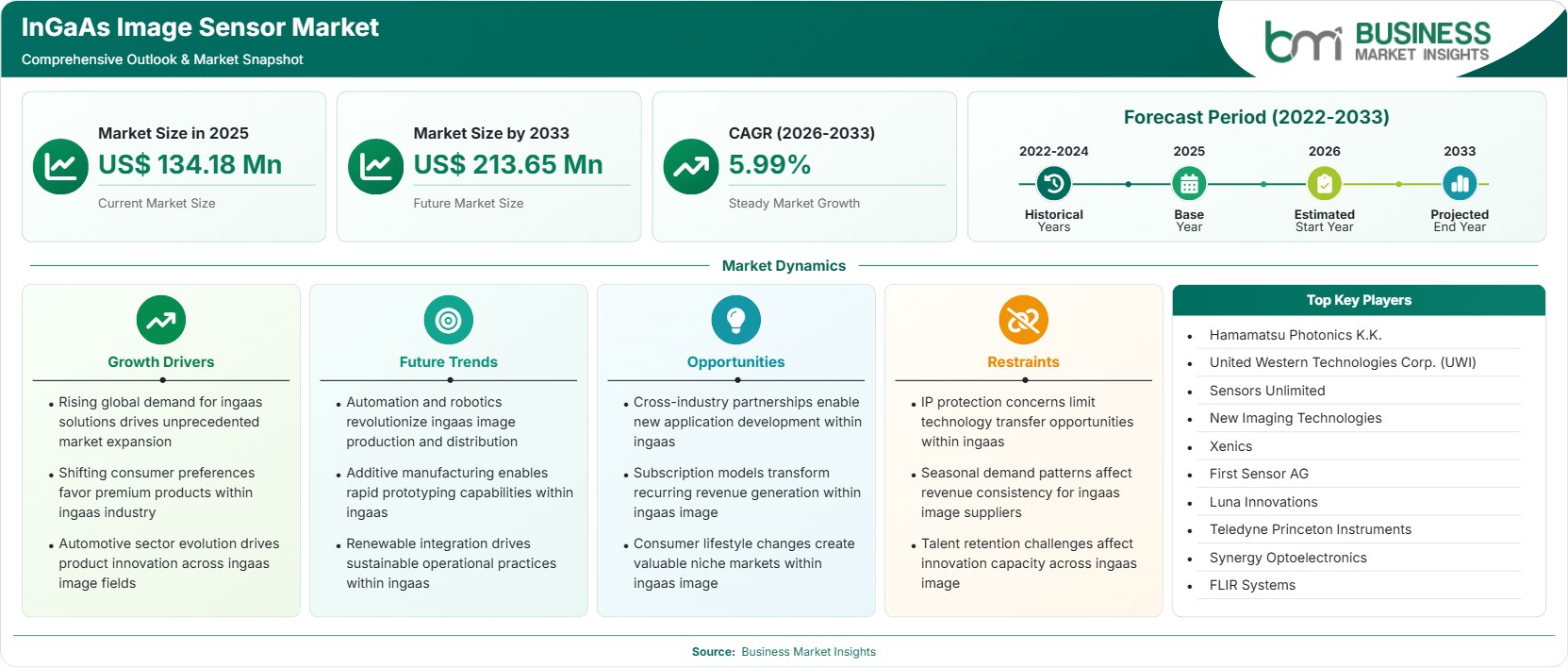
The InGaAs Image Sensor Market size was valued at US$ 134.18 Million in 2025 and is projected to reach US$ 213.65 Million by 2033, growing at a CAGR of 5.99% during 2026–2033. Growth is supported by expanding SWIR imaging adoption, defense modernization programs, industrial inspection automation, spectroscopy deployment, and rising opportunities across healthcare diagnostics, food quality monitoring, and machine vision applications.

Report Coverage
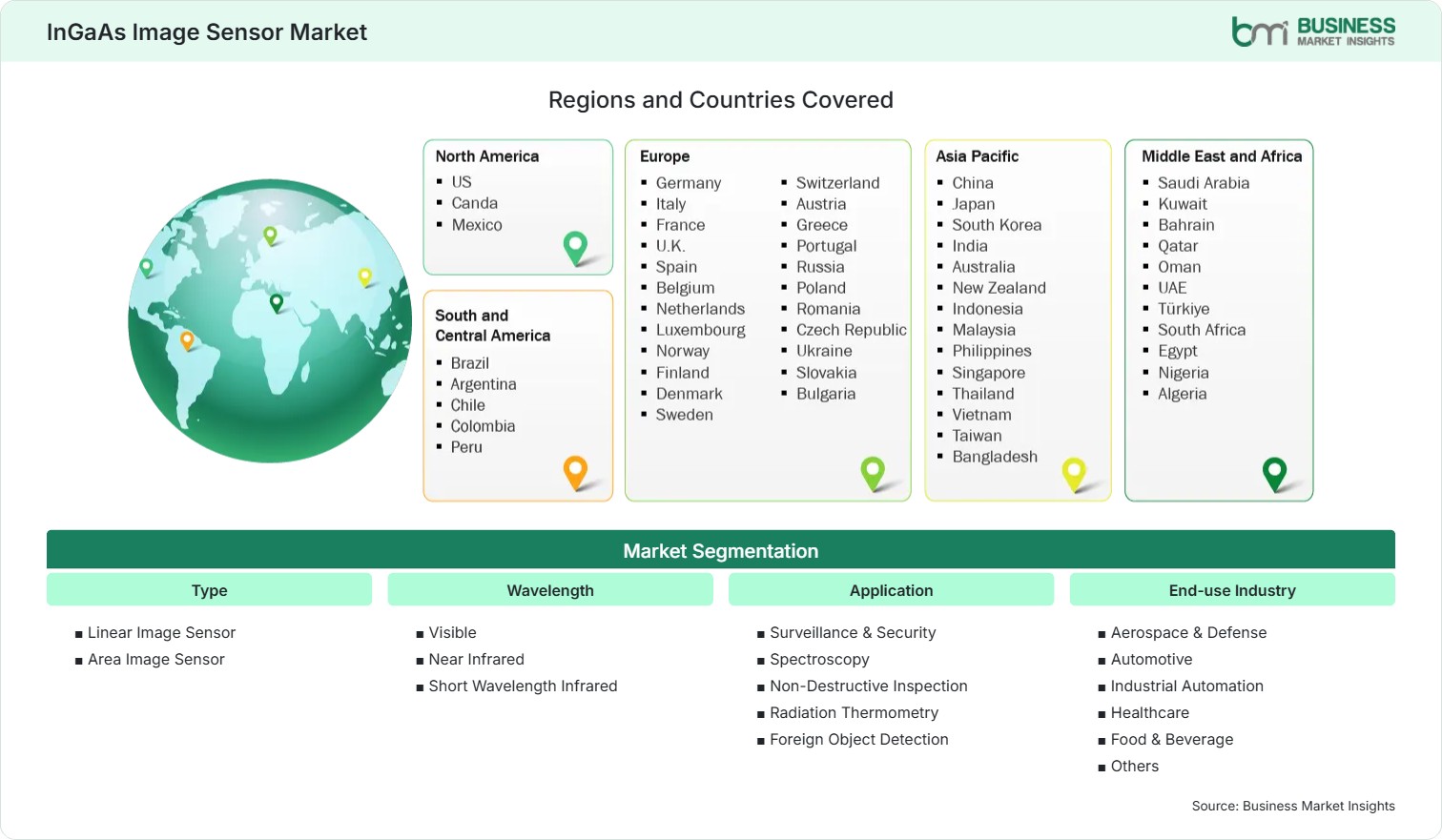
  • Type: Linear Image Sensor, Area Image Sensor
  • Wavelength: Visible, Near Infrared, Short Wavelength Infrared
  • Application: Surveillance & Security, Spectroscopy, Non-Destructive Inspection, Radiation Thermometry, Foreign Object Detection
  • End-use Industry: Aerospace & Defense, Automotive, Industrial Automation, Healthcare, Food & Beverage, Others
US$ 134.18 Mn Market size in 2025
US$ 213.65 Mn Market Size by 2033
5.99% CAGR, 2026 - 2033
2026-2033 Forecast Period

01 AI Overview

InGaAs Image Sensor Market Summary

  • North America Region: North America holds a market share of 36%–39% in 2025, growing with a CAGR of 5.2%–5.7% during 2026–2033. Demand is supported by defense imaging spending, semiconductor inspection expansion, industrial automation upgrades, spectroscopy adoption, SWIR innovation programs, advanced healthcare imaging investments, machine vision integration, security modernization, research funding, and aerospace sensing requirements. The U.S. remains the largest revenue contributor, supported by defense procurement and semiconductor manufacturing investments, recording a CAGR of 5.3%–5.8%.
  • Fastest Growing Region: Asia Pacific holds a market share of 28%–31% in 2025, growing with a CAGR of 7.1%–7.8% during 2026–2033. Growth is driven by electronics manufacturing expansion, industrial inspection deployment, government technology initiatives, automotive sensing innovations, healthcare equipment investment, food processing modernization, semiconductor fabrication capacity growth, and machine vision adoption.
  • Leading Segment: Area Image Sensor accounts for 56%–60% share in 2025 and grows at 5.7%–6.2% CAGR through 2033. Adoption benefits from superior imaging performance, increasing surveillance integration, semiconductor inspection demand, industrial automation requirements, advanced spectroscopy deployment, healthcare imaging applications, and expanding SWIR-enabled machine vision platforms.
  • High Growth Segment: Short Wavelength Infrared holds 23%–27% share in 2025 and expands at 7.0%–7.6% CAGR. Growth is supported by material identification requirements, semiconductor inspection, defense surveillance demand, process monitoring, agricultural imaging, quality control applications, foreign object detection systems, and advanced analytics integration.
  • Key Market Opportunity: Expansion of affordable uncooled SWIR platforms enables broader deployment across food sorting, industrial quality inspection, pharmaceutical manufacturing, medical diagnostics, and smart factory ecosystems, creating substantial commercialization opportunities globally.
  • Major Market Players: Hamamatsu Photonics K.K., Teledyne Technologies Incorporated, Sony Group Corporation, ams-OSRAM AG, Xenics NV, New Imaging Technologies SAS, Leonardo DRS, Lynred SAS, Raptor Photonics Limited, and TRIWAVE Corporation.
02 Strategic Insights

InGaAs Image Sensor Market: Strategic Insights

InGaAs Image Sensor Market Strategic Framework
FREE PDF
Request your free sample
Request free sample
03 Stakeholder View

Key Takeaways

  • The value chain increasingly integrates wafer fabrication, sensor packaging, imaging software, optics providers, and machine vision system developers, creating opportunities for vertically integrated offerings.
  • Spectroscopy, foreign object detection, and industrial automation applications offer the strongest expansion potential due to growing quality-control requirements.
  • Innovation is shifting toward higher-resolution area-array architectures, compact uncooled SWIR modules, and AI-assisted image processing capabilities.
  • Asia Pacific presents the most compelling investment case, particularly across China, Japan, South Korea, and India due to manufacturing scale.
  • Strategic partnerships, technology licensing agreements, and photonics acquisitions are strengthening competitive positioning and accelerating product commercialization.
  • Demand diversification beyond defense and aerospace is reducing market concentration risks and increasing recurring industrial revenues.
04 Geographic Outlook

InGaAs Image Sensor Market Regional Highlights

North America InGaAs Image Sensor Market

North America accounted for 36%–39% of revenue in 2025 and is expected to expand at 5.2%–5.7% CAGR through 2033. Strong defense procurement, industrial automation, semiconductor inspection investments, and healthcare innovation support regional leadership. The region benefits from a mature photonics ecosystem, significant R&D funding, and early adoption of SWIR imaging technologies. The InGaAs Image Sensor Market share remains highest in North America due to advanced manufacturing and security applications.

  • Defense modernization initiatives continue accelerating procurement of advanced infrared imaging technologies.
  • Semiconductor inspection applications support stable demand from wafer fabrication facilities.
  • Industrial machine vision deployment strengthens adoption across manufacturing environments.
  • Research institutions actively invest in spectroscopy and photonics innovation programs.
  • Healthcare imaging applications create additional commercial opportunities beyond defense markets.

US InGaAs Image Sensor Market

The U.S. accounts for 78% – 82% of North American market revenues and has an estimated CAGR of 5.3% – 5.8%. Adoption in the region is driven by defense expenditure, aerospace programs, semiconductor production incentives, and industrial modernization investments. High capabilities in technological development and the prevalence of imaging companies make the region a leader in innovation. Federal support for advanced manufacturing and critical infrastructure monitoring continues to create sustained demand for infrared sensing technologies.

  • Semiconductor capacity investments support increased deployment within inspection systems.
  • Defense and homeland security programs maintain steady procurement activity.
  • Photonics research funding encourages commercialization of advanced imaging platforms.
  • Industrial automation trends support machine vision integration across factories.

Europe InGaAs Image Sensor Market

Europe captured a 24%–27% share in 2025 and is projected to grow at 5.6%–6.1% CAGR. Germany leads regional revenue generation, while France demonstrates strong aerospace and defense demand. The United Kingdom records one of the stronger growth trajectories at approximately 6.2%–6.7% CAGR. Demand is supported by industrial automation, food quality monitoring, photonics innovation initiatives, and semiconductor manufacturing activities.

  • Germany remains the leading regional market due to industrial automation strength.
  • France benefits from aerospace, defense, and advanced optics industries.
  • The UK displays higher adoption across research and healthcare applications.
  • EU digitalization programs support industrial inspection investments.
  • Sustainability-focused manufacturing encourages advanced sensing deployment.

Asia Pacific InGaAs Image Sensor Market

Asia Pacific accounted for 28%-31% in 2025 and is the leading regional market, with a CAGR of 7.1%-7.8%. China leads regional demand through its manufacturing investments, and India exhibits strong growth potential at an 8.0%-8.6% CAGR. Japan and South Korea enable adoption via their semiconductors, electronics, and photonics industries. Increasing industrial digitalization strengthens regional competitiveness.

  • China benefits from large-scale electronics and semiconductor production.
  • Japan maintains leadership in photonics research and sensor innovation.
  • South Korea drives adoption through advanced electronics manufacturing.
  • India records strong expansion driven by industrial modernization projects.
  • Regional smart factory initiatives support long-term deployment trends.

Rest of World InGaAs Image Sensor Market

Rest of World holds an 8% to 11% market share and is anticipated to expand at a CAGR of 5.9% to 6.5%. The use of advanced imaging in the Middle East is driven by increased spending on surveillance and security. Brazil is the major market in South America, while Saudi Arabia shows more growth potential. Infrastructure development, industrial diversification, and security modernization initiatives are strengthening demand for advanced imaging technologies.

  • GCC countries invest heavily in surveillance and critical infrastructure monitoring.
  • Saudi Arabia benefits from industrial diversification and technology programs.
  • Brazil leads South American industrial adoption of machine vision solutions.
  • Food processing industries increasingly utilize advanced inspection systems.
  • Mining and resource industries support specialized imaging applications.
Global Market Geography
FREE PDF
Request your free sample
Request free sample
05 Segment Analysis

InGaAs Image Sensor Market Segmentation

Type

Type segmentation is led by Area Image Sensor, accounting for 56%-60% of the market share and registering a CAGR of 5.7%-6.2% in 2025. It will be driven by higher-resolution imaging, increased use of surveillance, and industrial inspections. The InGaAs Image Sensor Market scope will continue to expand as sensor performance advances, supporting wider machine vision, spectroscopy, and automation deployments globally.

  • Linear Image Sensor: Widely used in spectroscopy, sorting, and conveyor-based inspection systems where line-scan imaging enables precise material identification and quality evaluation.
  • Area Image Sensor: Preferred for surveillance, industrial automation, and healthcare imaging due to broad field-of-view capabilities and enhanced imaging performance.

Wavelength

The wavelengths are confined to the visible and near-infrared, whereas short-wave infrared is growing quickly. The market sustains solid momentum due to demand for spectroscopy, defense imaging, industrial inspection, and automation. The InGaAs Image Sensor Market trends have been shifting toward SWIR performance due to improved material discrimination and low-light imaging capabilities.

  • Visible: Supports hybrid imaging systems requiring integration with conventional machine vision environments.
  • Near Infrared: Extensively adopted in spectroscopy, industrial inspection, and biomedical imaging workflows.
  • Short Wavelength Infrared: Gains momentum through semiconductor inspection, defense surveillance, and advanced material recognition applications.

Application

The applications are driven by the need for surveillance and security, which account for 29%–33%, and are supported by consistent deployment across both defense and infrastructure surveillance. Spectroscopy, nondestructive testing, and foreign object detection continue to benefit from improved quality control processes.

  • Surveillance & Security: Enables imaging under challenging visibility conditions for defense and critical infrastructure monitoring.
  • Spectroscopy: Supports material characterization, pharmaceutical analysis, and scientific research activities.
  • Non-Destructive Inspection: Facilitates defect detection without damaging products during manufacturing processes.
  • Radiation Thermometry: Assists temperature measurement in industrial and research environments.
  • Foreign Object Detection: Increasingly used in food processing and manufacturing quality assurance systems.

End-use Industry

Industrial automation is the major end-use segment, accounting for a 31%-35% share and a 6.1%-6.6% CAGR. The demand in the market comes from the increase in machine vision applications, smart manufacturing, and quality control through automation. Aerospace & Defense is crucial, whereas Healthcare and Food Processing create new opportunities.

  • Aerospace & Defense: Relies on SWIR sensing for surveillance, navigation, and reconnaissance systems.
  • Automotive: Supports advanced sensing, inspection, and manufacturing quality control applications.
  • Industrial Automation: Benefits from machine vision growth and smart factory implementation.
  • Healthcare: Utilized in diagnostics, imaging research, and specialized medical equipment.
  • Food & Beverage: Supports contamination detection, sorting, and production quality assurance.
06 Market Forces

InGaAs Image Sensor Market Dynamics

Key Market Drivers

Expansion of SWIR-Based Industrial Inspection

The increasing use of industrial automation is driving demand for short-wave infrared imaging technology to identify defects at wavelengths beyond human vision. Companies such as semiconductor fabrication plants, electronics assembly plants, pharmaceutical companies, and food processing plants are investing more in machine vision to enhance their quality control and waste reduction processes. These organizations need to identify contaminants, material differences, and other defects that conventional imaging technologies fail to detect. SWIR imaging facilitates this through enhanced penetration and contrast characteristics. Rising global manufacturing digitization initiatives further strengthen demand, positioning advanced image sensors as critical components in next-generation inspection and process-optimization environments.

Defense and Security Modernization Programs

Military organizations continue to invest in next-generation sensors to enhance surveillance, target acquisition, border security, and situational awareness. The InGaAs sensors deliver significant operational benefits in dark and harsh environments. The rising geopolitical tensions justify purchasing activities in North America, Europe, and Asia Pacific. Military personnel need more monitoring of vital infrastructures and transport facilities. Such tasks can be accomplished using effective IR imaging technologies, which have excellent sensitivity and operational endurance. Continuous defense modernization programs, therefore, remain a major contributor to market expansion and technology innovation.

Advancements in Sensor Architecture and Performance

Advances in technology have enabled greater sensitivity, lower dark current, higher resolution, and simpler systems. They are developing smaller, uncooled infrared cameras that help reduce the overall cost of ownership and make them more accessible. Advances in sensor technology make them available for more uses, including spectroscopy, automation, and healthcare applications. Better integration of artificial intelligence analytics makes the operation more valuable by automating detection and classification functions. As performance improves and system costs gradually decline, users across multiple industries gain stronger incentives to adopt advanced infrared imaging solutions, accelerating commercialization opportunities.

Key Market Opportunities

Affordable Uncooled SWIR Imaging Solutions

The move to uncooled systems is a key growth driver. Since less cooling is needed, there is a reduction in system size, energy usage, and maintenance costs, making implementation possible even for medium-sized industrial players. The move towards food processing, recycling, pharmaceutical manufacturing, and logistics opens up new target markets. Investors have become more interested in cost-efficient imaging systems that deliver good performance with minimal infrastructure. As per InGaAs Image Sensor Market Forecasts for the long term, affordability will play an important role in revenue generation.

Healthcare and Biomedical Imaging Expansion

The growing interest in the application of infrared imaging in healthcare facilities for diagnosis, tissue assessment, and more advanced scientific research is seen in healthcare institutions. Increased sensitivity and image quality enable the development of new medical applications that involve non-invasive assessments. Older demographics and increased investment in healthcare technology contribute to the market's bright future. Cooperation among medical equipment companies, research centers, and photonics businesses accelerates the development process.

Growth of Smart Factories and Industry 4.0

Smart manufacturing solutions focus on data-driven manufacturing, predictive maintenance, and automated quality control. Advanced imaging systems can be easily integrated into these operations, as they can provide insights for operational improvement. The combination of robots, analytics, and digital twins extends the application domain beyond inspection tasks. Manufacturers become interested in technologies that will help improve yield, minimize downtime, and increase process consistency.

Market Restraints and Challenges

High Production Costs and Material Complexity

Factor: InGaAs fabrication relies on specialized semiconductor materials, advanced epitaxial growth processes, and sophisticated packaging techniques. Impact: These requirements elevate production costs compared with conventional silicon-based alternatives. Higher pricing can limit penetration among cost-sensitive industries and prolong purchasing cycles. Organizations evaluating imaging upgrades frequently compare performance advantages against total system costs, creating barriers for broader adoption. Although technological advancements are improving efficiency, production economics remain a challenge that influences competitiveness and slows deployment across certain applications.

Supply Chain Concentration and Technical Barriers

Factor: The supply chain remains concentrated among a limited number of specialized manufacturers with expertise in infrared sensing technologies. Impact: Customers may encounter procurement constraints, longer lead times, and supplier dependency risks. Technical integration requirements also increase implementation complexity, particularly for organizations lacking photonics expertise. System calibration, optics selection, and software integration can extend deployment timelines. These challenges may delay purchasing decisions and constrain adoption rates despite strong underlying demand drivers.

07 Company Analysis

Competitive Landscape

The InGaAs Image Sensor Market analysis indicates competition is driven by sensor sensitivity, SWIR performance, packaging innovation, cost optimization, and application-specific customization.

Company Name

Overview

Products and Services relevant to this market

Hamamatsu Photonics K.K.

Global photonics specialist with extensive infrared sensor portfolio and strong research capabilities.

InGaAs linear sensors, area sensors, spectroscopy solutions, imaging modules.

Teledyne Technologies Incorporated

Advanced sensing and imaging provider serving industrial, defense, and scientific markets.

SWIR cameras, InGaAs sensors, machine vision systems, inspection solutions.

Sony Group Corporation

Technology leader expanding advanced imaging capabilities for industrial applications.

Imaging devices, sensor technologies, machine vision components.

ams-OSRAM AG

Optoelectronics company focused on sensing and infrared innovations.

Infrared components, imaging technologies, photonic solutions.

Xenics NV

Specialized SWIR imaging company serving industrial and security markets.

SWIR cameras, InGaAs detectors, machine vision products.

New Imaging Technologies SAS

Developer of advanced infrared imaging technologies and cameras.

SWIR sensors, imaging platforms, industrial monitoring solutions.

Leonardo DRS

Defense-focused technology supplier with sensing system expertise.

Infrared imaging systems, surveillance and defense solutions.

Lynred SAS

European infrared technology provider with strong detector capabilities.

Infrared detectors, imaging components, security imaging products.

Raptor Photonics Limited

Imaging specialist serving scientific and industrial customers globally.

High-performance cameras, infrared imaging systems, sensor platforms.

TRIWAVE Corporation

Japanese provider focused on InGaAs imaging technologies.

InGaAs image sensors, SWIR imaging devices, industrial imaging solutions.

10 Trust & Transparency

Research Methodology

The market analysis combines proprietary research with secondary data from government agencies, company disclosures, regulatory filings, industry databases and expert interviews. Market estimates are validated through data triangulation, cross-market benchmarking and analyst review.

View Full Research Methodology

11 Questions Answered

Frequently Asked Questions

What does the InGaAs Image Sensor Market Report typically evaluate?

A Market Report generally assesses market size, technology trends, competitive positioning, regional opportunities, demand drivers, investment activity, and future growth prospects.

Which region offers the strongest future growth potential?

Asia Pacific presents the strongest growth outlook due to manufacturing expansion, semiconductor investments, industrial digitization programs, and increasing deployment of machine vision technologies.

What makes SWIR imaging attractive for industrial users?

SWIR imaging enables material differentiation, contamination detection, and defect identification beyond visible wavelengths, improving inspection accuracy and operational efficiency.

What is the leading application area for these sensors?

Surveillance and security remain the dominant application segment due to strong utilization in defense, critical infrastructure monitoring, border security, and low-light imaging environments.

What factors are driving demand for InGaAs image sensors?

Demand is primarily driven by SWIR imaging adoption in industrial inspection, defense surveillance, spectroscopy, semiconductor manufacturing, and food quality monitoring, where conventional silicon sensors offer limited performance.

Access the Full InGaAs Image Sensor Market Report

Get segment-level forecasts, regional estimates, competitive benchmarking, company profiles and downloadable Excel datasets.

Access the full InGaAs Image Sensor Market Report
350 pages PDF & Excel | 2026-08-17