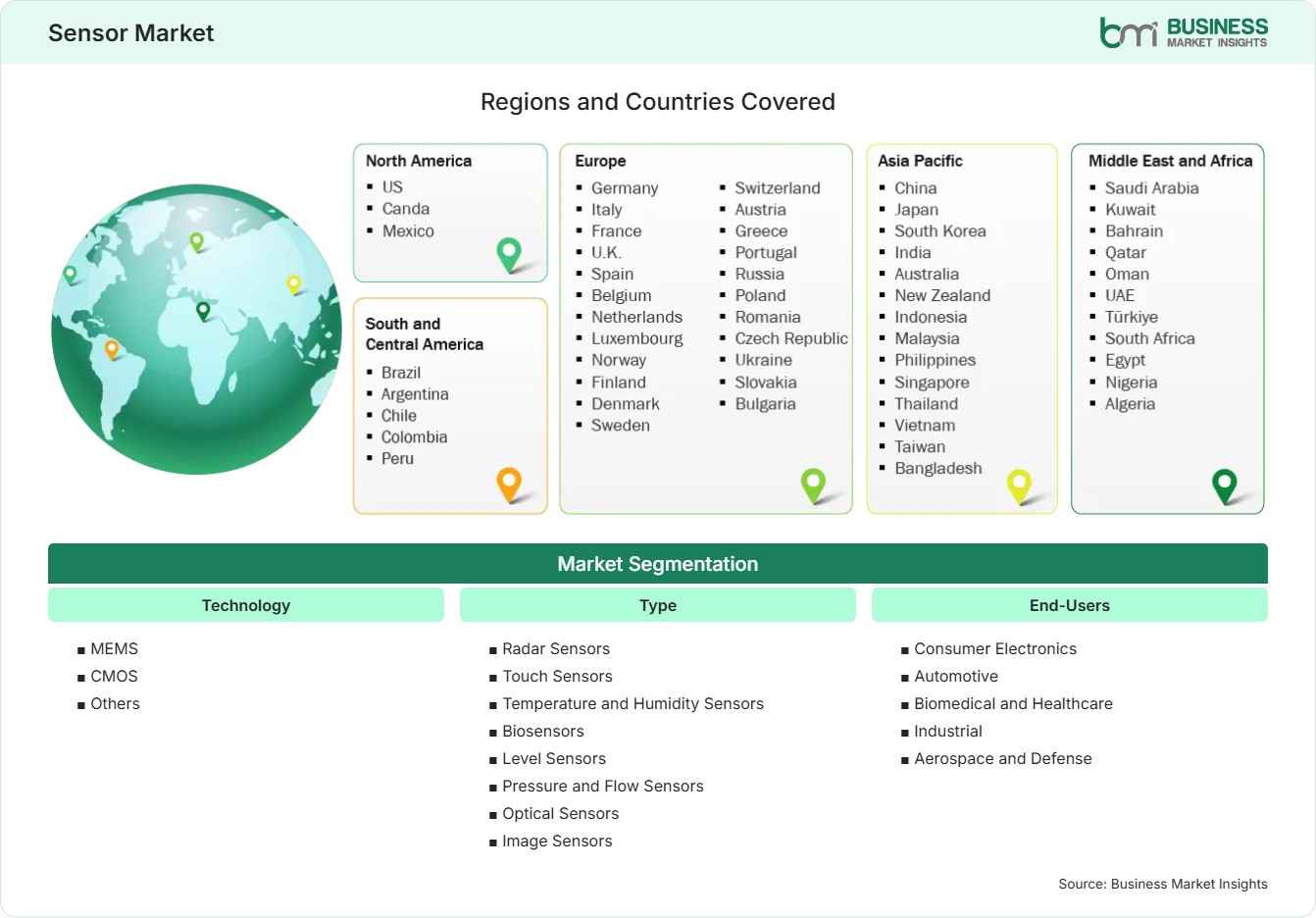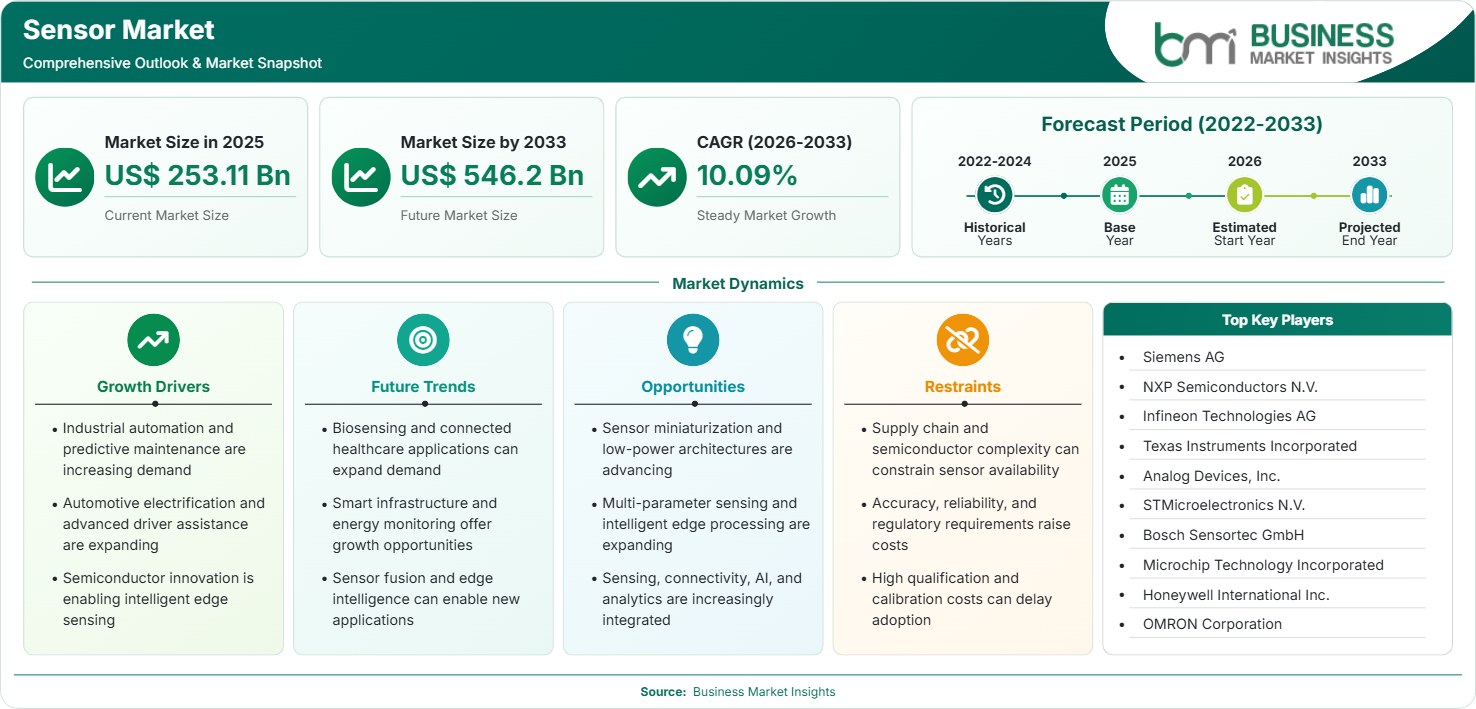
Sensor Market Regional Highlights
North America Sensor Market
North America represented a 28%–31% share in 2025 and is projected to expand at a 9.2%–9.8% CAGR of the Sensor Market during 2026–2033. Demand is supported by industrial automation, aerospace, defense, healthcare electronics, connected infrastructure, automotive technologies, and advanced semiconductor development. The region benefits from established technology ecosystems and strong research capabilities. Industrial users increasingly deploy sensors for predictive maintenance and energy optimization, while automotive manufacturers expand electronic content across safety and electrification platforms. These conditions support sustained regional adoption.
- Industrial automation is increasing demand for pressure, temperature, motion, optical, and proximity sensors as manufacturers improve machine visibility and predictive-maintenance capabilities.
- Aerospace and defense applications require highly reliable sensing for navigation, flight control, engine monitoring, and mission systems, supporting premium demand for ruggedized components.
- Healthcare digitization is increasing opportunities for biosensors, wearable monitoring, and connected diagnostic equipment, particularly as healthcare systems emphasize continuous and data-supported patient management.
- Automotive electrification creates additional requirements for battery temperature, pressure, current, position, acceleration, and thermal-management measurement across electric and hybrid vehicle architectures.
US Sensor Market
The U.S. represented 82%–85% of North American demand in 2025 and is projected to grow at a 9.3%–9.9% CAGR of the Sensor Market during 2026–2033. Demand is supported by semiconductor investment, aerospace programs, industrial automation, medical technology, automotive electronics, and connected infrastructure. Sensor adoption increasingly depends on system-level integration, cybersecurity, reliability, and edge intelligence. Domestic technology capabilities provide suppliers with access to high-value applications requiring specialized measurement performance. Aerospace and defense remain important premium-use sensor markets.
- U.S. aerospace applications require precision sensing across flight controls, navigation, engines, landing systems, and autonomous platforms. Honeywell identifies aerospace sensing applications spanning flight control, landing gear, engine systems, and UAV platforms.
- Industrial manufacturers are adopting connected sensing for equipment health, energy management, quality control, and process optimization, strengthening demand for multi-parameter industrial platforms.
- Medical-device development supports biosensors and precision measurement technologies as connected monitoring, diagnostics, and digital-health infrastructure expand.
Europe Sensor Market
Europe accounted for a 22%–25% share in 2025 and is projected to expand at an 8.7%–9.3% CAGR during 2026–2033. Germany remains a leading Sensor Market because of industrial automation, automotive engineering, machinery production, and semiconductor expertise. France, Italy, the United Kingdom, and the Netherlands contribute through aerospace, industrial technology, automotive, healthcare, and electronics ecosystems. Europe's emphasis on energy efficiency, factory modernization, vehicle electrification, and advanced manufacturing supports adoption of precise, reliable sensing platforms.
- Germany remains a leading country, with automotive manufacturing, industrial automation, robotics, and machine-building applications supporting broad sensor demand.
- France and the United Kingdom provide opportunities across aerospace, defense, healthcare technology, transportation, and industrial automation requiring high-reliability sensing.
- The Netherlands benefits from semiconductor and advanced-electronics capabilities, supporting specialized sensing components and equipment ecosystems.
- European industrial modernization encourages sensors for energy monitoring, machine condition assessment, process control, and resource efficiency.
Asia Pacific Sensor Market
Asia Pacific held a 39%–42% share in 2025 and is expected to record a 10.8%–11.5% CAGR during 2026–2033, making it the fastest-growing region. China leads regional demand through electronics, automotive, industrial automation, and manufacturing. Japan and South Korea provide advanced semiconductor, automotive, robotics, and electronics ecosystems, while India and Southeast Asia are expanding manufacturing and digital infrastructure. High production volumes and increasing local technology capabilities strengthen the regional supply chain.
- China remains a leading market because electronics manufacturing, electric vehicles, industrial automation, smartphones, and smart infrastructure require high volumes of sensing components.
- Japan combines automotive, robotics, industrial machinery, healthcare, and electronics expertise, supporting demand for precision sensors and advanced MEMS technologies.
- South Korea benefits from semiconductor, consumer-electronics, automotive, and display industries requiring compact, high-performance sensing solutions.
- India and Southeast Asia provide high-growth opportunities through electronics manufacturing, automotive production, industrial digitization, and expanding connected-device ecosystems.
Rest of World Sensor Market
Rest of World represented an 8%–10% share in 2025 and is projected to expand at an 8.5%–9.1% CAGR of the Sensor Market during 2026–2033. South and Central America are supported by automotive, agriculture, manufacturing, healthcare, and energy applications, while Middle East and Africa demand is increasingly connected to infrastructure modernization, industrial automation, energy systems, and smart-city development. Brazil, Mexico, the UAE, Saudi Arabia, and South Africa provide important application opportunities.
- Brazil benefits from agricultural technology, automotive production, industrial processing, healthcare equipment, and energy applications requiring environmental and operational monitoring.
- Mexico's manufacturing ecosystem creates demand for industrial, automotive, temperature, pressure, motion, and quality-control sensing technologies.
- Saudi Arabia and the UAE are expanding industrial automation and smart infrastructure, supporting sensors for energy, buildings, logistics, transportation, and process industries.
- South Africa offers applications across mining, industrial processing, automotive, healthcare, and energy, with rugged sensing particularly relevant to harsh operating environments.