
Radar Sensor Market Outlook: Size, Share, Trends, Growth Analysis, Competitive Landscape & Forecast, 2026-2033

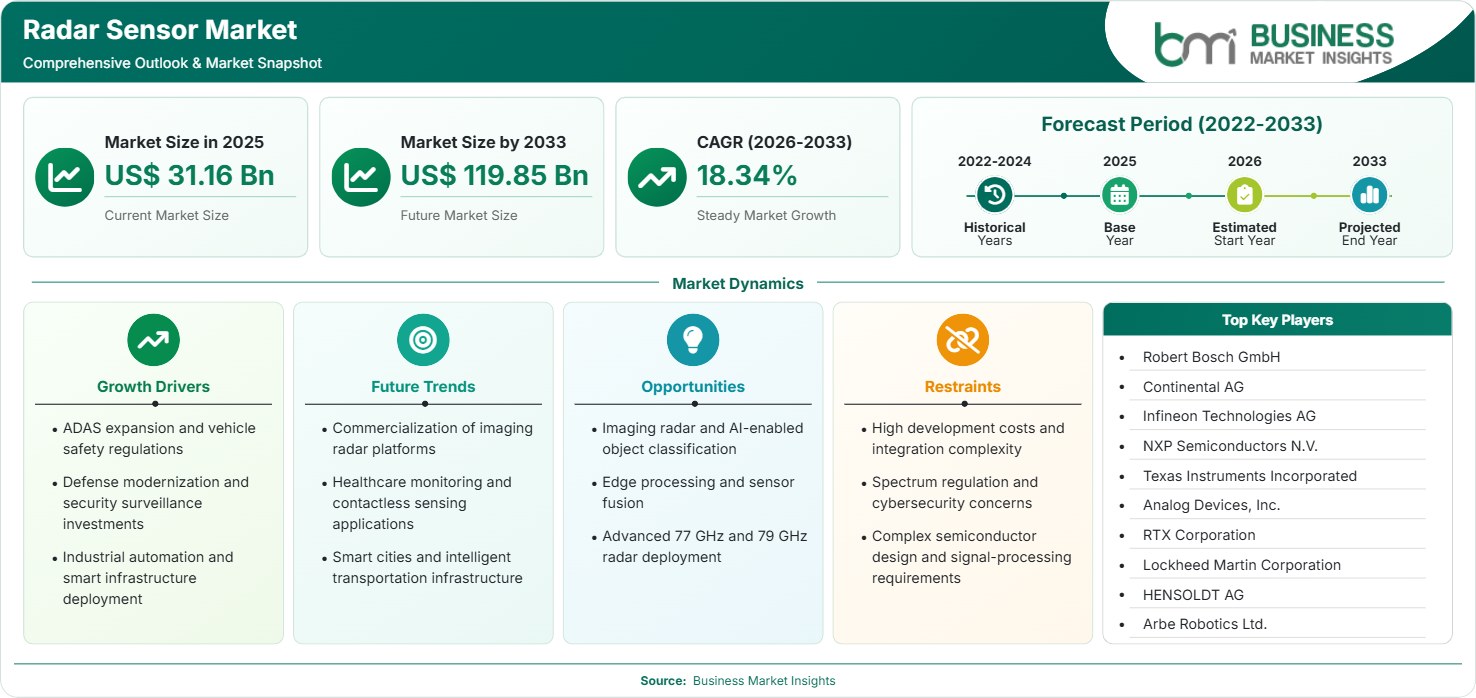
The Radar Sensor Market size was valued at US$ 31.16 Billion in 2025 and is projected to reach US$ 119.85 Billion by 2033, growing at a CAGR of 18.34% during 2026–2033, driven by ADAS deployment, defense modernization, industrial automation, weather intelligence systems, and expanding healthcare sensing applications.

Report Coverage
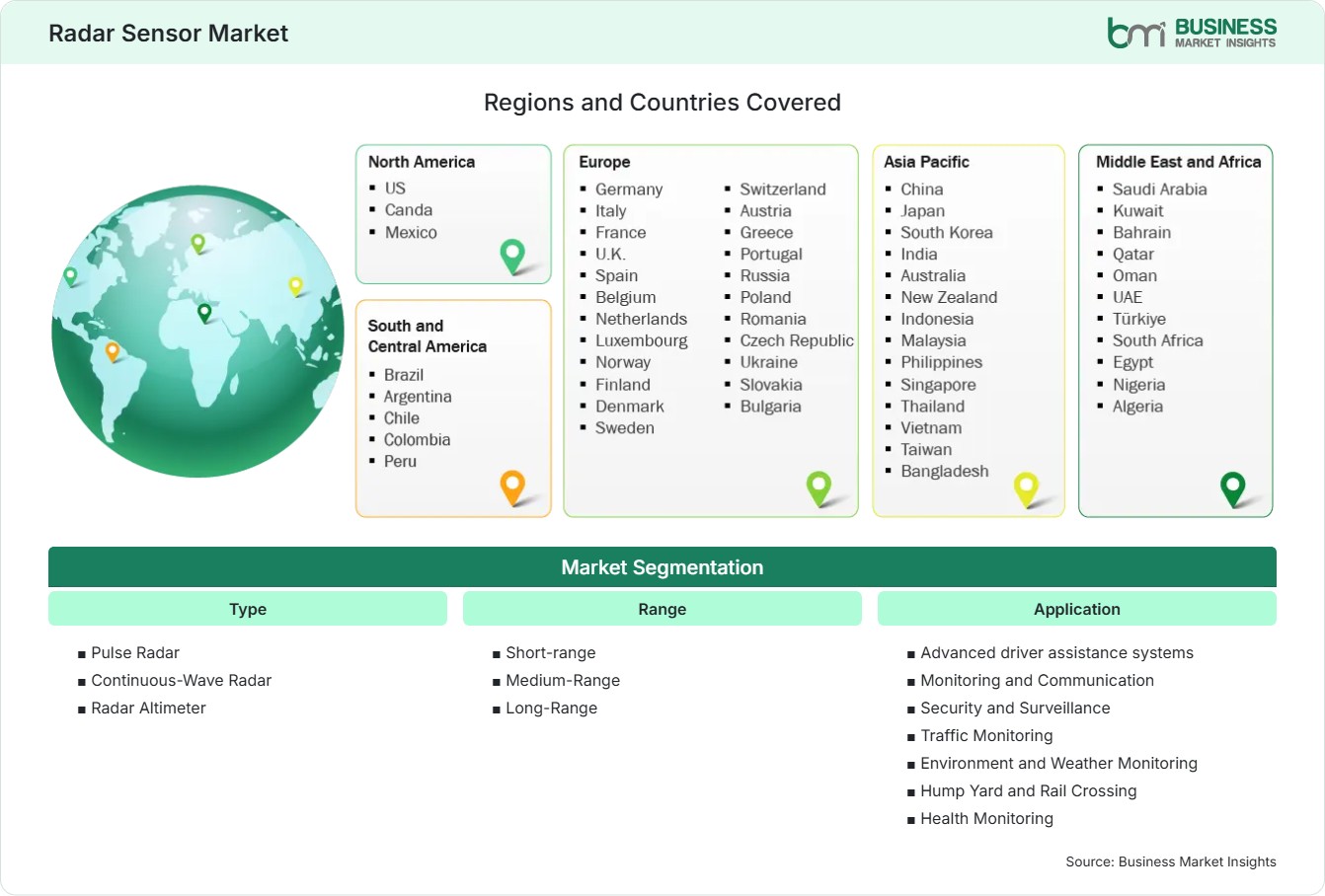
  • Type: Pulse Radar, Continuous-Wave Radar, Radar Altimeter
  • Range: Short-range, Medium-Range, Long-Range
  • Application: Advanced driver assistance systems, Monitoring and Communication, Security and Surveillance, Traffic Monitoring, Environment and Weather Monitoring, Hump Yard and Rail Crossing, Health Monitoring
US$ 31.16 Bn Market size in 2025
US$ 119.85 Bn Market Size by 2033
18.34% CAGR, 2026 - 2033
2026-2033 Forecast Period

AI Overview

Radar Sensor Market Summary

  • North America Region: Holds a market share of 33%–36% in 2025, growing at a CAGR of 16.5%–18.0% during 2026–2033. Strong defense spending, ADAS penetration, smart infrastructure deployment, and industrial automation investments create significant demand and long-term innovation opportunities across multiple sensing applications. US market remains dominant, supported by automotive safety regulations, aerospace investments, and estimated CAGR of 16.8%–18.2%.
  • Fastest Growing Region: Asia Pacific accounts for 28%–31% share in 2025 and advances at a CAGR of 20.5%–22.5%. Expanding vehicle production, manufacturing digitization, smart city development, and surveillance investments accelerate deployment of advanced sensing solutions across industries.
  • Leading Segment: Automotive represents 30%–34% market share in 2025 and grows at 19.0%–20.5% CAGR. Regulatory mandates for vehicle safety, autonomous driving development, and increasing sensor content per vehicle sustain long-term demand worldwide.
  • High Growth Segment: Advanced driver assistance systems (ADAS) holds 24%–28% share in 2025 and expands at 21.0%–23.0% CAGR. Automatic emergency braking, blind-spot monitoring, adaptive cruise control, and autonomous mobility investments support rapid deployment.
  • Key Market Opportunity: Integration of imaging radar, AI-enabled processing, and edge analytics is creating scalable opportunities across transportation, healthcare monitoring, industrial automation, and intelligent infrastructure over the forecast horizon.
  • Major Market Players: Robert Bosch GmbH, Continental AG, Infineon Technologies AG, NXP Semiconductors N.V., Texas Instruments Incorporated, Analog Devices, Inc., RTX Corporation, Lockheed Martin Corporation, HENSOLDT AG, and Arbe Robotics Ltd.
Strategic Insights

Radar Sensor Market: Strategic Insights

Radar Sensor Market Strategic Framework
FREE PDF
Request your free sample
Request free sample
Stakeholder View

Key Takeaways

  • The value chain increasingly depends on semiconductor suppliers, software developers, module manufacturers, system integrators, and OEMs working collaboratively to accelerate deployment cycles and reduce integration complexity.
  • The largest upside exists in ADAS, health monitoring, and smart transportation systems, where real-time detection capabilities support safety, automation, and operational efficiency objectives.
  • Innovation is shifting toward imaging radar, AI-based object classification, edge processing, and sensor fusion platforms capable of operating reliably under low-visibility conditions.
  • Asia Pacific presents the most compelling investment case due to expanding vehicle production, smart city programs, and increasing deployment of industrial automation technologies.
  • Mergers, strategic alliances, and semiconductor investments are strengthening competitive positioning as companies seek differentiated sensing capabilities and broader application portfolios.
  • Demand diversification beyond automotive into healthcare, maritime, rail safety, and environmental intelligence reduces dependence on any single end-use sector.
Geographic Outlook

Radar Sensor Market Regional Highlights

North America Radar Sensor Market

North America accounts for 33%–36% Radar Sensor Market share in 2025 and is projected to expand at a CAGR of 16.5%–18.0% through 2033. Growth stems from defense modernization, strong ADAS integration rates, industrial automation adoption, and critical infrastructure protection investments. The region benefits from advanced semiconductor capabilities and sustained R&D expenditure. Federal transportation safety initiatives and increasing deployment of smart mobility technologies continue to support commercial adoption across automotive, aerospace, logistics, and public security applications.

  • Defense procurement programs continue expanding demand for advanced surveillance and situational-awareness technologies.
  • Strong ADAS implementation across passenger vehicles supports long-term radar module requirements.
  • Industrial digitization initiatives accelerate deployment within manufacturing and logistics facilities.
  • Airport modernization and aerospace investments strengthen demand for precision sensing technologies.

US Radar Sensor Market

The United States contributes approximately 76%–80% of the North American Radar Sensor Market share and advances at a CAGR of 16.8%–18.2%. Automotive safety mandates, aerospace innovation, and military technology investments drive deployment. Strong participation from semiconductor manufacturers and technology providers supports product innovation and commercialization, while federal investments in transportation infrastructure create additional opportunities for intelligent traffic monitoring and safety applications.

  • Vehicle manufacturers continue expanding sensor deployment across premium and mass-market models.
  • Aerospace and defense contracts support development of next-generation radar technologies.
  • Smart traffic management projects increase adoption of monitoring platforms.
  • Research institutions accelerate innovation in imaging and AI-enhanced sensing.

Europe Radar Sensor Market

Europe holds 24%–27% share in 2025 and records CAGR of 17.0%–18.8%. Automotive safety legislation, industrial automation initiatives, and border surveillance investments sustain demand. Germany remains the leading country owing to automotive technology leadership, while Eastern European markets demonstrate faster expansion through manufacturing investments. Sustainability-focused transportation modernization programs further strengthen adoption across commercial mobility ecosystems.

  • Germany leads regional revenue generation through strong automotive and industrial sectors.
  • France and the United Kingdom maintain sizeable aerospace and defense demand.
  • EU safety regulations stimulate deployment of sensing technologies in vehicles.
  • Poland and Czech Republic emerge as high-growth manufacturing centers.
  • Rail infrastructure modernization strengthens transportation monitoring applications.

Asia Pacific Radar Sensor Market

Asia Pacific represents 28%–31% share in 2025 and exhibits the highest CAGR of 20.5%–22.5%. Large-scale automotive manufacturing, expanding smart city initiatives, and industrial automation investments support acceleration. China leads regional demand through vehicle production scale and intelligent infrastructure deployment, while India records among the fastest growth rates due to transportation modernization and industrial digitization programs.

  • China remains the dominant market through smart mobility and manufacturing investments.
  • India demonstrates rapid adoption across transportation and industrial applications.
  • Japan strengthens advanced automotive sensing innovation.
  • South Korea supports growth through semiconductor leadership and vehicle technology.
  • Smart city development increases intelligent monitoring installations.

Rest of World Radar Sensor Market

The Rest of World region accounts for 10%–13% share in 2025 and advances at 18.0%–20.0% CAGR. South & Central America benefit from transportation modernization and security initiatives. Middle East and Africa growth is supported by border security, smart infrastructure, and energy-sector investments. Brazil leads Latin American adoption, while Saudi Arabia and the UAE remain high-growth markets due to diversification strategies and digital transformation spending.

  • Brazil drives regional automotive and transportation deployment demand.
  • Saudi Arabia expands intelligent infrastructure and surveillance investments.
  • UAE accelerates smart city and airport modernization projects.
  • Energy facilities increasingly adopt radar-enabled monitoring systems.
  • Security modernization programs create new government procurement opportunities.
Global Market Geography
FREE PDF
Request your free sample
Request free sample
Segment Analysis

Radar Sensor Market Segmentation

Type

This segment accounts for approximately 26%–30% market share and is expected to grow at 17.5%–19.0% CAGR. Rapid evolution in sensing accuracy, range optimization, and environmental resilience is influencing procurement decisions. The Radar Sensor Market scope continues to broaden as different architectures address automotive, aviation, industrial, and defense use cases.

  • Pulse Radar: Widely used in surveillance, weather observation, and defense applications requiring accurate distance measurement and reliable performance across long operational ranges.
  • Continuous-Wave Radar: Preferred for velocity measurement applications including automotive systems, traffic monitoring, and industrial motion detection because of efficient operational characteristics.
  • Radar Altimeter: Essential for aviation operations, terrain awareness, and flight safety applications where altitude measurement precision remains critical.

Range

This segment represents nearly 22%–26% share in 2025 and is forecast to expand at 18.0%–19.5% CAGR. Demand patterns are influenced by application-specific requirements involving detection distance, resolution, and environmental operating conditions.

  • Short-range: Commonly integrated into parking assistance, proximity detection, industrial automation, and indoor monitoring scenarios requiring precision within limited coverage areas.
  • Medium-Range: Supports blind-spot detection, traffic monitoring, security applications, and industrial sensing environments where balanced coverage and accuracy are required.
  • Long-Range: Extensively deployed in adaptive cruise control, defense surveillance, aviation, and maritime navigation requiring distant target identification.

Application

Application segment holds 32%–36% share and advances at 19.5%–21.0% CAGR. The Radar Sensor Market trends reveal expanding adoption across mobility, industrial intelligence, public safety, healthcare, and environmental monitoring ecosystems.

  • Advanced driver assistance systems (ADAS): The fastest expanding application area due to regulatory support, safety awareness, and autonomous vehicle development initiatives.
  • Monitoring and Communication: Increasingly utilized for infrastructure management, industrial operations, and mission-critical communications support.
  • Security and Surveillance: Growth supported by border security investments, critical infrastructure protection, and public safety modernization.
  • Traffic Monitoring: Enables intelligent transportation systems through real-time vehicle detection and traffic flow optimization.
  • Environment and Weather Monitoring: Supports meteorological forecasting and climate observation applications requiring continuous data collection.
  • Hump Yard and Rail Crossing: Improves rail operational safety through object detection and movement monitoring capabilities.
  • Health Monitoring: Expanding adoption for contactless patient observation, fall detection, and remote care environments.

Vertical

Vertical demand accounts for 30%–34% share and is projected to record 19.0%–20.5% CAGR. End-use adoption is increasingly shaped by automation priorities, safety mandates, and digital transformation initiatives.

  • Automotive: Largest revenue contributor due to widespread ADAS integration and autonomous driving research.
  • Aerospace and Defence: Continuous modernization programs sustain demand for high-performance sensing technologies.
  • Healthcare: Contactless monitoring applications create new growth avenues across hospitals and remote-care settings.
  • Maritime: Navigation safety and vessel monitoring requirements support adoption.
  • Manufacturing: Industrial automation and predictive maintenance initiatives strengthen deployments.
  • Oil and Gas: Hazardous-environment monitoring and asset protection applications contribute to demand.
Market Forces

Radar Sensor Market Dynamics

Key Market Drivers

ADAS Expansion and Vehicle Safety Regulations

Governments increasingly require advanced vehicle safety functions, including emergency braking and collision avoidance. Regulatory frameworks in Europe, North America, and parts of Asia are encouraging broader deployment of sensing technologies. Radar remains a preferred all-weather detection solution compared with camera-only configurations. Radar Sensor Market growth is thus in tune with the growth in the number of sensors used per vehicle. Data from the industry suggest that there will be increases in the global ADAS penetration rates, and automotive companies are incorporating several sensing devices into one unit. This creates a strong base for industry demands for the years to come.

Defense Modernization and Security Surveillance Investments

Defense departments are making more investments in surveillance, reconnaissance, border control, and situational awareness systems. With the help of sophisticated sensors, it is possible to detect targets even in difficult conditions and at the same time achieve national security goals. Many governments are providing increased funding for modernization programs in defense, especially radar-based ones. Radar Sensor Market trends can be boosted through such acquisitions, as defense requirements rely heavily on reliability, range, and performance. Growth in security systems within transportation centers, energy plants, and cities can increase demand even more. Public and private funding is constantly creating opportunities in hardware, software, and integrated system areas.

Industrial Automation and Smart Infrastructure Deployment

Manufacturers increasingly utilize sensing technologies for automation, occupancy monitoring, machine safety, and predictive maintenance. Smart infrastructure initiatives also require intelligent traffic controls, environmental monitoring, and public safety systems. Radars operate reliably in conditions of dust, smoke, fog, and darkness. With the increasing spending on Industry 4.0 worldwide, the number of implementations in factories and logistics is growing. The digitalization of cities promotes faster implementation in transport networks and city infrastructures. This will create broader applications outside of the automotive industry.

Key Market Opportunities

Commercialization of Imaging Radar Platforms

Radar imaging systems have superior object classification, resolution, and environmental sensing ability when compared to traditional radar systems. Potential applications include autonomous cars, industrial robots, security cameras, and intelligent transport systems. The increased computing power allows manufacturers to distinguish their products based on the performance of their software. Radar Sensor Market Forecasts increasingly reflect growing interest in imaging architectures because they improve safety and operational efficiency. Strategic investments in semiconductor integration, AI processing, and edge computing are expected to accelerate market penetration over the forecast period and support premium-value product positioning.

Healthcare Monitoring and Contactless Sensing Applications

Healthcare providers increasingly explore contactless monitoring solutions capable of tracking respiration, movement, occupancy, and patient activity. Systems equipped with radar technology decrease physical contact needs and increase observation capacity in hospitals, nursing homes, and home-based scenarios. The aging population, along with increasing demands in managing chronic illnesses, suggests growth opportunities in the future. Combining systems with telemedicine platforms opens up further business prospects. Companies that manufacture medically tested and privacy-enhanced sensor devices can gain access to a growing market and outperform existing monitoring solutions.

Smart Cities and Intelligent Transportation Infrastructure

Governments are investing in urban mobility enhancements focused on congestion reduction, safety improvement, and operational efficiency. Radar-based technology systems allow for real-time vehicle count, incident detection, pedestrian detection, and adaptive traffic control. The greatest growth potential is in places that are urbanizing very quickly and need their transportation infrastructure modernized. Being integrated with intelligent infrastructure and analysis platforms enables a scalable business model. Companies that offer an integrated solution can profit from both hardware sales as well as services revenues.

Market Restraints and Challenges

High Development Costs and Integration Complexity

Factor: Advanced sensing modules require sophisticated semiconductor designs, signal-processing capabilities, and extensive validation procedures. Impact: Development costs and engineering complexities may inhibit the commercialization and adoption of products, especially from cost-conscious customers. In the automotive and industrial applications sector, there is a need for thorough testing, certification, and compatibility assurance before any deployment. This will extend the product development period and erect barriers for small players in the market. With increasing expectations for performance, vendors will need to continually conduct research and development, software upgrades, and production improvements.

Spectrum Regulation and Cybersecurity Concerns

Factor: Radar systems operate within regulated frequency bands and increasingly connect with digital ecosystems. Impact: The issues of compliance and security can impact deployment approaches. The different regulatory environment in each region might necessitate changes in the product design and increase development costs. On the other hand, the increased connectivity is making infrastructure and transportation systems vulnerable to cyber-attacks. Thus, the users call for adequate security measures, encryption, and software update tools. This leads to additional complexities in the operation of IoT devices.

Company Analysis

Competitive Landscape

Radar Sensor Market analysis indicates competition is centered on semiconductor innovation, imaging capabilities, ADAS integration, and defense-grade sensing performance.

Company Name

Overview

Products and Services relevant to this market

Robert Bosch GmbH

Global technology supplier with strong automotive electronics and mobility solutions portfolio.

Automotive radar sensors, ADAS platforms, safety systems, sensing integration services.

Continental AG

Major automotive technology company focused on intelligent mobility systems.

Radar modules, driver assistance solutions, autonomous sensing platforms.

Infineon Technologies AG

Semiconductor leader serving automotive and industrial markets globally.

Radar chipsets, RF semiconductors, sensing components, controller solutions.

NXP Semiconductors N.V.

Leading provider of automotive and industrial semiconductor technologies.

Radar processors, transceivers, ADAS-enabling semiconductor platforms.

Texas Instruments Incorporated

Analog and embedded processing specialist serving multiple industries.

mmWave radar sensors, industrial monitoring, automotive sensing devices.

Analog Devices, Inc.

High-performance semiconductor company with sensing expertise.

RF technologies, signal processing solutions, industrial radar systems.

RTX Corporation

Aerospace and defense leader with extensive surveillance capabilities.

Defense radar systems, sensor integration, aerospace monitoring solutions.

Lockheed Martin Corporation

Defense contractor supporting advanced sensing technologies.

Surveillance radar, military detection systems, integrated defense platforms.

HENSOLDT AG

European defense electronics and sensing technology provider.

Airborne, naval, and ground-based radar solutions.

Arbe Robotics Ltd.

Specialist focused on high-resolution imaging radar innovation.

Imaging radar platforms, autonomous mobility sensing technologies.

Trust & Transparency

Research Methodology

The market analysis combines proprietary research with secondary data from government agencies, company disclosures, regulatory filings, industry databases and expert interviews. Market estimates are validated through data triangulation, cross-market benchmarking and analyst review.

View Full Research Methodology

Questions Answered

Frequently Asked Questions

Which vertical generates the highest demand for radar sensors?

Automotive remains the largest revenue-generating vertical because safety regulations, ADAS deployment, and autonomous driving initiatives continue increasing radar content per vehicle.

What does a Radar Sensor Market Report typically evaluate?

It assesses industry size, technology developments, competitive positioning, segmentation trends, regulatory influences, investment opportunities, regional performance, and long-term demand outlook.

How does imaging radar differ from traditional radar systems?

Imaging radar provides higher resolution, improved object classification, and richer environmental awareness, allowing more accurate detection capabilities for autonomous and safety-critical applications.

Which region offers the strongest future growth potential?

Asia Pacific is expected to deliver the fastest expansion due to vehicle production growth, urbanization, infrastructure modernization, semiconductor investments, and increasing deployment of automation technologies.

What is driving adoption of radar sensors beyond automotive applications?

Industrial automation, healthcare monitoring, smart infrastructure, rail safety, maritime navigation, and environmental observation are increasingly adopting radar technologies because of reliable performance under challenging visibility conditions.

Access the Full Radar Sensor Market Report

Get segment-level forecasts, regional estimates, competitive benchmarking, company profiles and downloadable Excel datasets.

Access the full Radar Sensor Market Report
350 pages PDF & Excel | 2026-09-02
Similar Research

Related Market Reports