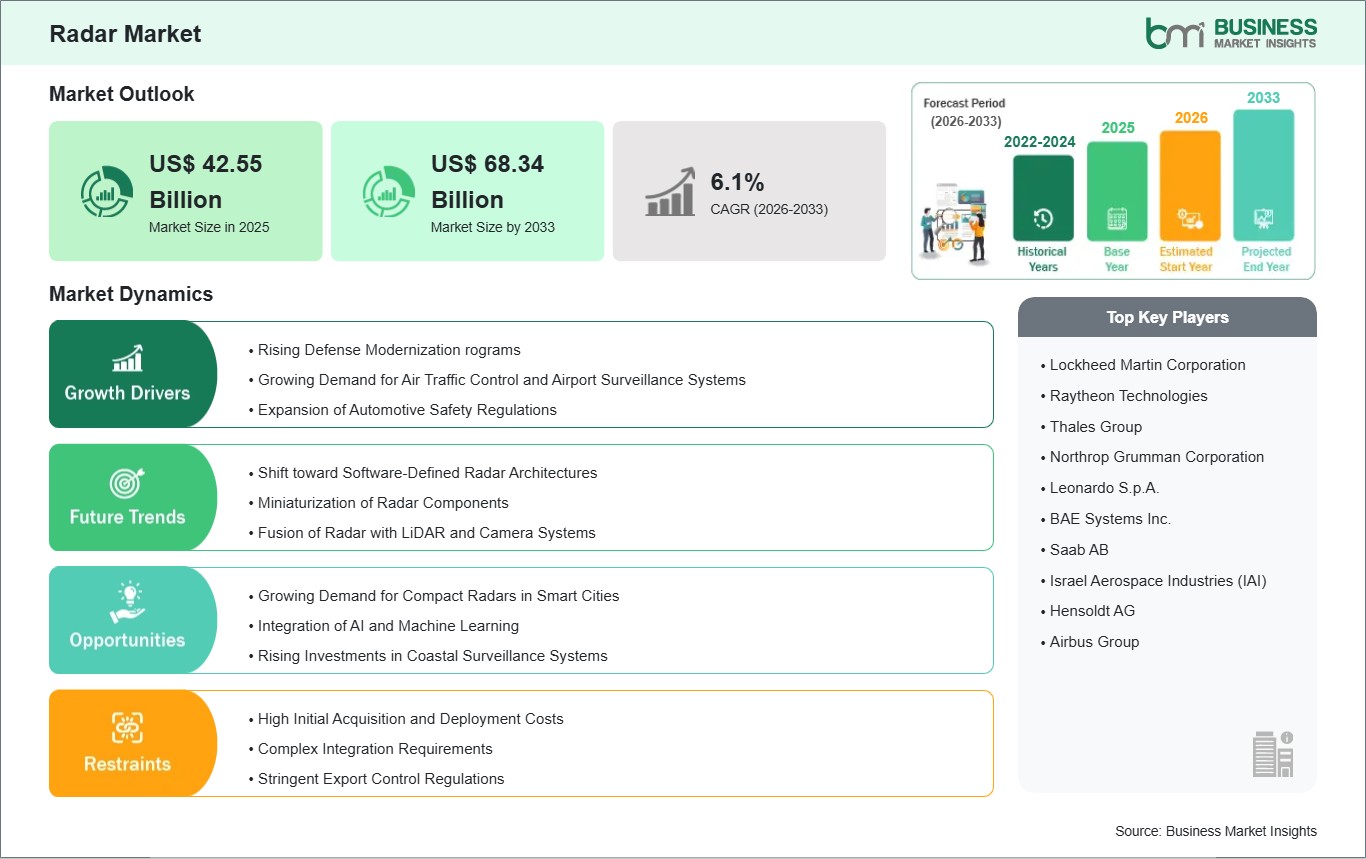
The radar market size is expected to reach US$68,342.54 million by 2033 from US$42,556.71 million in 2025. The market is estimated to record a CAGR of 6.1% from 2026 to 2033.
The increasing demand for advanced sensing, surveillance, and navigation solutions across defense, automotive, aerospace, and industrial sectors is the primary driver of the global radar market. The rapid adoption of autonomous vehicles, unmanned aerial vehicles (UAVs), smart transportation systems, and air traffic management solutions is a key factor boosting the need for radar systems with higher accuracy, range, and reliability. Defense modernization programs, border security initiatives, and maritime surveillance are further accelerating radar deployment globally. In the commercial sector, applications in automotive safety systems, collision avoidance, and adaptive cruise control are contributing significantly to market growth. Advancements in technologies such as phased array antennas, solid-state radar, and AI-enabled radar signal processing are enabling enhanced detection capabilities, real-time analytics, and smaller, more energy-efficient systems. Despite strong growth prospects, the market faces challenges such as high R&D and manufacturing costs, complex regulatory compliance, spectrum allocation limitations, and integration challenges with existing infrastructure. Additionally, varying adoption rates across regions and industries may affect the pace of market expansion. Nevertheless, the radar market is poised for robust growth due to emerging opportunities such as the rise of autonomous transportation, increasing government investments in defense and smart city initiatives, and the integration of radar with IoT, AI, and 5G technologies. Continuous innovations in miniaturized radar modules, long-range detection systems, and multifunctional radar platforms are expected to shape the competitive landscape in the coming years.

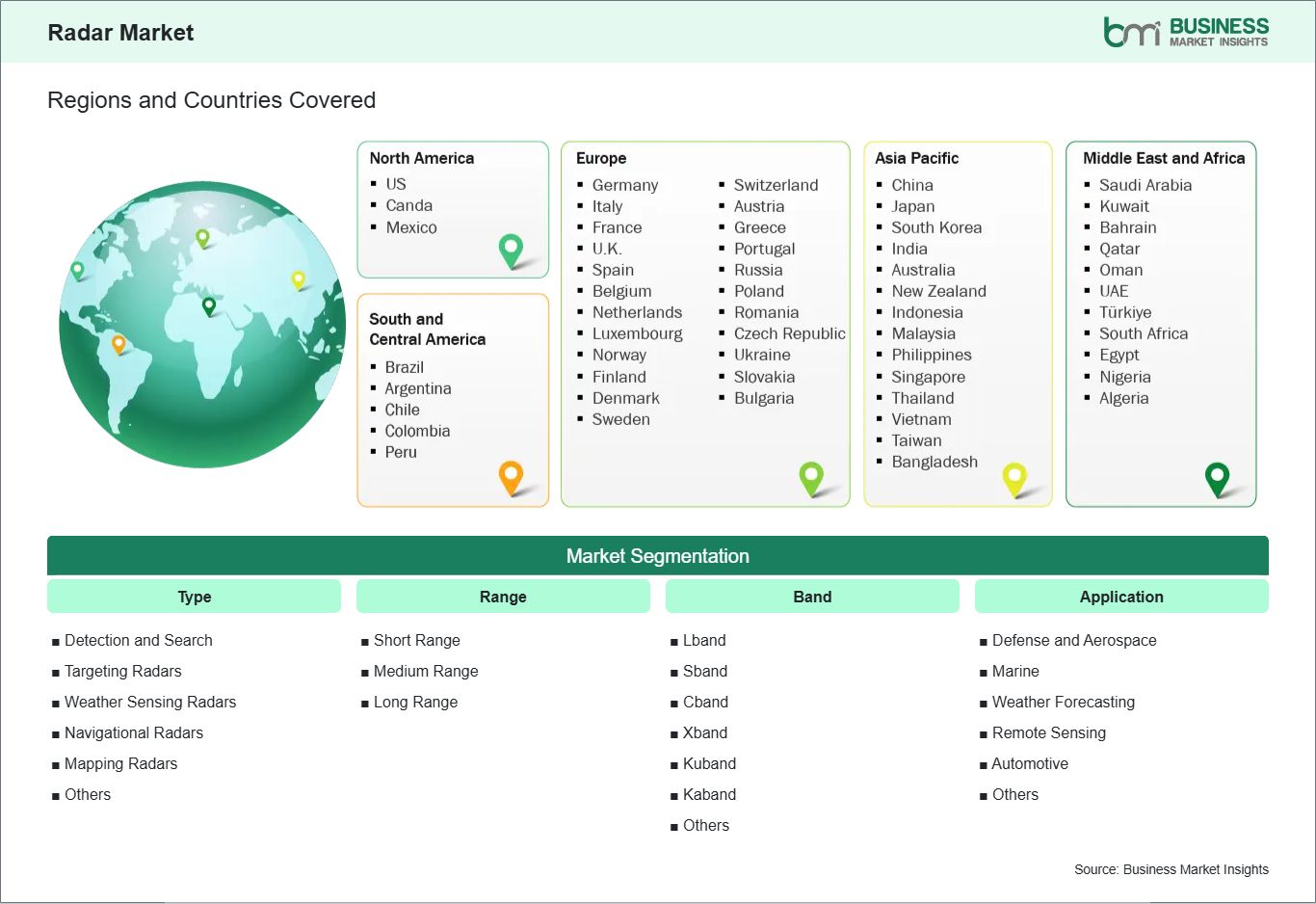
Key segments that contributed to the derivation of the radar market analysis are type, range, band, and application.
The growing adoption of autonomous vehicles (AVs), advanced driver-assistance systems (ADAS), and connected mobility solutions is driving demand for high-precision radar sensors. Automotive manufacturers are investing heavily in short-, medium-, and long-range radar systems to ensure safety, collision avoidance, and improved navigation. Increasing regulations for road safety and government support for smart transportation are further accelerating radar integration in vehicles.
Defense modernization programs, border security enhancements, and maritime and air surveillance initiatives are creating substantial opportunities for radar technologies. Advanced phased-array and solid-state radar systems are being deployed to improve situational awareness, threat detection, and strategic decision-making, especially in regions with rising geopolitical tensions.
Based on type, the radar market is segmented into detection and search radars, targeting radars, weather sensing radars, navigational radars, mapping radars, and others. Detection and search radars currently dominate due to their critical role in defense surveillance, air traffic control, and autonomous vehicle navigation.
Based on range, the market is classified into short range, medium range, and long range. Short-range radars see significant adoption in automotive and industrial applications, while long-range radars are preferred in defense, aerospace, and maritime monitoring due to their extended detection capabilities.
By band, the market includes L-band, S-band, C-band, X-band, Ku-band, Ka-band, and Others. X-band and Ka-band radars are leading the market because of their high-resolution imaging and precision in military, weather forecasting, and autonomous vehicle applications.
By application, the market is categorized into defense and aerospace, marine, weather forecasting, remote sensing, automotive, and others. The Defense and Aerospace segment remains the largest, driven by global modernization programs, while Automotive radar adoption is growing rapidly due to autonomous driving and advanced driver-assistance systems.
| Report Attribute | Details |
|---|---|
| Market size in 2025 | US$ 42.55 Billion |
| Market Size by 2033 | US$ 68.34 Billion |
| Global CAGR (2026 - 2033) | 6.1% |
| Historical Data | 2022-2024 |
| Forecast period | 2026-2033 |
| Segments Covered | By Type
|
|
Regions and Countries Covered
| |
| North America | US, Canada, Mexico |
| Europe | Belgium, Austria, Finland, Denmark, Greece, Poland, Romania, Russia, Ukraine, Czech Republic, Slovakia, Bulgaria, Italy, Luxembourg, Germany, Switzerland, France, Netherlands, Norway, Portugal, Spain, Sweden, United Kingdom |
| Asia-Pacific | Australia, China, India, Japan, South Korea, Indonesia, Malaysia, Philippines, Singapore, Thailand, Vietnam, Bangladesh, New Zealand, Taiwan |
| South and Central America | Brazil, Argentina, Peru, Chile, Colombia |
| Middle East and Africa | Bahrain, Kuwait, Oman, Qatar, Saudi Arabia, United Arab Emirates, Turkiye, South Africa, Egypt, Algeria, Nigeria |
| Market leaders and key company profiles |
|
The Telematics Market Size and Forecast (2022–2033) report provides a detailed analysis of the market covering below areas:
The geographical scope of the Telematics Market report is divided into five regions: North America, Asia Pacific, Europe, Middle East &; Africa, and South & Central America. The Telematics Market in Asia Pacific is expected to grow significantly during the forecast period.
The global radar market is segmented into five major regions: North America, Europe, Asia-Pacific, the Middle East & Africa, and South & Central America. Asia-Pacific is expected to experience the fastest growth during the forecast period. Key drivers include rapid adoption of autonomous vehicles, expansion of defense and aerospace programs, increasing smart city initiatives, and significant investments in advanced radar technologies. China, Japan, South Korea, India, and Southeast Asian countries are investing heavily in automotive radar, long-range defense radars, and multifunctional weather and mapping radars to support both civilian and military applications.
North America remains a key market due to the presence of leading radar system manufacturers, strong defense spending, and early adoption of automotive and commercial radar technologies. The U.S. and Canada are driving demand through investments in advanced driver-assistance systems (ADAS), border security radar networks, and aerospace radar platforms.
Europe is experiencing steady growth, supported by government initiatives for defense modernization, smart transportation, and weather monitoring infrastructure. Countries such as Germany, the U.K., France, and Italy are investing in high-precision radars for automotive, aerospace, and maritime applications.

The Telematics Market is evaluated by gathering qualitative and quantitative data post primary and secondary research, which includes important corporate publications, association data, and databases. A few of the key developments in the Telematics Market are:
The Radar Market is valued at US$ 42.55 Billion in 2025, it is projected to reach US$ 68.34 Billion by 2033.
As per our report Radar Market, the market size is valued at US$ 42.55 Billion in 2025, projecting it to reach US$ 68.34 Billion by 2033. This translates to a CAGR of approximately 6.1% during the forecast period.
The Radar Market report typically cover these key segments-
The historic period, base year, and forecast period can vary slightly depending on the specific market research report. However, for the Radar Market report:
The Radar Market is populated by several key players, each contributing to its growth and innovation. Some of the major players include:
The Radar Market report is valuable for diverse stakeholders, including:
Essentially, anyone involved in or considering involvement in the Radar Market value chain can benefit from the information contained in a comprehensive market report.
Please tell us your area of interest
(Market Segments/ Regions and Countries/ Companies)