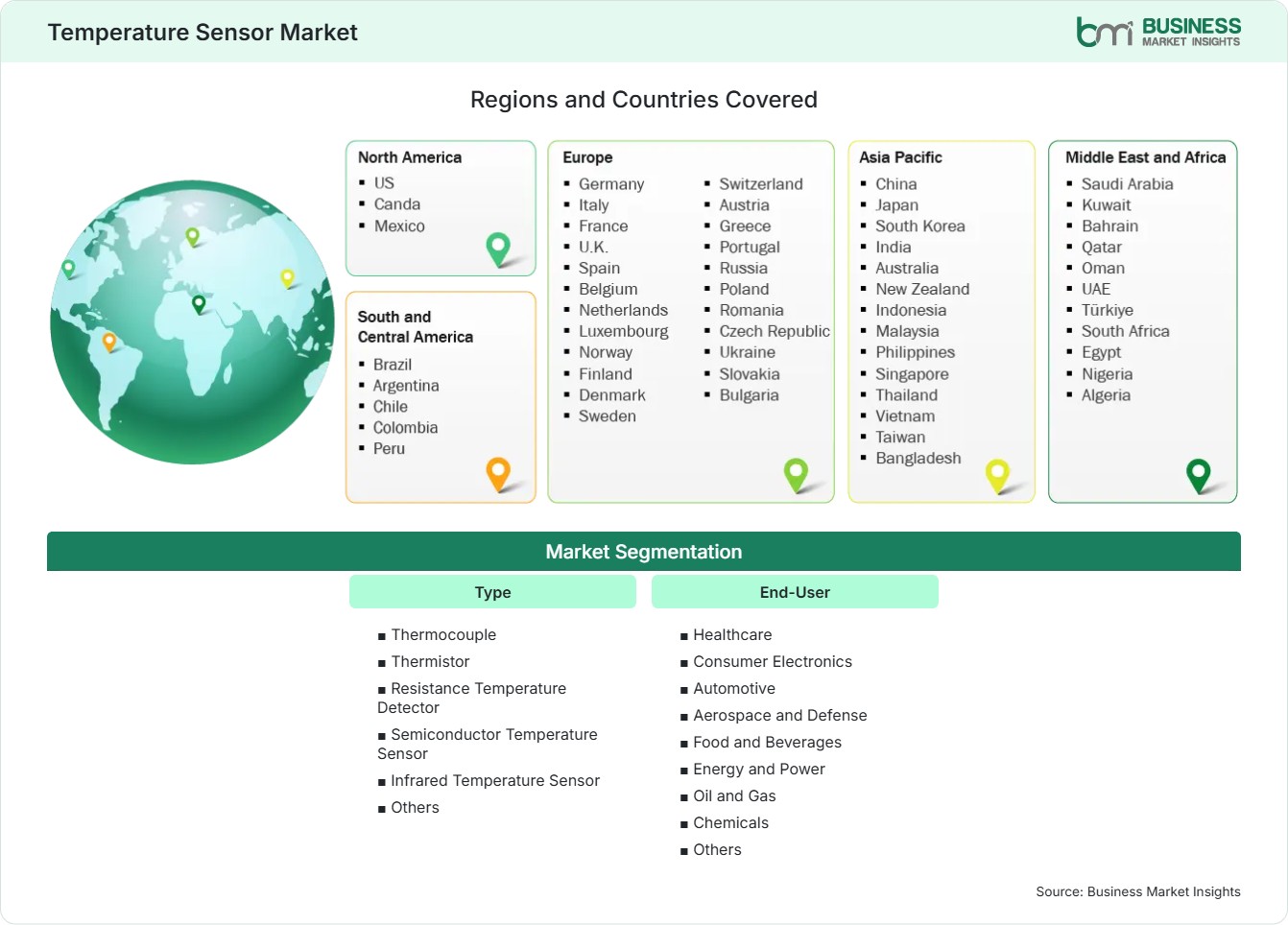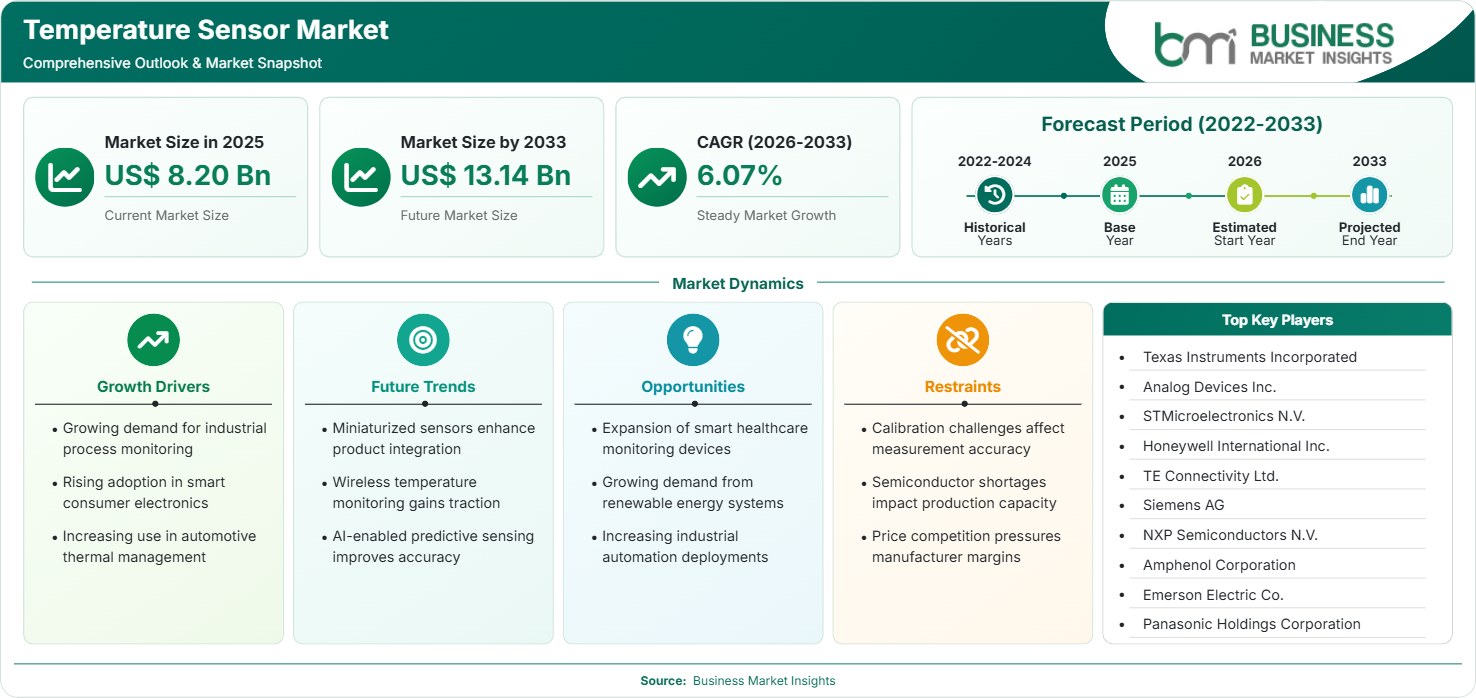
Temperature Sensor Market Regional Highlights
North America Temperature Sensor Market
North America accounted for 34%–37% of the Temperature Sensor Market Share in 2025 and is projected to expand at a CAGR of 5.8%–6.2% during 2026–2033. Strong semiconductor manufacturing, expanding industrial automation, increasing electric vehicle production, and continuous investments in smart manufacturing technologies continue supporting regional growth. High adoption of Industry 4.0 solutions, advanced process monitoring, and intelligent sensing systems further strengthen the region's leadership across multiple industrial applications.
- Industrial manufacturers continue investing in predictive maintenance systems integrating advanced temperature sensors to improve equipment reliability, reduce operational downtime, and optimize production efficiency across manufacturing facilities.
- Growing electric vehicle production continues increasing demand for battery thermal management systems requiring highly accurate temperature monitoring for enhanced safety, efficiency, and battery performance.
- Semiconductor manufacturers continue introducing highly integrated digital sensing solutions supporting industrial automation, healthcare devices, consumer electronics, and connected infrastructure applications.
- Expanding adoption of Industrial Internet of Things technologies strengthens deployment of intelligent sensors capable of delivering continuous real-time monitoring across industrial environments.
- Increasing investment in smart buildings and energy-efficient infrastructure supports broader implementation of advanced sensing technologies for environmental monitoring and energy management.
US Temperature Sensor Market
The United States represented 29%–32% of global revenue in 2025 and is forecast to register a CAGR of 5.9%–6.3% during 2026–2033. Strong research capabilities, advanced semiconductor manufacturing, growing electric vehicle production, and widespread industrial automation continue supporting sustained market expansion across healthcare, automotive, aerospace, and consumer electronics industries.
- Leading semiconductor companies continue investing in next-generation sensor technologies featuring improved accuracy, miniaturization, and low-power consumption for advanced electronic applications.
- Expansion of electric vehicle manufacturing strengthens demand for precision thermal monitoring solutions supporting battery safety, charging efficiency, and vehicle performance optimization.
- Industrial automation projects continue driving deployment of intelligent sensing systems integrated with artificial intelligence and predictive maintenance platforms.
- Healthcare technology manufacturers increasingly incorporate miniature temperature sensors into wearable monitoring devices, patient diagnostics, and connected medical equipment.
Europe Temperature Sensor Market
Europe held 25%–28% temperature sensor market share in 2025 and is expected to grow at a CAGR of 5.7%–6.1% through 2026–2033. Strong industrial engineering capabilities, increasing renewable energy investments, expanding automotive electrification, and advanced manufacturing technologies continue supporting regional development. Germany leads regional demand with a CAGR of 5.8%–6.2%, while Poland records the fastest growth at 6.5%–6.9% owing to expanding industrial manufacturing investments.
- Germany continues leading regional adoption through advanced automotive manufacturing, industrial automation expertise, and strong investments in precision sensing technologies.
- Poland benefits from increasing electronics manufacturing, industrial modernization, and expanding foreign direct investment supporting sensor deployment across multiple industries.
- Renewable energy projects continue increasing deployment of temperature monitoring systems across wind, solar, and energy storage infrastructure.
- Healthcare digitalization initiatives strengthen demand for highly accurate sensing technologies supporting patient monitoring, laboratory diagnostics, and connected medical equipment.
- European manufacturers increasingly prioritize energy-efficient industrial operations supported by intelligent sensing and predictive maintenance technologies.
Asia Pacific Temperature Sensor Market
Asia Pacific accounted for 29%–32% of industry revenue in 2025 and is projected to register the highest CAGR of 6.9%–7.4% during 2026–2033. Rapid semiconductor manufacturing expansion, increasing industrial automation, growing consumer electronics production, and rising electric vehicle manufacturing continue driving regional growth. China leads regional demand with a CAGR of 6.8%–7.2%, while India records the fastest expansion at 7.5%–7.9%.
- China continues strengthening semiconductor manufacturing capacity while expanding production of consumer electronics, industrial equipment, and intelligent sensing technologies.
- India experiences strong expansion through government manufacturing initiatives, increasing electronics production, and growing industrial automation investments.
- Japan and South Korea continue advancing precision sensor innovation through investments in semiconductor fabrication, robotics, and next-generation industrial technologies.
- Expanding smart factory deployments continue accelerating adoption of intelligent temperature monitoring systems across manufacturing facilities.
- Rising renewable energy investments further increase demand for precision sensing solutions supporting energy storage, grid infrastructure, and power generation applications.
Rest of World Temperature Sensor Market
The Rest of World represented 8%–10% temperature sensor market share during 2025 and is anticipated to expand at a CAGR of 6.1%–6.5% through 2026–2033. South & Central America continue increasing investments in industrial modernization, while the Middle East & Africa strengthen deployment of sensing technologies across energy, manufacturing, and infrastructure projects.
Brazil leads South & Central America with a CAGR of 6.2%–6.6%, while Saudi Arabia records the fastest regional growth at 6.8%–7.2%, supported by industrial diversification initiatives, smart infrastructure development, and increasing energy sector investments.
- Brazil continues expanding industrial automation and manufacturing modernization, creating sustained demand for advanced industrial sensing technologies.
- Saudi Arabia strengthens adoption through investments in smart industrial cities, energy infrastructure modernization, and digital manufacturing initiatives.
- Oil and gas companies increasingly deploy precision sensing technologies for equipment monitoring, operational safety, and predictive maintenance applications.
- Growing food processing and healthcare industries contribute to increasing implementation of reliable temperature monitoring systems across critical operational environments.
- Expanding digital infrastructure projects continue supporting broader deployment of connected sensing technologies across emerging industrial economies.