
Ultrasonic Sensor Market Outlook: Size, Share, Trends, Growth Analysis, Competitive Landscape & Forecast, 2026-2033

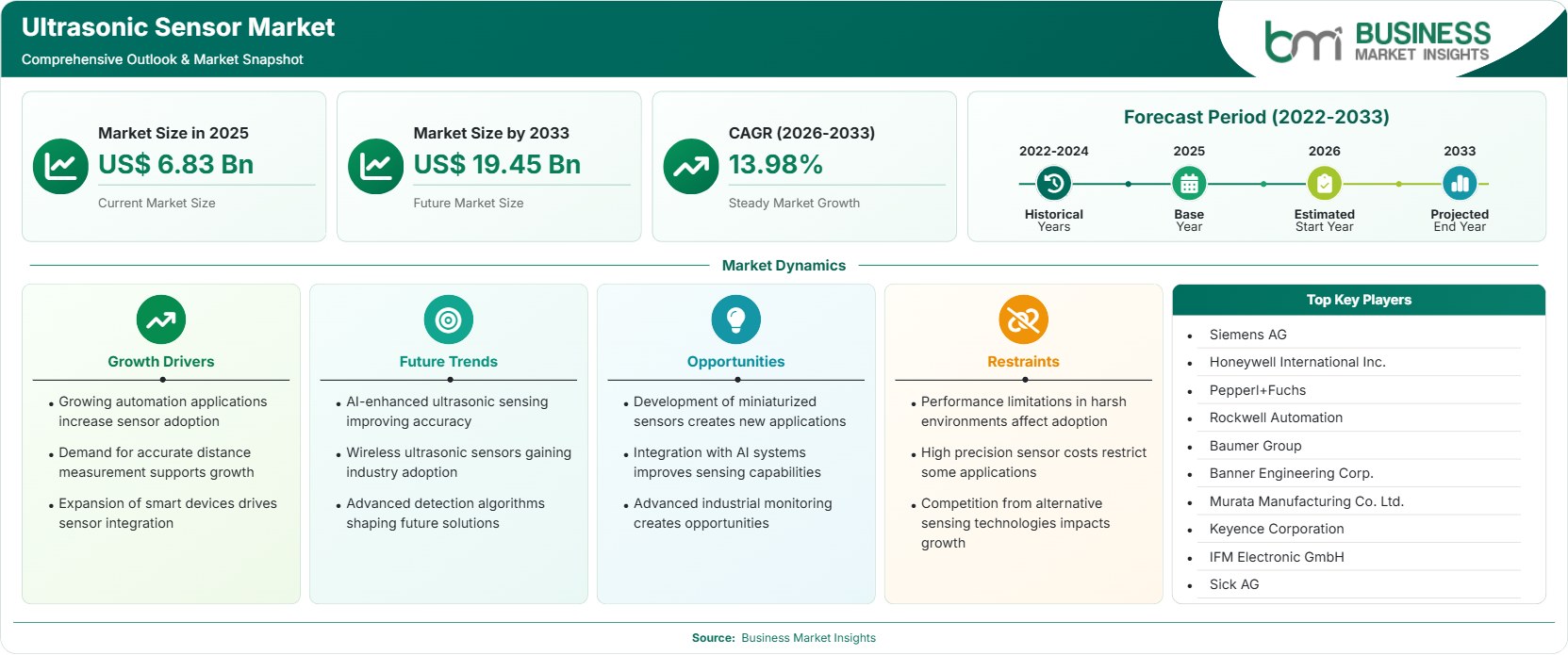
The Ultrasonic Sensor Market size was valued at US$ 6.83 billion in 2025 and is projected to reach US$ 19.45 billion by 2033, growing at a CAGR of 13.98% during 2026–2033. Growing automation applications, demand for accurate distance measurement, smart-device integration, industrial monitoring, and sensor miniaturization are strengthening adoption across connected systems.

Report Coverage
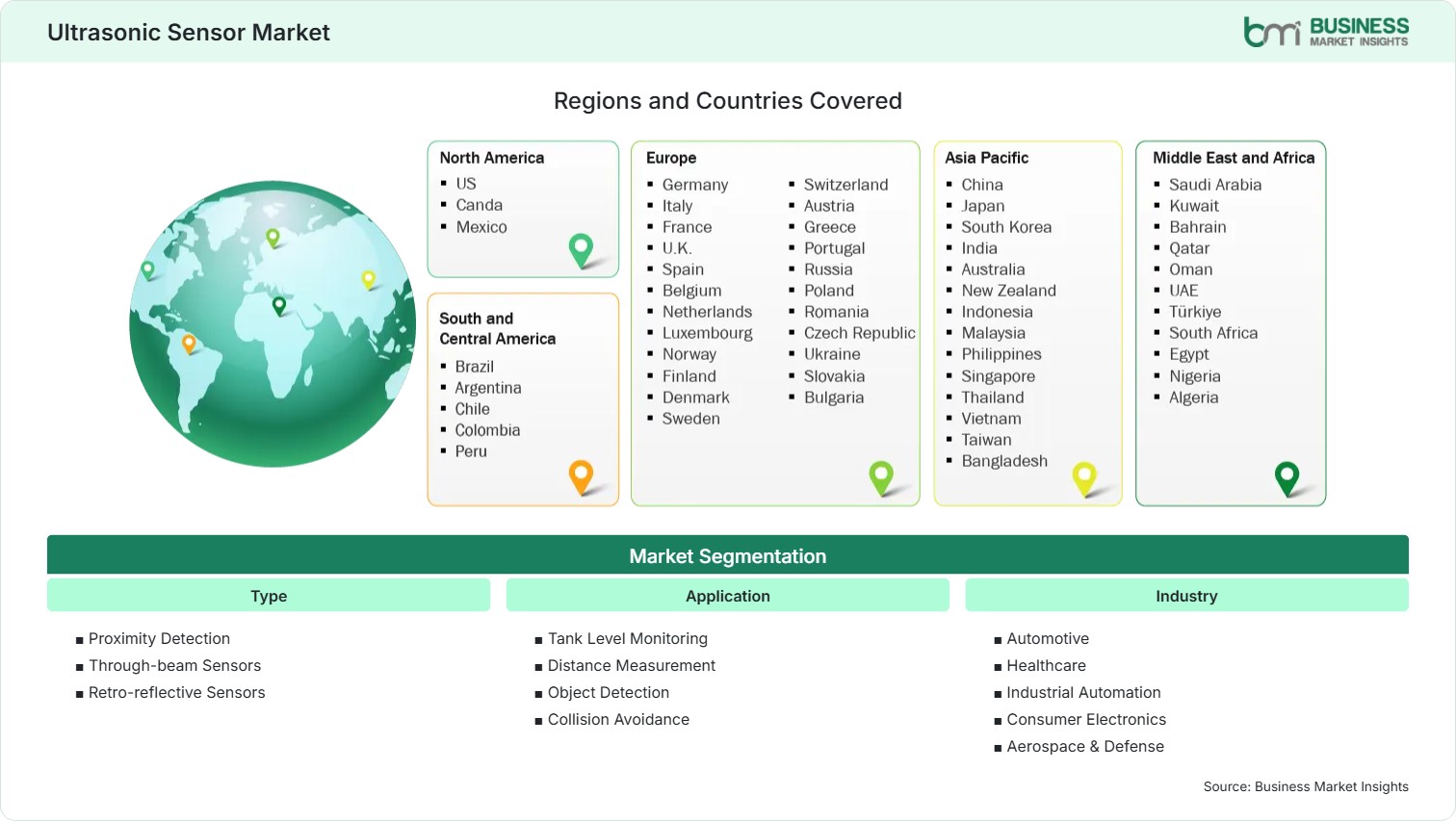
  • Type: Proximity Detection, Through-beam Sensors, Retro-reflective Sensors
  • Application: Tank Level Monitoring, Distance Measurement, Object Detection, Collision Avoidance
  • Industry: Automotive, Healthcare, Industrial Automation, Consumer Electronics, Aerospace & Defense
US$ 6.83 Bn Market size in 2025
US$ 19.45 Bn Market Size by 2033
13.98% CAGR, 2026 - 2033
2026-2033 Forecast Period

01 AI Overview

Ultrasonic Sensor Market Summary

  • North America Region: North America holds 24%–27% market share in 2025 and is expected to expand at a CAGR of 12.6%–13.2% during 2026–2033. Industrial automation, automotive sensing, warehouse robotics, smart infrastructure, and advanced monitoring applications support regional expansion. The U.S. contributes the majority of regional demand with a CAGR of 12.8%–13.4%, supported by factory automation, autonomous equipment, logistics modernization, and increasing deployment of connected sensing platforms.
  • Fastest Growing Region: Asia Pacific represents 34%–38% market share in 2025 and is projected to register a CAGR of 15.0%–15.6%, supported by expanding electronics manufacturing, industrial automation, automotive production, robotics deployment, smart-device adoption, factory digitization, and increasing investment in connected production environments.
  • Leading Segment: Proximity Detection accounts for 43%–47% market share in 2025 and is expected to grow at a CAGR of 13.4%–13.9%, driven by object presence sensing, industrial automation, robotic systems, automated material handling, vehicle applications, and reliable non-contact detection requirements.
  • High Growth Segment: Industrial Automation captures 29%–33% market share in 2025 and is projected to achieve a CAGR of 15.2%–15.8%, supported by factory digitization, robotic handling, machine monitoring, automated inspection, production-line optimization, and demand for dependable non-contact sensing technologies.
  • Key Market Opportunity: Miniaturized sensing modules, AI-assisted signal interpretation, multi-sensor systems, industrial monitoring, robotics, and connected devices are creating opportunities for manufacturers to deliver compact, intelligent, and application-specific ultrasonic sensing solutions.
  • Major Market Players: Siemens AG, Honeywell International Inc., Pepperl+Fuchs SE, Rockwell Automation, Inc., Baumer Holding AG, Banner Engineering Corp., Murata Manufacturing Co., Ltd., KEYENCE CORPORATION, ifm electronic GmbH, and SICK AG.
02 Strategic Insights

Ultrasonic Sensor Market: Strategic Insights

Ultrasonic Sensor Market Strategic Framework
FREE PDF
Request your free sample
Request free sample
03 Stakeholder View

Key Takeaways

  • The competitive value chain is moving from standalone sensing components toward integrated sensing platforms combining transducers, signal processing, connectivity, diagnostics, control interfaces, and application-specific software.
  • Industrial automation provides a particularly attractive growth avenue because manufacturers increasingly require non-contact measurement for robotic handling, production-line inspection, object positioning, machine protection, and automated material movement.
  • Sensor miniaturization is expanding the addressable market beyond conventional industrial equipment into consumer electronics, compact robotics, healthcare devices, smart appliances, and portable monitoring systems.
  • Asia Pacific offers a compelling investment case because electronics production, automotive manufacturing, robotics, and factory automation are developing simultaneously, creating demand for both high-volume and specialized sensing components.
  • Strategic competition is increasingly centered on application engineering, sensor integration, signal reliability, connectivity, and customization rather than basic transducer availability, favoring suppliers with broad technical portfolios.
  • AI-enabled interpretation can increase the value of ultrasonic data by identifying patterns, filtering interference, combining readings from multiple sensors, and supporting predictive decisions within automated equipment.
04 Geographic Outlook

Ultrasonic Sensor Market Regional Highlights

North America Ultrasonic Sensor Market

North America accounted for 24%–27% Ultrasonic Sensor Market share in 2025 and is expected to grow at a CAGR of 12.6%–13.2% during 2026–2033. Regional demand is supported by established automation infrastructure, industrial robotics, advanced automotive production, logistics modernization, and connected equipment adoption. The United States remains the leading contributor, while Canada and Mexico provide additional opportunities through manufacturing, warehousing, automotive supply chains, and process industries. Demand is shifting toward intelligent, compact, network-compatible sensing systems.

  • Industrial automation projects are increasing requirements for non-contact sensing in robotic cells, conveyor systems, packaging equipment, machine protection, and automated material handling applications.
  • Automotive manufacturers are integrating ultrasonic sensing into production systems and vehicle-related applications where reliable object detection and distance information are required.
  • Warehouse automation is expanding sensor requirements as autonomous equipment, sorting systems, pallet handling, and robotic platforms require dependable proximity information.
  • Suppliers are emphasizing configurable sensors, improved diagnostics, digital interfaces, and compact housings to address increasingly sophisticated automation architectures.

US Ultrasonic Sensor Market

The United States contributes 82%–86% of North American demand and is projected to register a CAGR of 12.8%–13.4% during 2026–2033. Demand is supported by factory automation, logistics infrastructure, automotive manufacturing, robotics, healthcare equipment, and connected industrial systems. Manufacturers are increasingly adopting sensors that can integrate with programmable controllers and industrial networks. Replacement demand from established production facilities also provides a recurring opportunity, while new automation installations create demand for larger volumes of standardized and specialized sensing components.

  • Factory modernization is increasing the use of ultrasonic sensors for object detection, positioning, level measurement, conveyor monitoring, and robotic process control.
  • Logistics facilities are adopting automated handling systems that require compact sensors capable of detecting packages, pallets, containers, and moving equipment.
  • Automotive applications are expanding as manufacturers increase automation across assembly, inspection, material movement, and vehicle-related sensing systems.
  • Industrial users increasingly prefer sensors with diagnostics and flexible communication options that simplify installation, monitoring, troubleshooting, and maintenance.

Europe Ultrasonic Sensor Market

Europe represents 25%–28% Ultrasonic Sensor Market share in 2025 and is anticipated to grow at a CAGR of 12.4%–13.0% during 2026–2033. Germany remains the leading market because of its industrial automation and automotive manufacturing base, while France, Italy, and the United Kingdom contribute through machinery, transportation, healthcare, and process applications. Poland provides comparatively strong expansion potential as manufacturing capacity develops. Demand is increasingly tied to smart factories, robotics, automated inspection, and connected production equipment requiring accurate non-contact measurement.

  • Germany remains a major demand center because advanced machinery and automotive production require high volumes of industrial sensing and automation components.
  • France and Italy provide opportunities through packaging machinery, food processing, manufacturing equipment, automotive applications, and automated material handling systems.
  • Poland and other Central European manufacturing locations are supporting sensor demand as production facilities increase automation and integrate connected equipment.
  • European suppliers are emphasizing compact designs, configurable outputs, robust housings, and integration capabilities for increasingly complex industrial control architectures.

Asia Pacific Ultrasonic Sensor Market

Asia Pacific holds 34%–38% Ultrasonic Sensor Market share in 2025 and is projected to achieve the highest CAGR of 15.0%–15.6% during 2026–2033. China represents the largest regional demand base, while Japan, South Korea, India, and Southeast Asia provide significant expansion opportunities. Electronics manufacturing, automotive production, robotics, smart factories, and consumer-device development are simultaneously increasing sensor requirements. Local production capabilities and expanding automation investments are also supporting faster adoption across both high-volume and specialized applications.

  • China provides substantial demand through electronics manufacturing, industrial automation, robotics, automotive production, and large-scale deployment of connected factory equipment.
  • Japan and South Korea remain important technology markets because advanced manufacturing environments require compact, accurate, reliable sensing systems for automated processes.
  • India offers strong growth potential as manufacturing modernization, logistics automation, automotive production, and industrial digitization increase demand for non-contact sensing.
  • Southeast Asian manufacturing economies are creating additional opportunities through electronics assembly, automotive supply chains, warehousing, and industrial automation projects.

Rest of World Ultrasonic Sensor Market

The Rest of World region accounts for 12%–16% Ultrasonic Sensor Market share in 2025 and is expected to expand at a CAGR of 11.8%–12.5% during 2026–2033. Latin America benefits from manufacturing modernization, logistics investment, mining, food processing, and automotive production. Brazil and Mexico remain important markets, while the Middle East and Africa provide opportunities through industrial infrastructure, energy applications, smart facilities, and warehouse automation. Regional adoption is increasingly connected to modernization of production and material-handling operations.

Brazil and Mexico are positioned as important Latin American demand centers because manufacturing, logistics, food processing, and automotive applications require reliable object detection and measurement. Middle Eastern markets are creating opportunities through industrial automation, infrastructure development, and advanced facility management, while South Africa and other African economies offer longer-term potential as industrial digitization expands.

  • Manufacturing modernization is increasing sensor requirements for conveyor systems, packaging machinery, automated inspection, and production monitoring across developing industrial markets.
  • Mining and processing applications can benefit from non-contact measurement where dust, vibration, and irregular surfaces create challenges for alternative sensing technologies.
  • Logistics investment is supporting demand for object detection and positioning sensors in warehouses, distribution centers, sorting systems, and automated handling equipment.
  • Local distributors and system integrators are becoming increasingly important for adapting sensor technologies to regional machinery, maintenance, and automation requirements.
Global Market Geography
FREE PDF
Request your free sample
Request free sample
05 Segment Analysis

Ultrasonic Sensor Market Segmentation

Type

The type segment is led by Proximity Detection, which accounted for 43%–47% Ultrasonic Sensor Market share in 2025 and is expected to grow at a CAGR of 13.4%–13.9% during 2026–2034. Proximity systems remain important because they provide reliable non-contact detection across automation, robotics, material handling, and vehicle applications. Through-beam and retro-reflective configurations address specialized detection requirements.

  • Proximity Detection: Dominates adoption because non-contact object presence sensing supports automation, robotics, conveyor control, machine protection, and material-handling applications requiring dependable detection.
  • Through-beam Sensors: Support demanding detection applications where separated transmitter and receiver arrangements provide reliable sensing across defined paths, including production lines and automated handling equipment.
  • Retro-reflective Sensors: Provide compact detection configurations for machinery and automation where simplified installation, controlled sensing zones, and reliable object recognition are important.

Application

Application demand is diversified across level monitoring, distance measurement, object detection, collision avoidance, and specialized uses. Distance Measurement and Object Detection represent particularly attractive areas because both benefit from non-contact sensing and automation. Tank Level Monitoring remains important in industrial environments, while Collision Avoidance is gaining relevance as automated vehicles, robotics, and smart equipment become more widespread. Ultrasonic Sensor scope is consequently expanding across connected physical systems.

  • Tank Level Monitoring: Supports non-contact measurement of liquids and materials where continuous level information improves process control, inventory visibility, equipment protection, and operational efficiency.
  • Distance Measurement: Enables accurate non-contact measurement for robotics, machinery, automated positioning, material handling, and process-control applications requiring repeatable spatial information.
  • Object Detection: Provides dependable presence and position information across conveyors, production equipment, automated inspection systems, and robotic work cells.
  • Collision Avoidance: Supports safer operation of vehicles, autonomous equipment, robots, and automated platforms by identifying nearby obstacles and generating distance-based control inputs.

Industry

The industry segment is increasingly influenced by automation intensity, equipment connectivity, product miniaturization, and requirements for non-contact measurement. Industrial Automation represented 29%–33% Ultrasonic Sensor Market share in 2025 and is projected to grow at a CAGR of 15.2%–15.8% during 2026–2034. Automotive and consumer electronics provide substantial volume opportunities, while healthcare and aerospace applications support specialized, higher-value sensing requirements.

  • Automotive: Uses ultrasonic sensing for object detection, parking-related systems, production automation, vehicle assembly, component inspection, and manufacturing process control.
  • Healthcare: Creates specialized opportunities for non-contact measurement, equipment monitoring, patient-related devices, fluid-level applications, and compact diagnostic or assistive systems.
  • Industrial Automation: Represents a major growth area because factories require object detection, distance measurement, positioning, machine protection, robotic control, and automated inspection.
  • Consumer Electronics: Expands the addressable market through compact devices, smart appliances, human-machine interaction, proximity functions, and connected equipment requiring small sensing modules.
  • Aerospace & Defense: Supports specialized demand where reliable distance, proximity, structural, equipment, and environmental sensing can improve monitoring and operational awareness.
06 Market Forces

Ultrasonic Sensor Market Dynamics

Key Market Drivers

Growing automation applications increase sensor adoption

Automation is increasing the number of physical processes that require continuous information about object presence, position, distance, and movement. Ultrasonic sensors are well suited to these applications because they operate without direct contact and can detect many target types that create challenges for conventional optical sensing. Factory automation, robotics, automated storage, packaging machinery, and material handling are consequently generating broader sensor requirements. The Ultrasonic Sensor Market trend is being strengthened by the transition from manually controlled processes toward equipment capable of autonomous or semi-autonomous operation.

Demand for accurate distance measurement supports growth

Accurate distance information is becoming more important across automated machinery, vehicle systems, robotics, process equipment, and smart devices. The ultrasonic measurement technique offers a feasible way to determine distance without making any direct physical contact with the object. The property of ultrasonic measurement is useful in cases where the object is mobile or the shape of the target is constantly changing or in liquid form. It has become increasingly necessary to develop sensors that deliver accurate results and enable easy installation.

Expansion of smart devices drives sensor integration

Smart equipment is increasing the number of embedded sensing functions required across consumer, industrial, automotive, and connected-device platforms. The ultrasonic sensors can provide information on proximity, presence, distance, and environment in a limited physical size. Therefore, such devices can be used in smart appliances, robotics, automated systems, human-machine interfaces, and other applications involving compact monitoring systems. The producers of different devices need sensors that will work effectively and interact with the processor and other software-based decision making systems. The forecast of the market for ultrasonic sensors can be supported by these trends.

Key Market Opportunities

Development of miniaturized sensors creates new applications

Miniaturization can expand ultrasonic sensing into applications where conventional industrial sensors are too large, power-intensive, or difficult to integrate. Smaller transducers and electronic packages would enable compact robots, portable devices, smart home appliances, medical equipment, wearable technologies, and embedded automotive electronics. Electronics companies that develop smaller packages but maintain the sensing capabilities can explore new markets for application and increase sensor contents per unit. Miniaturization alone is not the only way for development as miniaturized products could also allow multi-sensing structures, where multiple sensing points are working in a limited area.

Integration with AI systems improves sensing capabilities

AI-enabled processing can increase the value of ultrasonic data by distinguishing meaningful patterns from noise, combining readings from multiple sensors, and supporting adaptive decision-making. For industrial operations, smart algorithmic solutions can be used for identifying unusual distance patterns, recognizing the properties of objects, and predictive maintenance. Similarly, automotive and robotic applications can integrate information from ultrasonic sensors with other forms of sensory data. The business opportunity comes in with combining these sensors with computing resources and software systems rather than considering the transducer as a stand-alone product.

Advanced industrial monitoring creates opportunities

Industrial monitoring is expanding beyond basic machine status toward continuous measurement of process conditions, equipment position, material movement, and operating anomalies. The ultrasonic sensors have the potential to provide distance and level measurements without physical contact, especially in cases where mechanical sensing could cause wear-and-tear issues. Monitoring systems linked to these sensors can integrate the output from the sensors with control systems, dashboards, and maintenance schedules. This creates possibilities for the suppliers to offer integrated solutions beyond just the sensors.

Market Restraints and Challenges

Performance limitations in harsh environments affect adoption

Factor: Ultrasonic sensing can be affected by environmental conditions such as extreme temperatures, turbulent airflow, heavy dust, irregular surfaces, acoustic interference, and challenging target geometries. Impact: Reduced measurement stability or detection reliability can restrict deployment in demanding applications and encourage customers to evaluate alternative sensing technologies. Manufacturers address these limitations through improved transducer design, signal processing, protective housings, calibration features, and application-specific algorithms. However, no single sensor architecture is optimal for every environment. Users may therefore require multiple technologies or customized configurations, increasing system complexity.

High precision sensor costs restrict some applications

Factor: High-performance ultrasonic sensors can require specialized transducers, electronics, signal-processing capabilities, robust housings, calibration, and application engineering. Impact: Higher acquisition costs can restrict adoption in price-sensitive machinery, high-volume consumer applications, and smaller automation projects where basic sensing functions may be available through lower-cost alternatives. Customers often compare sensor price against installation complexity, maintenance savings, accuracy, and expected operating life. Manufacturers can address this challenge through standardized platforms, higher-volume production, modular electronics, and application-specific product tiers. Cost pressure may also accelerate integration of multiple functions into single sensor modules, allowing customers to reduce component counts.

07 Company Analysis

Competitive Landscape

Ultrasonic Sensor Market analysis indicates that competition is shaped by sensing performance, industrial integration, application engineering, product breadth, miniaturization, connectivity, reliability, and geographic coverage. Major suppliers serve industrial automation, automotive, electronics, healthcare, logistics, and specialized applications, while their competitive strategies increasingly emphasize intelligent sensing and compatibility with connected control architectures.

Company Name

Overview

Products and Services relevant to this market

Siemens AG

Global technology and automation supplier serving industrial customers through connected control, sensing, manufacturing, and digitalization solutions.

Industrial ultrasonic sensors, automation systems, controllers, monitoring solutions, industrial networking, and digital factory technologies.

Honeywell International Inc.

Diversified technology company serving industrial, aerospace, building, and automation markets with sensing and control technologies.

Ultrasonic sensing solutions, industrial controls, monitoring systems, automation components, and integrated sensing technologies.

Pepperl+Fuchs SE

Industrial sensor specialist focused on factory automation, process automation, object detection, and reliable sensing technologies.

Ultrasonic proximity sensors, distance sensors, level measurement solutions, interfaces, and automation components.

Rockwell Automation, Inc.

Industrial automation provider combining sensing, control, software, and connected manufacturing technologies for automated facilities.

Ultrasonic sensing, automation controllers, industrial networks, machine monitoring, safety systems, and control solutions.

Baumer Holding AG

Sensor and automation specialist supplying precision measurement and detection technologies for industrial applications.

Ultrasonic distance sensors, proximity sensors, measurement systems, encoders, and industrial automation components.

Banner Engineering Corp.

Industrial automation technology company focused on sensing, wireless connectivity, machine safety, and process monitoring.

Ultrasonic sensors, object detection systems, measurement devices, wireless sensor platforms, and automation accessories.

Murata Manufacturing Co., Ltd.

Electronics manufacturer providing compact sensing and electronic components for industrial, automotive, and consumer applications.

Ultrasonic transducers, compact sensing components, electronic modules, connectivity solutions, and embedded sensor technologies.

KEYENCE CORPORATION

Automation technology supplier specializing in high-performance sensing, measurement, inspection, and machine-vision applications.

Ultrasonic sensors, distance measurement systems, detection sensors, controllers, inspection equipment, and automation solutions.

ifm electronic GmbH

Industrial automation specialist providing sensors, control systems, connectivity, and process monitoring technologies.

Ultrasonic sensors, distance sensors, level sensors, controllers, IO-Link solutions, and industrial monitoring products.

SICK AG

Sensor technology company serving factory, logistics, process, and automation markets with advanced detection and measurement solutions.

Ultrasonic sensors, distance measurement, object detection, safety sensing, identification, and industrial monitoring systems.

10 Trust & Transparency

Research Methodology

The market analysis combines proprietary research with secondary data from government agencies, company disclosures, regulatory filings, industry databases and expert interviews. Market estimates are validated through data triangulation, cross-market benchmarking and analyst review.

View Full Research Methodology

11 Questions Answered

Frequently Asked Questions

What information is covered in the Ultrasonic Sensor Market Report?

The Market Report covers market dynamics, regional development, segmentation by type, application and industry, competitive positioning, technology trends, growth opportunities, adoption barriers, and strategic considerations for sensor manufacturers and users.

How does miniaturization affect sensor demand?

Miniaturization allows ultrasonic sensing to enter compact robotics, consumer devices, healthcare equipment, smart appliances, embedded automotive systems, and portable equipment. Smaller modules can also enable multiple sensors to be integrated within limited physical spaces.

Why is industrial automation an important opportunity?

Industrial automation requires continuous information about object presence, position, distance, and movement. Ultrasonic sensing can provide this information without physical contact, making it useful for robotics, conveyors, production machinery, automated inspection, and material handling.

Which type is expected to maintain the largest position?

Proximity Detection is expected to remain the leading type because it supports object presence sensing across factory automation, robotics, material handling, machine protection, and vehicle-related applications where dependable non-contact detection is required.

What is driving the rapid expansion of ultrasonic sensing applications?

The main expansion factors are industrial automation, robotics, accurate distance measurement, smart-device integration, automotive sensing, connected equipment, automated logistics, and increasing demand for non-contact measurement across production and monitoring systems.

Access the Full Ultrasonic Sensor Market Report

Get segment-level forecasts, regional estimates, competitive benchmarking, company profiles and downloadable Excel datasets.

Access the full Ultrasonic Sensor Market Report
350 pages PDF & Excel | 2026-08-19