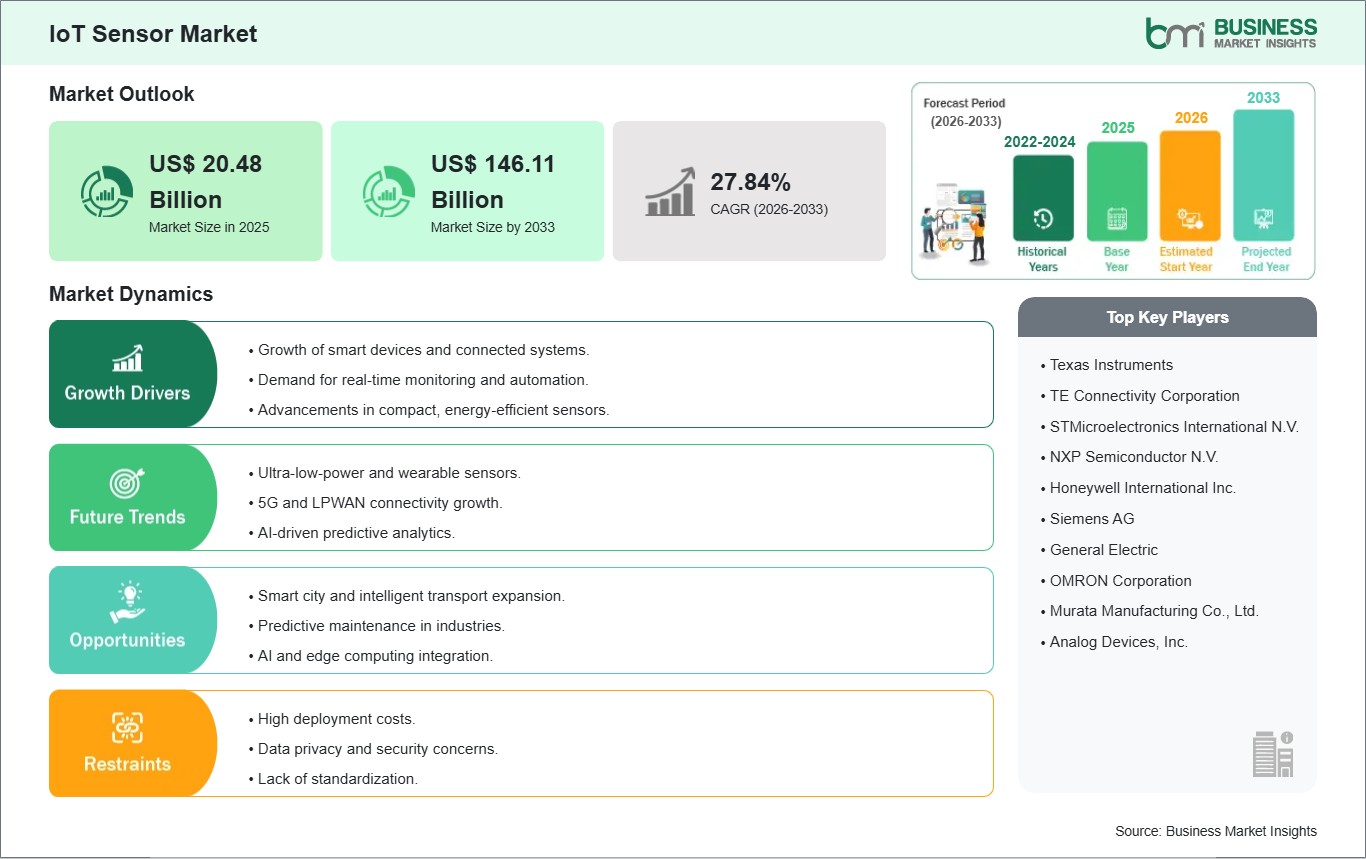
The IoT Sensor Market size is expected to reach US$ 146.11 Billion by 2033 from US$ 20.48 Billion in 2025. The market is estimated to record a CAGR of 27.84% from 2026 to 2033.
IoT (Internet of Things) sensors are smart electronic devices that detect physical or environmental parameters such as temperature, pressure, motion, humidity, gas concentration, light, and more, and convert them into digital signals for processing, monitoring, and action within IoT systems. These sensors form the foundational sensing layer in connected ecosystems, enabling real‑time data acquisition and communication to cloud platforms, analytics engines, or edge systems. The primary benefits of IoT sensors include enhanced operational efficiency through real‑time monitoring, predictive maintenance to reduce downtime, improved safety and security through environmental and motion detection, data‑driven insights that optimize processes, and significant cost savings via automation and energy management.
The global IoT sensor market is experiencing robust growth, propelled by several key drivers such as the accelerating adoption of Industry 4.0 automation in manufacturing, increased deployment of connected devices across consumer electronics and healthcare, proliferation of smart infrastructure projects, and advancements in 5G, LPWAN and low‑power wireless technologies that enhance seamless connectivity for sensors across applications. Growing emphasis on predictive maintenance, asset tracking, and real‑time environmental monitoring is further expanding demand across sectors.

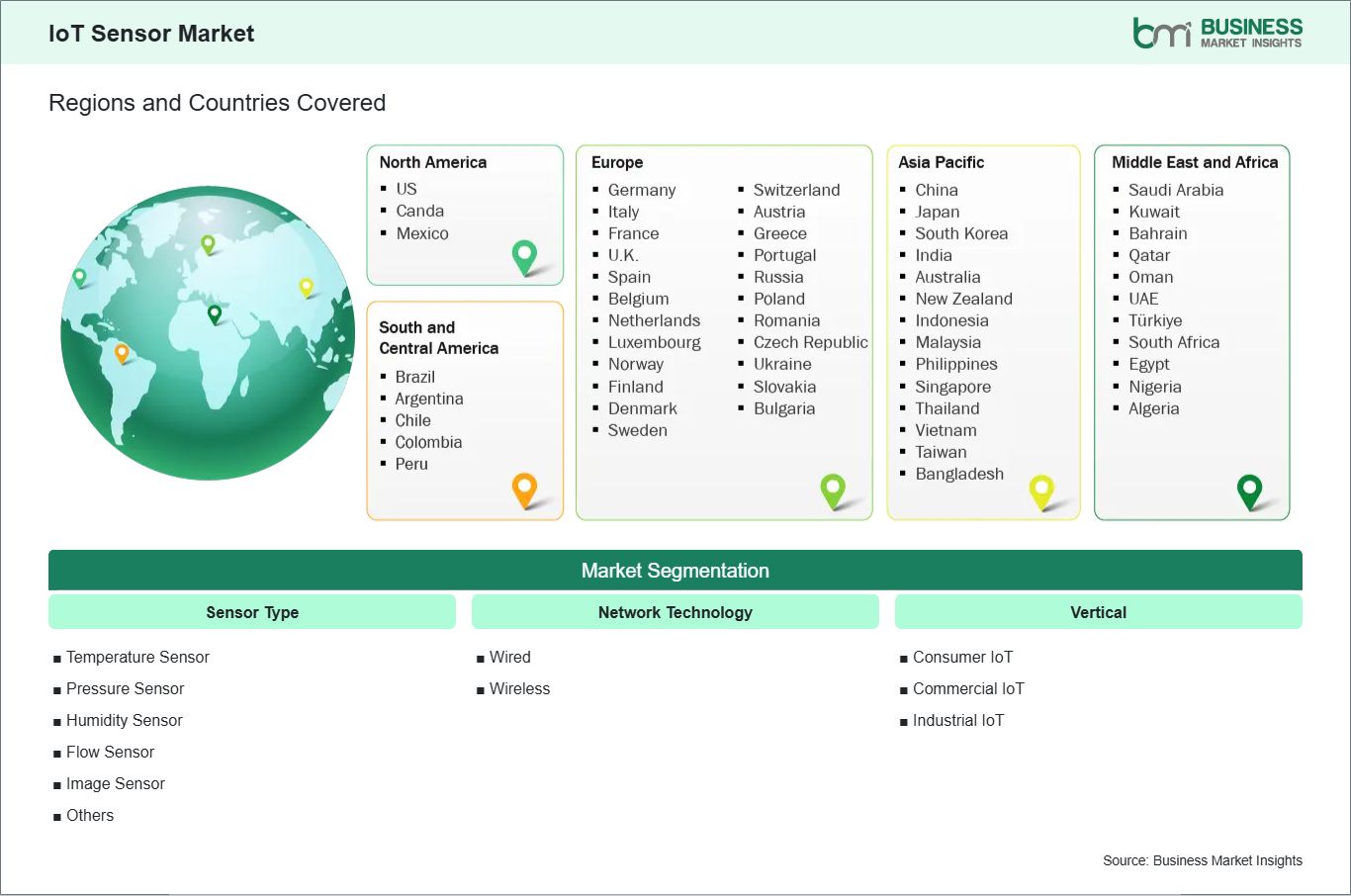
Key segments that contributed to the derivation of the IoT sensor market analysis are Sensor Type, Network Technology, and Vertical.
The rapid adoption of smart devices across industries is a major driver of the IoT sensor market. Businesses and consumers are increasingly relying on connected devices for improved efficiency, automation, and convenience. For instance, smart homes use sensors for temperature, motion, and security monitoring, while industries deploy IoT sensors for predictive maintenance, asset tracking, and process optimization. This surge in connected devices increases the demand for a wide range of sensors, such as temperature, pressure, humidity, and motion sensors. Additionally, the growing interest in wearable devices for health monitoring and fitness tracking further accelerates market growth. The ability of IoT sensors to generate real-time data that informs decision-making and improves operational efficiency makes them indispensable. As technology advances and more devices integrate IoT capabilities, the market is expected to expand significantly, driven by the continuous push for smarter and more connected environments.
The integration of Artificial Intelligence (AI) with IoT sensors presents a significant growth opportunity in the market. AI enhances the capabilities of IoT sensors by enabling real-time data analysis, predictive insights, and automated decision-making. For example, in industrial settings, AI-powered IoT sensors can detect anomalies in machinery before failures occur, reducing downtime and maintenance costs. Similarly, in smart cities, AI-integrated sensors can optimize traffic management, energy consumption, and public safety systems. This combination of IoT and AI not only improves operational efficiency but also creates opportunities for innovative applications, such as precision agriculture, smart healthcare monitoring, and environmental monitoring. As AI algorithms become more sophisticated and IoT sensor networks expand, the market can tap into new sectors and applications. Companies that leverage AI-driven insights from IoT sensors are likely to gain a competitive edge, making this integration a key opportunity for future growth.
By Sensor Type, the market is segmented into Temperature Sensor, Pressure Sensor, Humidity Sensor, Flow Sensor, Image Sensor, and Others. The Pressure Sensor segment dominated the market in 2024. It enables real-time monitoring of gases and liquids, improving industrial automation, smart homes, and healthcare applications by providing accurate, compact, and energy-efficient sensing solutions.
By Network Technology, the market is segmented into Wired (KNX, Ethernet, MODBUS, Others), Wireless (Wi-Fi, Bluetooth, RFID, ZIGBEE, Others). The Wireless segment held the largest share of the market in 2024. Wireless network technology in the IoT sensor market enables seamless, real-time data transmission, supporting smart devices, industrial automation, and healthcare applications with low-power, reliable, and scalable connectivity for efficient monitoring and control.
By Vertical, the market is segmented into Consumer IoT, Commercial IoT, and Industrial IoT. The Industrial IoT segment held the largest share of the market in 2024. The Industrial IoT vertical in the IoT sensor market focuses on smart manufacturing, predictive maintenance, and process optimization, leveraging connected sensors to enhance efficiency, safety, and real-time decision-making across industries.
| Report Attribute | Details |
|---|---|
| Market size in 2025 | US$ 20.48 Billion |
| Market Size by 2033 | US$ 146.11 Billion |
| Global CAGR (2026 - 2033) | 27.84% |
| Historical Data | 2022-2024 |
| Forecast period | 2026-2033 |
| Segments Covered | By Sensor Type
|
|
Regions and Countries Covered
| |
| North America | US, Canada, Mexico |
| Europe | Belgium, Austria, Finland, Denmark, Greece, Poland, Romania, Russia, Ukraine, Czech Republic, Slovakia, Bulgaria, Italy, Luxembourg, Germany, Switzerland, France, Netherlands, Norway, Portugal, Spain, Sweden, United Kingdom |
| Asia-Pacific | Australia, China, India, Japan, South Korea, Indonesia, Malaysia, Philippines, Singapore, Thailand, Vietnam, Bangladesh, New Zealand, Taiwan |
| South and Central America | Brazil, Argentina, Peru, Chile, Colombia |
| Middle East and Africa | Bahrain, Kuwait, Oman, Qatar, Saudi Arabia, United Arab Emirates, Turkiye, South Africa, Egypt, Algeria, Nigeria |
| Market leaders and key company profiles |
|
The IoT Sensor Market Size and Forecast (2022–2033) report provides a detailed analysis of the market covering below areas:
The geographical scope of the IoT sensor market report is divided into five regions: North America, Asia Pacific, Europe, Middle East &; Africa, and South & Central America. The IoT sensor market in Asia Pacific is expected to grow significantly during the forecast period.
The Asia-Pacific IoT sensor market is segmented into China, Japan, South Korea, India, Australia, New Zealand, Indonesia, Malaysia, the Philippines, Singapore, Thailand, Vietnam, Taiwan, Bangladesh, and the Rest of Asia. The Asia-Pacific IoT sensor market is segmented into China, Japan, South Korea, India, Australia, New Zealand, Indonesia, Malaysia, the Philippines, Singapore, Thailand, Vietnam, Taiwan, Bangladesh, and the Rest of Asia. The Asia-Pacific IoT sensor market is experiencing robust growth due to rapid industrialization, increasing adoption of smart manufacturing, and expansion of smart city initiatives. Rising demand for connected devices, technological advancements, and government support for IoT infrastructure are driving widespread deployment of sensors across automotive, healthcare, and consumer electronics sectors.
Additionally, Asia-Pacific benefits from a large consumer base, growing investment in automation, and the presence of key sensor manufacturers. These factors collectively accelerate IoT sensor adoption, boosting market expansion and innovation.

The IoT sensor market is evaluated by gathering qualitative and quantitative data post primary and secondary research, which includes important corporate publications, association data, and databases. A few of the key developments in the IoT sensor market are:
The IoT Sensor Market is valued at US$ 20.48 Billion in 2025, it is projected to reach US$ 146.11 Billion by 2033.
As per our report IoT Sensor Market, the market size is valued at US$ 20.48 Billion in 2025, projecting it to reach US$ 146.11 Billion by 2033. This translates to a CAGR of approximately 27.84% during the forecast period.
The IoT Sensor Market report typically cover these key segments-
The historic period, base year, and forecast period can vary slightly depending on the specific market research report. However, for the IoT Sensor Market report:
The IoT Sensor Market is populated by several key players, each contributing to its growth and innovation. Some of the major players include:
The IoT Sensor Market report is valuable for diverse stakeholders, including:
Essentially, anyone involved in or considering involvement in the IoT Sensor Market value chain can benefit from the information contained in a comprehensive market report.
Please tell us your area of interest
(Market Segments/ Regions and Countries/ Companies)