Current Sensor Market Outlook (2022–2033)

Historic Data: 2022-2024   |   Base Year: 2025   |   Forecast Period: 2026-2033
Report Content: Market Scope, Market Segmentation, Market Dynamics, and Competitive Analysis

Report Coverage:
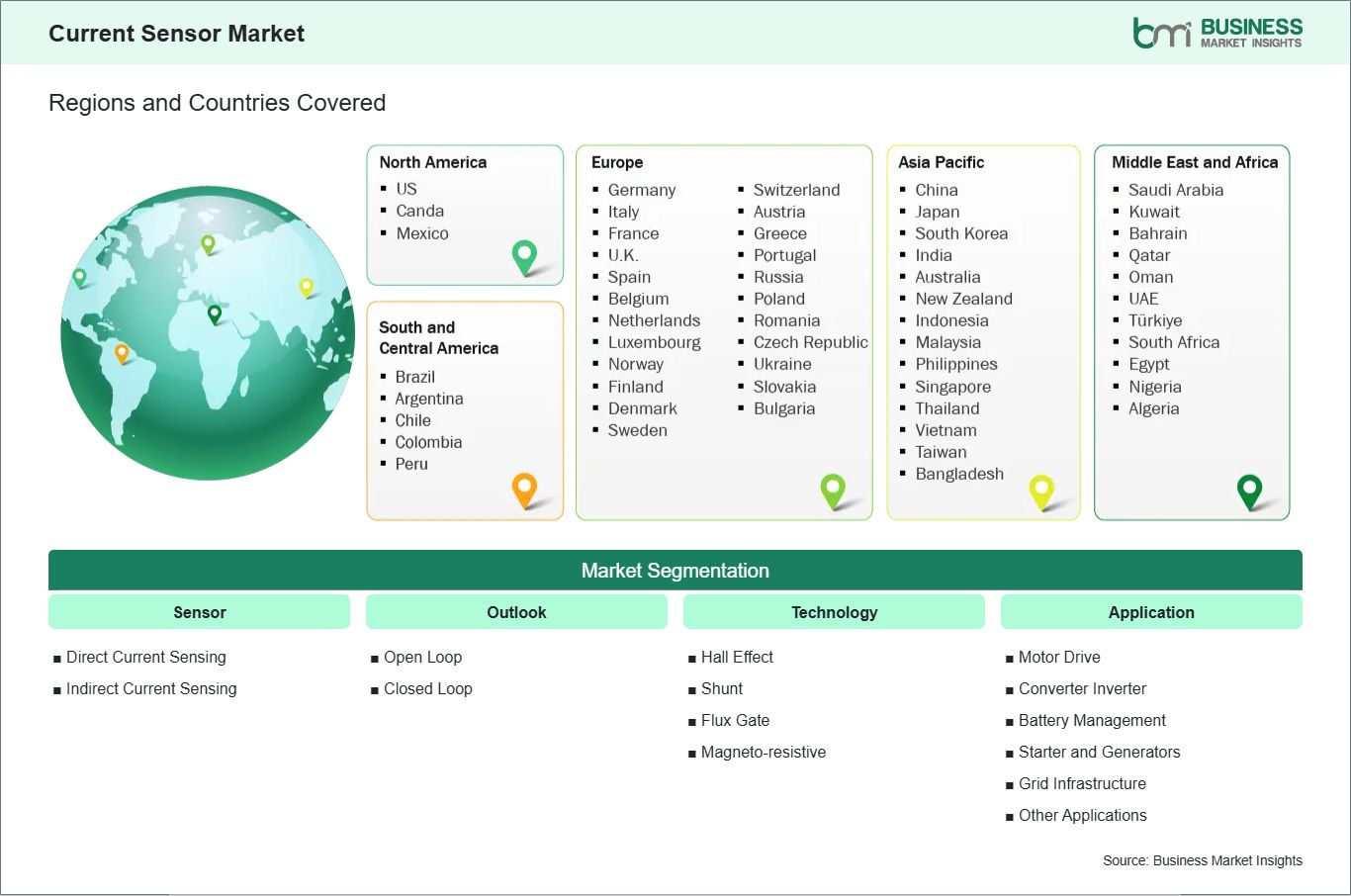
  • Sensor (Direct Current Sensing, Indirect Current Sensing)
  • Outlook (Open Loop, Closed Loop)
  • Technology (Hall Effect, Shunt, Flux Gate, Magneto-resistive)
  • Application (Motor Drive, Converter Inverter, Battery Management, Starter and Generators, Grid Infrastructure, Other Applications)

No. of Pages: 400
Report Code: BMIPUB00033597
Category: Electronics and Semiconductor
Current Sensor Market

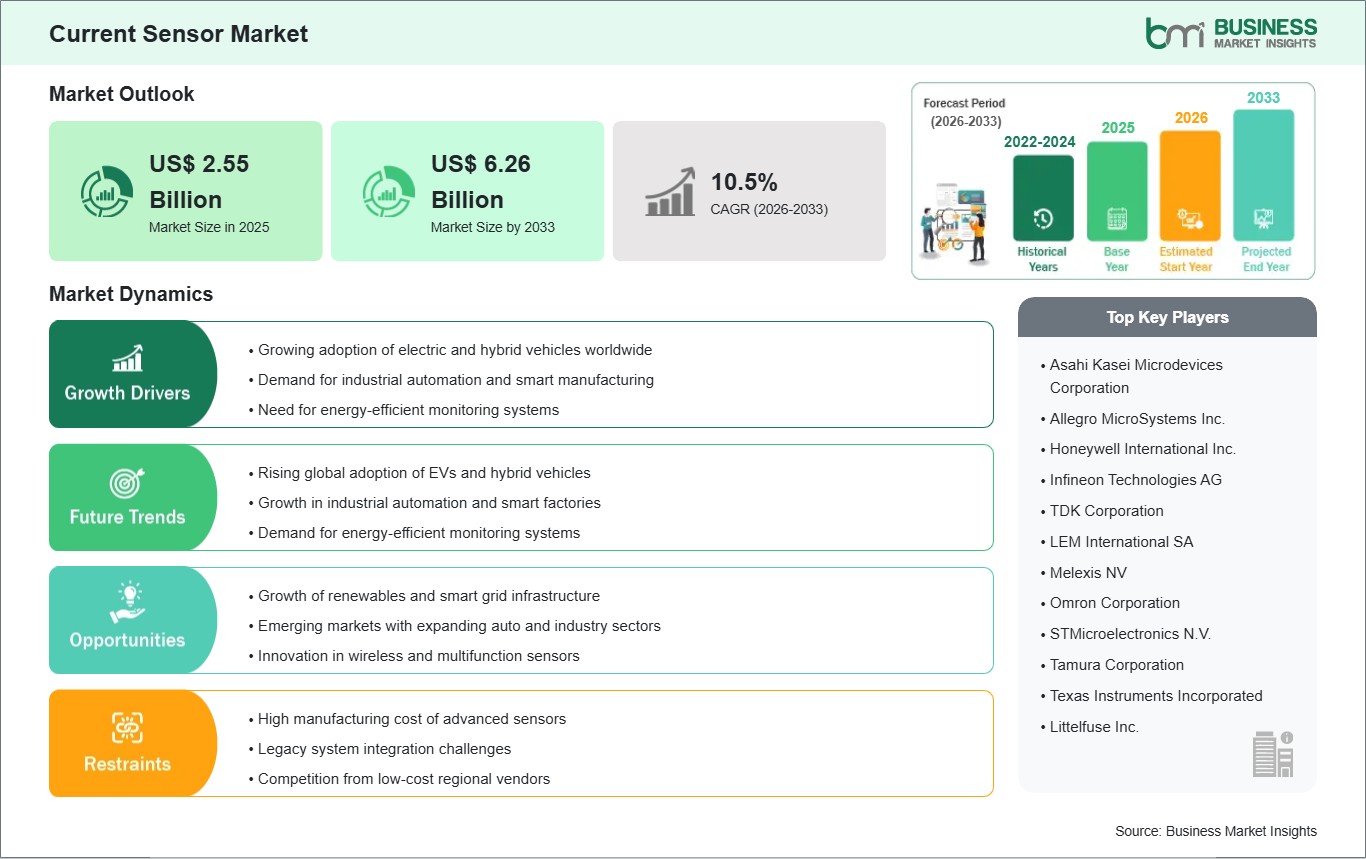
The Current Sensor size is expected to reach US$6.26 billion by 2033 from US$2.55 billion in 2025. The market is estimated to record a CAGR of 10.5% from 2026 to 2033.  

Executive Summary and Global Market Analysis:

The Current Sensor Market refers to the collection of devices and technologies that have the capability to measure and monitor the flow of electrical current in a variety of electrical and electronic systems. Such sensors are essential for safe, efficient, and dependable operation of systems across different sectors such as residential, commercial, industrial, automotive, renewable energy, and utilities. Current sensors mainly aim at detecting and measuring AC, DC, and pulsed currents, thus facilitating energy monitoring, load management, fault detection, and system optimization. The Current Sensor Market is undergoing rapid expansion as a result of several factors. One is the increased use of electric vehicles and hybrid vehicles, which, along with renewable energy generation through solar and wind, is generating strong demand for accurate current measurement solutions. Furthermore, the ongoing rollout of smart grids, energy storage systems, and industrial automation technologies continues to be a major driver of the market. Besides that, urbanization and industrialization in developing regions, as well as infrastructure upgrades in developed markets, are also helping to increase the market size.

Current Sensor Market - Strategic Insights:

global-market-strategic-framework
Get more information on this report

Current Sensor Market Segmentation Analysis:

Key segments that contributed to the derivation of the Current Sensor analysis are technology, wafer size, and application.

  • By Sensor, the Current Sensor market is segmented into direct current sensing, indirect current sensing. The direct current sensing segment accounted for the largest share of the market in 2025,
  • By Outlook, the Current Sensor market is segmented into open loop, closed loop. The closed-loop segment held the largest share of the market in 2025.
  • By Technology, the Current Sensor market is segmented into Hall effect, shunt, flux gate, and magneto-resistive. The hall effect segment held the largest share of the market in 2025.
  • By Application, the Current Sensor market is segmented into motor drive, converter inverter, battery management, starter and generators, grid infrastructure, and others. The motor drive segment held the largest share of the market in 2025.

Current Sensor Market Drivers and Opportunities:

Growing Electric Vehicle (EV) Adoption

The case of electric vehicles (EVs) is probably one of the biggest influences on the sensor economy at the moment. The electric vehicle sector is a major contributor to the sensor economy at the moment. As the global vehicle manufacturers are electrifying transport to adhere to the emission regulations and to meet the demand for sustainability, electric and hybrid vehicles use an increased number of current sensors. These sensors play a crucial role in monitoring battery management systems, motor control, powertrain efficiency, and charging safety, thus ensuring the components of the EV are not only working at their optimum but are also safe and have a longer life span. Subsidies and regulatory requirements aimed at increasing the adoption of EVs are pushing the trend further, and yearly EV sales are increasing, which is leading to an increasing demand for current sensing technologies. Moreover, the drive for advanced battery packs that deliver top performance and come with smart energy management features requires even more precise current measurement solutions; thus, the market for high-tech sensors, such as Hall effect and isolated current sensors, is being boosted. The production of EVs is set to increase significantly in the coming years, and, hence, automotive electrification will be one of the greatest drivers of the current sensor market.

Integration with IoT and Smart Systems

One of the major avenues for growth for sensors in today's market is to convert them for use with the Internet of Things (IoT) and smart monitoring systems. As industries, utilities, and infrastructure come to embrace connected technologies to gain higher efficiency, predictive maintenance, and real-time monitoring, it is the sensors embedded with current IoT that will be essential. Smart grids, industrial automation, smart buildings, and energy management systems are progressively dependent on the distribution recognition networks that not only gather but also transmit electrical data, which is the basis of detailed insights into energy usage, fault detection, and performance optimization. The emergence of IoT platforms greatly increases the range of applications for current sensors, which are no longer just restricted to their traditional roles, but are also capable of offering new services such as remote diagnostics and automated control. Given that wireless connectivity and data analytics are turning into the new standards of modern systems, sensor manufacturers have the opportunity to create innovative smart connected current sensing solutions. This direction not only helps the industry make new types of products but also encourages widespread adoption across sectors that include manufacturing, energy, telecommunications, and smart infrastructure, thereby increasing the overall market potential.

Current Sensor Market Size and Share Analysis:

By Sensor, the Current Sensor market is segmented into direct current sensing, indirect current sensing. The Direct Current Sensing portion is at the forefront of the market at present. This is because it can provide accurate and real-time measurement of the current flow, which is very important for the battery management systems (BMS) of electric vehicles, energy storage systems, industrial power monitoring, etc. Direct current sensors, such as shunt resistors and Hall effect sensors, give high accuracy and quick response times that are very important for safety, efficiency, as well as performance optimization. The increasing use of EVs, renewable energy systems, and smart grid infrastructure is raising the demand for direct current sensing solutions, as these applications require current monitoring that is not only reliable but also constant. The Indirect Current Sensing division, which comprises instruments like current transformers, Rogowski coils, and fluxgate sensors, still controls a considerable part of the market. Indirect sensors have a great advantage in high-voltage industrial and utility applications because they provide safe isolation of the monitoring system from the high-current circuit.  

By Outlook, the Current Sensor market is segmented into open loop, closed loop. The Closed Loop segment presently dominates the market thanks to the very high accuracy, dependability, and flexibility it offers to a wide range of sectors. Closed-loop systems keep track of electrical parameters like current and voltage all the time, enabling them to give a live response and correct automatically to avert overloads, short circuits, and equipment damage. This characteristic makes them very suitable for use in industrial automation, renewable energy systems, and smart grid infrastructure where precise control and protection are essential. Moreover, the increasing use of advanced monitoring systems and intelligent control units is further boosting the demand for closed-loop solutions, which can easily be integrated with IoT, enabled devices and predictive maintenance platforms. Besides, the regulatory requirements focused on electrical safety and system efficiency are also the reasons why the demand for closed loop devices is getting stronger, thus making them the first choice for large-scale and mission-critical installations. On the other hand, the Open Loop segment still holds a significant share of the market, especially in residential, commercial, and low, voltage industrial applications. Open loop systems give basic Current Sensor but without feedback or real, time adjustment, thus providing simplicity and cost, effectiveness for standard electrical setups.

By Technology, the Current Sensor market is segmented as hall effect, shunt, flux gate, magneto-resistive. Hall Effect technology is the leading one in the market today largely because of its capability to measure without intrusion, handle a wide current range, and maintain high accuracy. Hall sensors are commonly used in electric vehicles (EVs), renewable energy systems, industrial motor control, and power electronics, which require real, time current monitoring. The fact that they can give isolated measurements without the need to open the circuit makes them a perfect fit for current smart grid and automation applications.

By Application, the Current Sensor market is segmented as motor drive, converter inverter, battery management, starter and generators, grid infrastructure, others. The Motor Drive segment is presently at the forefront of the market due to its extensive application in various fields such as industrial automation, HVAC systems, electric vehicles, and robotics. Motor drives must be equipped with dependable protection against overcurrent, short circuits, and voltage fluctuations if the continuous operation and equipment longevity are to be ensured. Current Sensor devices in this segment do more than just safeguarding the motors; they also increase the operational efficiency, decrease the downtime, and significantly lower the maintenance costs. A further factor that drives the demand for this application is the surge in the use of energy, efficient motors and automated industrial systems. The Converter/Inverter segment, on the other hand, also accounts for a large portion of the market, especially in the areas of renewable energy systems, electric vehicles, and power electronics. To stabilize the operation, protect semiconductor devices, and guarantee the efficiency of energy conversion, these applications necessitate very accurate current and voltage protection.

Current Sensor Market Report Highlights:

Report Attribute Details
Market size in 2025 US$ 2.55 Billion
Market Size by 2033 US$ 6.26 Billion
Global CAGR (2026 - 2033)10.5%
Historical Data 2022-2024
Forecast period 2026-2033
Segments Covered By Sensor
  • Direct Current Sensing
  • Indirect Current Sensing
By Outlook
  • Open Loop
  • Closed Loop
By Technology
  • Hall Effect
  • Shunt
  • Flux Gate
  • Magneto-resistive
By Application
  • Motor Drive
  • Converter Inverter
  • Battery Management
  • Starter and Generators
  • Grid Infrastructure
  • Other Applications
Regions and Countries Covered
North America US, Canada, Mexico
Europe Belgium, Austria, Finland, Denmark, Greece, Poland, Romania, Russia, Ukraine, Czech Republic, Slovakia, Bulgaria, Italy, Luxembourg, Germany, Switzerland, France, Netherlands, Norway, Portugal, Spain, Sweden, United Kingdom
Asia-Pacific Australia, China, India, Japan, South Korea, Indonesia, Malaysia, Philippines, Singapore, Thailand, Vietnam, Bangladesh, New Zealand, Taiwan
South and Central America Brazil, Argentina, Peru, Chile, Colombia
Middle East and Africa Bahrain, Kuwait, Oman, Qatar, Saudi Arabia, United Arab Emirates, Turkiye, South Africa, Egypt, Algeria, Nigeria
Market leaders and key company profiles
  • Asahi Kasei Microdevices Corporation
  • Allegro MicroSystems Inc.
  • Honeywell International Inc.
  • Infineon Technologies AG
  • TDK Corporation
  • LEM International SA
  • Melexis NV
  • Omron Corporation
  • STMicroelectronics N.V.
  • Tamura Corporation
Get more information on this report

Current Sensor Market Report Coverage and Deliverables:

The "Current Sensor Size and Forecast (2022 - 2033)" report provides a detailed analysis of the market covering below areas:

  • Current Sensor size and forecast at global, regional, and country levels for all the key market segments covered under the scope
  • Current Sensor trends, as well as market dynamics such as drivers, restraints, and key opportunities
  • Current Sensor analysis covering key market trends, global and regional framework, major players, regulations, and recent market developments
  • Industry landscape and competition analysis covering market concentration, heat map analysis, prominent players, and recent developments for the Current Sensor
  • Detailed company profiles, including SWOT analysis

Current Sensor Market Geographic Insights:

The geographical scope of the Current Sensor report is divided into five regions: North America, Asia Pacific, Europe, the Middle East & Africa, and South & Central America.

During the forecast period, the Asia Pacific region is predicted to experience the fastest growth, and it currently accounts for the largest share in the market. The rapid industrialization, urbanization, electrification initiatives, and big, scale renewable energy projects (REPs) in China, India, Japan, South Korea, and other countries are the main factors of this growth. The establishment of electric vehicle (EV) infrastructure, smart grids, and energy storage systems in the region is resulting in a surge of demand for current sensors in automotive, utility, and industrial applications. Besides that, energy efficiency, grid modernization, and sustainable power systems support policies by the government are driving the use further. North America has a significant share of the market, primarily driven by the U.S. and Canada, where substantial efforts are being made to replace the old grid infrastructure, install smart meters, and add renewable energy sources. The requirement for extremely accurate and dependable current sensors is enhanced by the presence of strict safety regulations, the growth of industrial automation to a higher level, and the increase of electric mobility.

global-market-geography
Get more information on this report

Current Sensor Market Research Report Guidance:

  • The report includes qualitative and quantitative data in the Current Sensor across technology, wafer size, application and geography.
  • The report starts with the key takeaways (chapter 2), highlighting the key trends and outlook of the Current Sensor.
  • Chapter 3 includes the research methodology of the study.
  • Chapter 4 further includes ecosystem analysis.
  • Chapter 5 highlights the major industry dynamics in the Current Sensor, including factors that are driving the market, prevailing deterrents, potential opportunities, as well as future trends. Impact analysis of these drivers and restraints is also covered in this section.
  • Chapter 6 discusses the Current Sensor scenario, in terms of historical market revenues, and forecast till the year 2031.
  • Chapters 7 to 11 cover Current Sensor segments by sensor, outlook, technology, application and geography across North America, Europe, Asia Pacific, Middle East and Africa, and South and Central America. They cover the market volume revenue forecast and factors driving the market.
  • Chapter 12 describes the competitive analysis along with the heat map analysis for the key players operating in the market.
  • Chapter 13 describes the industry landscape analysis. It provides detailed descriptions of business activities such as market initiatives, new developments, mergers, and joint ventures globally, along with a competitive landscape.
  • Chapter 14 provides detailed profiles of the major companies operating in the Current Sensor. Companies have been profiled on the basis of their key facts, business descriptions, products and services, financial overview, SWOT analysis, and key developments.
  • Chapter 15, i.e., the appendix is inclusive of a brief overview of the company, list of abbreviations, and disclaimer.

Current Sensor Market News and Key Development:

The Current Sensor is evaluated by gathering qualitative and quantitative data post primary and secondary research, which includes important corporate publications, association data, and databases. A few of the key developments in the Current Sensor are:

  • In February 2026, Allegro MicroSystems, Inc.introduced the ACS37017, a new Hall-effect current sensor that sets the industry benchmark for accuracy. With the launch of the ACS37017, Allegro completes a strategic expansion of its high-performance portfolio that now includes definitive, market-leading solutions for the three critical challenges in modern power electronics: Speed (ACS37100), Power Density (ACS37200), and Accuracy (ACS37017.
  • In December 2025, Littelfuse, Inc., a diversified industrial technology manufacturing company empowering a sustainable, connected, and safer world, today announced the release of six new automotive current sensors designed to enhance electric and hybrid vehicle performance, efficiency, and functional safety.

Key Sources Referred:

  • International Electrotechnical Commission (IEC)
  • International Organization for Standardization (ISO)
  • IEEE Standards Association (IEEE SA)
  • American National Standards Institute (ANSI)
  • European Committee for Standardization (CEN)
  • Standardization Administration of China (SAC)
  • National Accreditation Board for Testing & Calibration Laboratories (NABL)
  • Bureau of Indian Standards (BIS)
  • Telecommunication Engineering Centre (TEC)
  • Standardization Testing & Quality Certification Directorate (STQC)
  • Society of Automotive Engineers (SAE)Company Websites
  • Company Annual Reports
  • Company Investor Presentations
The List of Companies - Current Sensor Market
  • AsahiKaseiMicrodevicesCorporation
  • AllegroMicroSystemsInc
  • HoneywellInternationalInc
  • InfineonTechnologiesAG
  • TDKCorporation
  • LEMInternationalSA
  • MelexisNV
  • OmronCorporation
  • STMicroelectronicsNV
  • TAMURACorporation
  • TexasInstrumentsIncorporated
  • LittelfuseInc
  • KOHSHINElectricCorporation
  • ROHMCoLtd
  • PulseElectronicsCorporation
  • SensitecGmbH
  • AceinnaInc
  • VishayIntertechnologyInc
Frequently Asked Questions
How big is the Current Sensor Market?

The Current Sensor Market is valued at US$ 2.55 Billion in 2025, it is projected to reach US$ 6.26 Billion by 2033.

What is the CAGR for Current Sensor Market by (2026 - 2033)?

As per our report Current Sensor Market, the market size is valued at US$ 2.55 Billion in 2025, projecting it to reach US$ 6.26 Billion by 2033. This translates to a CAGR of approximately 10.5% during the forecast period.

What segments are covered in this report?

The Current Sensor Market report typically cover these key segments-

  • Sensor (Direct Current Sensing, Indirect Current Sensing)
  • Outlook (Open Loop, Closed Loop)
  • Technology (Hall Effect, Shunt, Flux Gate, Magneto-resistive)
  • Application (Motor Drive, Converter Inverter, Battery Management, Starter and Generators, Grid Infrastructure, Other Applications)

What is the historic period, base year, and forecast period taken for Current Sensor Market?

The historic period, base year, and forecast period can vary slightly depending on the specific market research report. However, for the Current Sensor Market report:

  • Historic Period : 2022-2024
  • Base Year : 2025
  • Forecast Period : 2026-2033
  • Who are the major players in Current Sensor Market?

    The Current Sensor Market is populated by several key players, each contributing to its growth and innovation. Some of the major players include:

  • Asahi Kasei Microdevices Corporation
  • Allegro MicroSystems Inc.
  • Honeywell International Inc.
  • Infineon Technologies AG
  • TDK Corporation
  • LEM International SA
  • Melexis NV
  • Omron Corporation
  • STMicroelectronics N.V.
  • Tamura Corporation
  • Texas Instruments Incorporated
  • Littelfuse Inc.
  • Kohshin Electric Corporation
  • ROHM Co. Ltd.
  • Pulse Electronics Corporation
  • Sensitec GmbH
  • Aceinna Inc.
  • Vishay Intertechnology Inc.
  • Who should buy this report?

    The Current Sensor Market report is valuable for diverse stakeholders, including:

    • Investors: Provides insights for investment decisions pertaining to market growth, companies, or industry insights. Helps assess market attractiveness and potential returns.
    • Industry Players: Offers competitive intelligence, market sizing, and trend analysis to inform strategic planning, product development, and sales strategies.
    • Suppliers and Manufacturers: Helps understand market demand for components, materials, and services related to concerned industry.
    • Researchers and Consultants: Provides data and analysis for academic research, consulting projects, and market studies.
    • Financial Institutions: Helps assess risks and opportunities associated with financing or investing in the concerned market.

    Essentially, anyone involved in or considering involvement in the Current Sensor Market value chain can benefit from the information contained in a comprehensive market report.

    Available Report Formats

    pdf-format excel-format pptx-format
    Buy Now
    Sales Assistance
    +1 646 791 7070 (US & UK)
    Customization Form

    Please tell us your area of interest
    (Market Segments/ Regions and Countries/ Companies)