Humidity Sensor Market Outlook (2022-2033)

Historic Data: 2022-2024   |   Base Year: 2025   |   Forecast Period: 2026-2033
Report Content: Market Scope, Market Segmentation, Market Dynamics, and Competitive Analysis

Report Coverage:
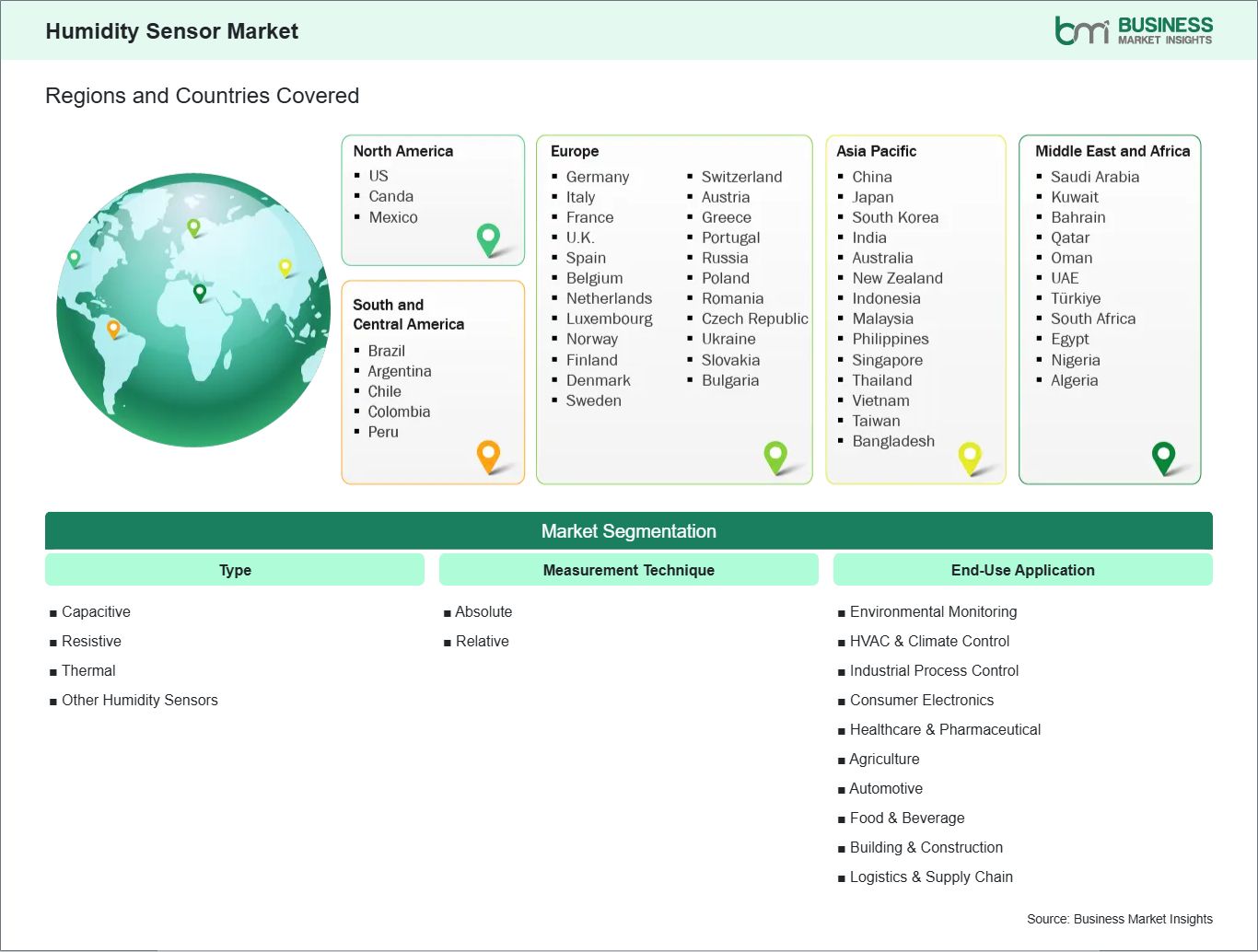
  • Type (Capacitive, Resistive, Thermal, Other Humidity Sensors)
  • Measurement Technique (Absolute, Relative)
  • End-Use Application (Environmental Monitoring, HVAC & Climate Control, Industrial Process Control, Consumer Electronics, Healthcare & Pharmaceutical, Agriculture, Automotive, Food & Beverage, Building & Construction, Logistics & Supply Chain)

No. of Pages: 393
Report Code: BMIPUB00033976
Category: Electronics and Semiconductor
Humidity Sensor Market

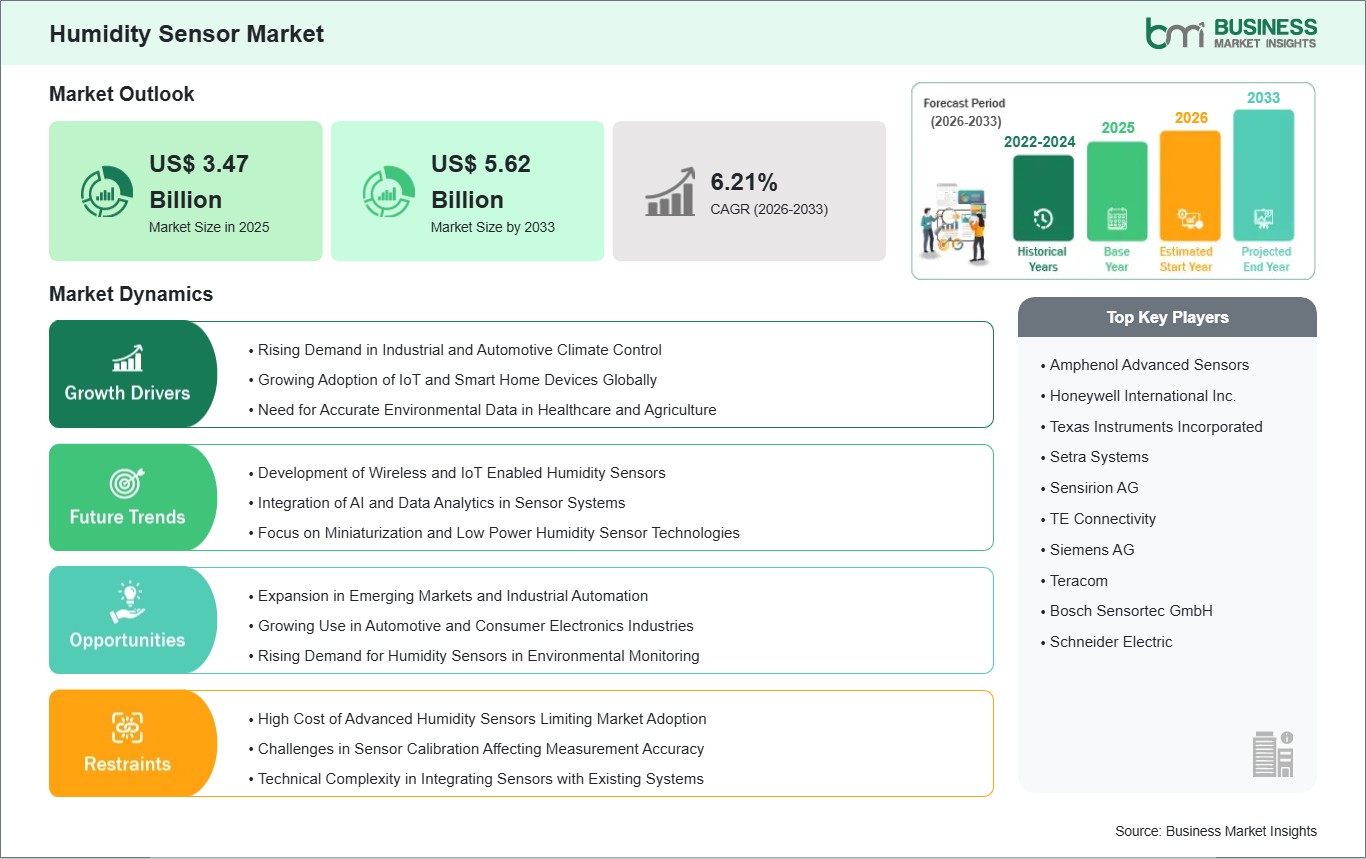
The Humidity Sensor Market size is expected to reach US$ 5.62 Billion by 2033 from US$ 3.47 Billion in 2025. The market is estimated to record a CAGR of 6.21% from 2026 to 2033.

Executive Summary and Global Market Analysis:

The global humidity sensor market has seen a tremendous evolution in recent times due to an increase in the need to monitor environmental factors more accurately in industrial, commercial, and consumer markets. Humidity sensors, which measure humidity levels in gases and air, are a crucial part of various industries such as pharmaceuticals, food storage, automotive, HVAC systems, data centers, and more. Over time, technology has helped to make humidity sensors more accurate, efficient, and compact, allowing them to become an integral part of various devices. Today, organizations are making use of humidity sensors to optimize their efficiency, product quality, and environmental practices, especially in industries that require high energy consumption.

However, there are a few challenges in this market. The humidity sensors also have the challenge of operating in extreme and changing environmental conditions. There is also the challenge of being cost-effective and precise at the same time. There is also the challenge of integration when trying to link the advanced humidity monitoring technology with existing industrial systems. This has been a challenge for the advancement of the technology. Nevertheless, the industry is responding well by developing the durability and energy efficiency of the humidity sensors and increasing the versatility of the technology for use in different applications. The industry has been boosted by the trends in predictive maintenance and AI-based environmental monitoring and the global focus on air quality and comfort.

Humidity Sensor Market - Strategic Insights:

global-market-strategic-framework
Get more information on this report

Humidity Sensor Market Segmentation Analysis:

Key segments that contributed to the derivation of the humidity sensor market analysis are type, measurement technique and end-use application.

  • By type, the humidity sensor market is segmented into capacitive, resistive, thermal and other humidity sensors. The capacitive segment dominated the market in 2025.
  • Based on measurement technique, the humidity sensor market is categorized into absolute, relative. The relative segment dominated the market in 2025.
  • In terms of end-use application, the humidity sensor market is categorized into environmental monitoring, HVAC & climate control, industrial process control, consumer electronics, healthcare & pharmaceutical, agriculture, automotive, food & beverage, building & construction, logistics & supply chain. The industrial process control segment dominated the market in 2025.

Humidity Sensor Market Drivers and Opportunities:

Rising Demand in Industrial and Automotive Climate Control

The global market for humidity sensors is increasingly being determined by the requirement for precise environmental control within various processes of industry. Industries such as pharmaceuticals, food, beverages, chemical, and electronics require precise humidity sensing to ensure product quality, regulatory compliance, and process efficiency. Modern industries have incorporated humidity sensors within their processes, enabling real-time monitoring and precise control of environmental air, which reduces wastage, promotes efficient use of resources, and ensures process reliability. As various industries around the world continue to evolve towards modernization, humidity sensing technology is becoming a critical component of smart manufacturing processes.

Another critical component of the global market is the automotive industry. Modern cars feature sophisticated climate control systems that require high-precision humidity sensing to optimize driver comfort, defogging, and air quality. Automotive manufacturers have incorporated high-precision humidity sensing within their processes, enabling precise climate control while enhancing driver experience. In addition to traditional automotive and industrial processes, various other industries such as data centers, logistics, cold storage, etc., have incorporated humidity sensing technology. As various organizations around the world have begun adopting real-time analytics, connected climate control, etc., humidity sensing has become a critical component of achieving process efficiency, sustainability, etc.

Expansion in Emerging Markets and Industrial Automation

New opportunities are emerging in the global humidity sensor market from the growing economies in the Asia Pacific, Latin American, and African countries, driven by the expansion of industries in these regions, including the development of new infrastructures. For example, in the textile, chemical, and food processing industries, the use of humidity sensors is critical in order to maintain consistency in the quality of the products, as changes in humidity can have a significant impact on the final products. The development of industrial automation systems has opened new avenues for the use of humidity sensors in the global market. The use of humidity sensors in automated systems helps in the efficient operation of the machines, as the systems use real-time data from the environmental conditions in order to operate the machines in the most efficient manner. The development of the concept of Industry 4.0 across the globe highlights the importance of humidity sensors as integral components of the systems in the global market.

Humidity Sensor Market Size and Share Analysis:

The humidity sensor market demonstrates steady growth, with size and share analysis highlighting evolving trends and competitive dynamics among key players. The report examines subsegments categorized within type, measurement technique and end-use application, offering insights into their contribution to overall market performance.

By type, the capacitive subsegment dominated the market in 2025, driven by its high accuracy, stability, wide humidity measurement range, and extensive use in HVAC systems, industrial equipment, and consumer electronics.

Based on measurement technique, the relative subsegment dominated the market in 2025, driven by its widespread adoption in environmental monitoring, HVAC, and industrial applications due to easier measurement and cost-effective sensing technology.

In terms of end-use application, the industrial process control subsegment dominated the market in 2025, driven by the increasing need for precise humidity monitoring in manufacturing industries such as chemicals, pharmaceuticals, and electronics to ensure product quality and process efficiency.

Humidity Sensor Market Report Highlights:

Report Attribute Details
Market size in 2025 US$ 3.47 Billion
Market Size by 2033 US$ 5.62 Billion
Global CAGR (2026 - 2033)6.21%
Historical Data 2022-2024
Forecast period 2026-2033
Segments Covered By Type
  • Capacitive
  • Resistive
  • Thermal
  • Other Humidity Sensors
By Measurement Technique
  • Absolute
  • Relative
By End-Use Application
  • Environmental Monitoring
  • HVAC & Climate Control
  • Industrial Process Control
  • Consumer Electronics
  • Healthcare & Pharmaceutical
  • Agriculture
  • Automotive
  • Food & Beverage
  • Building & Construction
  • Logistics & Supply Chain
Regions and Countries Covered
North America US, Canada, Mexico
Europe Belgium, Austria, Finland, Denmark, Greece, Poland, Romania, Russia, Ukraine, Czech Republic, Slovakia, Bulgaria, Italy, Luxembourg, Germany, Switzerland, France, Netherlands, Norway, Portugal, Spain, Sweden, United Kingdom
Asia-Pacific Australia, China, India, Japan, South Korea, Indonesia, Malaysia, Philippines, Singapore, Thailand, Vietnam, Bangladesh, New Zealand, Taiwan
South and Central America Brazil, Argentina, Peru, Chile, Colombia
Middle East and Africa Bahrain, Kuwait, Oman, Qatar, Saudi Arabia, United Arab Emirates, Turkiye, South Africa, Egypt, Algeria, Nigeria
Market leaders and key company profiles
  • Amphenol Advanced Sensors
  • Honeywell International Inc.
  • Texas Instruments Incorporated
  • Setra Systems
  • Sensirion AG
  • TE Connectivity
  • Siemens AG
  • Teracom
  • Bosch Sensortec GmbH
  • Schneider Electric
Get more information on this report

Humidity Sensor Market Report Coverage and Deliverables:

The "Humidity Sensor Market Size and Forecast (2022 - 2033)" report provides a detailed analysis of the market covering below areas:

  • Humidity Sensor Market size and forecast at global, regional, and country levels for all the key market segments covered under the scope
  • Humidity Sensor Market trends, as well as drivers, restraints, and opportunities
  • Humidity Sensor Market analysis covering key trends, global and regional framework, major players, regulations, and recent developments
  • Industry landscape and competition analysis covering market concentration, heat map analysis, prominent players, and recent developments for the Humidity Sensor Market
  • Detailed company profiles, including SWOT analysis

Humidity Sensor Market Geographic Insights:

The geographical scope of the Humidity Sensor Market report is divided into North America, Asia Pacific, Europe, Middle East & Africa, and South & Central America. North America held the largest share in 2025.

The humidity sensors market has shown significant geographical differences; however, the global market for humidity sensors has been dominated by the North American region due to its high industrial base and the early adoption of such technologies. The United States has been a major contributor to the growth of the humidity sensor market in the region. This is because the United States has witnessed significant demand for humidity sensors in various sectors such as healthcare, pharmaceuticals, automobile, and food processing. Moreover, the United States has witnessed significant growth in data center management and the use of smart HVAC systems. Additionally, the United States has witnessed significant growth in the use of IoT-based humidity sensors. Furthermore, the United States has witnessed significant growth in the use of humidity sensors in the healthcare and biotechnology sectors due to the stringent regulatory environment for environmental monitoring and storage.

The Asia Pacific market for humidity sensors is expected to show the highest growth. This is because the Asia Pacific has witnessed significant growth in industrialization and the development of manufacturing infrastructure. Moreover, the Asia Pacific has witnessed significant growth in the use of humidity sensors in the production of various electronic devices. The emphasis placed on smart homes, energy-efficient infrastructure, and smart manufacturing facilities is expected to boost the market growth in this region. In addition, the increasing trend of precision agriculture solutions is creating new market opportunities for humidity sensors.

In the European region, the market is driven by strong regulatory policies that promote energy-efficient solutions and environmental sustainability. This region boasts a well-established industry base, especially in automotive, pharmaceutical, and engineering sectors, where accurate humidity monitoring is required. The growth of smart building technology and efficient HVAC systems in countries such as Germany, the United Kingdom, and France also increases the demand for humidity sensors.

The Middle East & Africa market is also growing gradually with the increasing industrial diversification and infrastructure development in the region. Various sectors such as the oil and gas industry, construction industry, and logistics are increasingly adopting environmental monitoring systems. Moreover, the extreme climatic conditions in the countries of this region also contribute to the growth of the humidity sensor market.

South & Central America represents a developing market with growth potential. Increasing agriculture and food processing industries, along with the development of industrial automation in the region, are boosting the demand for humidity sensors. Countries such as Brazil and Mexico are the major contributors in this region.

global-market-geography
Get more information on this report

Humidity Sensor Market Research Report Guidance:

  • The report includes qualitative and quantitative data in the Humidity Sensor Market across type, measurement technique, end-use application and geography.
  • The report starts with the key takeaways (chapter 2), highlighting key trends and outlook of the Humidity Sensor Market.
  • Chapter 3 focuses on the research methodology of the study.
  • Chapter 4 includes ecosystem analysis.
  • Chapter 5 highlights the major industry dynamics in the Humidity Sensor Market, including factors that are driving the market, prevailing deterrents, potential opportunities, as well as future trends. Impact analysis of these drivers and restraints is also covered in this section.
  • Chapter 6 discusses the Humidity Sensor Market scenario, in terms of historical market revenues, and forecast till the year 2033.
  • Chapters 7 to 10 cover Humidity Sensor Market segments by type, measurement technique, end-use application and geography across North America, Asia Pacific, Europe, Middle East & Africa, and South & Central America. They cover the market revenue forecast and factors driving the market.
  • Chapter 11 describes the competitive analysis along with the heat map analysis for the key players operating in the market.
  • Chapter 12 describes the industry landscape analysis. It provides detailed descriptions of business activities such as market initiatives, new developments, mergers, and joint ventures globally, along with a competitive landscape.
  • Chapter 13 provides detailed profiles of the major companies operating in the Humidity Sensor Market. Companies have been profiled on the basis of their key facts, business descriptions, products, financial overview, SWOT analysis, and key developments.
  • Chapter 14, i.e., the appendix, is inclusive of a brief overview of the company, a list of abbreviations, and a disclaimer.

Humidity Sensor Market News and Key Development:

The Humidity Sensor Market is evaluated by gathering qualitative and quantitative data post primary and secondary research, which includes important corporate publications, association data, and databases. A few of the key developments in the humidity sensor market are:

  • In June 2025, Sensirion AG announced that it had launched two new digital humidity and temperature sensors the SHT40‑AD1P‑R2 and SHT41‑AD1P‑R2 featuring high measurement accuracy, a removable protective cover for durability, and broad applicability across industrial, HVAC, and consumer device segments.
  • In March 2025, ZHICE‑ELEC confirmed its participation at the 66th National Pharmaceutical Machinery Exposition (CIPM) where it showcased its Real‑Time Temperature & Humidity Monitoring System and other precision monitoring solutions.

Key Sources Referred:

  • World Health Organization (WHO)
  • Organisation for Economic Cooperation and Development (OECD)
  • The World Bank Group
  • Worldometer
  • The Lancet
  • International Bar Association
  • International Trade Administration
The List of Companies - Humidity Sensor Market
  • Amphenol Advanced Sensors
  • Honeywell International Inc.
  • Texas Instruments Incorporated
  • Setra Systems
  • Sensirion AG
  • TE Connectivity
  • Siemens AG
  • Teracom
  • Bosch Sensortec GmbH
  • Schneider Electric
Frequently Asked Questions
How big is the Humidity Sensor Market?

The Humidity Sensor Market is valued at US$ 3.47 Billion in 2025, it is projected to reach US$ 5.62 Billion by 2033.

What is the CAGR for Humidity Sensor Market by (2026 - 2033)?

As per our report Humidity Sensor Market, the market size is valued at US$ 3.47 Billion in 2025, projecting it to reach US$ 5.62 Billion by 2033. This translates to a CAGR of approximately 6.21% during the forecast period.

What segments are covered in this report?

The Humidity Sensor Market report typically cover these key segments-

  • Type (Capacitive, Resistive, Thermal, Other Humidity Sensors)
  • Measurement Technique (Absolute, Relative)
  • End-Use Application (Environmental Monitoring, HVAC & Climate Control, Industrial Process Control, Consumer Electronics, Healthcare & Pharmaceutical, Agriculture, Automotive, Food & Beverage, Building & Construction, Logistics & Supply Chain)

What is the historic period, base year, and forecast period taken for Humidity Sensor Market?

The historic period, base year, and forecast period can vary slightly depending on the specific market research report. However, for the Humidity Sensor Market report:

  • Historic Period : 2022-2024
  • Base Year : 2025
  • Forecast Period : 2026-2033
  • Who are the major players in Humidity Sensor Market?

    The Humidity Sensor Market is populated by several key players, each contributing to its growth and innovation. Some of the major players include:

  • Amphenol Advanced Sensors
  • Honeywell International Inc.
  • Texas Instruments Incorporated
  • Setra Systems
  • Sensirion AG
  • TE Connectivity
  • Siemens AG
  • Teracom
  • Bosch Sensortec GmbH
  • Schneider Electric
  • Who should buy this report?

    The Humidity Sensor Market report is valuable for diverse stakeholders, including:

    • Investors: Provides insights for investment decisions pertaining to market growth, companies, or industry insights. Helps assess market attractiveness and potential returns.
    • Industry Players: Offers competitive intelligence, market sizing, and trend analysis to inform strategic planning, product development, and sales strategies.
    • Suppliers and Manufacturers: Helps understand market demand for components, materials, and services related to concerned industry.
    • Researchers and Consultants: Provides data and analysis for academic research, consulting projects, and market studies.
    • Financial Institutions: Helps assess risks and opportunities associated with financing or investing in the concerned market.

    Essentially, anyone involved in or considering involvement in the Humidity Sensor Market value chain can benefit from the information contained in a comprehensive market report.

    Available Report Formats

    pdf-format excel-format pptx-format
    Buy Now
    Sales Assistance
    +1 646 791 7070 (US & UK)
    Customization Form

    Please tell us your area of interest
    (Market Segments/ Regions and Countries/ Companies)