Market Summary
Executive Summary and Global Market Analysis
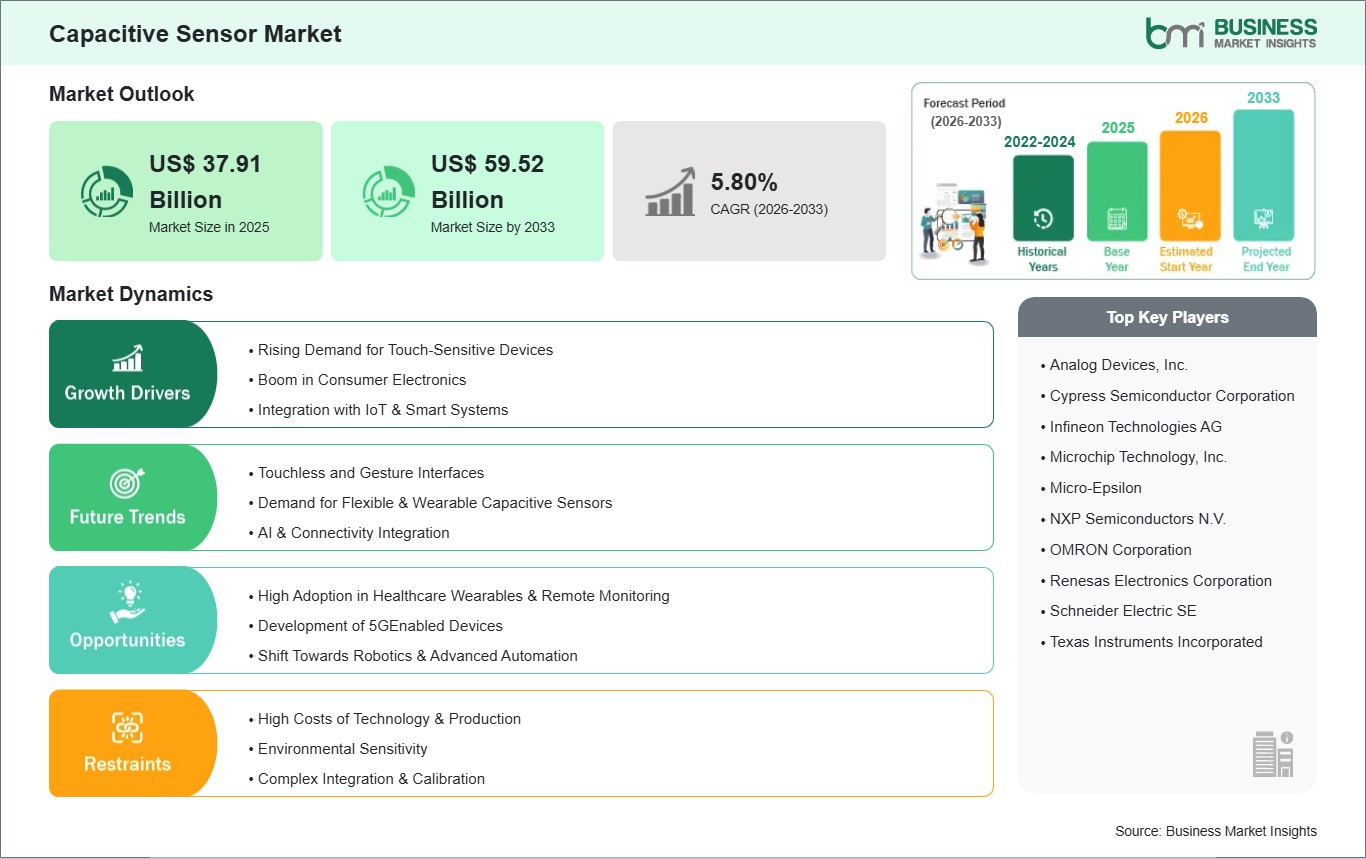
Capacitive sensors are electronic devices that detect changes in capacitance caused by the presence or proximity of an object, often without physical contact. They work by measuring variations in an electric field between conductive elements and a target, enabling precise detection of materials such as metals, liquids, or even human touch. These sensors are widely used in applications ranging from industrial automation, touchscreens, and medical devices to automotive systems and consumer electronics. The benefits of capacitive sensors include high sensitivity, durability due to the lack of moving parts, low maintenance, and the ability to operate in harsh environments. Additionally, they offer fast response times and can detect both conductive and non-conductive materials, making them versatile across multiple industries. The growing demand for capacitive sensors is driven by factors such as the proliferation of smart devices, automation in manufacturing, rising adoption of electric vehicles, and the expansion of IoT-enabled systems. Increasing emphasis on safety, energy efficiency, and user-friendly interfaces further fuels market growth globally.
Segment Analysis
Capacitive Sensor Market Segmentation
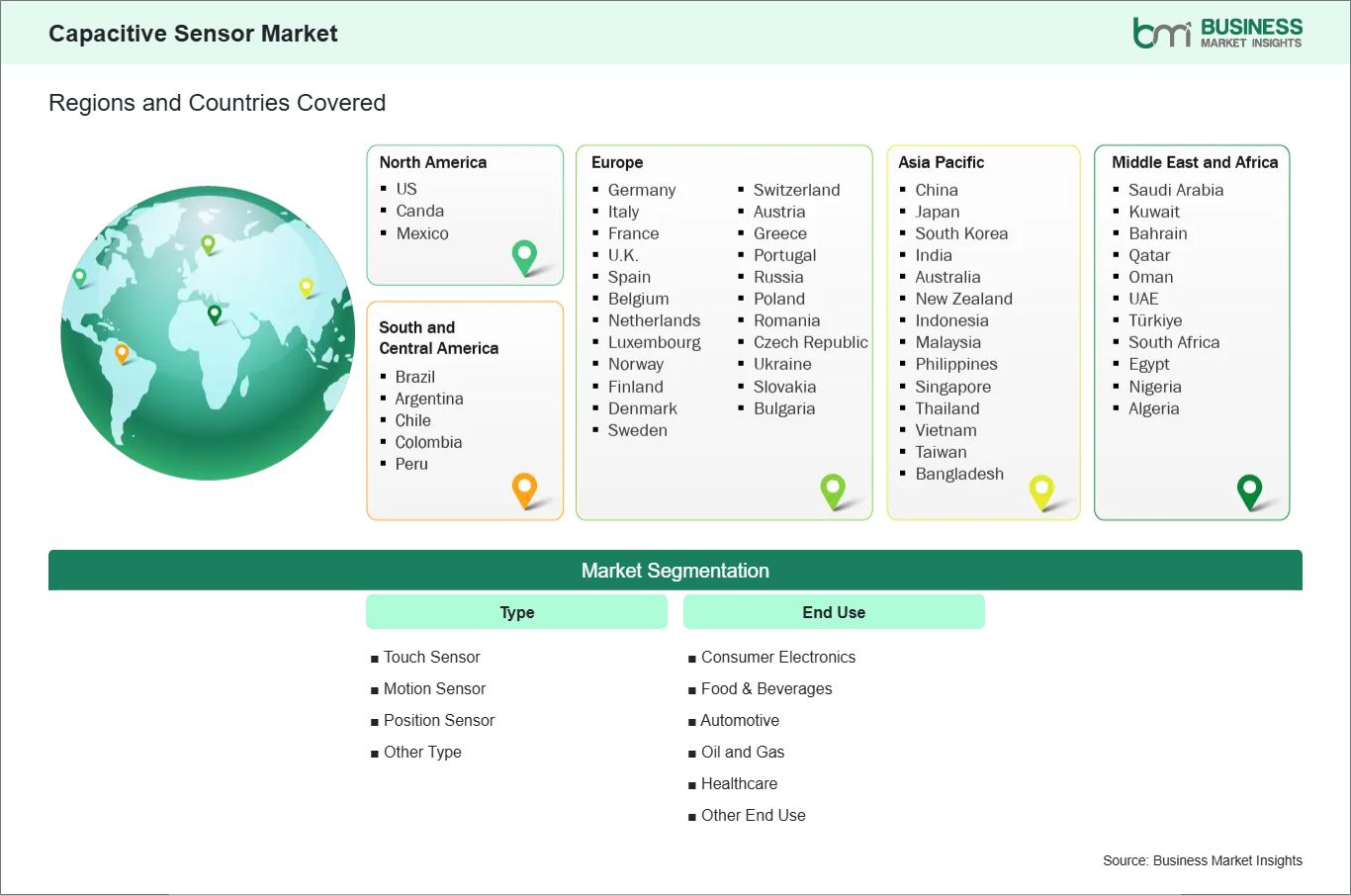
Key segments that contributed to the derivation of the capacitive sensor market analysis are type and end use.
- By type, the market is segmented into touch sensor, motion sensor, position sensor, and other type. The touch sensor segment held the largest share of the market in 2025.
- By end use, the market is segmented into consumer electronics, food & beverages, automotive, oil and gas, healthcare, and other end use. The consumer electronics segment held the largest share of the market in 2025.
Market Forces
Capacitive Sensor Market Drivers and Opportunities
Rising Demand for Touch-Sensitive Devices
The increasing adoption of touch-sensitive technologies in consumer electronics, automotive, and industrial applications is a major driver for the capacitive sensors market. Capacitive sensors are widely used in smartphones, tablets, wearable devices, laptops, and infotainment systems in vehicles due to their ability to detect touch accurately and provide a seamless user experience. The growing consumer preference for intuitive interfaces, sleek designs, and advanced functionalities encourages manufacturers to integrate capacitive sensing solutions. Additionally, industries such as healthcare, robotics, and home automation are increasingly implementing capacitive sensors for non-contact detection and precision monitoring, further boosting demand. The ongoing miniaturization of electronic devices and the push for smarter, more interactive systems also contribute to market growth. As touch-based technology becomes a standard expectation across applications, the need for reliable, efficient, and cost-effective capacitive sensors continues to expand globally.
Expansion in Automotive and Industrial Automation Sectors
The capacitive sensors market holds significant opportunities in automotive and industrial automation sectors due to the increasing focus on safety, efficiency, and user experience. In automobiles, capacitive sensors are increasingly integrated into touch-sensitive control panels, steering wheel controls, and advanced driver-assistance systems (ADAS), enabling seamless interaction while reducing physical buttons and improving interior aesthetics. Similarly, in industrial automation, capacitive sensors are crucial for detecting objects, monitoring fluid levels, and enabling contactless control in machinery, which enhances operational safety and productivity. The rising trend of smart factories and Industry 4.0 adoption emphasizes automation, precision, and real-time monitoring, creating a lucrative environment for capacitive sensor implementation. Additionally, environmental and regulatory factors encouraging energy-efficient and low-maintenance systems further boost their adoption. Companies developing sensors tailored for automotive and industrial needs have a significant opportunity to capture market share in these rapidly growing segments.
Size and Share Analysis
Capacitive Sensor Market Size and Share Analysis
By component, the market is segmented into touch sensor, motion sensor, position sensor, and other type. The touch sensor segment held the largest share of the market in 2025. Widespread use in consumer electronic devices such as smartphones, tablets, wearables, portable media players, and gaming consoles that rely on intuitive touch interfaces. Ongoing innovation and demand for multi‑touch and gesture control keep this segment at the forefront of investment.
By end use, the market is segmented consumer electronics, food & beverages, automotive, oil and gas, healthcare, and other end use. The consumer electronics segment held the largest share of the market in 2025. Use of capacitive sensors for motion tracking, gesture recognition, and proximity detection enhances device user experience. Miniaturization via MEMS and integration in consumer products further fuels expansion.
Report Coverage
Capacitive Sensor Market Report Coverage and Deliverables
The "Capacitive Sensor Market Size and Forecast (2022-2033)" report provides a detailed analysis of the market covering below areas:
- Capacitive sensor market size and forecast at global, regional, and country levels for all the key market segments covered under the scope
- Capacitive sensor market trends, as well as market dynamics such as drivers, restraints, and key opportunities
- Capacitive sensor market analysis covering key market trends, global and regional framework, major players, regulations, and recent market developments
- Industry landscape and competition analysis covering market concentration, heat map analysis, prominent players, and recent developments for the air circuit breaker market
- Detailed company profiles, including SWOT analysis
Geographic Insights
Capacitive Sensor Market Geographic Insights
The geographical scope of the capacitive sensor market report is divided into five regions: North America, Asia Pacific, Europe, Middle East & Africa, and South & Central America. The capacitive sensor market in North America is expected to grow significantly during the forecast period.
The Asia Pacific capacitive sensor market is segmented into China, Japan, South Korea, India, Australia, New Zealand, Indonesia, Malaysia, the Philippines, Singapore, Thailand, Vietnam, Taiwan, Bangladesh, and the Rest of Asia Pacific. Asia Pacific is a highly significant region in terms of adoption and growth for capacitive sensors due to its large and expanding consumer electronics industry. The region is expected to register one of the fastest compound annual growth rates during the forecast period, driven by strong demand for touchscreens in smartphones and other devices, as well as substantial R&D investment supported by governments in countries like China and Japan. The widespread smartphone penetration throughout Asia Pacific fuels demand for capacitive touch sensors, while ongoing innovation and manufacturing capabilities further elevate the market’s regional prominence.
Industry Activity
Recent Developments
The capacitive sensor market is evaluated by gathering qualitative and quantitative data post primary and secondary research, which includes important corporate publications, association data, and databases. A few of the key developments in the capacitive sensor market are:
- In March 2025, Infineon Technologies AG announced that its PSOC 4 microcontroller (MCU) family now features Multi-Sense capabilities. Infineon expands its leading capacitive sensing technology CAPSENSE with a new, proprietary inductive sensing technology, as well as a non-invasive and non-contact liquid sensing solution.
- In June 2025, Leinfelden-Echterdingen, June 25, 2025. EBE sensors + motion presents the new TCRC sensors, a groundbreaking solution for capacitive touch sensors that function reliably even under extreme conditions. This development addresses the challenges faced by manufacturers of operating panels in industrial, medical, and household applications.
Trust & Transparency
Research Methodology
The market analysis combines proprietary research with secondary data from government agencies, company disclosures, regulatory filings, industry databases and expert interviews. Market estimates are validated through data triangulation, cross-market benchmarking and analyst
review.
View Full Research Methodology
Key Sources Referred:
World Bank - Global Trade IndicatorsWorld Trade Organization (WTO)International Monetary Fund (IMF)International Trade Administration (ITA)Company websiteCompany annual reportsCompany investor presentations