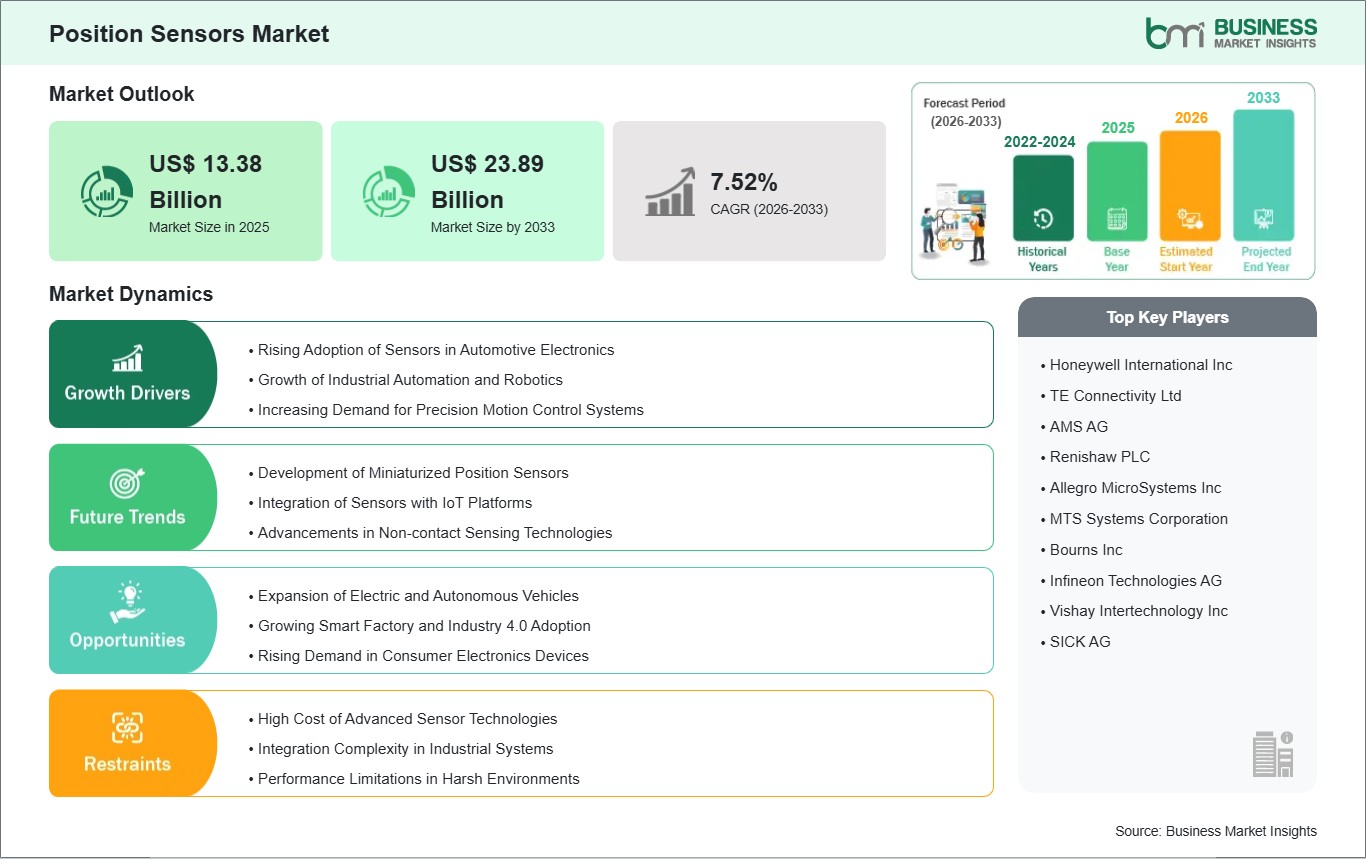
The Position Sensors Market size is expected to reach US$ 23.89 billion by 2033 from US$ 13.38 billion in 2025. The market is estimated to record a CAGR of 7.52% from 2026 to 2033.
The Position Sensors Market is experiencing strong growth as industries increasingly rely on precise motion detection and control systems across automotive, industrial automation, electronics, and aerospace applications. Position sensors are essential components used to detect the position, displacement, or rotation of objects and convert that information into electrical signals for monitoring and control. These sensors enable accurate motion control, improved operational efficiency, and enhanced safety across various industrial processes.
Advancements in sensor technologies, including non-contact sensing solutions, miniaturization, and improved durability, are significantly enhancing sensor performance. The growing adoption of automation, robotics, and smart manufacturing systems is also increasing the need for precise position sensing solutions. Additionally, expanding applications in automotive electronics, consumer devices, and industrial machinery are contributing to market expansion. As industries continue to adopt advanced automation technologies and intelligent control systems, the demand for high-performance position sensors is expected to grow steadily worldwide.

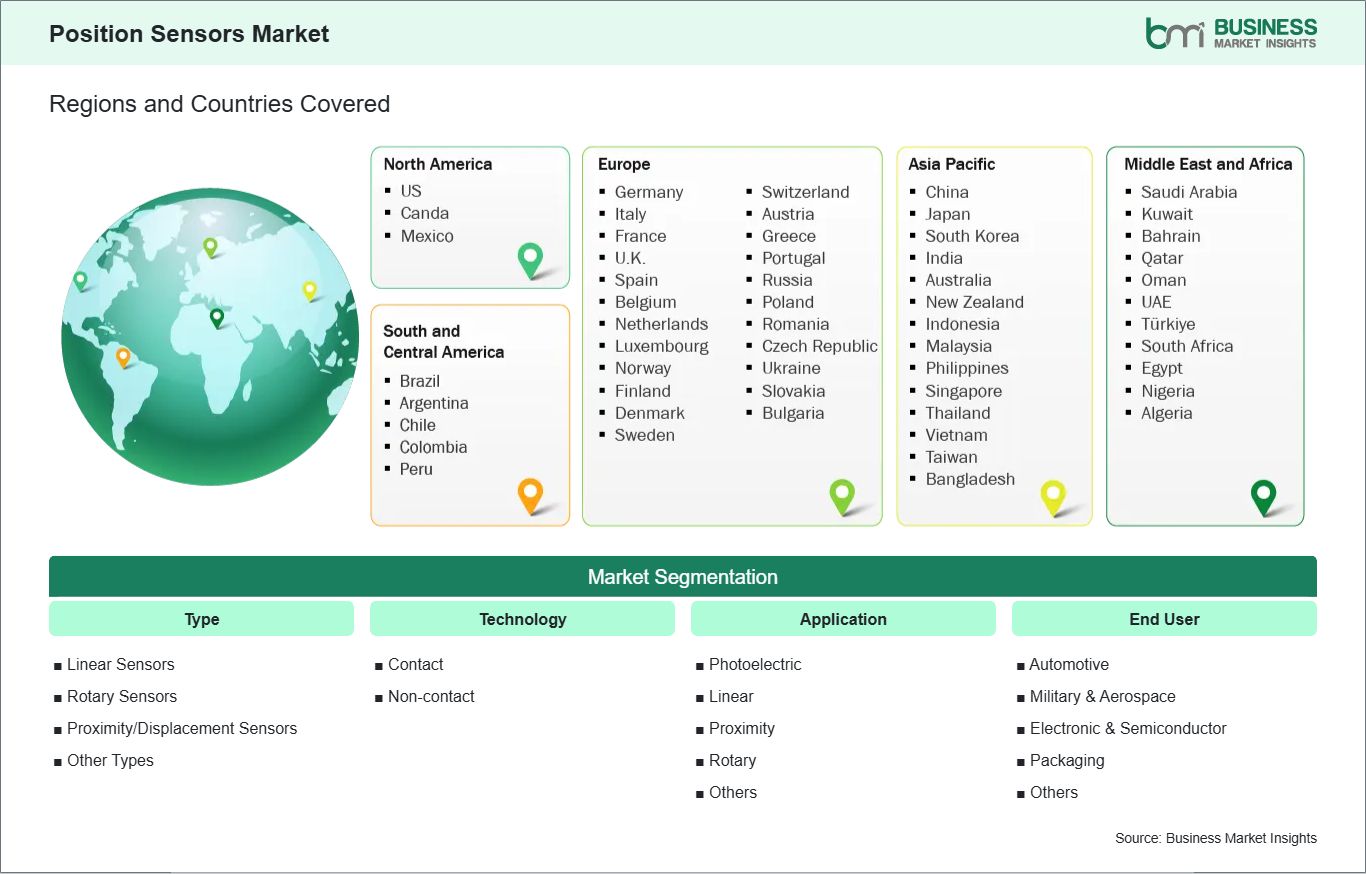
Key segments that contributed to the derivation of the Position Sensors market analysis are type, technology, application, end user.
The increasing integration of electronic systems in modern vehicles is a major driver of the Position Sensors Market. Automotive manufacturers are continuously incorporating advanced sensor technologies to enhance vehicle performance, safety, and fuel efficiency. Position sensors play a critical role in monitoring the movement and position of mechanical components such as throttle valves, steering systems, gear shifts, and brake pedals. Accurate sensing enables electronic control units to adjust vehicle operations in real time.
The rapid growth of advanced driver assistance systems (ADAS) has significantly increased the demand for position sensors. These systems rely on precise position data to ensure accurate functioning of steering angle detection, pedal position monitoring, and suspension control mechanisms. In addition, the transition toward electric vehicles is accelerating sensor adoption as EVs require advanced electronic monitoring for battery management, motor control, and regenerative braking systems.
Automotive manufacturers are also focusing on improving driving safety, comfort, and vehicle automation. Position sensors enable smooth control of steering, acceleration, and braking systems, ensuring reliable vehicle performance. As vehicles become more electronically controlled and intelligent, the demand for accurate and reliable position sensing solutions continues to expand, supporting long-term market growth.
The rapid expansion of electric and autonomous vehicles presents a major opportunity for the Position Sensors Market. Electric vehicles rely heavily on electronic control systems to manage powertrain operations, battery systems, and energy efficiency. Position sensors play a critical role in monitoring throttle position, steering angle, brake systems, and motor control components in EVs. Accurate position sensing ensures optimal vehicle performance and safe operation.
Autonomous vehicles further increase the importance of precise sensing technologies. These vehicles depend on multiple sensors and control systems to interpret driving conditions and make real-time decisions. Position sensors contribute to the proper functioning of steering mechanisms, suspension adjustments, and actuator movements, enabling vehicles to maintain stability and safety while operating autonomously.
Governments and automotive manufacturers worldwide are heavily investing in electric mobility and self-driving technologies. Increasing regulations supporting vehicle electrification and emission reduction are accelerating the production of electric vehicles globally. As a result, the demand for reliable and high-performance position sensors is expected to grow significantly, creating strong opportunities for manufacturers in the coming years.

The global Position Sensors market is experiencing steady growth, with market size and share analysis reflecting evolving treatment preferences and competitive dynamics among key players. The report evaluates important subsegments categorized within type, technology, application, end user, highlighting their respective contributions to overall market performance.
By type, the rotary sensors subsegment dominated in 2025 due to widespread adoption in automotive steering systems, industrial robotics, and automation equipment requiring precise angular measurement, motion control accuracy, and reliable performance in dynamic mechanical environments across manufacturing and mobility applications.
By technology, the non-contact subsegment dominated in 2025 due to superior durability, minimal mechanical wear, longer operational life, and increasing adoption in automotive electronics, industrial automation systems, and robotics where precise and maintenance-free position sensing is essential.
By application, the proximity subsegment dominated in 2025 due to extensive use in industrial automation, packaging equipment, safety systems, and manufacturing processes where reliable object detection, motion monitoring, and position sensing are critical for improving operational efficiency and equipment safety.
By end user, the automotive subsegment dominated in 2025 due to growing integration of electronic control systems, increasing vehicle electrification, rising adoption of advanced driver assistance systems, and demand for accurate position sensing in steering, throttle, and transmission components.
| Report Attribute | Details |
|---|---|
| Market size in 2025 | US$ 13.38 Billion |
| Market Size by 2033 | US$ 23.89 Billion |
| Global CAGR (2026 - 2033) | 7.52% |
| Historical Data | 2022-2024 |
| Forecast period | 2026-2033 |
| Segments Covered | By Type
|
|
Regions and Countries Covered
| |
| North America | US, Canada, Mexico |
| Europe | Belgium, Austria, Finland, Denmark, Greece, Poland, Romania, Russia, Ukraine, Czech Republic, Slovakia, Bulgaria, Italy, Luxembourg, Germany, Switzerland, France, Netherlands, Norway, Portugal, Spain, Sweden, United Kingdom |
| Asia-Pacific | Australia, China, India, Japan, South Korea, Indonesia, Malaysia, Philippines, Singapore, Thailand, Vietnam, Bangladesh, New Zealand, Taiwan |
| South and Central America | Brazil, Argentina, Peru, Chile, Colombia |
| Middle East and Africa | Bahrain, Kuwait, Oman, Qatar, Saudi Arabia, United Arab Emirates, Turkiye, South Africa, Egypt, Algeria, Nigeria |
| Market leaders and key company profiles |
|
The "Position Sensors Market Size and Forecast (2022 - 2033)" report provides a detailed analysis of the market covering below areas:
The geographical scope of the Position Sensors market report is divided into: North America, Asia Pacific, Europe, Middle East & Africa, and South & Central America. North America held the largest share in 2025.
North America dominates the Position Sensors Market due to strong adoption of industrial automation, advanced automotive technologies, and high demand for precision sensing solutions across multiple industries. The United States is a major contributor, supported by a large manufacturing sector, rapid development of robotics systems, and significant investments in smart factory technologies. The presence of major sensor manufacturers and technology companies in the region also strengthens market growth. North American industries are increasingly integrating advanced sensing technologies into production systems to improve efficiency, safety, and real-time monitoring capabilities.
Additionally, the growing electric vehicle market and continuous technological advancements in aerospace and defense systems are further driving the adoption of position sensors. These factors collectively position North America as a leading region in the global Position Sensors Market.

The Position Sensors market is evaluated by gathering qualitative and quantitative data post primary and secondary research, which includes important corporate publications, association data, and databases. A few of the key developments in the Position Sensors market are:
The Position Sensors Market is valued at US$ 13.38 Billion in 2025, it is projected to reach US$ 23.89 Billion by 2033.
As per our report Position Sensors Market, the market size is valued at US$ 13.38 Billion in 2025, projecting it to reach US$ 23.89 Billion by 2033. This translates to a CAGR of approximately 7.52% during the forecast period.
The Position Sensors Market report typically cover these key segments-
The historic period, base year, and forecast period can vary slightly depending on the specific market research report. However, for the Position Sensors Market report:
The Position Sensors Market is populated by several key players, each contributing to its growth and innovation. Some of the major players include:
The Position Sensors Market report is valuable for diverse stakeholders, including:
Essentially, anyone involved in or considering involvement in the Position Sensors Market value chain can benefit from the information contained in a comprehensive market report.
Please tell us your area of interest
(Market Segments/ Regions and Countries/ Companies)