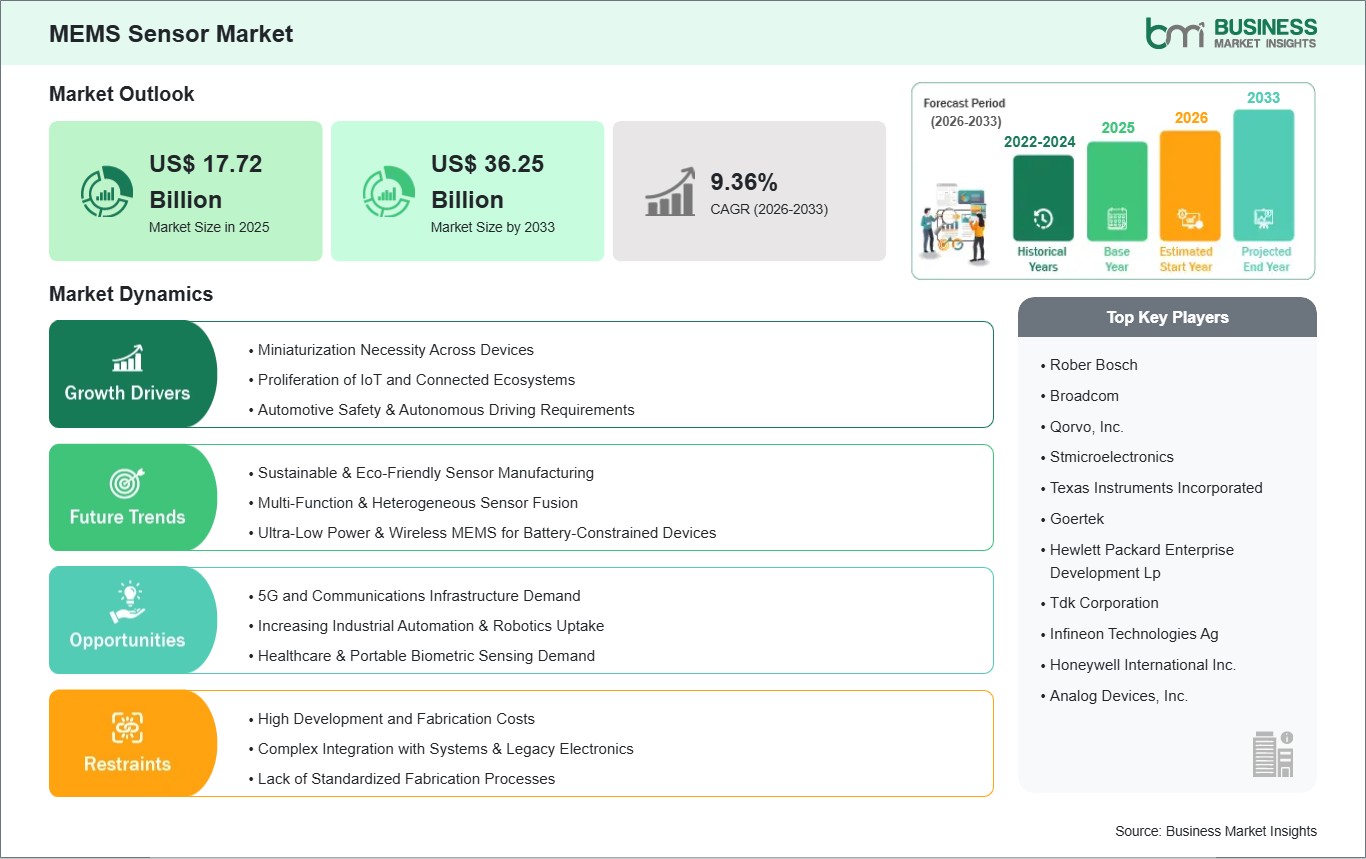
The MEMS sensor market size is expected to reach US$36,250.0 million by 2033 from US$17,720.0 million in 2025. The market is estimated to record a CAGR of 9.36% from 2026 to 2033.
The global MEMS sensor market is experiencing significant growth driven by the widespread adoption of smart devices, the expansion of the Internet of Things (IoT), and increasing automation across automotive, industrial, healthcare, and consumer electronics sectors. MEMS sensors play a critical role in modern electronic systems by enabling miniaturization, low power consumption, high accuracy, and cost-effective sensing solutions for motion, pressure, environmental, and acoustic applications. The rising demand for inertial measurement units (IMUs) in smartphones, wearables, gaming consoles, and AR/VR devices is a major contributor to market growth. In the automotive sector, the integration of MEMS sensors in advanced driver assistance systems (ADAS), vehicle safety systems, emission control, and electric vehicles is further accelerating adoption. Additionally, the growing use of MEMS-based medical devices for diagnostics, patient monitoring, and minimally invasive procedures is strengthening market expansion. Technological advancements in sensor fusion, wafer-level packaging, and edge intelligence are enhancing sensor performance and reliability. Despite strong growth potential, the market faces challenges such as high fabrication and packaging costs, complex manufacturing processes, and intense pricing pressure. However, emerging opportunities including the rollout of 5G infrastructure, autonomous and connected vehicles, smart manufacturing, and next-generation healthcare solutions are expected to drive sustained growth. Continuous innovation in ultra-low-power sensors, multifunctional MEMS platforms, and compact integrated modules is anticipated to shape the competitive landscape in the coming years.

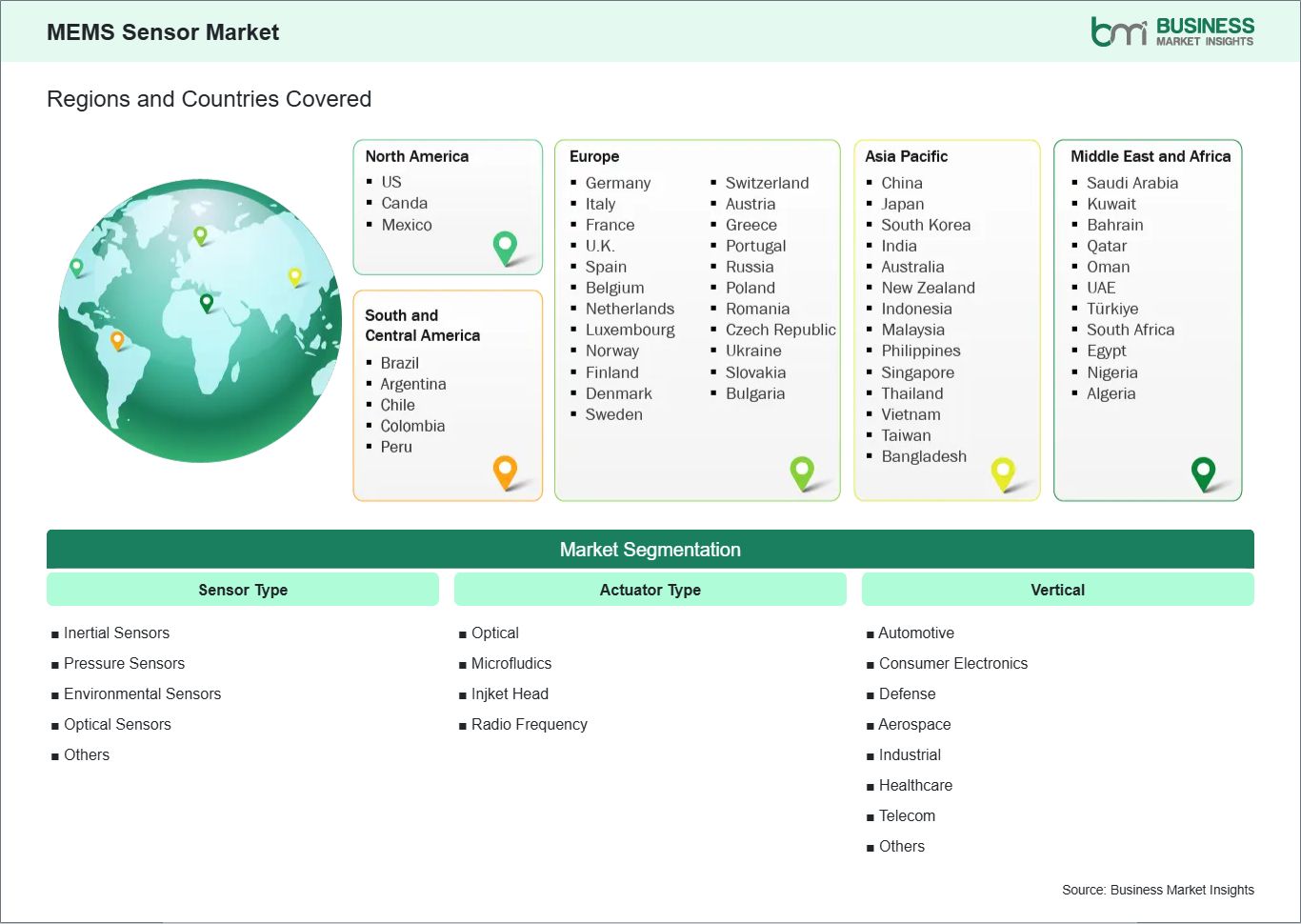
Key segments that contributed to the derivation of the MEMS sensor market analysis are sensor type, actuator type, and vertical.
The rapid expansion of the Internet of Things (IoT) and connected device ecosystems is a major driver accelerating the adoption of MEMS sensors across industries. As smart homes, wearables, industrial IoT platforms, and smart city infrastructure continue to scale, the need for compact, low-power, and highly reliable sensing solutions becomes critical. MEMS sensors enable real-time data collection for motion, pressure, temperature, humidity, and environmental monitoring, forming the backbone of connected systems. Their small form factor and energy efficiency make them ideal for battery-powered and edge devices, supporting continuous connectivity and data-driven decision-making. The growing deployment of connected sensors in industrial automation, asset tracking, and predictive maintenance further strengthens demand, positioning MEMS sensors as essential components in the evolving IoT landscape.
The integration of sensor fusion techniques and artificial intelligence (AI) is transforming MEMS sensors from standalone components into intelligent system enablers. By combining data from multiple MEMS sensors—such as accelerometers, gyroscopes, pressure, and environmental sensors—systems can achieve enhanced accuracy, contextual awareness, and operational reliability. When coupled with AI and machine learning algorithms, particularly at the edge, MEMS-enabled systems can perform real-time analytics, anomaly detection, and predictive decision-making. This capability is increasingly critical in applications such as autonomous vehicles, industrial condition monitoring, healthcare diagnostics, and smart consumer electronics. The shift toward intelligent, AI-enabled MEMS solutions is driving higher value creation, enabling advanced functionalities, and shaping the next generation of connected and autonomous systems.
Based on sensor type, the MEMS sensor market is segmented into inertial sensors, pressure sensors, environmental sensors, optical sensors, and others. Inertial sensors dominate the market due to their high-volume adoption in smartphones, wearables, gaming devices, and automotive safety and navigation systems. Meanwhile, environmental sensors are witnessing the fastest growth, supported by increasing demand for air quality monitoring, climate control, and smart environmental sensing applications.
Based on actuator type, the market is classified into optical, microfluidics, inkjet head, and radio frequency actuators. Optical actuators hold the largest market share, driven by their widespread use in consumer electronics, imaging systems, and fiber-optic communication networks. Radio frequency (RF) MEMS actuators are expected to experience strong growth, fueled by the expansion of 5G infrastructure, satellite communications, and advanced wireless technologies.
By vertical, the market includes automotive, consumer electronics, defense, aerospace, industrial, healthcare, telecom, and others. The automotive segment remains the largest contributor, supported by the increasing integration of MEMS sensors in ADAS, electric vehicles, and vehicle safety systems. However, the healthcare segment is anticipated to grow at a rapid pace due to rising adoption of MEMS-based diagnostic devices, patient monitoring systems, and minimally invasive medical technologies.
| Report Attribute | Details |
|---|---|
| Market size in 2025 | US$ 17.72 Billion |
| Market Size by 2033 | US$ 36.25 Billion |
| Global CAGR (2026 - 2033) | 9.36% |
| Historical Data | 2022-2024 |
| Forecast period | 2026-2033 |
| Segments Covered | By Sensor Type
|
|
Regions and Countries Covered
| |
| North America | US, Canada, Mexico |
| Europe | Belgium, Austria, Finland, Denmark, Greece, Poland, Romania, Russia, Ukraine, Czech Republic, Slovakia, Bulgaria, Italy, Luxembourg, Germany, Switzerland, France, Netherlands, Norway, Portugal, Spain, Sweden, United Kingdom |
| Asia-Pacific | Australia, China, India, Japan, South Korea, Indonesia, Malaysia, Philippines, Singapore, Thailand, Vietnam, Bangladesh, New Zealand, Taiwan |
| South and Central America | Brazil, Argentina, Peru, Chile, Colombia |
| Middle East and Africa | Bahrain, Kuwait, Oman, Qatar, Saudi Arabia, United Arab Emirates, Turkiye, South Africa, Egypt, Algeria, Nigeria |
| Market leaders and key company profiles |
|
The MEMS Sensor Market Size and Forecast (2022–2033) report provides a detailed analysis of the market covering below areas:
The geographical scope of the MEMS sensor market report is divided into five regions: North America, Asia Pacific, Europe, Middle East & Africa, and South & Central America. Asia Pacific stands as the fastest-growing and most dynamic market for MEMS sensors globally, driven by its dominant position in electronics manufacturing, rapid adoption of advanced technologies, and strong government support for semiconductor and industrial development. Countries such as China, Japan, South Korea, and Taiwan serve as global hubs for semiconductor fabrication and consumer electronics production, creating a highly integrated ecosystem that supports both large-scale manufacturing and growing domestic demand for MEMS sensors.
North America remains a technologically advanced and strategically important region in the MEMS sensor market, characterized by strong research and development capabilities, high innovation intensity, and early adoption of emerging applications. The United States plays a central role, hosting leading MEMS designers, fabless semiconductor companies, and integrated device manufacturers. Growth in the region is supported by robust demand from the aerospace, defense, automotive, and healthcare sectors, where high-reliability and precision MEMS sensors are critical for navigation, surveillance, automation, and medical monitoring applications.
Europe represents a stable and innovation-driven market for MEMS sensors, supported by its strong automotive manufacturing base, stringent regulatory standards, and leadership in industrial automation and healthcare technologies. Germany is a key contributor, with major automotive OEMs and tier-one suppliers increasingly integrating MEMS sensors into electric vehicles, advanced driver-assistance systems (ADAS), powertrain monitoring, and in-cabin sensing solutions. Additionally, investments in Industry 4.0, smart infrastructure, and medical technologies across countries such as France, the U.K., and Italy continue to support steady regional growth.

The MEMS Sensor Market is evaluated by gathering qualitative and quantitative data post primary and secondary research, which includes important corporate publications, association data, and databases. A few of the key developments in the MEMS sensor market are:
The MEMS Sensor Market is valued at US$ 17.72 Billion in 2025, it is projected to reach US$ 36.25 Billion by 2033.
As per our report MEMS Sensor Market, the market size is valued at US$ 17.72 Billion in 2025, projecting it to reach US$ 36.25 Billion by 2033. This translates to a CAGR of approximately 9.36% during the forecast period.
The MEMS Sensor Market report typically cover these key segments-
The historic period, base year, and forecast period can vary slightly depending on the specific market research report. However, for the MEMS Sensor Market report:
The MEMS Sensor Market is populated by several key players, each contributing to its growth and innovation. Some of the major players include:
The MEMS Sensor Market report is valuable for diverse stakeholders, including:
Essentially, anyone involved in or considering involvement in the MEMS Sensor Market value chain can benefit from the information contained in a comprehensive market report.
Please tell us your area of interest
(Market Segments/ Regions and Countries/ Companies)