Drone Sensor Market Outlook (2022–2033)

Historic Data: 2022-2024   |   Base Year: 2025   |   Forecast Period: 2026-2033
Report Content: Market Scope, Market Segmentation, Market Dynamics, and Competitive Analysis

Report Coverage:
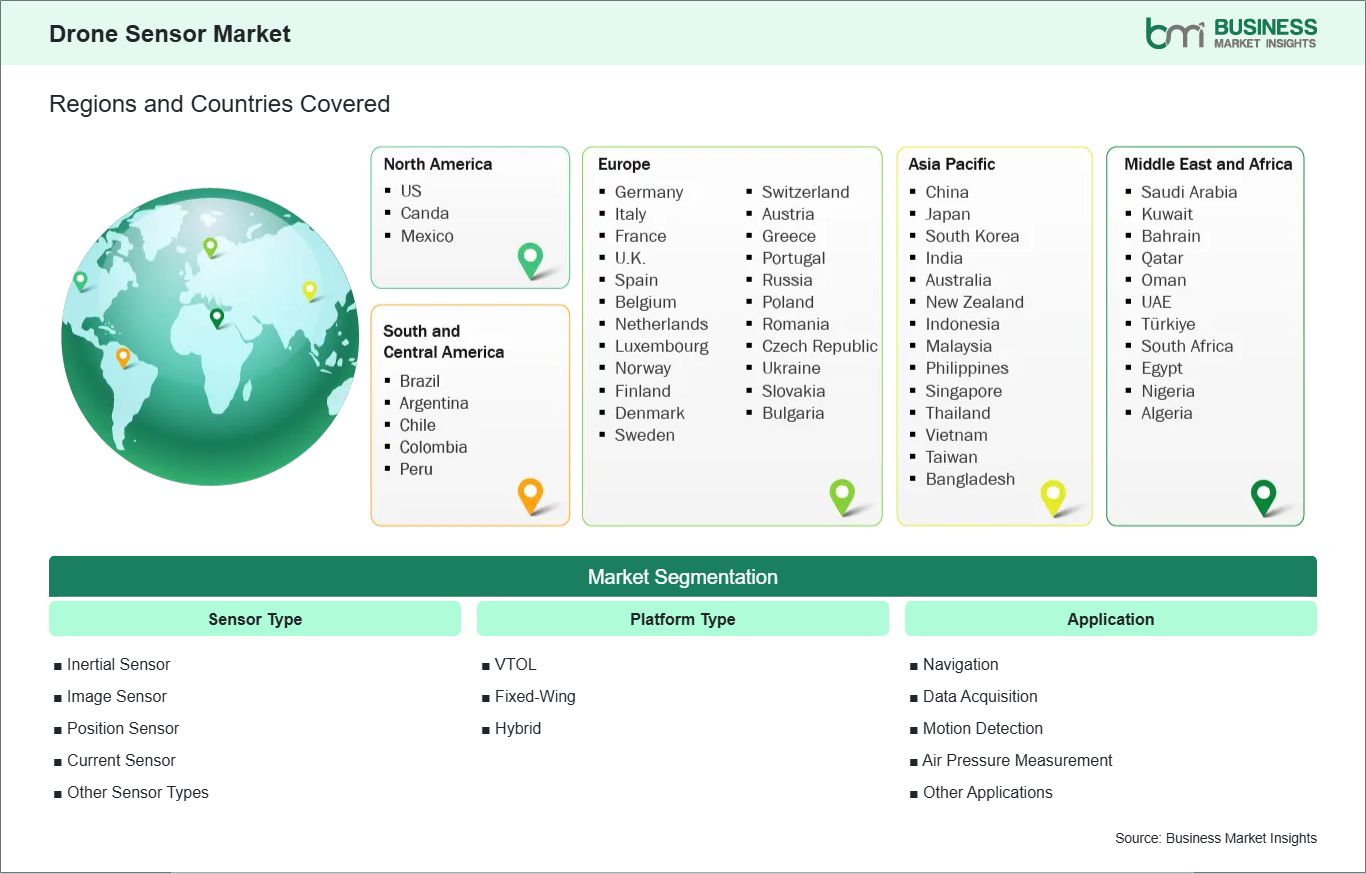
  • Sensor Type (Inertial Sensor, Image Sensor, Position Sensor, Current Sensor, Other Sensor Types)
  • Platform Type (VTOL, Fixed-Wing, Hybrid)
  • Application (Navigation, Data Acquisition, Motion Detection, Air Pressure Measurement, Other Applications)

No. of Pages: 400
Report Code: BMIPUB00033594
Category: Electronics and Semiconductor
Drone Sensor Market

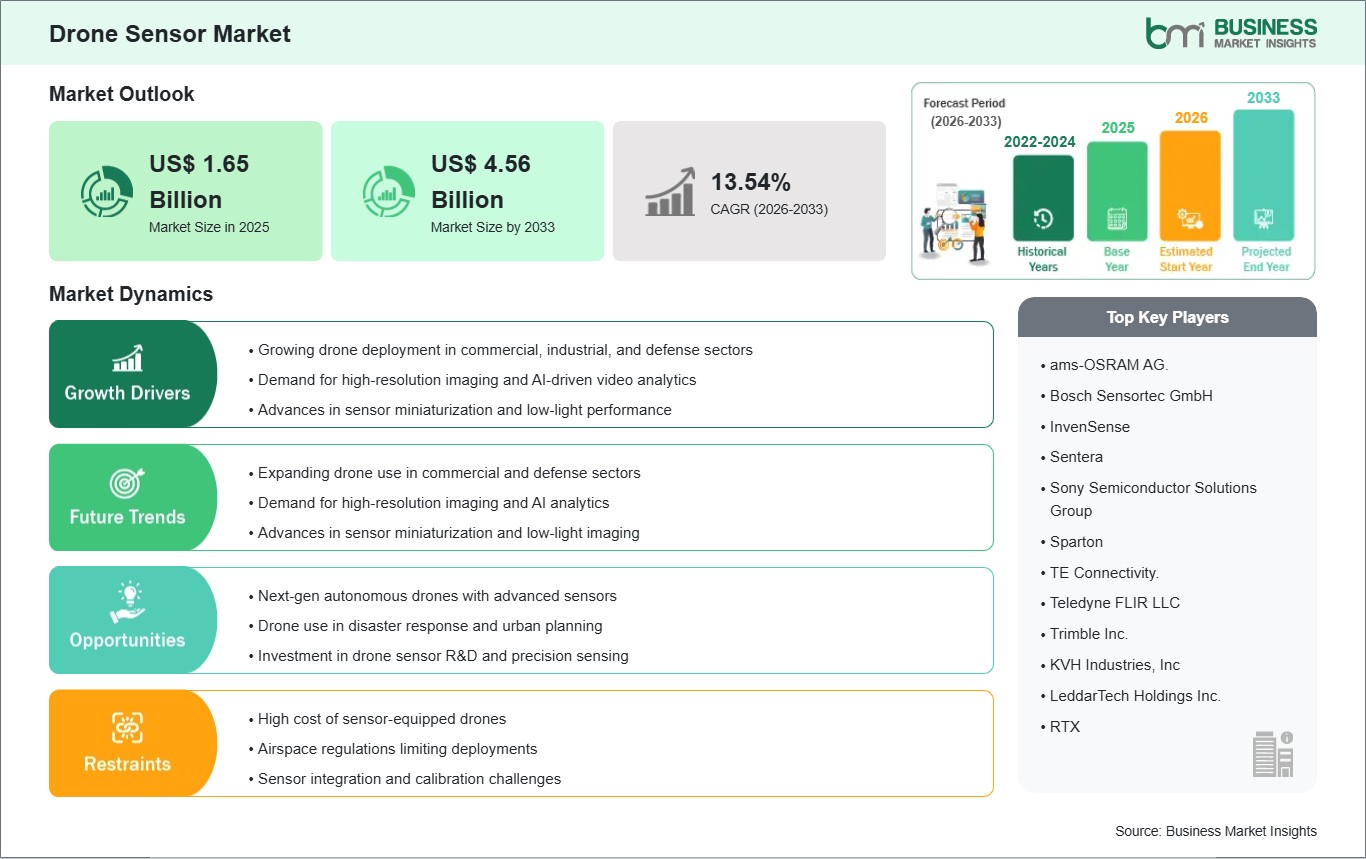
The Drone Sensor size is expected to reach US$ 4.56 billion by 2033 from US$ 1.65 billion in 2025. The market is estimated to record a CAGR of 13.54% from 2026 to 2033.

Executive Summary and Global Market Analysis:

The Drone Sensor Market broadly covers all the sensing technologies, parts, and integrated systems that are being utilized to equip unmanned aerial vehicles (UAVs) with the ability to detect, comprehend, and respond to their surroundings. Such sensors are crucial in navigation, stabilization, imaging, mapping, surveillance, inspection, environmental monitoring, as well as in carrying out autonomous operations within the commercial, industrial, and defense sectors. Drone sensors are at the core of the technological UAV platform layers, which decide the precision of the flight, the quality of the data, the safety of the operation, and the overall success of the mission.

Drone Sensor Market - Strategic Insights:

global-market-strategic-framework
Get more information on this report

Drone Sensor Market Segmentation Analysis:

Key segments that contributed to the derivation of the Drone Sensor analysis are technology, wafer size, and application.

  • By Sensor Type, the Drone Sensor market is segmented into inertial sensor, image sensor, position sensor, current sensor, and others. The image sensor segment held the largest share of the market in 2025.
  • By Platform Type, the Drone Sensor market is segmented into VTOL, fixed-wing, and hybrid. The VTOL segment held the largest share of the market in 2025.
  • By Application, the Drone Sensor market is segmented into navigation, data acquisition, motion detection, air pressure measurement, and others. The navigation segment held the largest share of the market in 2025.

Drone Sensor Market Drivers and Opportunities:

Growing Drone Adoption in Commercial Applications

A significant factor contributing to the growth of the Drone Sensor Market is the escalating commercial drone usage in various industries, including agriculture, infrastructure inspection, energy, and logistics. Companies are turning to drones outfitted with sophisticated sensor technology such as LiDAR, thermal imaging, multispectral cameras, and GNSS modules to streamline their operations, cut down on labor costs, and obtain more accurate data. For instance, precision agriculture, where drones equipped with sensors play a pivotal role in tracking the health of crops, water usage, and soil condition on a daily basis. On the other hand, the use of high-resolution images and thermal sensors by the infrastructure and utility sectors is indispensable for scheduled maintenance and equipment inspection. There is a continual increase in the requirement for top-notch, compact, and energy-saving drone sensors as companies embrace automation and data-centric decision-making, making.

Integration of AI

A big opportunity in the Drone Sensor Market is the incorporation of artificial intelligence (AI), edge computing, and multi-sensor fusion technologies. As drones become more autonomous, the demand is increasing for smart sensor systems that can process and analyze data on the spot. By merging data from LiDAR, cameras, radar, GPS, and IMUs, sensor fusion not only improves the drone's navigation accuracy but also obstacle avoidance and getting an understanding of the surroundings. There is a strong growth potential in these new areas, like drone delivery networks, urban air mobility, smart city surveillance, and disaster response management. Moreover, miniaturization and low-power sensor design are resulting in longer flight times and better payload efficiency. The defense sector is another major potential area, as governments are funding high-end surveillance and reconnaissance drones with sophisticated sensors. As the rules become clearer and BVLOS (beyond, visual, line, of, sight) operations are growing, the need for smart, integrated sensor systems is likely to increase considerably.

Drone Sensor Market Size and Share Analysis:

By Sensor Type, the Drone Sensor Market is segmented into inertial sensors, image sensors, position sensors, current sensors, and others. Aerial image sensors represent the overwhelming majority in the market because visual data gathering is the principal function behind the uptake of drones in the commercial, industrial, and defense sectors. Cameras with CMOS-based RGB sensors, thermal detectors, multispectral, and hyperspectral imaging systems are the mainstay of their use for aerial photography, infrastructure inspection, agriculture monitoring, mapping, surveillance, and disaster management, among other applications. The demand for high-resolution images, real-time video streaming, and image analytics powered by AI has greatly facilitated the adoption of sophisticated image sensors. Technology advances in sensor resolution, low-light sensitivity, dynamic range, and miniaturization have further increased the robustness of image sensor dominance. Besides, AI integration and edge processing enable drones to carry out object detection, facial recognition, crop health analysis, and thermal anomaly detection, thus pointing out that image sensors will be indispensable for the next-generation autonomous operations.

By Platform Type, the Drone Sensor Market is segmented into VTOL, fixed-wing, and hybrid platforms. VTOL drones greatly dominate the market because of their versatile nature and the fact that they can be easily deployed in various applications. VTOL drones, capable of take-off and landing vertically, hovering, and moving tightly, are perfectly suitable for the above purposes since they can operate close to the object/infrastructure without ground contact. Their dominance is further embellished with the embedding of advanced sensor suites such as high-resolution cameras, LiDAR, IMUs, and GNSS modules, which allow precise navigation, real-time imaging, and autonomous flight. The rising popularity of urban drone applications and last-mile delivery has also played a significant role in boosting the adoption of VTOL, as these drones are a perfect mix of helicopters, like flight and fixed, wing, like flight, providing both hovering capability and extended operational functionality.

By Application, the Drone Sensor Market is segmented into navigation, data acquisition, motion detection, air pressure measurement, and others. Navigation leads the market since accurate positioning and flight controls are, almost by definition, at the core of every drone operation. Navigation sensors such as GNSS/GPS modules, Inertial Measurement Units (IMUs), accelerometers, gyroscopes, magnetometers, and barometers help drones to be stable, on the route, in a state of hovering, and in a process of automated flight missions. The growth in the use of BVLOS operations, urban air mobility, and delivery drones has significantly increased the need for very accurate, dependable navigation sensors that can play a crucial role in collision avoidance, path optimization, and safety assurance in the commercial, industrial, and defense sectors.

Drone Sensor Market Report Highlights:

Report Attribute Details
Market size in 2025 US$ 1.65 Billion
Market Size by 2033 US$ 4.56 Billion
Global CAGR (2026 - 2033)13.54%
Historical Data 2022-2024
Forecast period 2026-2033
Segments Covered By Sensor Type
  • Inertial Sensor
  • Image Sensor
  • Position Sensor
  • Current Sensor
  • Other Sensor Types
By Platform Type
  • VTOL
  • Fixed-Wing
  • Hybrid
By Application
  • Navigation
  • Data Acquisition
  • Motion Detection
  • Air Pressure Measurement
  • Other Applications
Regions and Countries Covered
North America US, Canada, Mexico
Europe Belgium, Austria, Finland, Denmark, Greece, Poland, Romania, Russia, Ukraine, Czech Republic, Slovakia, Bulgaria, Italy, Luxembourg, Germany, Switzerland, France, Netherlands, Norway, Portugal, Spain, Sweden, United Kingdom
Asia-Pacific Australia, China, India, Japan, South Korea, Indonesia, Malaysia, Philippines, Singapore, Thailand, Vietnam, Bangladesh, New Zealand, Taiwan
South and Central America Brazil, Argentina, Peru, Chile, Colombia
Middle East and Africa Bahrain, Kuwait, Oman, Qatar, Saudi Arabia, United Arab Emirates, Turkiye, South Africa, Egypt, Algeria, Nigeria
Market leaders and key company profiles
  • ams-OSRAM AG.
  • Bosch Sensortec GmbH
  • InvenSense
  • Sentera
  • Sony Semiconductor Solutions Group
  • Sparton
  • TE Connectivity.
  • Teledyne FLIR LLC
  • Trimble Inc.
  • KVH Industries, Inc
Get more information on this report

Drone Sensor Market Report Coverage and Deliverables:

The "Drone Sensor Size and Forecast (2022 - 2033)" report provides a detailed analysis of the market covering below areas:

  • Drone Sensor size and forecast at global, regional, and country levels for all the key market segments covered under the scope
  • Drone Sensor trends, as well as market dynamics such as drivers, restraints, and key opportunities
  • Drone Sensor analysis covering key market trends, global and regional framework, major players, regulations, and recent market developments
  • Industry landscape and competition analysis covering market concentration, heat map analysis, prominent players, and recent developments for the Drone Sensor
  • Detailed company profiles, including SWOT analysis

Drone Sensor Market Geographic Insights:

The geographical scope of the Drone Sensor report is divided into five regions: North America, Asia Pacific, Europe, the Middle East & Africa, and South & Central America.

The Asia Pacific region accounts for the largest share of the Drone Sensor Market primarily because of the presence of major drone manufacturers, sensor component suppliers, and electronics production hubs in countries like China, Japan, South Korea, and Taiwan. These countries have strong capabilities in producing high-precision sensors such as cameras, LiDAR, IMUs, and GNSS modules, which are necessary for commercial, industrial, and defense drone use. Besides, the increasing use of drones for agriculture, infrastructure inspection, logistics, and urban monitoring in the region results in a huge demand for sophisticated sensors. Besides, the region is benefiting from cost advantages, large-scale manufacturing, and well-established supply chains, which further deepen its market position. North America and Europe are significant markets as well, with tech innovation, high-level adoption of autonomous UAVs, and defense, surveying, and industrial inspection applications being the main drivers.

global-market-geography
Get more information on this report

Drone Sensor Market Research Report Guidance:

  • The report includes qualitative and quantitative data in the Drone Sensor across technology, wafer size, application and geography.
  • The report starts with the key takeaways (chapter 2), highlighting the key trends and outlook of the Drone Sensor.
  • Chapter 3 includes the research methodology of the study.
  • Chapter 4 further includes ecosystem analysis.
  • Chapter 5 highlights the major industry dynamics in the Drone Sensor, including factors that are driving the market, prevailing deterrents, potential opportunities, as well as future trends. Impact analysis of these drivers and restraints is also covered in this section.
  • Chapter 6 discusses the Drone Sensor scenario, in terms of historical market revenues, and forecasts till the year 2031.
  • Chapters 7 to 10 cover Drone Sensor segments by sensor type, platform type, application and geography across North America, Europe, Asia Pacific, the Middle East and Africa, and South and Central America. They cover the market volume, revenue forecast, and factors driving the market.
  • Chapter 11 describes the competitive analysis along with the heat map analysis for the key players operating in the market.
  • Chapter 12 describes the industry landscape analysis. It provides detailed descriptions of business activities such as market initiatives, new developments, mergers, and joint ventures globally, along with a competitive landscape.
  • Chapter 13 provides detailed profiles of the major companies operating in the Drone Sensor. Companies have been profiled on the basis of their key facts, business descriptions, products and services, financial overview, SWOT analysis, and key developments.
  • Chapter 14, i.e., the appendix is inclusive of a brief overview of the company, list of abbreviations, and disclaimer.

Drone Sensor Market News and Key Development:

The Drone Sensor is evaluated by gathering qualitative and quantitative data post primary and secondary research, which includes important corporate publications, association data, and databases. A few of the key developments in the Drone Sensor are:

  • In March 2025, Voliro, in collaboration with Sixpec, launched the world’s first drone-based Pulsed Eddy Current (PEC) sensor. The PEC sensor is integrated into a payload designed exclusively for the Voliro T drone, combining Voliro’s unique inspection drone platform with world class PEC sensing
  • In October 2024, Dedrone launched RF sensor. The Advanced Detection RF-560 sensor is specifically designed to receive Remote ID and Remote ID equivalent data through advanced detection capabilities from many drone manufacturers including DJI. This sensor also offers flexibility to the user based on their specific threat profile. The sensor delivers long-range protection even in noisy RF environments like urban areas where the user can choose either omni-directional antennas to provide 360-degree coverage at shorter ranges, typically up to 5km or directional antennas (2 included with each sensor) to deliver 180-degree coverage with longer ranges, typically up to 8km.

Key Sources Referred:

  • Association for Uncrewed Vehicle Systems International (AUVSI)
  • International Drone Council (IDC)
  • World UAV Federation (WUAVF)
  • Drone Operators Association of India (DOAI)
  • UAVDACH (European Association for Unmanned Aviation)
  • Company Annual Reports
  • Company Investor Presentations
The List of Companies - Drone Sensor Market
  • ams-OSRAM AG.
  • Bosch Sensortec GmbH
  • InvenSense
  • Sentera
  • Sony Semiconductor Solutions Group
  • Sparton
  • TE Connectivity.
  • Teledyne FLIR LLC
  • Trimble Inc.
  • KVH Industries, Inc
  • LeddarTech Holdings Inc.
  • RTX
Frequently Asked Questions
How big is the Drone Sensor Market?

The Drone Sensor Market is valued at US$ 1.65 Billion in 2025, it is projected to reach US$ 4.56 Billion by 2033.

What is the CAGR for Drone Sensor Market by (2026 - 2033)?

As per our report Drone Sensor Market, the market size is valued at US$ 1.65 Billion in 2025, projecting it to reach US$ 4.56 Billion by 2033. This translates to a CAGR of approximately 13.54% during the forecast period.

What segments are covered in this report?

The Drone Sensor Market report typically cover these key segments-

  • Sensor Type (Inertial Sensor, Image Sensor, Position Sensor, Current Sensor, Other Sensor Types)
  • Platform Type (VTOL, Fixed-Wing, Hybrid)
  • Application (Navigation, Data Acquisition, Motion Detection, Air Pressure Measurement, Other Applications)

What is the historic period, base year, and forecast period taken for Drone Sensor Market?

The historic period, base year, and forecast period can vary slightly depending on the specific market research report. However, for the Drone Sensor Market report:

  • Historic Period : 2022-2024
  • Base Year : 2025
  • Forecast Period : 2026-2033
  • Who are the major players in Drone Sensor Market?

    The Drone Sensor Market is populated by several key players, each contributing to its growth and innovation. Some of the major players include:

  • ams-OSRAM AG.
  • Bosch Sensortec GmbH
  • InvenSense
  • Sentera
  • Sony Semiconductor Solutions Group
  • Sparton
  • TE Connectivity.
  • Teledyne FLIR LLC
  • Trimble Inc.
  • KVH Industries, Inc
  • LeddarTech Holdings Inc.
  • RTX
  • Who should buy this report?

    The Drone Sensor Market report is valuable for diverse stakeholders, including:

    • Investors: Provides insights for investment decisions pertaining to market growth, companies, or industry insights. Helps assess market attractiveness and potential returns.
    • Industry Players: Offers competitive intelligence, market sizing, and trend analysis to inform strategic planning, product development, and sales strategies.
    • Suppliers and Manufacturers: Helps understand market demand for components, materials, and services related to concerned industry.
    • Researchers and Consultants: Provides data and analysis for academic research, consulting projects, and market studies.
    • Financial Institutions: Helps assess risks and opportunities associated with financing or investing in the concerned market.

    Essentially, anyone involved in or considering involvement in the Drone Sensor Market value chain can benefit from the information contained in a comprehensive market report.

    Available Report Formats

    pdf-format excel-format pptx-format
    Buy Now
    Sales Assistance
    +1 646 791 7070 (US & UK)
    Customization Form

    Please tell us your area of interest
    (Market Segments/ Regions and Countries/ Companies)