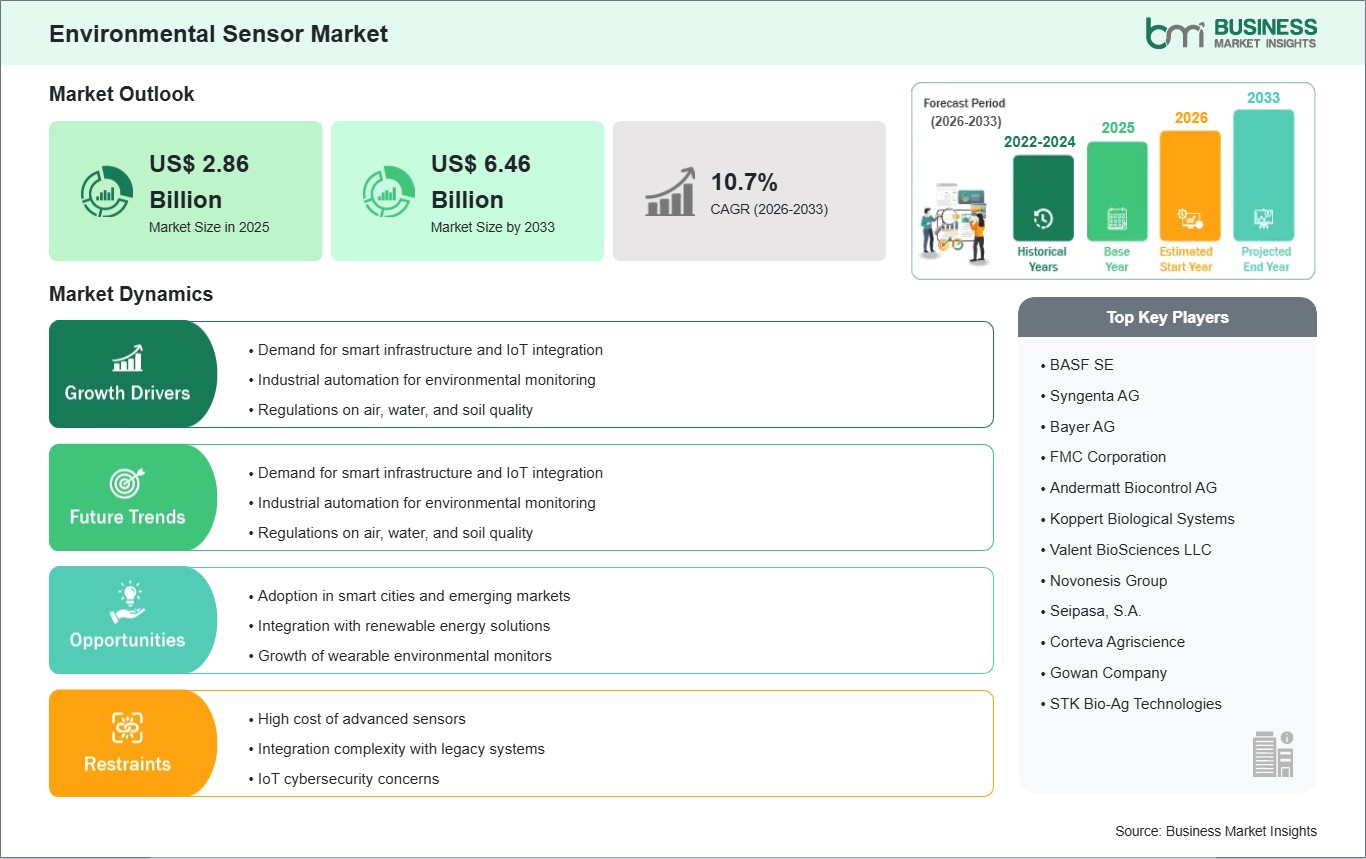
The environmental sensors market size is expected to reach US$ 6.46 billion by 2033 from US$ 2.86 billion in 2025. The market is estimated to record a CAGR of 10.7% from 2025 to 2033.
Environmental sensor systems have emerged as an essential component across industries worldwide for ensuring environmental monitoring, regulatory compliance, and operational efficiency. Environmental sensors—including temperature sensors, humidity sensors, air quality sensors, gas sensors, pressure sensors, and water quality monitoring devices—are increasingly deployed across industrial facilities, smart buildings, healthcare institutions, agriculture fields, data centers, and smart cities. These solutions have also gained significant adoption in manufacturing plants, energy facilities, and research laboratories. Environmental sensor systems provide multiple advantages, including real-time monitoring of environmental conditions, early detection of hazards, improved workplace safety, optimized energy usage, and enhanced compliance with environmental regulations. Growing concerns regarding climate change, air pollution, industrial emissions, workplace safety standards, and stringent environmental policies have intensified the focus on deploying advanced environmental monitoring technologies.
However, the environmental sensor market faces certain challenges that may restrain its growth. These include high initial deployment costs, calibration and maintenance requirements, data accuracy concerns, integration complexities with legacy infrastructure, and cybersecurity risks in connected sensor networks. Capital expenditure constraints and evolving environmental regulations also influence purchasing decisions. Despite these challenges, the market presents strong growth opportunities, primarily driven by the expansion of IoT-enabled monitoring systems, increasing adoption of smart city initiatives, advancements in wireless sensor technologies, rising demand for real-time environmental analytics, and the growing emphasis on sustainability and regulatory compliance across industries.

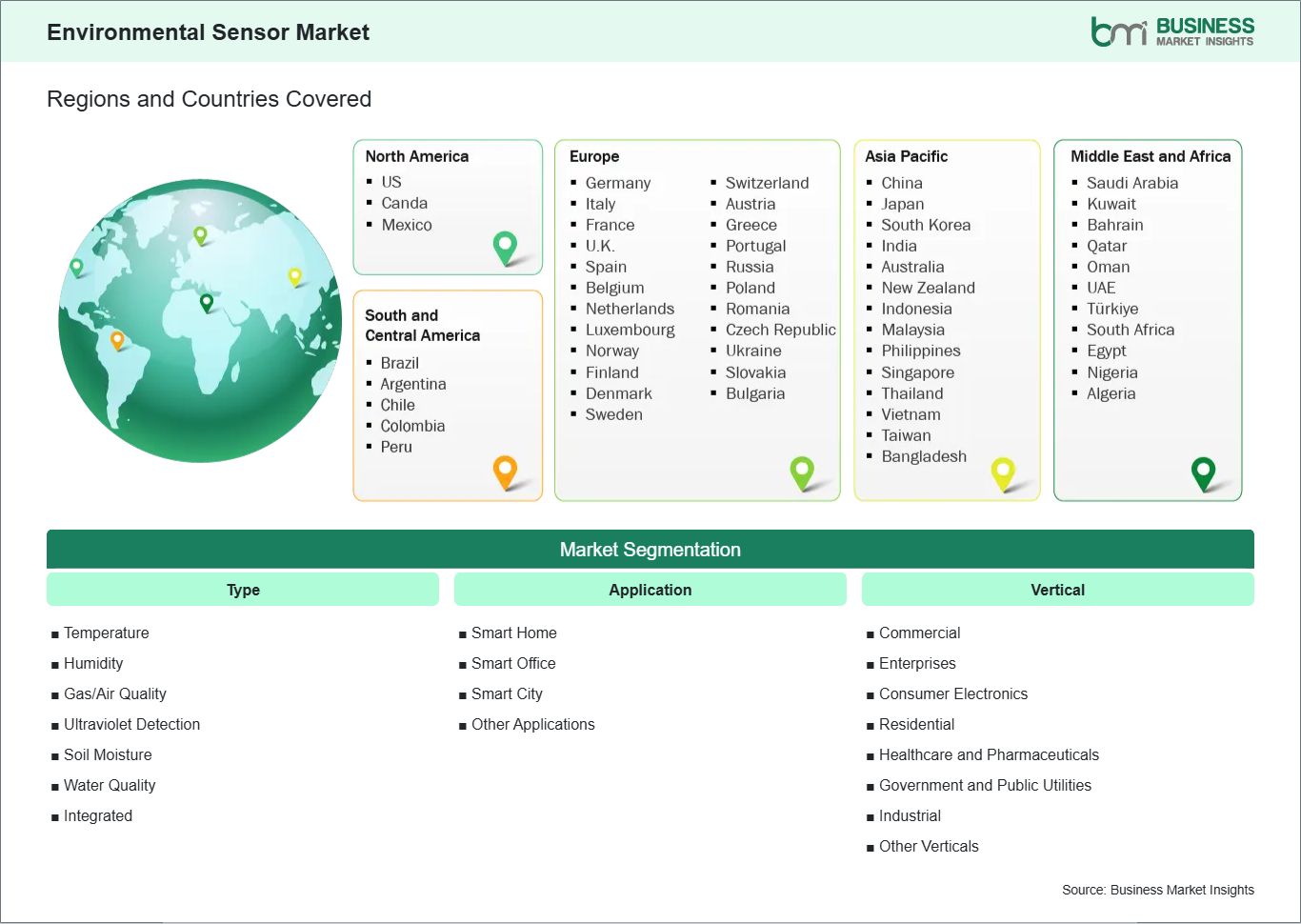
Key segments that contributed to the derivation of the environmental sensors market analysis are type, application, vertical, and deployment.
The growing deployment of smart infrastructure and Internet of Things (IoT) ecosystems is a major driver for the market. Rapid urbanization and digital transformation initiatives are encouraging the adoption of connected sensors across smart homes, smart offices, and smart cities. These sensors enable real-time monitoring of temperature, humidity, air quality, and other environmental parameters, improving energy efficiency, safety, and operational performance. Governments and private organizations are investing heavily in intelligent building systems and automation technologies, further accelerating demand. The integration of sensors with cloud platforms and analytics tools is also enhancing data-driven decision-making across industries..
Emerging economies present significant growth opportunities due to increasing investments in industrial automation and infrastructure modernization. Rapid industrialization, particularly in Asia-Pacific and Latin America, is creating strong demand for environmental and integrated sensing solutions in manufacturing plants, healthcare facilities, and public utilities. Additionally, the rising adoption of portable and outdoor sensors for agriculture, water quality monitoring, and environmental compliance is opening new revenue streams. As industries seek improved productivity, sustainability, and regulatory compliance, advanced sensing technologies integrated with AI and predictive analytics are expected to unlock substantial market expansion opportunities.
By type, the market is segmented into temperature, humidity, gas/air quality, ultraviolet (UV) detection, soil moisture, water quality, and integrated sensors. Temperature sensors held a significant share in 2025 due to their widespread deployment across smart homes, industrial facilities, healthcare environments, and commercial buildings, driven by strong demand for real-time environmental monitoring, energy management, and process optimization.
By application, the market is segmented into smart home, smart office, smart city, and others. Smart home held a significant share in 2025 due to increasing adoption of connected devices, home automation systems, and energy-efficient monitoring solutions, supported by growing consumer awareness and IoT integration.
By vertical, the market is segmented into commercial, enterprises, consumer electronics, residential, healthcare and pharmaceuticals, government and public utilities, industrial, and others. The industrial segment held a significant share in 2025 due to rising investments in automation, environmental compliance monitoring, and predictive maintenance solutions.
By deployment, the market is segmented into indoor, outdoor, and portable. Indoor deployment held a significant share in 2025 due to high installation rates in residential buildings, offices, hospitals, and manufacturing facilities for continuous environmental monitoring and control.
st fleet segment requiring electronic logging devices.| Report Attribute | Details |
|---|---|
| Market size in 2025 | US$ 2.86 Billion |
| Market Size by 2033 | US$ 6.46 Billion |
| Global CAGR (2026 - 2033) | 10.7% |
| Historical Data | 2022-2024 |
| Forecast period | 2026-2033 |
| Segments Covered | By Type
|
|
Regions and Countries Covered
| |
| North America | US, Canada, Mexico |
| Europe | Belgium, Austria, Finland, Denmark, Greece, Poland, Romania, Russia, Ukraine, Czech Republic, Slovakia, Bulgaria, Italy, Luxembourg, Germany, Switzerland, France, Netherlands, Norway, Portugal, Spain, Sweden, United Kingdom |
| Asia-Pacific | Australia, China, India, Japan, South Korea, Indonesia, Malaysia, Philippines, Singapore, Thailand, Vietnam, Bangladesh, New Zealand, Taiwan |
| South and Central America | Brazil, Argentina, Peru, Chile, Colombia |
| Middle East and Africa | Bahrain, Kuwait, Oman, Qatar, Saudi Arabia, United Arab Emirates, Turkiye, South Africa, Egypt, Algeria, Nigeria |
| Market leaders and key company profiles |
|
The "Environmental Sensor Market Size and Forecast (2022-2033)" report provides a detailed analysis of the market covering below areas:
The geographical scope of the environmental sensors market report is divided into five regions: North America, Asia Pacific, Europe, Middle East & Africa, and South & Central America. The environmental sensors market in Asia Pacific is expected to grow significantly during the forecast period.
The Asia-Pacific environmental sensors market is segmented into China, Japan, South Korea, India, Australia, New Zealand, Indonesia, Malaysia, the Philippines, Singapore, Thailand, Vietnam, Taiwan, Bangladesh, and the Rest of Asia. The region is witnessing strong growth, driven by rapid urbanization, expanding industrialization, and increasing investments in smart infrastructure and digital transformation initiatives. Major economies such as China, Japan, and India are leading market growth due to rising demand for advanced environmental monitoring solutions across smart cities, manufacturing facilities, commercial buildings, and healthcare institutions.
The region is also experiencing growing adoption of advanced sensing technologies, including air quality monitoring sensors, integrated environmental sensors, portable monitoring devices, and cloud-connected IoT platforms. Increasing awareness of environmental sustainability, stricter government regulations related to air and water quality monitoring, and strong support for smart city development are further boosting market demand. Additionally, rising investments in industrial automation, infrastructure modernization, and technological advancements in sensor miniaturization and wireless connectivity are positioning Asia-Pacific as a key growth region in the global environmental sensors market.

The environmental sensors market is evaluated by gathering qualitative and quantitative data post primary and secondary research, which includes important corporate publications, association data, and databases. A few of the key developments in the environmental sensors market are:
The Environmental Sensor Market is valued at US$ 2.86 Billion in 2025, it is projected to reach US$ 6.46 Billion by 2033.
As per our report Environmental Sensor Market, the market size is valued at US$ 2.86 Billion in 2025, projecting it to reach US$ 6.46 Billion by 2033. This translates to a CAGR of approximately 10.7% during the forecast period.
The Environmental Sensor Market report typically cover these key segments-
The historic period, base year, and forecast period can vary slightly depending on the specific market research report. However, for the Environmental Sensor Market report:
The Environmental Sensor Market is populated by several key players, each contributing to its growth and innovation. Some of the major players include:
The Environmental Sensor Market report is valuable for diverse stakeholders, including:
Essentially, anyone involved in or considering involvement in the Environmental Sensor Market value chain can benefit from the information contained in a comprehensive market report.
Please tell us your area of interest
(Market Segments/ Regions and Countries/ Companies)