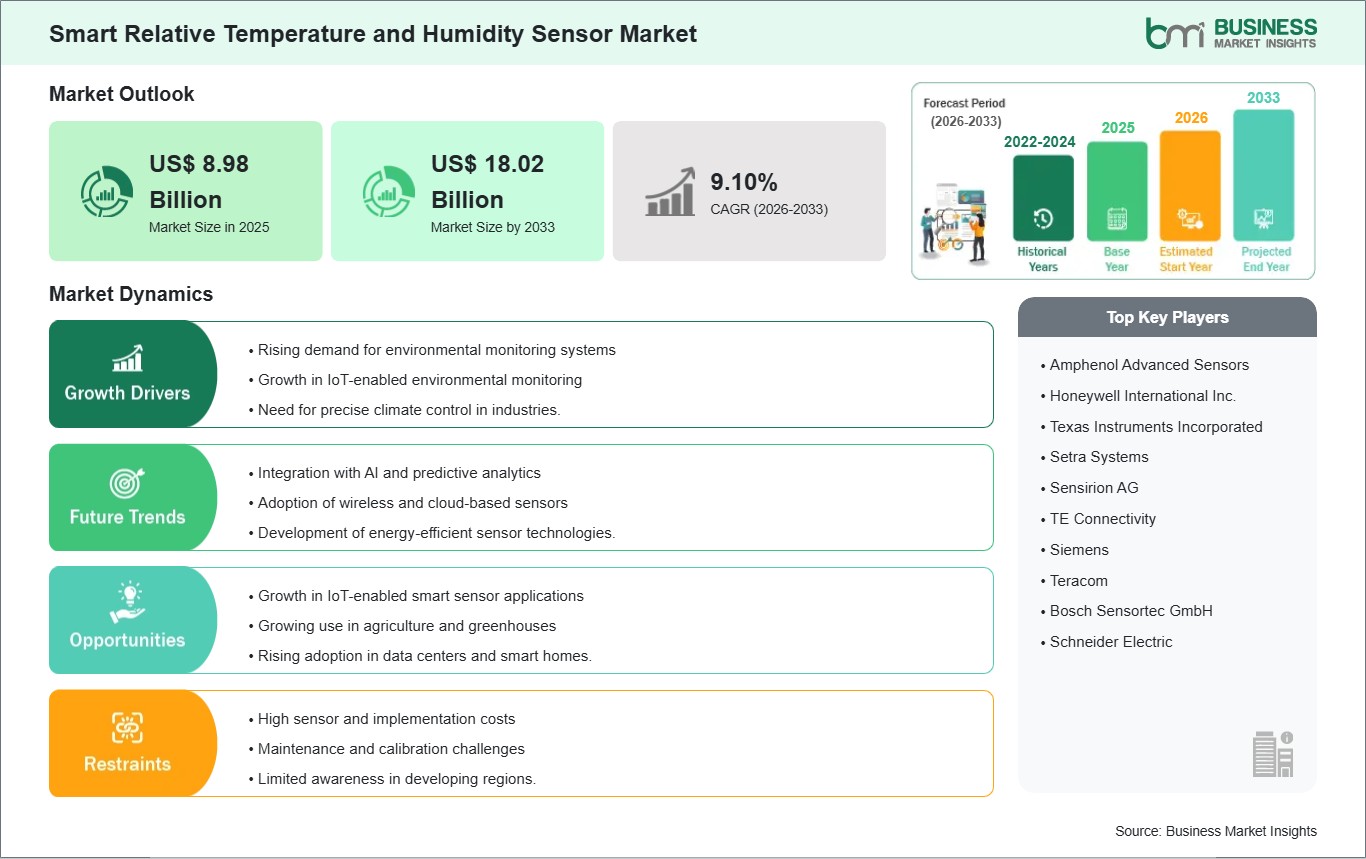
The Smart Relative Temperature and Humidity Sensor Market size is expected to reach US$ 18.02 billion by 2033 from US$ 8.98 billion in 2025. The market is estimated to record a CAGR of 9.10% from 2026 to 2033.
The smart temperature and humidity sensor market is growing due to a rising need for accurate environmental monitoring in industrial, commercial, and consumer settings. Advances in MEMS (Micro-Electro-Mechanical Systems) and IoT-enabled sensors are improving accuracy, energy use, and real-time data reporting. This helps businesses boost efficiency and maintain high-quality standards. Key factors include the growth of smart homes, smart buildings, and industrial automation. Climate-sensitive processes like cold chain management, HVAC systems, and pharmaceutical storage rely on dependable sensing technologies. The market is also shaped by increasing awareness of workplace safety and indoor air quality. This has led to the use of integrated sensing solutions for environmental control and compliance.
Companies are focusing on making devices smaller, adding wireless connectivity, and using AI-driven analytics to enhance sensor performance, prolong device lifespan, and allow for predictive maintenance. Competitive strategies focus on standing out with multi-parameter sensing, cloud integration, and designs that can handle extreme conditions. New applications in agriculture, automotive climate control, and wearable health monitoring are opening up fresh opportunities, adding to market diversity. With more regulations focused on energy efficiency and environmental monitoring, the market is set for steady growth driven by technology advances and the urgent need for environmental intelligence in today’s operations.

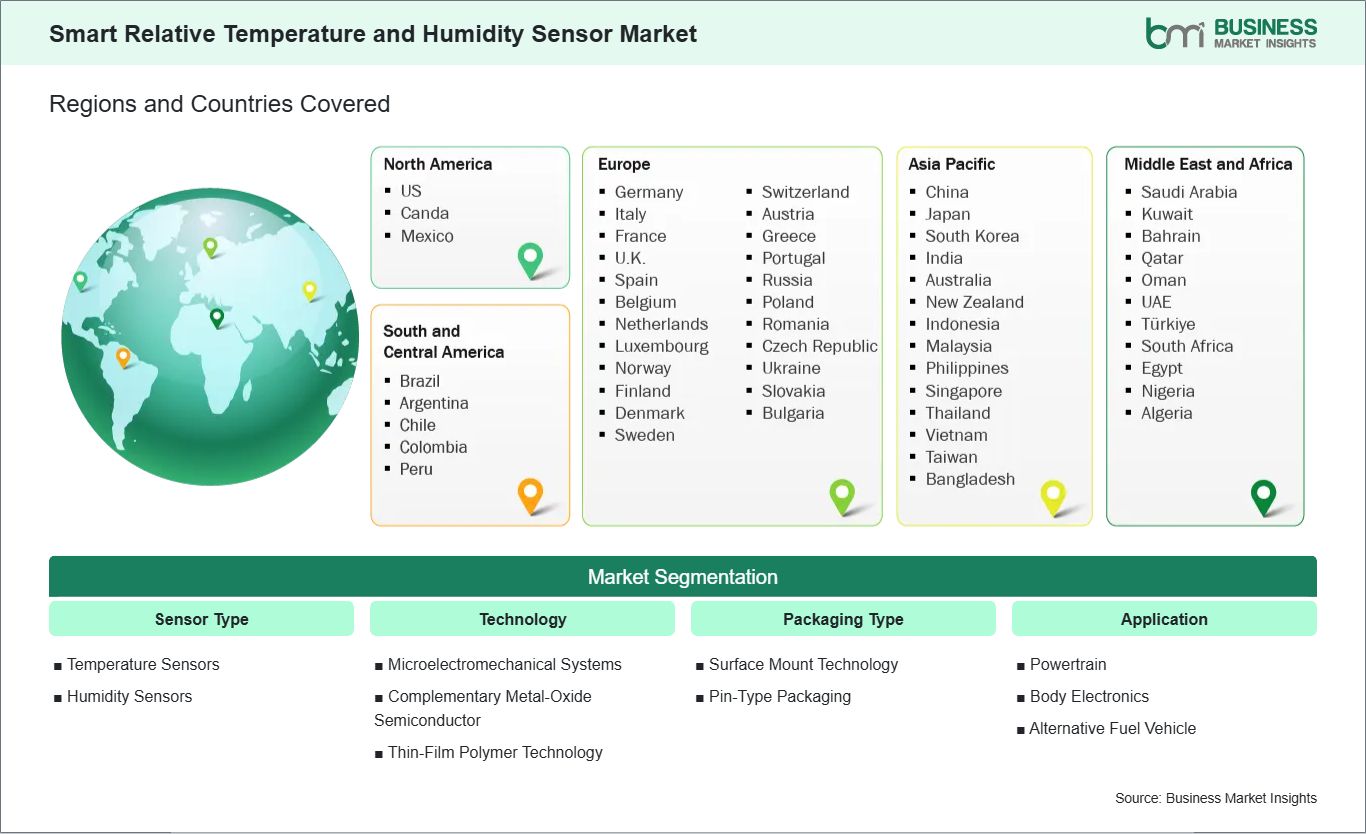
Key segments that contributed to the derivation of the smart relative temperature and humidity sensor market analysis are sensor type, technology, packaging type, and application.
The global market for smart temperature and humidity sensors is growing due to the increasing need for effective environmental monitoring systems across various industries. Organizations want to maintain controlled climates in manufacturing, storage, and processing areas, making accurate sensing solutions essential. These sensors are key to systems that constantly monitor and adjust ambient conditions. They help businesses maintain product quality, reduce waste, and lower operational risks. The global focus on safety and compliance is driving this adoption, particularly in sectors where precise environmental data is crucial. Awareness of environmental impact and regulatory requirements in climate-sensitive areas is also increasing sensor usage worldwide. From optimizing greenhouse conditions to ensuring air quality in public spaces and monitoring climate factors in logistics and cold chain management, temperature and humidity sensors provide vital data for automated control systems.
The ability to integrate sensor feedback into larger energy management platforms encourages organizations to invest in scalable monitoring solutions that support sustainability and efficiency. Technological advancements are improving the effectiveness of environmental monitoring systems that use temperature and humidity sensors. These sensors are becoming more accurate, compact, and energy-efficient, with better response times and longer lifespans. These improvements are leading to wider adoption in both industrial and commercial settings, boosting the global market for reliable and robust environmental sensing technologies.
The expansion of the Internet of Things (IoT) is unlocking vast new opportunities for temperature and humidity sensor technologies, as connected systems increasingly rely on real‑time environmental data. The global proliferation of smart devices, wireless networks, and cloud computing platforms has transformed how temperature and humidity information is collected, analyzed, and acted upon. IoT‑enabled sensors are now key components in smart buildings, automated industrial systems, and consumer gadgets that adjust settings dynamically to improve comfort, safety, and energy efficiency. Integration with IoT ecosystems is driving demand for sensors that offer enhanced connectivity, data analytics compatibility, and remote monitoring capabilities. These features allow businesses and end users to centralize environmental data streams, perform predictive maintenance, and implement automated controls based on actionable insights.
For example, connected sensors in HVAC systems can optimize airflow and temperature in real time, reducing energy consumption while maintaining ideal conditions. Emerging applications such as precision agriculture, smart warehousing, and wearable health monitoring are also benefiting from IoT‑integrated temperature and humidity sensors. As data aggregation and machine learning tools become more accessible, sensor deployments are expanding into areas previously limited by manual monitoring. This technological synergy is creating scalable smart systems that rely on accurate environmental sensing, establishing the global market for IoT‑ready temperature and humidity sensors as one of the fastest growing segments in the broader sensor industry.
The smart relative temperature and humidity sensor market demonstrates steady growth, with size and share analysis highlighting evolving trends and competitive dynamics among key players. The report examines subsegments categorized within sensor type, technology, packaging type, and application, offering insights into their contribution to overall market performance.
By Sensor Type, the temperature sensors subsegment dominated the market in 2025, driven by increasing demand for accurate in-vehicle temperature monitoring.
Based on Technology, the MEMS subsegment dominated the market in 2025, owing to its miniaturization, accuracy, and reliability in automotive applications.
On the Basis of Packaging Type, the surface mount technology (SMT) subsegment dominated the market in 2025, supported by easy integration into electronic control units and automotive boards.
By Application, the powertrain subsegment dominated the market in 2025, propelled by the growing need for optimized engine performance, emissions control, and thermal management.
| Report Attribute | Details |
|---|---|
| Market size in 2025 | US$ 8.98 Billion |
| Market Size by 2033 | US$ 18.02 Billion |
| Global CAGR (2026 - 2033) | 9.10% |
| Historical Data | 2022-2024 |
| Forecast period | 2026-2033 |
| Segments Covered | By Sensor Type
|
|
Regions and Countries Covered
| |
| North America | US, Canada, Mexico |
| Europe | Belgium, Austria, Finland, Denmark, Greece, Poland, Romania, Russia, Ukraine, Czech Republic, Slovakia, Bulgaria, Italy, Luxembourg, Germany, Switzerland, France, Netherlands, Norway, Portugal, Spain, Sweden, United Kingdom |
| Asia-Pacific | Australia, China, India, Japan, South Korea, Indonesia, Malaysia, Philippines, Singapore, Thailand, Vietnam, Bangladesh, New Zealand, Taiwan |
| South and Central America | Brazil, Argentina, Peru, Chile, Colombia |
| Middle East and Africa | Bahrain, Kuwait, Oman, Qatar, Saudi Arabia, United Arab Emirates, Turkiye, South Africa, Egypt, Algeria, Nigeria |
| Market leaders and key company profiles |
|
The "Smart Relative Temperature and Humidity Sensor Market Size and Forecast (2022 - 2033)" report provides a detailed analysis of the market covering below areas:
The geographical scope of the Smart Relative Temperature and Humidity Sensor Market report is divided into North America, Asia Pacific, Europe, Middle East & Africa, and South & Central America. North America held the largest share in 2025.
North America dominates the temperature and humidity sensor market, driven by strong adoption in smart building management, healthcare, aerospace, and industrial automation. The United States focuses on high-precision, connected sensors for applications such as cold chain logistics, laboratory monitoring, and data center climate control. Advanced R&D infrastructure and IoT integration capabilities enable real-time monitoring and predictive analytics across multiple sectors.
Asia Pacific represents a rapidly growing market, with China, Japan, South Korea, and India leading demand due to large-scale industrial production, smart city initiatives, and rising consumer electronics adoption. Government incentives for industrial IoT deployment and environmental monitoring are accelerating the installation of wireless and multi-functional sensors.
Europe emphasizes energy efficiency, sustainability, and regulatory compliance, with Germany, France, and the UK driving adoption in HVAC systems, green buildings, and industrial process monitoring. Sensors are increasingly integrated with building management systems to optimize energy consumption and maintain regulatory standards.
The Middle East and Africa are emerging markets where environmental monitoring for extreme climatic conditions, industrial expansion, and urban development is creating demand for robust and reliable sensor solutions.
South and Central America show moderate growth, particularly in Brazil, Mexico, and Argentina, where agricultural automation, warehouse monitoring, and climate-sensitive manufacturing processes are driving adoption. Local standards and cross-border trade requirements influence sensor specifications and deployment strategies.

The Smart Relative Temperature and Humidity Sensor Market is evaluated by gathering qualitative and quantitative data post primary and secondary research, which includes important corporate publications, association data, and databases. A few of the key developments in the spatial light Modulator market are:
The Smart Relative Temperature and Humidity Sensor Market is valued at US$ 8.98 Billion in 2025, it is projected to reach US$ 18.02 Billion by 2033.
As per our report Smart Relative Temperature and Humidity Sensor Market, the market size is valued at US$ 8.98 Billion in 2025, projecting it to reach US$ 18.02 Billion by 2033. This translates to a CAGR of approximately 9.10% during the forecast period.
The Smart Relative Temperature and Humidity Sensor Market report typically cover these key segments-
The historic period, base year, and forecast period can vary slightly depending on the specific market research report. However, for the Smart Relative Temperature and Humidity Sensor Market report:
The Smart Relative Temperature and Humidity Sensor Market is populated by several key players, each contributing to its growth and innovation. Some of the major players include:
The Smart Relative Temperature and Humidity Sensor Market report is valuable for diverse stakeholders, including:
Essentially, anyone involved in or considering involvement in the Smart Relative Temperature and Humidity Sensor Market value chain can benefit from the information contained in a comprehensive market report.
Please tell us your area of interest
(Market Segments/ Regions and Countries/ Companies)