Market Summary
Executive Summary and Global Market Analysis
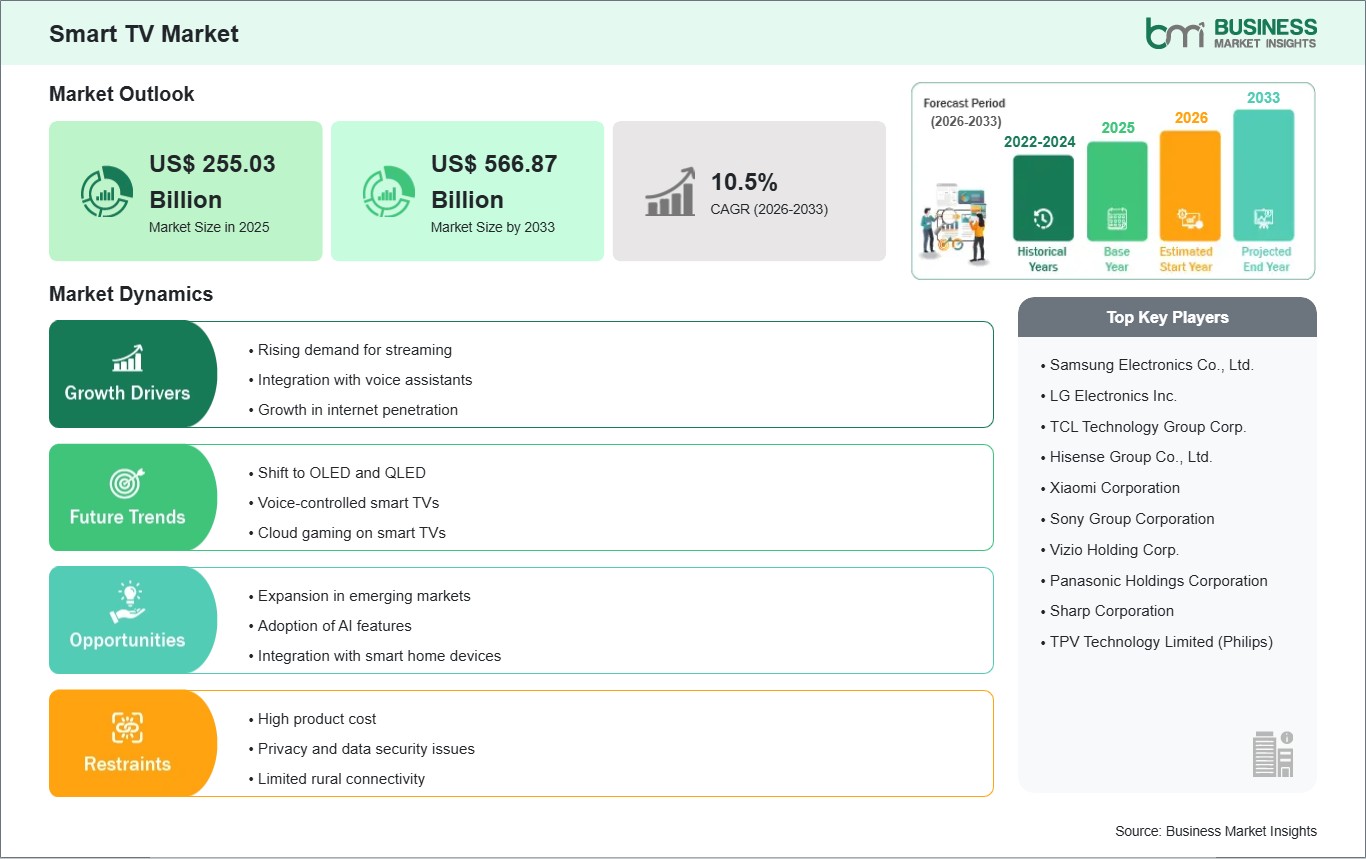
Smart TVs have transformed from simple display units into sophisticated, internet-enabled entertainment hubs that integrate traditional broadcasting with web-based services. They are essential components of the modern connected home, offering seamless access to over-the-top (OTT) platforms, social media, and gaming applications. Smart TVs offer several advantages, including high-definition visual quality (4K and 8K), voice-controlled navigation, and the ability to serve as a central command center for other IoT devices. Increasing high-speed internet penetration, the rising popularity of streaming services, and a significant shift in consumer preference toward immersive home-cinema experiences are fueling the market. Additionally, innovations in display technologies such as OLED, QLED, and Mini-LED, along with AI-powered picture enhancement, are enhancing viewer engagement and device efficiency.
However, several challenges can restrain market growth, such as high costs associated with premium large-screen models, concerns regarding data privacy and security through Automatic Content Recognition (ACR) technology, and the impact of international trade tariffs on critical components like display panels. The industry is also sensitive to consumer spending fluctuations and the rapid obsolescence of hardware. Despite these hurdles, the market holds significant opportunities driven by the expansion of 5G infrastructure, the rising demand for smart home integration, and the growth of the gaming sector, which requires high-refresh-rate displays. Investment in eco-friendly manufacturing and energy-efficient display technologies is also expected to open new avenues for market expansion.
Segment Analysis
Smart TV Market Segmentation
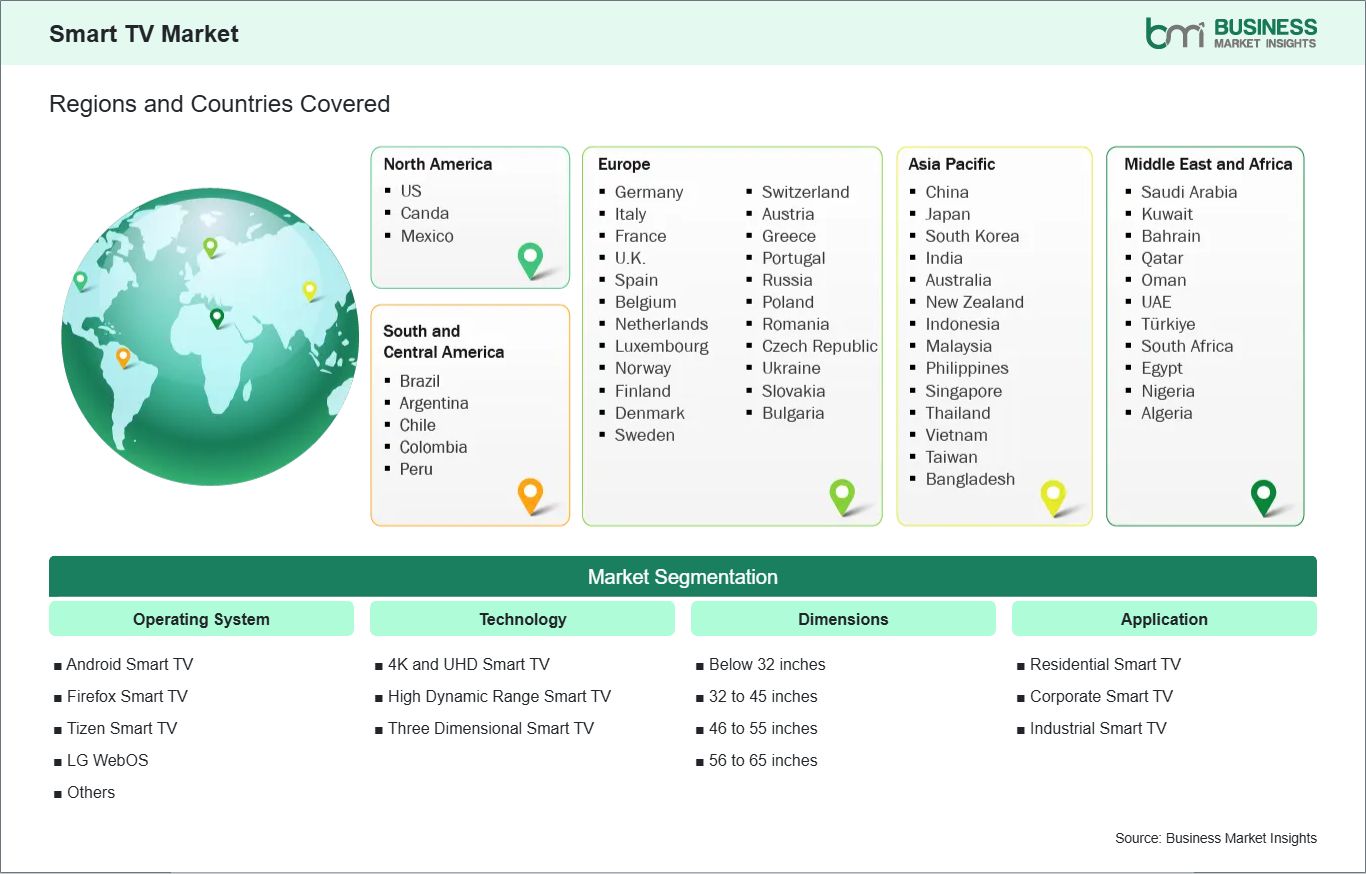
Key segments that contributed to the derivation of the Smart TV market analysis are operating system, technology, dimensions, and application.
- By Operating System, the market is segmented into Android Smart TV, Firefox Smart TV, Tizen Smart TV, LG WebOS, and Others.
- By Technology, the market is segmented into 4K and UHD Smart TV, High Dynamic Range (HDR) Smart TV, and Three Dimensional (3D) Smart TV.
- By Dimensions, the market is segmented into Below 32 inches, 32 to 45 inches, 46 to 55 inches, and 56 to 65 inches.
- By Application, the market is segmented into Residential Smart TV, Corporate Smart TV, and Industrial Smart TV.
Market Forces
Smart TV Market Drivers and Opportunities
Integration of AI and Voice Assistants
The integration of Artificial Intelligence (AI) and voice assistants has emerged as a pivotal factor positively driving the Smart TV market. As consumers seek more intuitive and hands-free ways to interact with their devices, manufacturers are embedding sophisticated AI algorithms that provide personalized content recommendations and voice-activated controls. This transformation makes the Smart TV a central hub for the smart home ecosystem.
For instance, in March 2025, Samsung Electronics America announced the availability of its 2025 Samsung Neo QLED 8K and Samsung Neo QLED 4K TV series. The new lineup offers stunning visuals and immersive sound, and are the first to feature Samsung Vision AI1 with smarter, adaptive features that reimagine what Samsung TVs can do. This advancement allows for real-time picture upscaling and conversational AI capabilities, enabling users to manage smart home tasks and receive tailored entertainment suggestions. According to industry surveys, approximately 89% of consumers now consider voice assistant compatibility a top priority when purchasing smart home products. This robust demand for intelligent interfaces directly supports the growth of the smart TV market, as these features reduce the complexity of content discovery and enhance the overall user experience.
Expansion of 5G and Rural Broadband Initiatives
The 5G infrastructure development and rural broadband initiative taken by governments across the world provides a massive opportunity for the Smart TV market. High-speed, low-latency connectivity is, therefore, the backbone of the smart TV experience, enabling seamless streaming of high-bandwidth 4K and 8K without buffering. As 5G becomes more widely implemented, it finally enables households from the earlier underserved or remote areas to access high-quality digital content, expanding potential customers for manufacturers.
Also, the growth of broadband networks in developing nations like India and Brazil is leading to a shift from cable-based to internet-based television. This will open up avenues for brands to offer entry-level smart TV models with OTT apps to a new set of first-time smart device owners. The capability of streaming 8K content and playing cloud games over 5G networks is likely to push the demand for high-end future-proof television sets, thereby ensuring a growth graph for the industry in the next decade.
Size and Share Analysis
Smart TV Market Size and Share Analysis
The smart TV market demonstrates steady growth, with size and share analysis revealing evolving trends and competitive positioning among key players. The report further examines subsegments categorized within operating system, technology, dimensions, and application, offering insights into their contribution to overall market performance.
For instance, the 46 to 55-inch screen size segment leads the market as consumers increasingly seek larger screens to recreate a cinema-like viewing experience at home. This trend is supported by the declining prices of large-format panels and flexible payment options like EMIs.
Report Coverage
Smart TV Market Report Coverage and Deliverables
The "Smart TV Market Size and Forecast (2022 - 2033)" report provides a detailed analysis of the market covering below areas:
- Smart TV market size and forecast at global, regional, and country levels for all the key market segments covered under the scope.
- Smart TV market trends, as well as market dynamics such as drivers, restraints, and key opportunities.
- Smart TV market analysis covering key market trends, global and regional framework, major players, regulations, and recent market developments.
- Industry landscape and competition analysis covering market concentration, heat map analysis, prominent players, and recent developments for the Smart TV market.
- Detailed company profiles, including SWOT analysis.
Geographic Insights
Smart TV Market Geographic Insights
The geographical scope of the Smart TV market report is divided into five regions: North America, Asia Pacific, Europe, Middle East & Africa, and South & Central America.
The Asia-Pacific Smart TV market is segmented into China, Japan, South Korea, India, Australia, and others. The region is experiencing robust growth, driven by the rapid expansion of the middle class, rising disposable incomes, and the presence of major manufacturing hubs in China and India. The surge in manufacturing activity and the availability of low-cost smart TV models have made these devices highly accessible.
The region is also witnessing increased adoption of advanced features like AI-based content curation and integrated gaming modes, particularly in South Korea and Japan. Strategic investments by regional players and government incentives for electronics manufacturing (such as India's PLI scheme) are further solidifying Asia-Pacific's position as the leading market for smart TVs globally.
Industry Activity
Recent Developments
The smart TV market is evaluated by gathering qualitative and quantitative data post primary and secondary research, which includes important corporate publications, association data, and databases. A few of the key developments in the smart TV market are:
- In December 2025, LG Electronics announced update its webOS smart TV platform to deliver faster, smarter, and more engaging ways to explore news content. With news being one of the most accessed types of content on TVs, LG is dedicated to providing streamlined access to free news channels, podcasts and more through the News Portal and web browser on its convenient webOS platform.
- In January 2025, Samsung Electronics unveiled Samsung Vision AI at the CES 2025 First Look event, delivering personal AI-powered screens to enrich your everyday life. Samsung also unveiled the latest flagship Neo QLED 8K QN990F and exciting updates to its Lifestyle TVs and future display technologies, reflecting Samsung’s vision to transform screens into adaptive, intelligent companions to simplify and enrich everyday living.
Trust & Transparency
Research Methodology
The market analysis combines proprietary research with secondary data from government agencies, company disclosures, regulatory filings, industry databases and expert interviews. Market estimates are validated through data triangulation, cross-market benchmarking and analyst
review.
View Full Research Methodology
Key Sources Referred:
World Bank - Global Trade IndicatorsWorld Trade Organization (WTO)International Monetary Fund (IMF)International Trade Administration (ITA)Company WebsitesCompany Annual ReportsCompany Investor Presentations