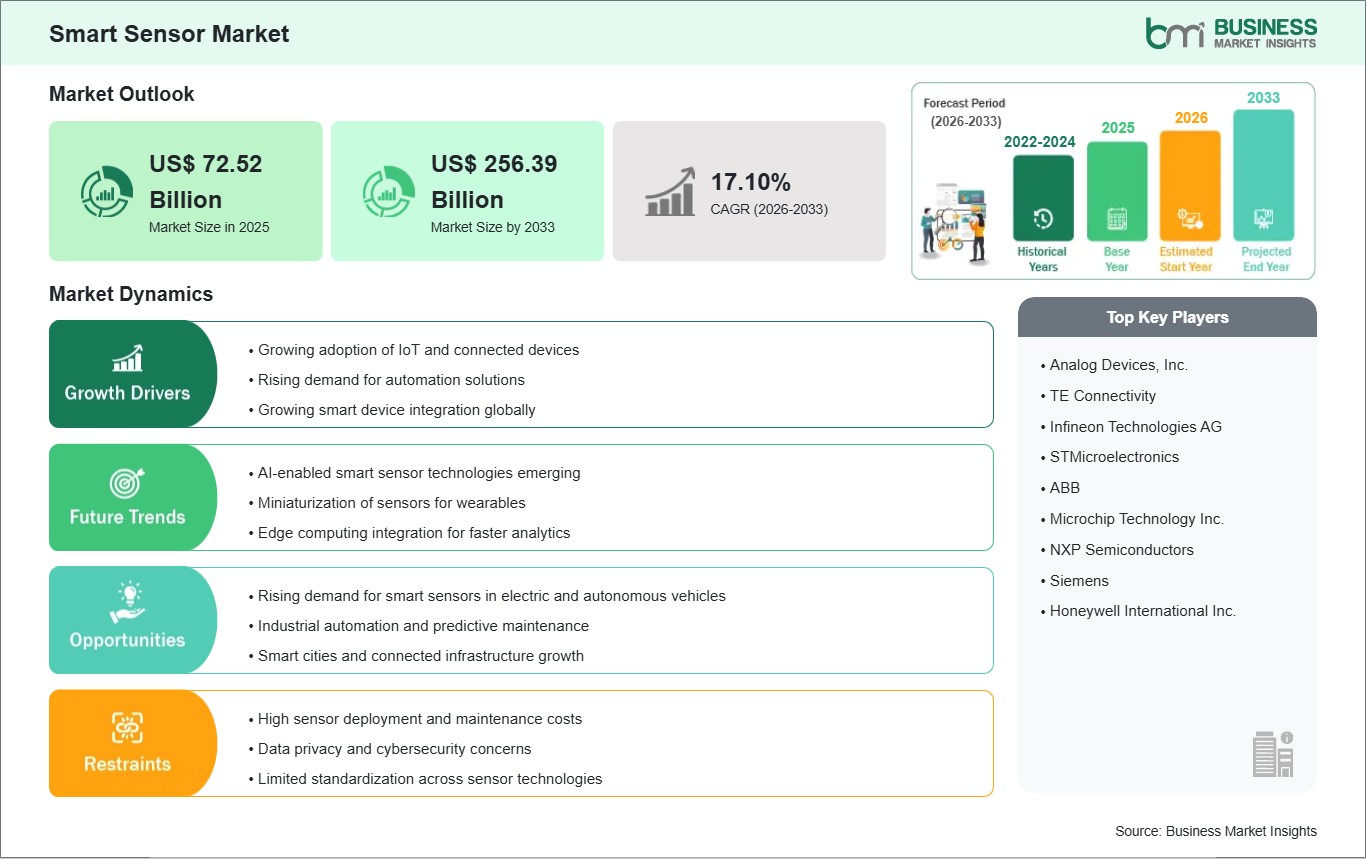
The Smart Sensor Market size is expected to reach US$ 256.39 billion by 2033 from US$ 72.52 billion in 2025. The market is estimated to record a CAGR of 17.10% from 2026 to 2033.
As more industries use intelligent sensing technologies to support automated and data-driven operations, the smart sensor market is growing steadily. By combining sensing components with embedded processing units and communication interfaces, smart sensors allow devices to collect, process, and send data without heavily depending on external processing systems. Organizations can maintain ongoing monitoring across complex environments, increase operational visibility, and improve decision-making efficiency thanks to this functionality. Smart sensing solutions are increasingly being used in industries like consumer electronics, manufacturing, automotive, energy, and healthcare to improve operational control and system performance. The expansion of smart sensor technologies has been made possible by the increasing use of industrial automation and connected infrastructure. These sensors are used in industrial settings to track variables like temperature, pressure, motion, and vibration in order to spot possible equipment problems and maximize machine efficiency.
Furthermore, real-time data processing is made possible by the incorporation of edge computing capabilities into sensor architectures, which lowers latency and speeds up operational responses. Microelectromechanical systems (MEMS) technology advancements have also made it possible for manufacturers to incorporate sensing capabilities into small electronic devices by improving sensor durability, accuracy, and miniaturization. Smart sensors are becoming crucial parts of contemporary digital infrastructure as businesses continue to prioritize efficiency, automation, and intelligent monitoring systems.

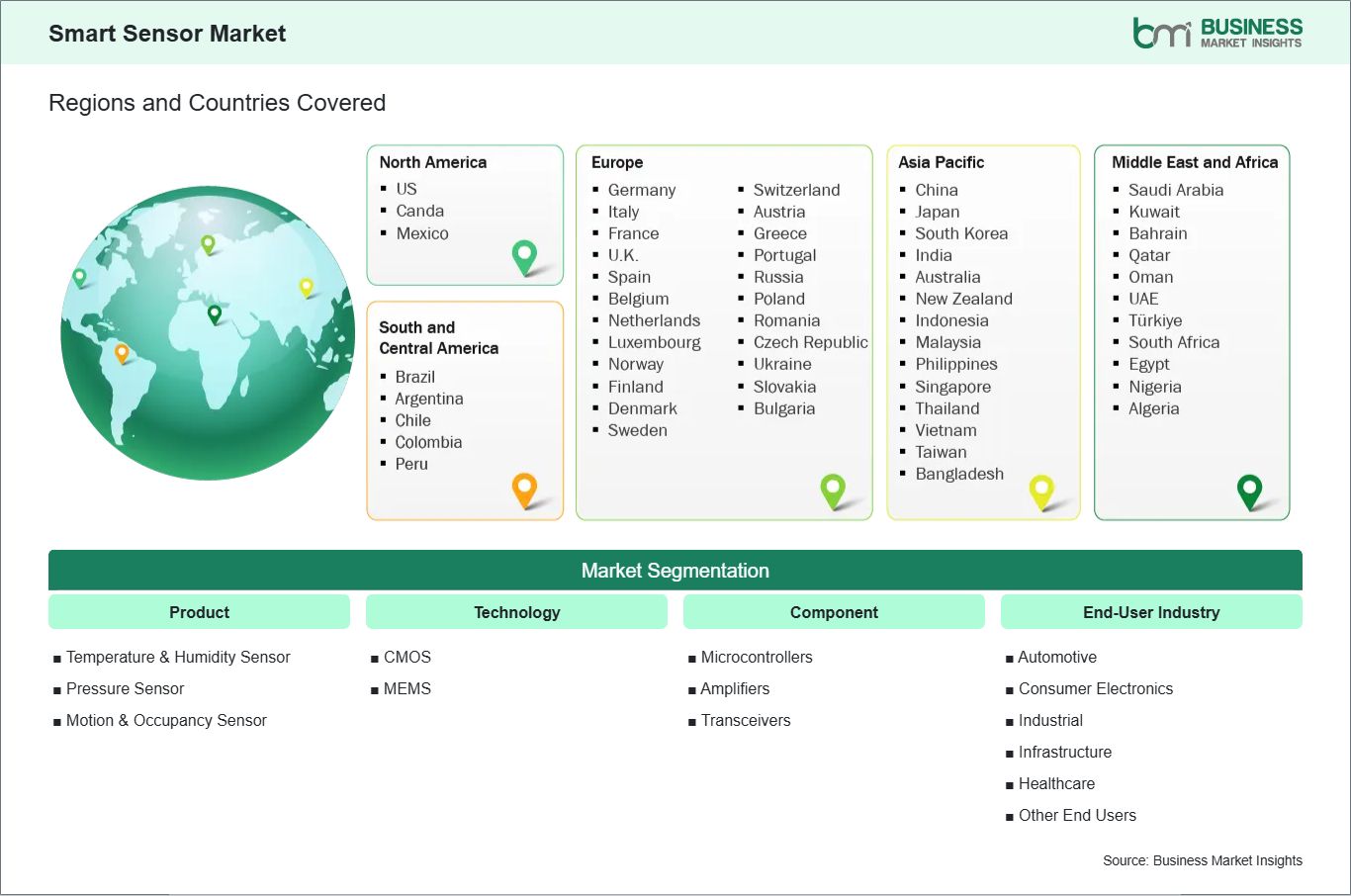
Key segments that contributed to the derivation of the smart sensor market analysis are product, technology, component, end-user industry.
The global smart sensor market is witnessing significant expansion as IoT and connected devices become increasingly prevalent across industries. These sensors provide real-time insights, enable predictive maintenance, and drive automation in sectors such as manufacturing, healthcare, logistics, and smart infrastructure. Rising demand for wearable devices, smart homes, and industrial IoT solutions is accelerating adoption. Advances in miniaturization, energy efficiency, and wireless communication are enhancing sensor capabilities and integration. Continuous innovation, particularly in AI-enabled and multi-functional sensors, is fueling deployment, supporting a globally interconnected ecosystem of devices, and strengthening the foundation for the next wave of digital transformation.
Smart sensors are playing an increasingly critical role in electric and autonomous vehicles, enabling enhanced safety, efficiency, and overall vehicle performance. Technologies such as lidar, radar, imaging, temperature, and battery management sensors support advanced driver assistance systems, autonomous navigation, and vehicle-to-everything (V2X) communication. The global push toward sustainable mobility and vehicle electrification is driving widespread sensor integration. Improvements in accuracy, durability, and AI-driven data processing are boosting system reliability. Investment from OEMs and technology providers, along with strategic collaborations, is accelerating adoption, positioning smart sensors as essential components in the evolving landscape of next-generation mobility.
The Smart Sensor Market demonstrates steady growth, with size and share analysis highlighting evolving trends and competitive dynamics among key players. The report examines subsegments categorized within product, technology, component and end-user offering insights into their contribution to overall market performance.
Product, the pressure sensors sub segment dominated the market in 2025, driven by their extensive use in industrial automation, automotive, and healthcare applications for monitoring and controlling physical parameters.
Based on technology, the MEMS sub segment dominated the market in 2025, driven by their compact size, low power consumption, and high integration capability, making them ideal for IoT and consumer electronics.
Based on component, the microcontrollers sub segment dominated the market in 2025, driven by their essential role in processing sensor data, enabling smart devices to perform real-time computations and control functions.
In terms of end-user, the Industrial sub segment dominated the market in 2025, driven by the growing adoption of automation, predictive maintenance, and smart manufacturing technologies across factories and industrial processes.
| Report Attribute | Details |
|---|---|
| Market size in 2025 | US$ 72.52 Billion |
| Market Size by 2033 | US$ 256.39 Billion |
| Global CAGR (2026 - 2033) | 17.10% |
| Historical Data | 2022-2024 |
| Forecast period | 2026-2033 |
| Segments Covered | By Product
|
|
Regions and Countries Covered
| |
| North America | US, Canada, Mexico |
| Europe | Belgium, Austria, Finland, Denmark, Greece, Poland, Romania, Russia, Ukraine, Czech Republic, Slovakia, Bulgaria, Italy, Luxembourg, Germany, Switzerland, France, Netherlands, Norway, Portugal, Spain, Sweden, United Kingdom |
| Asia-Pacific | Australia, China, India, Japan, South Korea, Indonesia, Malaysia, Philippines, Singapore, Thailand, Vietnam, Bangladesh, New Zealand, Taiwan |
| South and Central America | Brazil, Argentina, Peru, Chile, Colombia |
| Middle East and Africa | Bahrain, Kuwait, Oman, Qatar, Saudi Arabia, United Arab Emirates, Turkiye, South Africa, Egypt, Algeria, Nigeria |
| Market leaders and key company profiles |
|
The "Smart Sensor Market Size and Forecast (2022 - 2033)" report provides a detailed analysis of the market covering below areas:
The geographical scope of the Smart Sensor Market report is divided into North America, Asia Pacific, Europe, Middle East & Africa, and South & Central America. North America held the largest share in 2025.
North America leads the smart sensor market, driven by its advanced technological infrastructure, widespread industrial automation, and the presence of major semiconductor and electronics companies. Key sectors, including aerospace, automotive, healthcare, and advanced manufacturing, are increasingly leveraging smart sensors to enhance operational efficiency, enable predictive maintenance, and foster innovation. Robust investments in research and development, particularly in artificial intelligence, robotics, and connected device networks, further strengthen the region’s dominance. The growing deployment of smart homes, wearable health devices, and intelligent transportation systems continues to fuel demand across the United States and Canada.
Europe is a mature market with strong emphasis on industrial automation and sustainability-driven initiatives. Countries across the region are integrating smart sensors into manufacturing processes, energy management solutions, and environmental monitoring systems. The adoption of Industry 4.0 and digital manufacturing platforms is accelerating the use of intelligent sensing solutions in production and operational management.
Asia Pacific is expanding rapidly due to rising industrial automation, electronics manufacturing, and the proliferation of connected consumer devices. Nations such as China, Japan, South Korea, and India are driving sensor adoption across automotive manufacturing, smart infrastructure, and consumer electronics sectors.
Middle East and Africa are gradually embracing smart sensor technologies, with applications focused on energy management, urban infrastructure monitoring, and smart city initiatives.
South and Central America are steadily increasing adoption in industrial monitoring, agriculture technology, and transportation infrastructure projects, reflecting growing investment in modernization and efficiency improvements.

The Smart Sensor Market is evaluated by gathering qualitative and quantitative data post primary and secondary research, which includes important corporate publications, association data, and databases. A few of the key developments in the smart sensor market are:
The Smart Sensor Market is valued at US$ 72.52 Billion in 2025, it is projected to reach US$ 256.39 Billion by 2033.
As per our report Smart Sensor Market, the market size is valued at US$ 72.52 Billion in 2025, projecting it to reach US$ 256.39 Billion by 2033. This translates to a CAGR of approximately 17.10% during the forecast period.
The Smart Sensor Market report typically cover these key segments-
The historic period, base year, and forecast period can vary slightly depending on the specific market research report. However, for the Smart Sensor Market report:
The Smart Sensor Market is populated by several key players, each contributing to its growth and innovation. Some of the major players include:
The Smart Sensor Market report is valuable for diverse stakeholders, including:
Essentially, anyone involved in or considering involvement in the Smart Sensor Market value chain can benefit from the information contained in a comprehensive market report.
Please tell us your area of interest
(Market Segments/ Regions and Countries/ Companies)