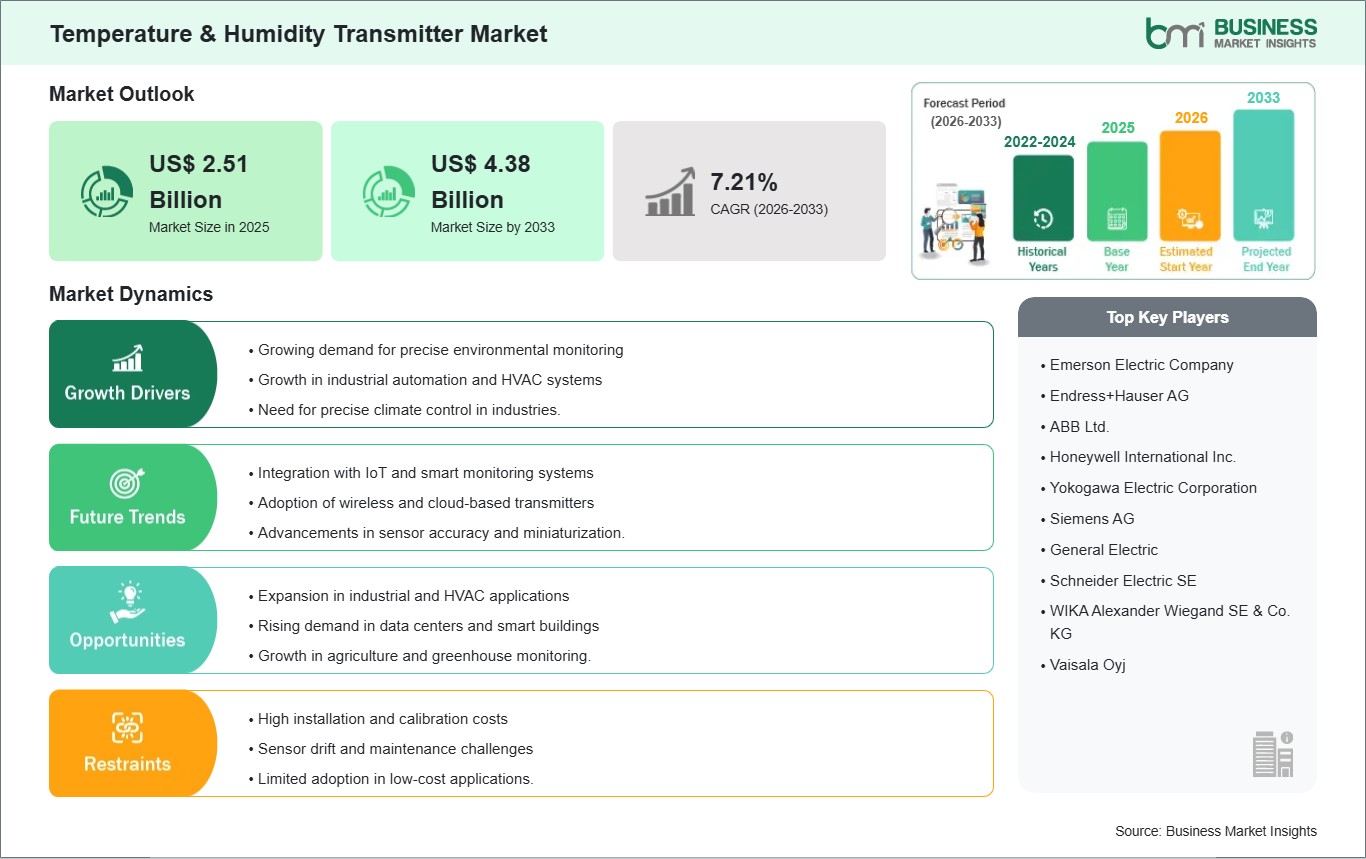
The Temperature & Humidity Transmitter Market size is expected to reach US$ 4.38 billion by 2033 from US$ 2.51 billion in 2025. The market is estimated to record a CAGR of 7.21% from 2026 to 2033.
The global temperature and humidity transmitter market is advancing as industries increasingly prioritize environmental control, process optimization, and energy efficiency. These transmitters enable precise temperature and humidity measurement, which they provide continuously throughout various applications that include HVAC systems and pharmaceuticals, food storage, laboratories and industrial manufacturing operations. The accuracy, stability, and response time of sensor technology innovations have improved through the development of microelectromechanical systems MEMS and digital signal processing technologies. Modern transmitters include wireless connectivity, IoT integration and building automation system compatibility, which enable users to operate centralized monitoring and data-driven operational adjustments.
The market is also witnessing the adoption of multi-sensor platforms, which can monitor additional parameters that include dew point and enthalpy to enable users to achieve complete climate control and energy optimization. The development of calibration-free and low-power designs enables use in remote or mobile sites while decreasing the need for ongoing maintenance. Long-term sensor reliability, electromagnetic interference reduction and legacy control system interoperability maintenance represent key challenges that developers need to address. The market today experiences rising demand for precision environmental monitoring and smart building integration and operational efficiency, which makes temperature and humidity transmitters vital for product quality maintenance, occupant comfort and regulatory compliance across various industrial and commercial applications.

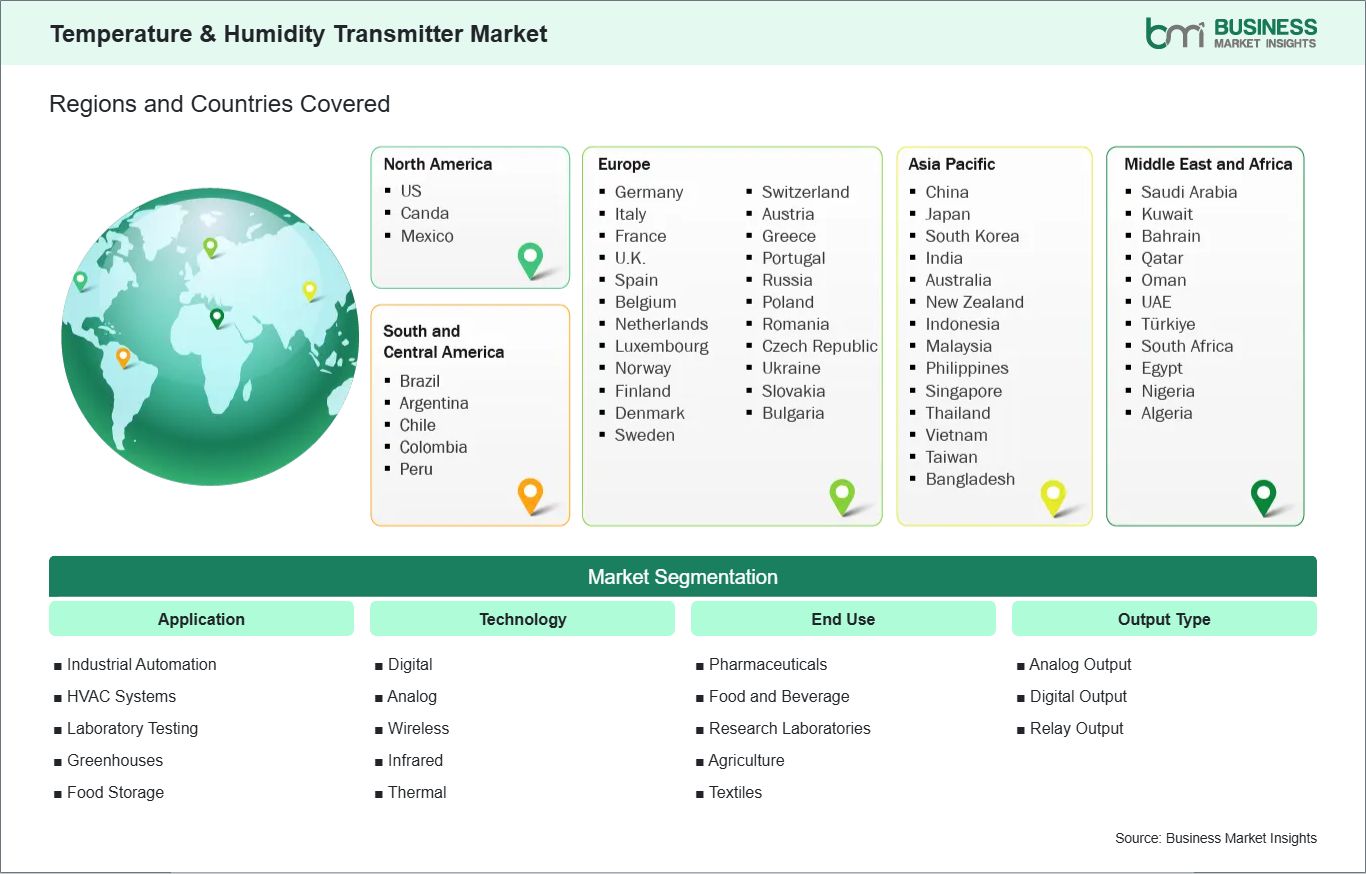
Key segments that contributed to the derivation of the temperature and humidity transmitter market analysis are application, technology, end use, and output type.
The global temperature and humidity transmitter market is being driven by the increasing need for precise environmental monitoring across industries. The facilities of manufacturing plants, laboratories and cleanrooms use these transmitters to establish controlled environments which protect product quality and operational efficiency. The accurate monitoring system prevents process deviations, contamination and equipment failures, which proves essential for operations in sensitive sectors like pharmaceuticals, electronics and food processing. The development of sensor technology and digital integration has improved transmitter systems through enhanced accuracy and reliable performance.
The modern devices provide users with real-time data and wireless connectivity, and IoT platform compatibility, which enables continuous monitoring and automated deviation alerts. The system reduces the need for manual inspections while it creates practical solutions to sustain optimal environmental conditions. The growing importance of temperature and humidity transmitters has emerged as regulatory standards and industry quality requirements have become more stringent. The global market growth is driven by organizations in different sectors who seek to achieve precise environmental control for safeguarding product integrity and enhancing operational efficiency, and complying with international standards.
Industrial operations function as the primary factor which drives the worldwide temperature and humidity transmitter industry. Transmitters function as tools to track environmental parameters within manufacturing and processing, and storage areas because they enable efficient equipment operation and product quality assessment. Organizations utilize precise climate information to improve their production efficiency while decreasing energy usage and safeguarding their delicate assets. The HVAC sector uses building management systems for transmitter implementation in order to create energy-efficient and comfortable indoor spaces. The system enables automatic climate control through real-time data, which adjusts temperature and humidity settings to boost occupant comfort while decreasing operational expenses.
The market expansion results from the growing number of data centers and warehouses, which contain sensitive technological infrastructure. Reliable temperature and humidity monitoring exists as a fundamental requirement, which allows equipment to function correctly while enabling organizations to use predictive maintenance. The world market for temperature and humidity transmitters experiences strong growth through the combined demand from industrial applications, commercial use and smart building technology.
The Temperature & Humidity Transmitter Market demonstrates steady growth, with size and share analysis highlighting evolving trends and competitive dynamics among key players. The report examines subsegments categorized within application, technology, end use, and output type, offering insights into their contribution to overall market performance.
By Application, the HVAC systems subsegment dominated the market in 2025, driven by the increasing adoption of advanced climate control and indoor air quality monitoring solutions in commercial and residential sectors.
Based on Technology, the digital subsegment dominated the market in 2025, owing to its superior measurement accuracy, enhanced connectivity, and compatibility with smart building and IoT systems.
On the Basis of End Use, the pharmaceuticals subsegment dominated the market in 2025, propelled by stringent regulatory standards requiring precise monitoring of temperature and humidity for drug safety and storage.
In terms of Output Type, the analog output subsegment dominated the market in 2025, due to its proven reliability, simplicity, and broad compatibility with existing industrial systems.
| Report Attribute | Details |
|---|---|
| Market size in 2025 | US$ 2.51 Billion |
| Market Size by 2033 | US$ 4.38 Billion |
| Global CAGR (2026 - 2033) | 7.21% |
| Historical Data | 2022-2024 |
| Forecast period | 2026-2033 |
| Segments Covered | By Application
|
|
Regions and Countries Covered
| |
| North America | US, Canada, Mexico |
| Europe | Belgium, Austria, Finland, Denmark, Greece, Poland, Romania, Russia, Ukraine, Czech Republic, Slovakia, Bulgaria, Italy, Luxembourg, Germany, Switzerland, France, Netherlands, Norway, Portugal, Spain, Sweden, United Kingdom |
| Asia-Pacific | Australia, China, India, Japan, South Korea, Indonesia, Malaysia, Philippines, Singapore, Thailand, Vietnam, Bangladesh, New Zealand, Taiwan |
| South and Central America | Brazil, Argentina, Peru, Chile, Colombia |
| Middle East and Africa | Bahrain, Kuwait, Oman, Qatar, Saudi Arabia, United Arab Emirates, Turkiye, South Africa, Egypt, Algeria, Nigeria |
| Market leaders and key company profiles |
|
The "Temperature & Humidity Transmitter Market Size and Forecast (2022 - 2033)" report provides a detailed analysis of the market covering below areas:
The geographical scope of the Temperature & Humidity Transmitter Market report is divided into North America, Asia Pacific, Europe, Middle East & Africa, and South & Central America. North America held the largest share in 2025.
Regional trends in the temperature and humidity transmitter market reflect differences in industrial infrastructure, climate management requirements, and regulatory frameworks. North America demonstrates strong adoption in commercial and industrial facilities, emphasizing smart building integration, energy management, and regulatory compliance in healthcare and laboratory environments.
Europe prioritizes sustainability and precision monitoring, particularly in HVAC, food storage, and industrial automation applications, leveraging multi-parameter transmitters to optimize energy consumption while maintaining environmental standards.
Asia Pacific is experiencing rapid growth due to expanding industrial production, urbanization, and investments in automated facilities and smart buildings; wireless and IoT-enabled transmitters are increasingly deployed to enable real-time monitoring in manufacturing plants, data centers, and cold storage facilities.
Middle East & Africa shows growing demand in harsh environments such as oil and gas facilities, industrial plants, and climate-controlled storage, where durable, low-maintenance devices are essential for continuous operation.
South & Central America is gradually adopting temperature and humidity transmitters in food processing, pharmaceuticals, and commercial building management, focusing on cost-effective and reliable devices to ensure compliance and quality control. Across regions, factors such as environmental conditions, energy efficiency priorities, and technological infrastructure shape deployment strategies, highlighting the role of transmitters in improving operational efficiency, safety, and compliance in diverse applications.

The Temperature & Humidity Transmitter Market is evaluated by gathering qualitative and quantitative data post primary and secondary research, which includes important corporate publications, association data, and databases. A few of the key developments in the spatial light Modulator market are:
The Temperature & Humidity Transmitter Market is valued at US$ 2.51 Billion in 2025, it is projected to reach US$ 4.38 Billion by 2033.
As per our report Temperature & Humidity Transmitter Market, the market size is valued at US$ 2.51 Billion in 2025, projecting it to reach US$ 4.38 Billion by 2033. This translates to a CAGR of approximately 7.21% during the forecast period.
The Temperature & Humidity Transmitter Market report typically cover these key segments-
The historic period, base year, and forecast period can vary slightly depending on the specific market research report. However, for the Temperature & Humidity Transmitter Market report:
The Temperature & Humidity Transmitter Market is populated by several key players, each contributing to its growth and innovation. Some of the major players include:
The Temperature & Humidity Transmitter Market report is valuable for diverse stakeholders, including:
Essentially, anyone involved in or considering involvement in the Temperature & Humidity Transmitter Market value chain can benefit from the information contained in a comprehensive market report.
Please tell us your area of interest
(Market Segments/ Regions and Countries/ Companies)