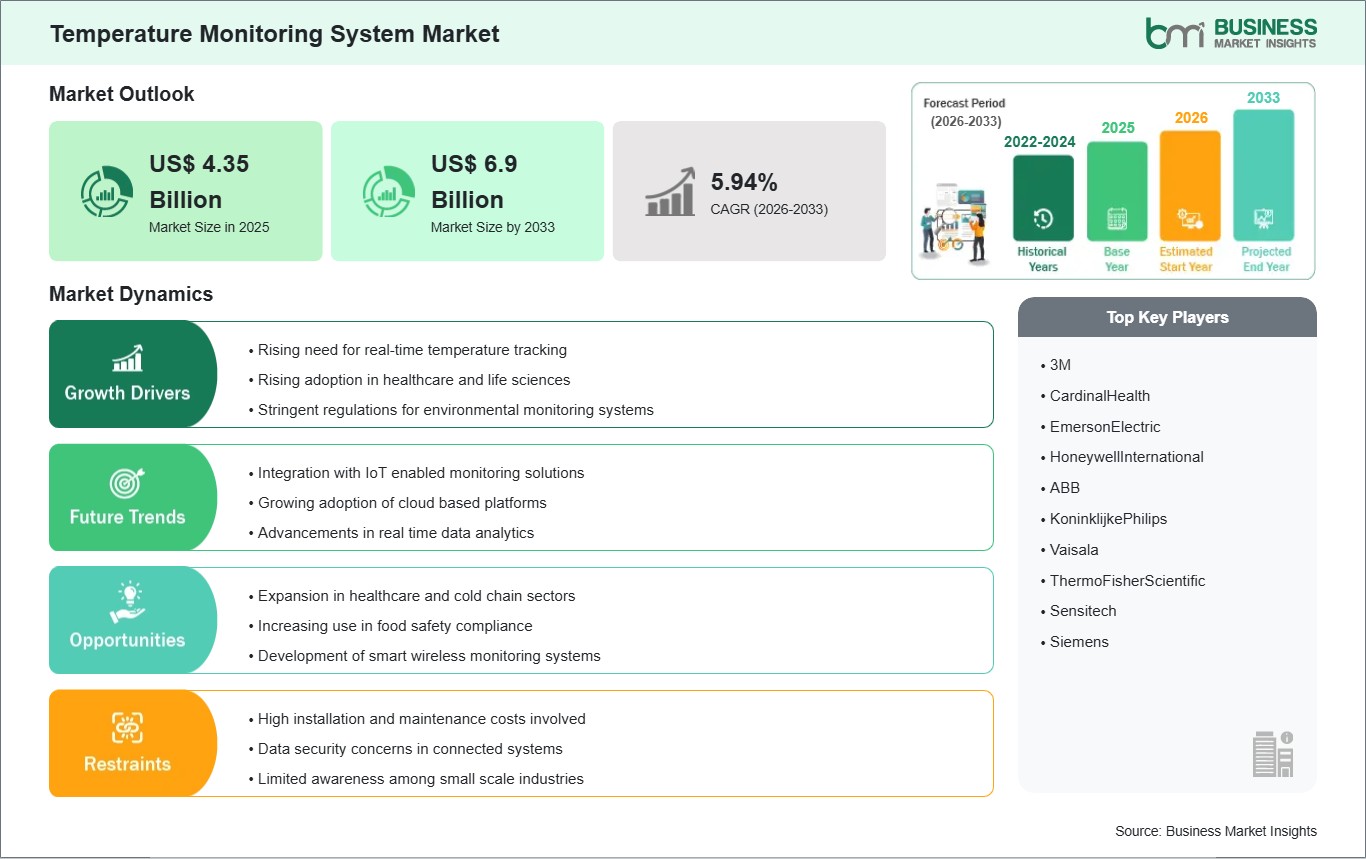
The Temperature Monitoring System Market size is expected to reach US$ 6.9 billion by 2033 from US$ 4.35 billion in 2025. The market is estimated to record a CAGR of 5.94% from 2026 to 2033.
Temperature monitoring systems for the global market are on the rise globally as businesses want to have safer workplace conditions and produce better quality products than ever before. There are numerous different industries looking to improve their temperature monitoring systems and following government and health/safety guidelines that include pharmaceutical, food and beverage, logistics, and chemical companies. With businesses being able to record real-time temperature changes in their facilities, they can now proactively intervene to avoid spoilage, prevent downtime by equipment failure, and avoid safety-related incidents. Some of the technological advancements that have contributed to the growth of the global temperature monitoring market are wireless sensor networks, remote data storage, and the ever-increasing growth of IoT-based solutions that allow users to have scalable solutions that match their individual needs.
Many of today’s temperature monitoring systems also provide a long history of collected temperature data, and many are designed to interface with analytical software applications to create predictive reports, perform trend analyses, and automate notifications to help organizations become more efficient, waste less, and achieve compliance with various regulations such as Good Distribution Practice and ISO certification. In addition, the use of portable designs and reduced size and power consumption of many of today’s products will help to expand the acceptance of temperature monitoring solutions in part due to the wide variety of locations where these solutions can be found, such as transportation, cold storage, and remote locations. Multi-zone, multi-parameter temperature monitoring systems are becoming a more common solution for organizations that want to monitor multiple temperature zones or assets at the same time.
Nevertheless, establishing secure data, properly calibrating sensors, and integrating temperature monitoring technology with existing systems will continue to take considerable time and cost. In summary, what drives the future direction of the temperature monitoring systems market is the continued growth of automation, the digitalization of processes within all types of industries, and the commitment to environmental sustainability, which will increase the importance of temperature monitoring systems in maintaining operational continuity, minimizing business losses, and making decisions that rely on data-driven information.

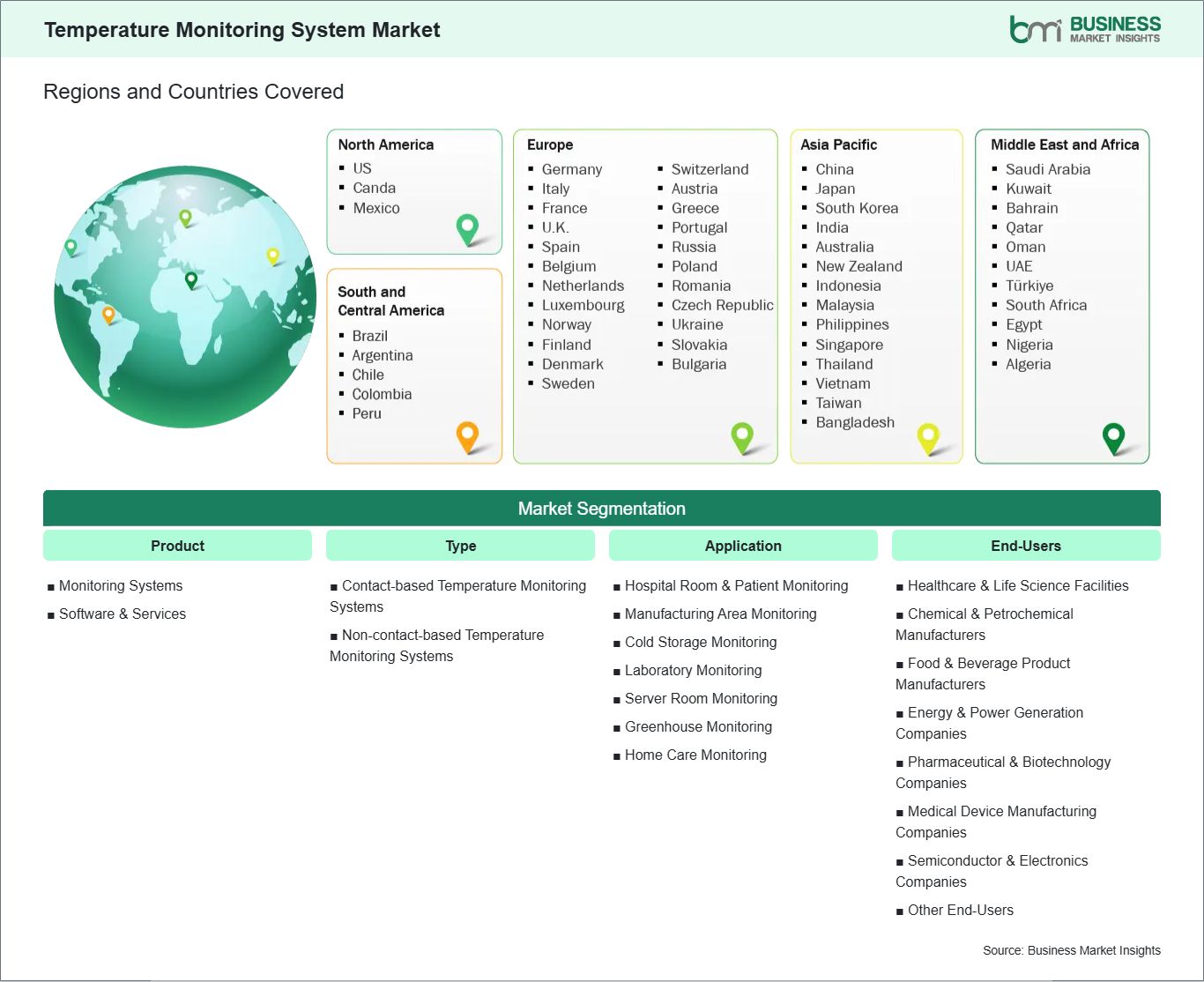
Key segments that contributed to the derivation of the temperature monitoring system market analysis are product, type, application, and end‑users.
The increasing demand for real-time temperature measurement is leading to growth in the global temperature & humidity transmitter market in all industries. Continuous monitoring of product quality to ensure operational efficiency, product safety and compliance with industry standards is required in all sectors, including manufacturing, logistics, laboratories and storage. Accurate measurement of internal and external temperature/humidity is essential to reduce spoilage, damage to equipment or deviations from process, allowing for compliance with the standards required within the industry, thereby decreasing operational loss. Technological advancements in sensor technology, wireless communications and the Internet of Things (IoT) have improved the ability to collect and transmit temperature and relative humidity data instantly.
In addition, the use of automated alerts or dashboards will allow organizations to monitor for deviations from normal ranges/modes, enabling immediate action to be taken, thus reducing the need for manual inspections of equipment. With increased adoption of digital transformation and increasingly stringent quality controls, real-time monitoring has now become an absolutely necessary requirement in all areas of business. Continuous real-time environmental monitoring contributes to better decision making, decreased risk to the organization and supports the protection of sensitive products by providing the needed components for successful temperature/humidity transmitter operations throughout the global industrial and commercial environment.
The global market is also expanding due to growing applications in healthcare and cold chain sectors. Temperature-sensitive products such as vaccines, biologics, pharmaceuticals, and perishable foods require strict environmental control during storage and transport. Monitoring systems ensure consistent conditions, prevent spoilage, and maintain product efficacy throughout the supply chain. Cold chain logistics and medical storage increasingly rely on automated transmitters integrated with cloud platforms, enabling remote tracking, predictive alerts, and compliance reporting. Real-time monitoring supports decision-making, ensures safety, and enhances operational efficiency in healthcare and food distribution networks.
Additionally, expanding global vaccination programs, medical storage requirements, and perishable goods distribution are boosting the need for reliable monitoring solutions. The combination of healthcare demand, stringent regulations, and growing cold chain networks continues to drive the adoption of temperature and humidity transmitters worldwide.
The Temperature Monitoring System Market demonstrates steady growth, with size and share analysis highlighting evolving trends and competitive dynamics among key players. The report examines subsegments categorized within product, type, application, and end‑users, offering insights into their contribution to overall market performance.
By Product, the monitoring systems subsegment dominated the market in 2025, driven by widespread deployment of temperature sensors and systems for continuous tracking across healthcare, industrial, and cold‑chain environments.
Based on Type, the contact‑based temperature monitoring systems subsegment dominated the market in 2025, owing to its precision, regulatory acceptance, and ease of integration with existing processes in pharmaceutical and laboratory settings.
On the Basis of Application, the cold storage monitoring subsegment dominated the market in 2025, propelled by stringent requirements for maintaining temperature‑controlled storage for vaccines, drugs, and perishable food products.
In terms of End‑Users, the healthcare & life science facilities subsegment dominated the market in 2025, driven by the increasing adoption of temperature monitoring for patient care, compliance with medical regulations, and expansion of healthcare infrastructure worldwide.
| Report Attribute | Details |
|---|---|
| Market size in 2025 | US$ 4.35 Billion |
| Market Size by 2033 | US$ 6.9 Billion |
| Global CAGR (2026 - 2033) | 5.94% |
| Historical Data | 2022-2024 |
| Forecast period | 2026-2033 |
| Segments Covered | By Product
|
|
Regions and Countries Covered
| |
| North America | US, Canada, Mexico |
| Europe | Belgium, Austria, Finland, Denmark, Greece, Poland, Romania, Russia, Ukraine, Czech Republic, Slovakia, Bulgaria, Italy, Luxembourg, Germany, Switzerland, France, Netherlands, Norway, Portugal, Spain, Sweden, United Kingdom |
| Asia-Pacific | Australia, China, India, Japan, South Korea, Indonesia, Malaysia, Philippines, Singapore, Thailand, Vietnam, Bangladesh, New Zealand, Taiwan |
| South and Central America | Brazil, Argentina, Peru, Chile, Colombia |
| Middle East and Africa | Bahrain, Kuwait, Oman, Qatar, Saudi Arabia, United Arab Emirates, Turkiye, South Africa, Egypt, Algeria, Nigeria |
| Market leaders and key company profiles |
|
The "Temperature Monitoring System Market Size and Forecast (2022 - 2033)" report provides a detailed analysis of the market covering below areas:
The geographical scope of the Temperature Monitoring System Market report is divided into North America, Asia Pacific, Europe, Middle East & Africa, and South & Central America. North America held the largest share in 2025.
Regional adoption of temperature monitoring systems reflects differences in industrial activity, infrastructure maturity, and environmental challenges. North America exhibits strong integration in pharmaceutical production, cold chain logistics, and industrial facilities, with a focus on automated alerts, cloud-based monitoring, and regulatory compliance.
Europe emphasizes energy-efficient solutions and environmental sustainability, particularly in food storage, laboratory, and manufacturing operations, often deploying multi-sensor systems to optimize performance and reduce operational costs.
Asia Pacific is experiencing rapid adoption due to growing manufacturing and logistics sectors, urbanization, and increased digitization; wireless and IoT-enabled temperature monitoring solutions are being integrated across warehouses, distribution centers, and hospitals to ensure real-time visibility.
Middle East & Africa shows growing demand in oil and gas, industrial facilities, and remote storage applications, where robust, low-maintenance systems are critical under extreme environmental conditions.
South & Central America is gradually adopting temperature monitoring solutions in cold chain management, pharmaceuticals, and food processing, prioritizing reliability and cost-effectiveness to maintain product integrity across distributed supply chains.
Across all regions, factors such as regulatory frameworks, operational efficiency goals, and environmental conditions drive system deployment, highlighting temperature monitoring as a strategic tool for ensuring quality, safety, and operational resilience across diverse sectors.

The Temperature Monitoring System Market is evaluated by gathering qualitative and quantitative data post primary and secondary research, which includes important corporate publications, association data, and databases. A few of the key developments in the spatial light Modulator market are:
The Temperature Monitoring System Market is valued at US$ 4.35 Billion in 2025, it is projected to reach US$ 6.9 Billion by 2033.
As per our report Temperature Monitoring System Market, the market size is valued at US$ 4.35 Billion in 2025, projecting it to reach US$ 6.9 Billion by 2033. This translates to a CAGR of approximately 5.94% during the forecast period.
The Temperature Monitoring System Market report typically cover these key segments-
The historic period, base year, and forecast period can vary slightly depending on the specific market research report. However, for the Temperature Monitoring System Market report:
The Temperature Monitoring System Market is populated by several key players, each contributing to its growth and innovation. Some of the major players include:
The Temperature Monitoring System Market report is valuable for diverse stakeholders, including:
Essentially, anyone involved in or considering involvement in the Temperature Monitoring System Market value chain can benefit from the information contained in a comprehensive market report.
Please tell us your area of interest
(Market Segments/ Regions and Countries/ Companies)