Market Summary
Executive Summary and Global Market Analysis
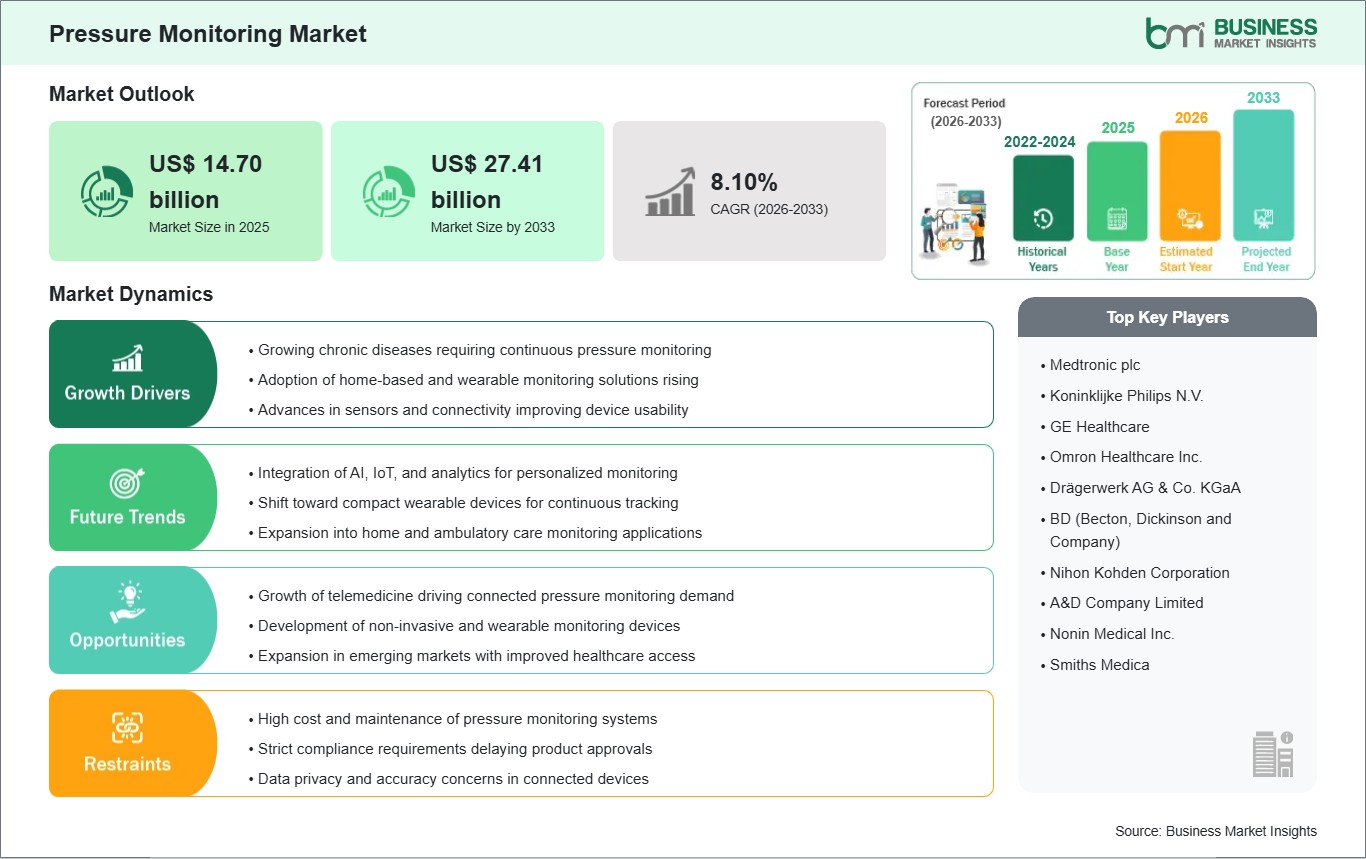
Pressure monitoring refers to a specialized category of diagnostic and therapeutic technologies designed to measure and track pressure levels within biological systems or industrial environments. Market expansion is fundamentally driven by the rising global prevalence of chronic conditions, particularly hypertension, cardiovascular diseases, and respiratory disorders, which necessitate regular and accurate pressure measurement. Furthermore, the shift toward remote patient monitoring (RPM) and the integration of telehealth services are accelerating the adoption of connected, digital monitoring solutions. The global aging population, characterized by a higher susceptibility to pressure-related ailments, continues to serve as a primary catalyst for sustained demand.
However, several factors can restrain market growth. The high cost of advanced, clinically validated systems, such as implantable or smart-sensor-enabled monitors, remains a barrier for healthcare facilities in emerging economies. Stringent regulatory and certification processes for new medical devices often extend development timelines and increase capital requirements. Additionally, the industry faces constraints due to accuracy concerns with consumer-grade wearable devices, which can occasionally lead to data discrepancies and reduced clinician confidence in non-clinical monitoring environments.
Despite these hurdles, the market holds significant opportunities in the miniaturization of sensors and the development of cuffless wearable technologies. The rise of artificial intelligence (AI) and machine learning (ML) for predictive analytics, enabling the identification of pressure fluctuations before they lead to acute events, and the expansion of personalized hypertension management programs are expected to support long-term development within the sector.
Segment Analysis
Pressure Monitoring Market Segmentation
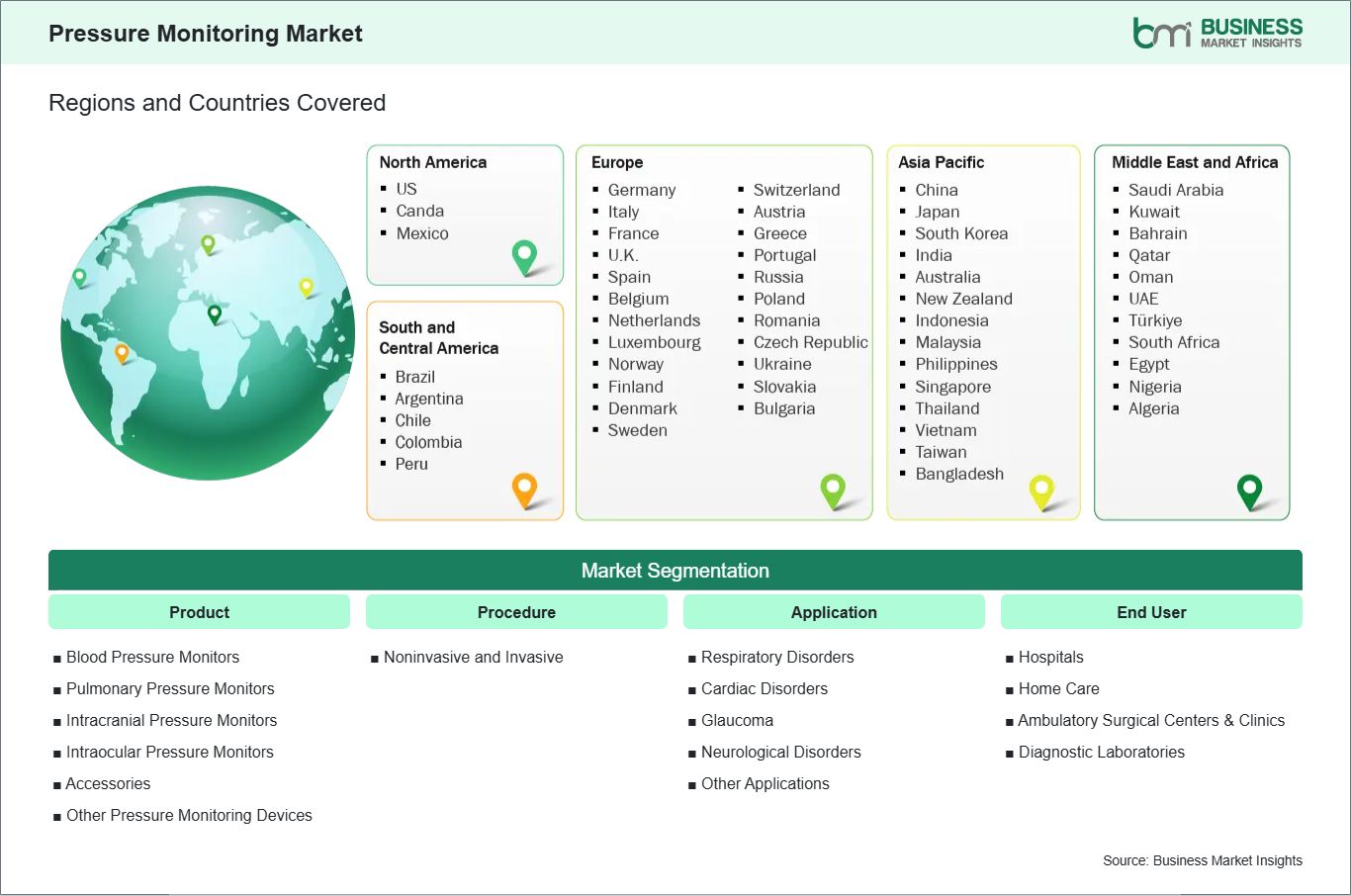
Key segments that contributed to the derivation of the Pressure Monitoring market analysis are product, procedure, application, and end user.
- By Product, the market is segmented into Blood Pressure Monitors, Pulmonary Pressure Monitors, Intracranial Pressure Monitors, Intraocular Pressure Monitors, Accessories, and Other Pressure Monitoring Devices.
- By Procedure, the market is divided into Noninvasive and Invasive.
- By Application, the market is segmented into Respiratory Disorders, Cardiac Disorders, Glaucoma, Neurological Disorders, and Others.
- By End User, the market is categorized into Hospitals, Home Care, Ambulatory Surgical Centers & Clinics, and Diagnostic Laboratories.
Market Forces
Pressure Monitoring Market Drivers and Opportunities
Expanding Chronic Disease Burden and the Telehealth Infrastructure
The primary driver for the Pressure Monitoring Market is the systemic global rise in chronic conditions, notably hypertension, which remains a leading cause of premature mortality. The Rising Prevalence of Hypertension, Cardiovascular Disorders, and Respiratory Conditions acts as a foundational catalyst, as billions of individuals worldwide require ongoing monitoring to mitigate the risks of stroke, heart failure, and renal damage. This momentum is further propelled by the Global Proliferation of Remote Patient Monitoring (RPM) and Home Healthcare Models; both healthcare payers and providers are prioritizing out-of-hospital care to reduce facility burden and improve patient convenience, driving the widespread adoption of digital, Bluetooth-enabled monitoring kits. In the technological sphere, the Rapid Adoption of AI-Powered Diagnostic Algorithms serves as a critical driver, with new systems, such as those pioneered by Omron and Philips, offering integrated detection for secondary conditions like atrial fibrillation during routine pressure checks. Furthermore, Favorable Reimbursement Policies for Telemedicine and Digital Vital-Sign Tracking are incentivizing the establishment of connected-care networks, particularly in North America and Western Europe. Together, these factors, demographic vulnerability, the shift to decentralized care, and AI-enabled precision, ensure a robust and essential growth path for the global Pressure Monitoring Market.
Cuffless Wearable Innovation and the Rise of Smart Multi-Sensory Systems
A significant high-value opportunity lies in the convergence of Pressure Monitoring with Non-Invasive, Cuffless Sensing Technologies. Next-generation wearables, including smartwatches and specialized patches, are being developed to utilize optical sensors and ultrasound to generate continuous pressure waveforms without the discomfort of pneumatic inflation, a breakthrough for long-term patient compliance. There is also a major growth frontier in the development of Miniaturized Implantable Pressure Sensors for Chronic Management; in areas like neurosurgery and cardiology, smart implants that monitor intracranial or pulmonary artery pressure can provide early warning signs of complications, allowing for intervention weeks before symptoms appear. Furthermore, the expansion of Advanced Predictive Analytics for Maternal and Prenatal Care presents a unique opportunity, where AI analyzes blood pressure trends to predict and manage preeclampsia risk more effectively than traditional methods. Beyond hardware, the rise of Digital Biomarkers and Digital Twin Modeling offers a significant frontier, where individualized physiological profiles allow for highly personalized therapeutic adjustments. Manufacturers who focus on Ultra-Low Power MEMS (Micro-Electro-Mechanical Systems) Sensors and those pioneering Liquid-Filled Medical-Grade Wearables are positioned to lead the global Pressure Monitoring Market.
Size and Share Analysis
Pressure Monitoring Market Size and Share Analysis
The Pressure Monitoring market demonstrates steady growth, with size and share analysis revealing evolving trends and competitive positioning among key players. The report examines subsegments categorized within product, procedure, application, and end user, offering insights into their contribution to overall market performance.
Based on the product, the Blood Pressure Monitors subsegment holds the primary market presence, acting as the ubiquitous foundational tool for general health assessment. These systems are indispensable for the market, maintaining a significant position due to the persistent global requirement for hypertension management across all clinical and residential settings. While Pulmonary, Intracranial, and Intraocular Pressure Monitors provide critical support for specialized chronic and acute care, they hold secondary positions. A notable trend is the surge in the Intracranial Pressure (ICP) Monitors and Wearable Cuffless Devices subsegments, which are registering the highest pace of adoption. These technologies are becoming essential for Critical Care and Lifestyle Integration, as the move toward minimally invasive intraparenchymal sensors and smart-watch-integrated sensors allows for high-frequency data collection with significantly reduced patient discomfort and procedural risk.
Report Coverage
Pressure Monitoring Market Report Coverage and Deliverables
The "Pressure Monitoring Market Size and Forecast (2022–2033)" report provides a detailed analysis of the market covering below areas:
- Pressure Monitoring market size and forecast at global, regional, and country levels for all market segments covered under the scope
- Pressure Monitoring market trends, as well as drivers, restraints, and opportunities
- Pressure Monitoring market analysis covering key trends, global and regional framework, major players, regulations, and recent developments
- Industry landscape and competition analysis covering market concentration, heat map analysis, prominent players, and recent developments for the Pressure Monitoring market
- Detailed company profiles, including SWOT analysis
Geographic Insights
Pressure Monitoring Market Geographic Insights
The geographical scope of the Pressure Monitoring market report is divided into five regions: North America, Asia Pacific, Europe, Middle East & Africa, and South & Central America.
North America maintains a dominant market share, supported by a sophisticated healthcare infrastructure, high consumer demand for remote monitoring, and favorable reimbursement policies for digital health adoption. Europe represents a mature and technologically advanced market where growth is sustained by rising investment in digital health, an aging population, and a strong institutional focus on preventive care for chronic illnesses. Asia Pacific is identified as the most rapidly advancing region, propelled by accelerating healthcare modernization, increasing occurrence of cardiac and respiratory disorders, and substantial public investments to expand medical service access in emerging economies.
The Asia-Pacific Pressure Monitoring Market is segmented into China, Japan, South Korea, India, Australia, and the Rest of Asia Pacific. China serves as a central hub for regional expansion, driven by a growing geriatric population and rising incidence of hypertension requiring clinical and home-based monitoring. India is witnessing a notable transition as private healthcare providers and diagnostic chains expand their monitoring portfolios to address a burgeoning middle-class demographic. Japan continues to prioritize high-specification instrumentation, focusing on the integration of smart, wearable monitors for home use to manage age-related chronic conditions.
Industry Activity
Recent Developments
The Pressure Monitoring market is evaluated by gathering qualitative and quantitative data post primary and secondary research, which includes important corporate publications, association data, and databases. A few of the key developments in the Pressure Monitoring market are:
- In February 2026, Sky Labs launched ‘CART ON’, the world`s first ring-type wearable blood pressure monitoring solution designed specifically for hospital wards. The system enables continuous 24-hour ambulatory blood pressure monitoring (ABPM) using a PPG-based ring device and automatically integrates patient data into nurse dashboards and hospital EMR systems.
- In April 2025, Becton, Dickinson and Company launched the HemoSphere Alta™ Advanced Monitoring Platform, an AI-driven hemodynamic monitoring system designed to predict and manage blood pressure instability during critical care procedures. The platform integrates predictive algorithms like Hypotension Prediction Index (HPI)™ and introduces the Cerebral Autoregulation Index (CAI) to optimize blood flow and pressure management.
Trust & Transparency
Research Methodology
The market analysis combines proprietary research with secondary data from government agencies, company disclosures, regulatory filings, industry databases and expert interviews. Market estimates are validated through data triangulation, cross-market benchmarking and analyst
review.
View Full Research Methodology
Key Sources Referred:
World Bank – Global Trade IndicatorsWorld Trade Organization (WTO)(International Monetary Fund )IMFInternational Trade Administration (ITA)Company websiteCompany annual reportsCompany investor presentations