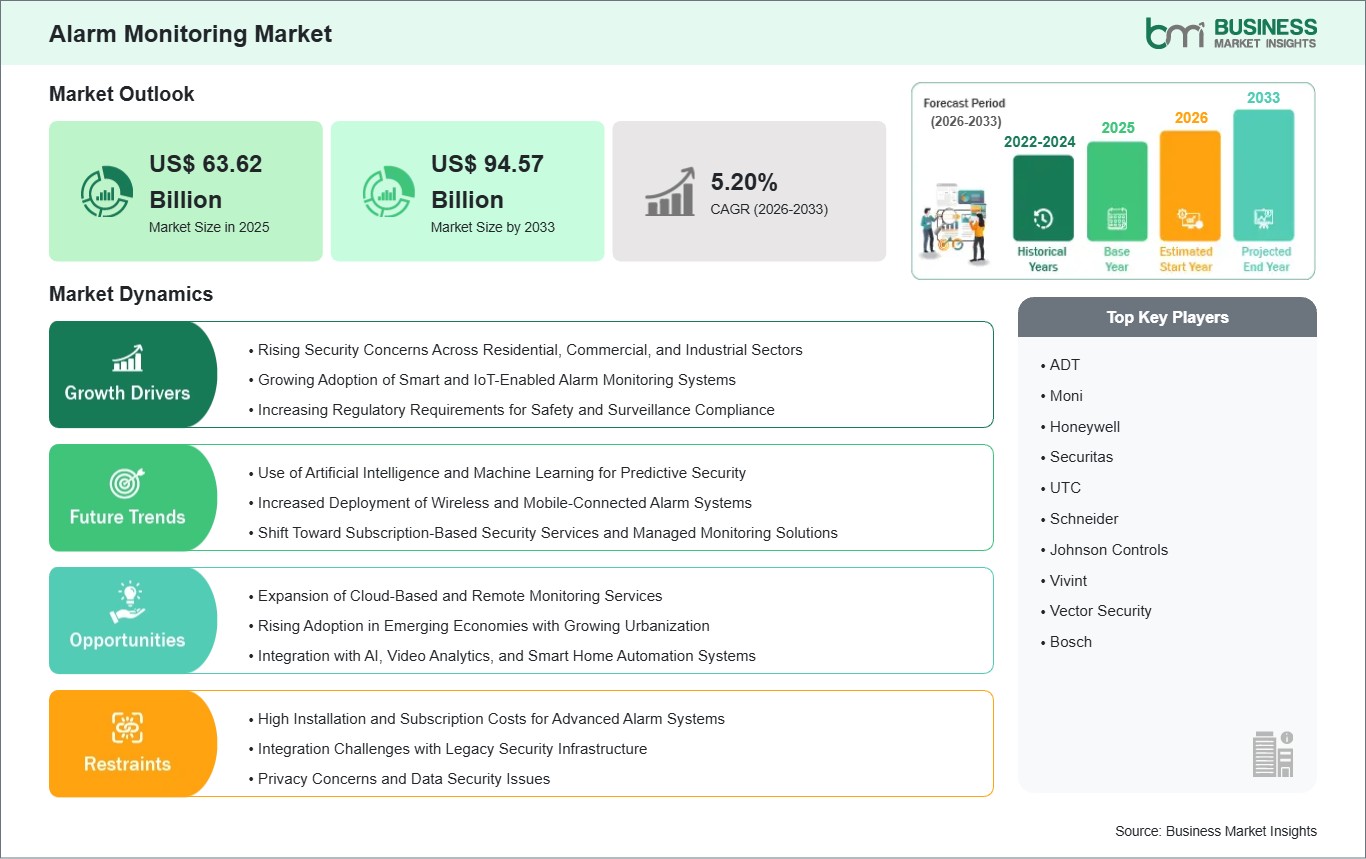
The Alarm Monitoring market size is expected to reach US$ 94.57 billion by 2033 from US$ 63.62 billion in 2025. The market is estimated to record a CAGR of 5.2% from 2026 to 2033.
The global alarm monitoring market is experiencing strong growth, driven by the rising need for security and surveillance across residential, commercial, and industrial sectors. Increasing incidents of theft, vandalism, and unauthorized access have prompted both individuals and organizations to adopt advanced alarm monitoring solutions that offer real-time alerts, remote monitoring, and professional response services. Alarm monitoring encompasses systems hardware—such as sensors, control panels, and communication devices—and services, including installation, maintenance, and 24/7 monitoring, providing a comprehensive approach to security management. The market is further supported by the proliferation of smart and connected technologies, including IoT-enabled devices, wireless and cellular communication systems, and AI-based analytics, which enhance the efficiency, reliability, and scalability of alarm monitoring solutions.
By application, building alarm monitoring dominates the market, reflecting high demand from residential, commercial, and institutional buildings for comprehensive protection. Wireless and cellular technologies are gaining preference over traditional wired systems due to their ease of installation, flexibility, and ability to support remote management. Geographically, North America holds the largest share of the market due to advanced security infrastructure, high adoption of smart building solutions, and stringent regulatory compliance requirements. Asia Pacific, however, is the fastest-growing region, driven by rapid urbanization, rising disposable incomes, and growing awareness of security solutions in emerging economies such as China and India. Key market players focus on innovation, strategic partnerships, and service expansion to strengthen their position in the competitive landscape. Overall, the alarm monitoring market is poised for sustained growth, fueled by technological advancements, increasing security concerns, and the rising adoption of managed and automated monitoring services globally.

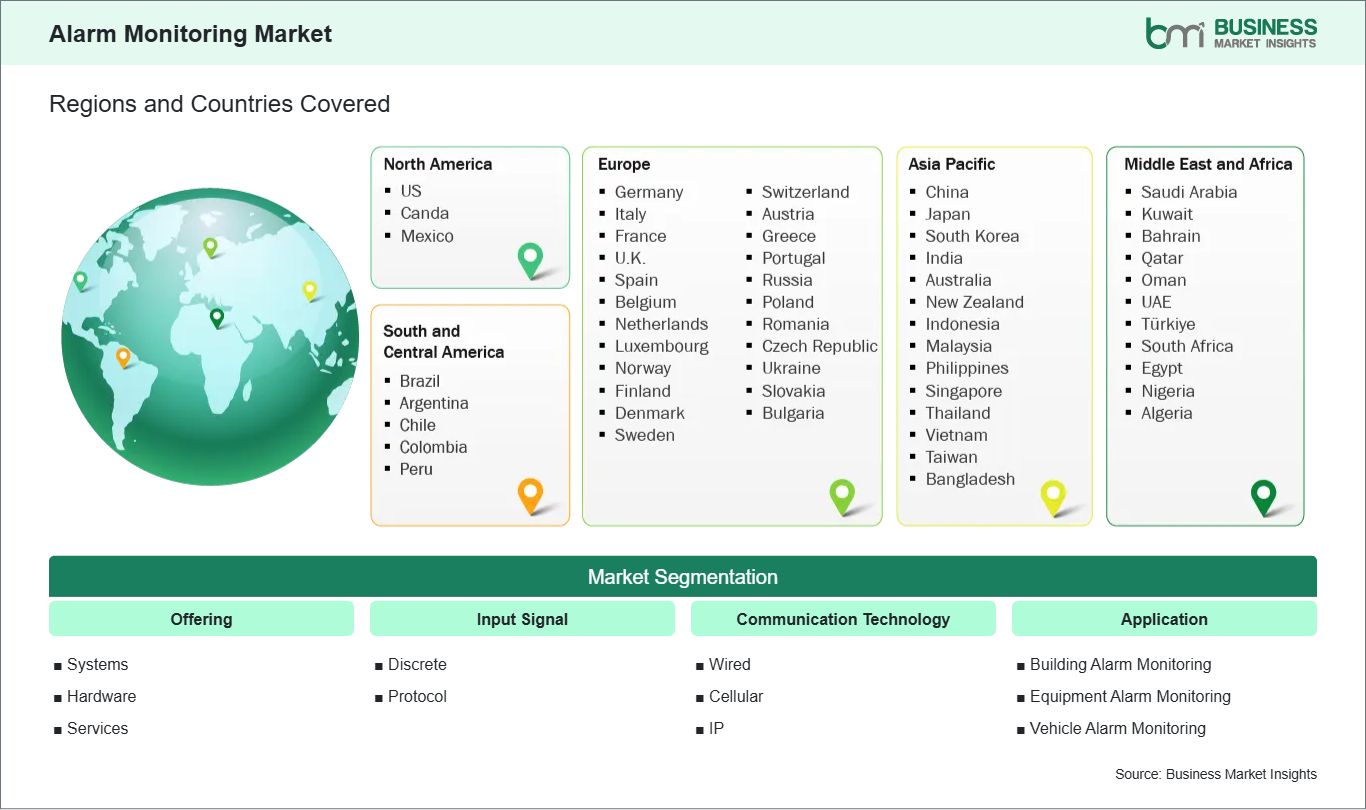
Key segments that contributed to the derivation of the Alarm Monitoring market analysis are offerings, input signal, communication technology, and application.
One of the primary drivers of the alarm monitoring market is the increasing need for security and safety in residential, commercial, and industrial buildings. With growing urbanization and population density, incidents of theft, burglary, and vandalism have been on the rise, prompting both individuals and organizations to adopt advanced security solutions. Residential homeowners are increasingly investing in smart alarm systems that can provide real-time alerts, remote monitoring, and integration with other smart home devices. Similarly, commercial establishments such as offices, retail outlets, and warehouses are deploying sophisticated alarm monitoring solutions to safeguard assets, prevent unauthorized access, and maintain employee and customer safety. The rise in e-commerce and logistics operations has also expanded the requirement for secure storage and transport, which often involves continuous monitoring of alarm systems. Alarm monitoring services, which provide 24/7 monitoring and rapid response capabilities, are particularly attractive because they reduce the need for on-site security personnel while ensuring immediate action in case of an incident. Additionally, advancements in alarm technologies—such as IoT-enabled devices, AI-based threat detection, and mobile notifications—have enhanced the reliability and efficiency of alarm systems, encouraging further adoption. This sustained demand across residential and commercial sectors continues to drive market growth, positioning alarm monitoring solutions as essential infrastructure for safety and security in modern society.
Another key driver for the alarm monitoring market is the rapid technological advancement in alarm systems, particularly the shift toward wireless, IP-based, and IoT-enabled solutions. Traditional wired alarm systems, though reliable, often require complex installation and limit scalability. Wireless and cellular systems, on the other hand, offer flexibility, ease of installation, and real-time communication, making them more appealing to both consumers and businesses. Modern alarm systems now integrate smart sensors, motion detectors, video surveillance, and AI-based analytics, which allow for proactive threat detection, automatic alerts, and predictive maintenance. IP-enabled alarm systems facilitate remote monitoring through mobile apps and cloud platforms, empowering users to control and track their security from anywhere. Additionally, the integration of alarm monitoring with other smart building systems—such as access control, HVAC, and lighting—enhances overall building management efficiency. As energy-efficient and cost-effective solutions, these technological advancements not only improve system performance but also encourage broader adoption across small and medium enterprises, residential complexes, and large industrial setups. Furthermore, regulatory and compliance requirements in certain regions are increasingly mandating reliable monitoring systems for sensitive facilities, further accelerating the adoption of technologically advanced alarm solutions. Collectively, these innovations are expanding the market potential and are expected to drive steady growth for the alarm monitoring industry over the forecast period.

By Offerings, the market is segmented into Systems Hardware and Services. The Services segment held the largest share of the market in 2025, driven by recurring revenue from professional monitoring, installation, and maintenance services.
By Input Signal, the market is segmented into Discrete and Protocol. The Discrete segment held the largest share of the market in 2025, due to the widespread adoption of simple on/off signal systems in traditional alarm setups.
By Communication Technology, the market is segmented into Wired, Cellular, and IP. The Cellular segment held the largest share of the market in 2025, supported by the increasing deployment of wireless alarm systems using mobile networks for reliable connectivity.
By Application, the market is segmented into Building Alarm Monitoring, Equipment Alarm Monitoring, and Vehicle Alarm Monitoring. The Building Alarm Monitoring segment held the largest share of the market in 2025, owing to high demand from residential and commercial buildings for comprehensive security solutions.
| Report Attribute | Details |
|---|---|
| Market size in 2025 | US$ 63.62 Billion |
| Market Size by 2033 | US$ 94.57 Billion |
| Global CAGR (2026 - 2033) | 5.20% |
| Historical Data | 2022-2024 |
| Forecast period | 2026-2033 |
| Segments Covered | By Offering
|
|
Regions and Countries Covered
| |
| North America | US, Canada, Mexico |
| Europe | Belgium, Austria, Finland, Denmark, Greece, Poland, Romania, Russia, Ukraine, Czech Republic, Slovakia, Bulgaria, Italy, Luxembourg, Germany, Switzerland, France, Netherlands, Norway, Portugal, Spain, Sweden, United Kingdom |
| Asia-Pacific | Australia, China, India, Japan, South Korea, Indonesia, Malaysia, Philippines, Singapore, Thailand, Vietnam, Bangladesh, New Zealand, Taiwan |
| South and Central America | Brazil, Argentina, Peru, Chile, Colombia |
| Middle East and Africa | Bahrain, Kuwait, Oman, Qatar, Saudi Arabia, United Arab Emirates, Turkiye, South Africa, Egypt, Algeria, Nigeria |
| Market leaders and key company profiles |
|
The "Alarm Monitoring Market Size and Forecast (2022–2033)" report provides a detailed analysis of the market covering below areas:
The geographical scope of the Alarm Monitoring market report is divided into five regions: North America, Asia Pacific, Europe, Middle East & Africa, and South & Central America. The Alarm Monitoring market in Asia Pacific is expected to grow significantly during the forecast period.
North America leads the global alarm monitoring market, holding the largest share due to widespread adoption of advanced alarm systems, strong security awareness, and well-established service provider networks. The United States, in particular, drives this growth with high demand across residential, commercial, and government sectors, supported by IoT-enabled devices, cloud integration, and regulatory emphasis on safety. Europe also represents a significant market, driven by countries like Germany, the UK, and France, where regulatory compliance, smart city initiatives, and integration with building automation systems contribute to steady adoption of intelligent alarm monitoring solutions.
Asia Pacific is the fastest-growing region, fueled by rapid urbanization, increasing investments in smart cities, and rising consumer awareness of security solutions in countries such as China, India, Japan, and South Korea. Wireless and cloud-based systems are gaining traction in both residential and commercial applications. Latin America and the Middle East & Africa are emerging markets, witnessing growth due to increasing security concerns and expanding commercial infrastructure, though their market share remains smaller compared to North America, Europe, and Asia Pacific. Overall, the geographic landscape highlights North America as dominant, Asia Pacific as high-growth, and Europe as a steady adopter, shaping the global dynamics of the alarm monitoring market..

The Alarm Monitoring market is evaluated by gathering qualitative and quantitative data post primary and secondary research, which includes important corporate publications, association data, and databases. A few of the key developments in the Alarm Monitoring market are:
The Alarm Monitoring Market is valued at US$ 63.62 Billion in 2025, it is projected to reach US$ 94.57 Billion by 2033.
As per our report Alarm Monitoring Market, the market size is valued at US$ 63.62 Billion in 2025, projecting it to reach US$ 94.57 Billion by 2033. This translates to a CAGR of approximately 5.20% during the forecast period.
The Alarm Monitoring Market report typically cover these key segments-
The historic period, base year, and forecast period can vary slightly depending on the specific market research report. However, for the Alarm Monitoring Market report:
The Alarm Monitoring Market is populated by several key players, each contributing to its growth and innovation. Some of the major players include:
The Alarm Monitoring Market report is valuable for diverse stakeholders, including:
Essentially, anyone involved in or considering involvement in the Alarm Monitoring Market value chain can benefit from the information contained in a comprehensive market report.
Please tell us your area of interest
(Market Segments/ Regions and Countries/ Companies)