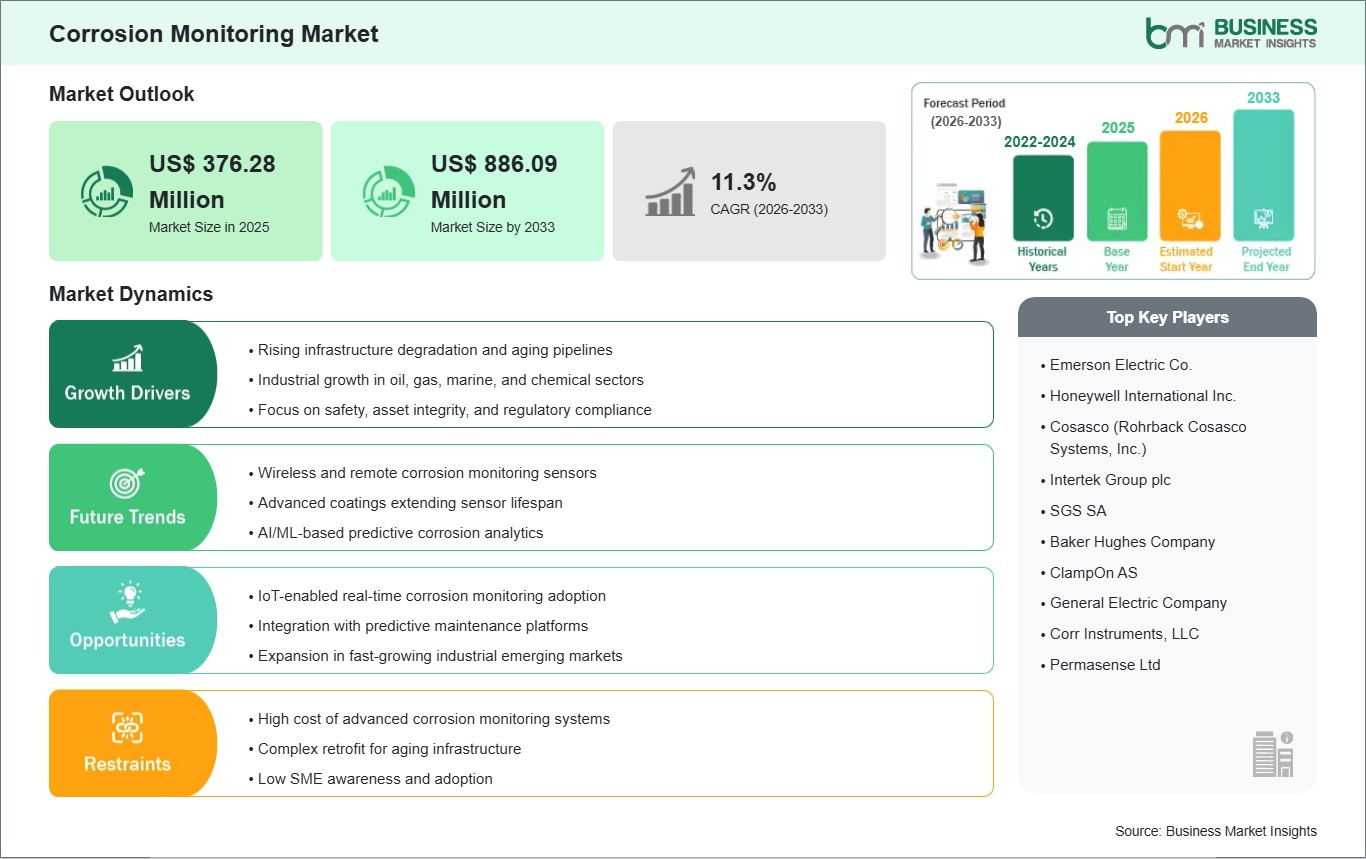
The corrosion monitoring market size is expected to reach US$ 886.09 million by 2033 from US$ 376.28 million in 2025. The market is estimated to record a CAGR of 11.3% from 2026 to 2033.
Corrosion monitoring systems are critical technologies designed to detect, measure, and manage the degradation of metals and infrastructure caused by corrosive environments. These solutions help industrial operators maintain asset integrity, enhance operational safety, and comply with stringent regulatory standards across sectors such as oil & gas, petrochemicals, power generation, water/wastewater, and mining. Modern corrosion monitoring integrates advanced sensors, real‑time data analytics, and connectivity platforms—such as IoT and AI‑enabled systems—to enable predictive maintenance, reduce unplanned downtime, and extend the life cycle of critical assets. As infrastructure ages and regulatory pressures grow, industries are increasingly adopting both intrusive and non‑intrusive monitoring techniques to minimize safety risks, optimize maintenance expenditures, and support sustainable operations.
The global corrosion monitoring market is experiencing robust growth driven by several key factors. Demand for asset protection and operational safety has surged as industries seek to avoid costly failures and mitigate environmental hazards associated with corrosion‑related incidents. Regulatory frameworks in major regions—such as occupational safety and environmental protection standards in the U.S. and Europe—are reinforcing the need for continuous monitoring and compliance, further incentivizing adoption of corrosion monitoring technologies.

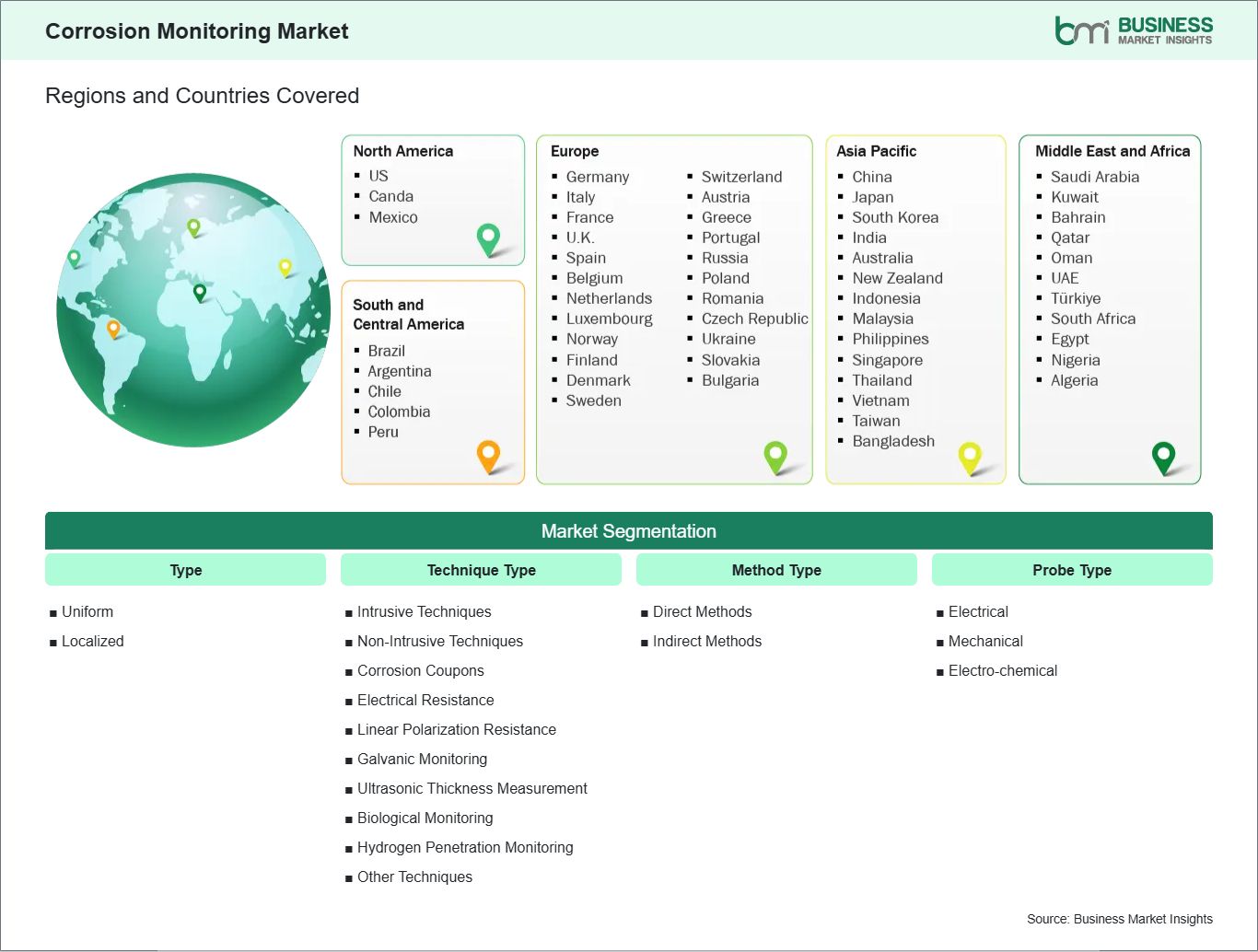
Key segments that contributed to the derivation of the corrosion monitoring market analysis are type, technique type, method type, probe type, and end user/industry.
Industries such as oil & gas, power generation, marine, and chemical processing rely heavily on expensive and critical infrastructure. Corrosion can lead to unplanned downtime, safety hazards, and significant maintenance costs. Corrosion monitoring solutions provide real-time insights into material degradation, enabling proactive maintenance and extending asset life. The growing emphasis on operational efficiency and minimizing asset failure is driving demand for advanced corrosion monitoring technologies.
Stringent regulations and safety standards across various sectors are pushing companies to adopt corrosion monitoring practices. Standards set by organizations such as NACE International and ISO require regular inspection and preventive maintenance to reduce environmental and operational risks. Compliance-driven adoption of corrosion monitoring solutions is opening new growth opportunities, particularly in highly regulated industries such as oil & gas, chemicals, and marine transport.
By Type, the corrosion monitoring market is segmented into electrical resistance (ER) probes, linear polarization resistance (LPR) probes, ultrasonic thickness gauges, and chemical sensors. The electrical resistance (ER) probes segment held a significant share of the market in 2025. ER probes are widely used in oil & gas pipelines, chemical plants, and water treatment facilities due to their ability to provide continuous and accurate monitoring of metal loss caused by corrosion. Their cost-effectiveness and compatibility with various metals drive adoption in this type segment globally.
By Technique, the market is segmented into offline (manual inspection) and online (real-time monitoring) techniques. The online monitoring segment held the largest share of the market in 2025. Online techniques are preferred in critical infrastructure such as pipelines, storage tanks, and industrial machinery due to their ability to provide continuous, real-time data on corrosion rates, enabling predictive maintenance and reducing the risk of unexpected failures. The increasing need for operational efficiency and safety fuels growth in this technique segment.
By Application, the market is segmented into oil & gas, power generation, marine, chemical processing, and water & wastewater treatment. The oil & gas segment held the largest share of the market in 2025. Corrosion monitoring in this sector is critical to preventing leaks, equipment failures, and environmental hazards. The extensive use of pipelines, offshore rigs, and refineries, combined with stringent safety and environmental regulations, drives demand for advanced corrosion monitoring solutions in the oil & gas industry globally.
By End User / Industry, the market is segmented into industrial manufacturing, energy & utilities, oil & gas, marine & shipping, and chemical processing. The industrial manufacturing segment held the largest share of the market in 2025. Corrosion monitoring is extensively implemented in industrial plants to protect machinery, reduce maintenance costs, and ensure uninterrupted production. The growing focus on predictive maintenance and asset reliability across manufacturing sectors is a key factor driving growth in this industry segment.
By Vertical / End User, the market is segmented into residential, municipal, industrial, and commercial. The municipal segment held the largest share of the market in 2025. Municipal authorities rely on crawler camera systems to inspect drainage networks, sewer lines, and stormwater systems to ensure uninterrupted service and compliance with environmental standards. The increasing focus on urban infrastructure management and public safety fuels growth in this segment.

| Report Attribute | Details |
|---|---|
| Market size in 2025 | US$ 376.28 Million |
| Market Size by 2033 | US$ 886.09 Million |
| Global CAGR (2026 - 2033) | 11.3% |
| Historical Data | 2022-2024 |
| Forecast period | 2026-2033 |
| Segments Covered | By Type
|
|
Regions and Countries Covered
| |
| North America | US, Canada, Mexico |
| Europe | Belgium, Austria, Finland, Denmark, Greece, Poland, Romania, Russia, Ukraine, Czech Republic, Slovakia, Bulgaria, Italy, Luxembourg, Germany, Switzerland, France, Netherlands, Norway, Portugal, Spain, Sweden, United Kingdom |
| Asia-Pacific | Australia, China, India, Japan, South Korea, Indonesia, Malaysia, Philippines, Singapore, Thailand, Vietnam, Bangladesh, New Zealand, Taiwan |
| South and Central America | Brazil, Argentina, Peru, Chile, Colombia |
| Middle East and Africa | Bahrain, Kuwait, Oman, Qatar, Saudi Arabia, United Arab Emirates, Turkiye, South Africa, Egypt, Algeria, Nigeria |
| Market leaders and key company profiles |
|
The "Corrosion Monitoring Market Size and Forecast (2022 - 2033)" report provides a detailed analysis of the market covering below areas:
The geographical scope of the corrosion monitoring market report is divided into five regions: North America, Asia Pacific, Europe, Middle East & Africa, and South & Central America. The corrosion monitoring market in Asia Pacific is expected to grow significantly during the forecast period.
Asia Pacific has emerged as a key region for corrosion monitoring solutions, driven by rapid industrialization, expansion of oil & gas infrastructure, growing energy demand, and large-scale maritime activities. Countries such as China, India, Japan, and South Korea are at the forefront of this growth, supported by strong investments in pipelines, chemical plants, power generation facilities, and water treatment infrastructure. The increasing need to prevent asset degradation, reduce maintenance costs, and ensure operational safety is boosting the adoption of advanced corrosion monitoring technologies in the region.
In addition, Asia Pacific benefits from cost-effective manufacturing capabilities, supportive government initiatives for industrial safety and infrastructure modernization, and growing adoption of digital monitoring and IoT-based predictive maintenance solutions. Rising investments in offshore oil & gas, chemical processing, and marine shipping industries are accelerating the deployment of corrosion monitoring systems. The need for regulatory compliance, environmental protection, and long-term asset management is expected to sustain strong market growth in Asia Pacific over the coming years.

The corrosion monitoring market is evaluated by gathering qualitative and quantitative data post primary and secondary research, which includes important corporate publications, association data, and databases. A few of the key developments in the corrosion monitoring market are:
The Corrosion Monitoring Market is valued at US$ 376.28 Million in 2025, it is projected to reach US$ 886.09 Million by 2033.
As per our report Corrosion Monitoring Market, the market size is valued at US$ 376.28 Million in 2025, projecting it to reach US$ 886.09 Million by 2033. This translates to a CAGR of approximately 11.3% during the forecast period.
The Corrosion Monitoring Market report typically cover these key segments-
The historic period, base year, and forecast period can vary slightly depending on the specific market research report. However, for the Corrosion Monitoring Market report:
The Corrosion Monitoring Market is populated by several key players, each contributing to its growth and innovation. Some of the major players include:
The Corrosion Monitoring Market report is valuable for diverse stakeholders, including:
Essentially, anyone involved in or considering involvement in the Corrosion Monitoring Market value chain can benefit from the information contained in a comprehensive market report.
Please tell us your area of interest
(Market Segments/ Regions and Countries/ Companies)