Market Summary
Executive Summary and Global Market Analysis
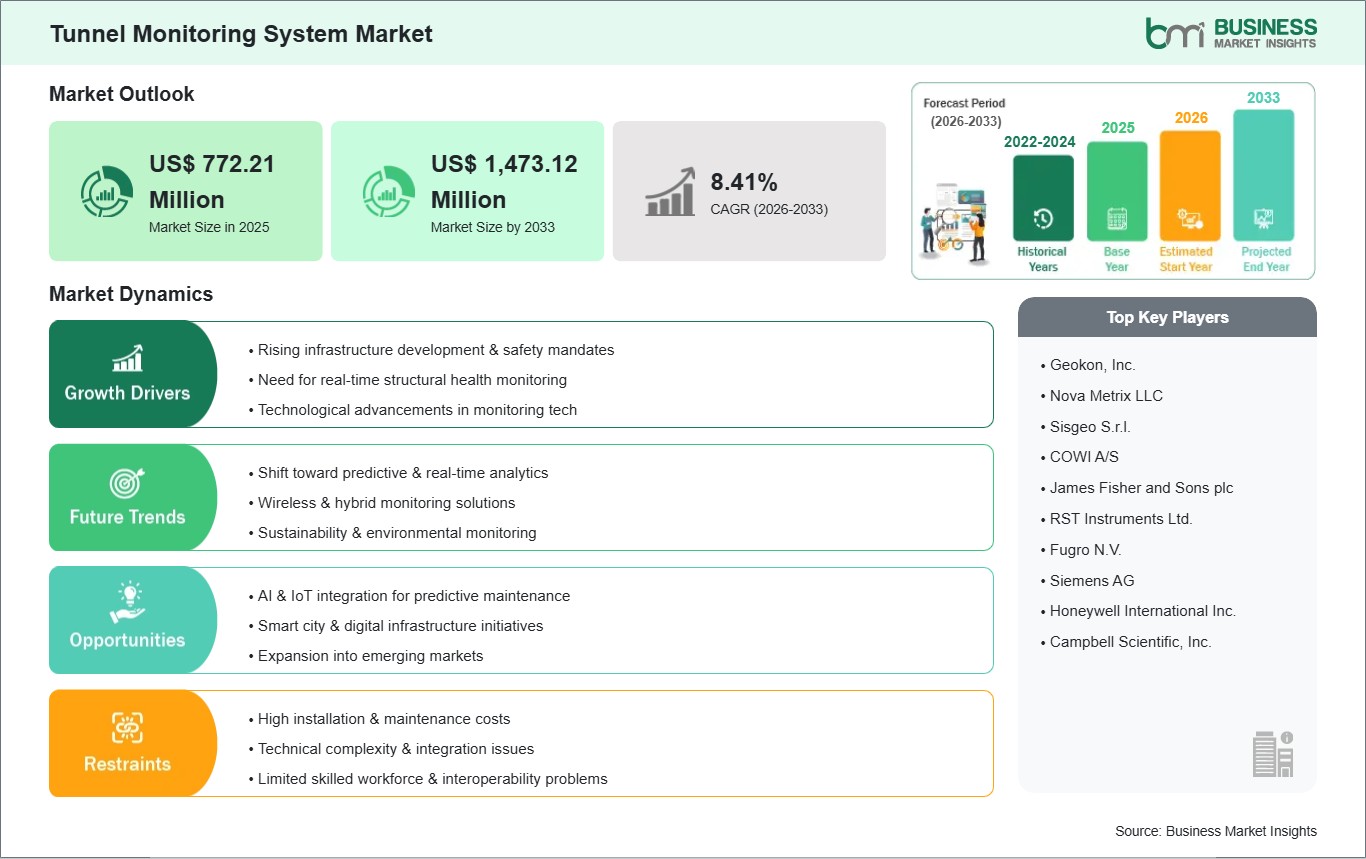
Tunnel Monitoring Systems (TMS) represent a sophisticated convergence of geotechnical engineering and digital instrumentation, designed to serve as the sensory nervous system for critical subterranean infrastructure. These systems are fundamental to the structural longevity and operational safety of transit networks, utilizing an integrated suite of fiber-optic sensors, piezometers, and gas detectors to monitor variables such as seismic displacement, structural strain, and environmental air quality. By facilitating the seamless transition from manual inspections to automated, real-time data acquisition, TMS frameworks ensure that highway and railway tunnels remain resilient against geological shifts and material degradation.
However, the market faces significant structural restraints, primarily centered on the exorbitant capital expenditure required for the installation of high-precision hardware in existing brownfield tunnels. The technical complexity of ensuring consistent signal integrity in electromagnetically noisy and high-moisture environments often leads to significant integration hurdles. Furthermore, the lack of standardized communication protocols between multi-vendor hardware components can stifle large-scale deployment, particularly in developing regions where budget constraints limit the adoption of premium sensing technologies.
Despite these challenges, the market is characterized by lucrative opportunities driven by the global mandate for "Smart Infrastructure." The integration of Artificial Intelligence (AI) and Machine Learning (ML) enables a shift toward predictive health monitoring, allowing operators to preempt structural failures before they manifest. Additionally, the proliferation of 5G-enabled IoT sensor networks offers a cost-effective alternative to traditional wired systems, providing a scalable pathway for the modernization of global transportation corridors and ensuring the market's robust expansion through 2033.
Segment Analysis
Tunnel Monitoring System Market Segmentation
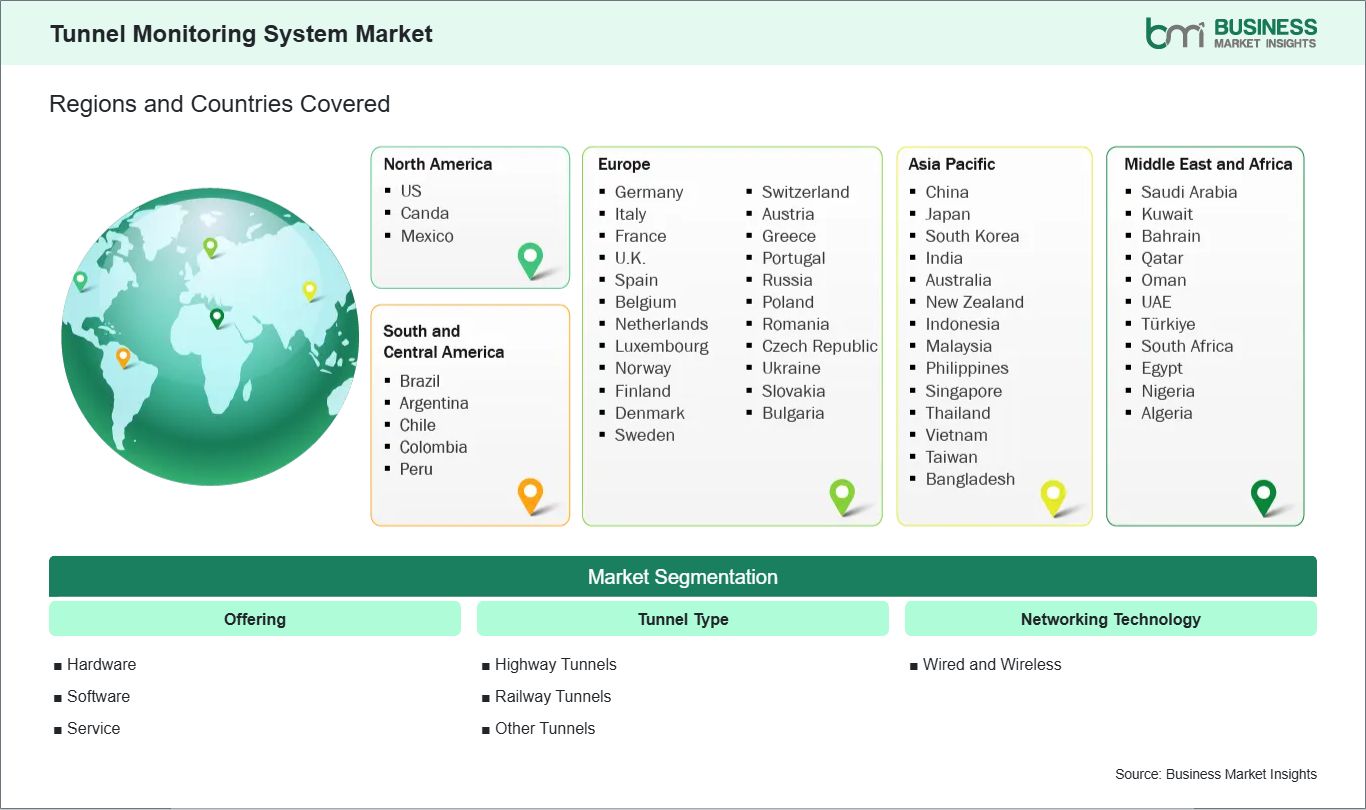
Key segments that contributed to the derivation of the Tunnel Monitoring System market analysis are offering, tunnel type, and networking technology.
- By Offering, the market is segmented into Hardware, Software, and Service.
- By Tunnel Type, the market is divided into Highway Tunnels, Railway Tunnels, and Other Tunnels.
- By Networking Technology, the market is categorized into Wired and Wireless.
Market Forces
Tunnel Monitoring System Market Drivers and Opportunities
Escalating Global Safety Standards and the Rehabilitation of Critical Infrastructure
The primary driver of the tunnel monitoring system market is the comprehensive paradigm shift in global transportation safety mandates, alongside the urgent need to address the structural integrity of aging subterranean assets. Regulatory bodies across major economies have moved toward a philosophy of continuous oversight, requiring that all transit passages—ranging from historical road tunnels to modern deep-bore railways—be equipped with automated sensing frameworks. This regulatory pressure is not merely a bureaucratic requirement but a response to the catastrophic social and economic risks associated with tunnel failure. As urban populations expand and the frequency of heavy transit loads increases, existing structures are subjected to unprecedented levels of stress, geological pressure, and vibration-induced fatigue.
To mitigate these risks, national infrastructure authorities are prioritizing substantial investment programs focused on the digital rehabilitation of older tunnels. These initiatives involve the deployment of high-precision instrumentation that provides an uninterrupted stream of data regarding structural health and environmental safety. For example, the integration of advanced displacement sensors and automated crack detection systems allows for the immediate identification of subtle shifts in the tunnel lining that would remain invisible to the naked eye during periodic manual inspections. This move toward a "sensing-first" approach is further propelled by the rising frequency of severe weather events and seismic activity, which necessitate more resilient monitoring capabilities to ensure the safe and uninterrupted flow of commuters and commercial freight across the global transportation network.
Integration of AI-Powered Digital Twins and Predictive Ecosystems
A significant opportunity in the tunnel monitoring system market lies in the transition from traditional, reactive data collection to the implementation of intelligent "Digital Twins" and AI-driven predictive analytics. While historical systems were designed to record and report incidents as they occurred, the next era of infrastructure management focuses on the ability to foresee and prevent failures long before they manifest. Digital twin technology creates a high-fidelity virtual replica of a physical tunnel, dynamically updated with real-time sensor data from the field. This allows engineers and operators to conduct sophisticated simulations, testing how the structure might respond to extreme traffic volume, environmental changes, or emergency scenarios such as fire or ventilation failure.
The fusion of Artificial Intelligence with these virtual models enables the analysis of massive datasets to detect complex patterns that indicate structural wear or mechanical degradation. By leveraging machine learning algorithms, tunnel operators can move toward a predictive maintenance model, which significantly reduces the need for expensive, unscheduled closures and emergency repairs. This creates a specialized market for advanced software-as-a-service platforms that can harmonize data from disparate sources—such as fiber-optic sensors, air quality monitors, and seismic gauges—into a single, actionable dashboard. As smart city frameworks continue to evolve, the demand for these integrated, intelligent monitoring solutions will expand, offering manufacturers the chance to develop highly specialized, energy-efficient hardware and software tailored for the autonomous management of future-ready urban and intercity transit corridors.
Size and Share Analysis
Tunnel Monitoring System Market Size and Share Analysis
The Tunnel Monitoring System market demonstrates steady growth, with size and share analysis revealing evolving trends and competitive positioning among key players. The report further examines subsegments categorized within offering, tunnel type, and networking technology, offering insights into their contribution to overall market performance.
Within the offering segment, the hardware sub-segment currently commands a significant portion of the market share due to the intensive deployment of physical sensors and data loggers required for baseline data acquisition.
Regarding tunnel types, the railway tunnels sub-segment is a primary contributor, driven by the rapid expansion of high-speed rail and metro networks that require high-frequency structural monitoring.
In terms of networking technology, the wireless sub-segment is witnessing the fastest growth as advancements in IoT allow for easier, cost-effective installation in complex environments without the need for extensive cabling.
Report Coverage
Tunnel Monitoring System Market Report Coverage and Deliverables
The "Tunnel Monitoring System Market Size and Forecast (2022 - 2033)" report provides a detailed analysis of the market covering below areas:
- Tunnel Monitoring System market size and forecast at global, regional, and country levels for all the key market segments covered under the scope
- Tunnel Monitoring System market trends, as well as market dynamics such as drivers, restraints, and key opportunities
- Tunnel Monitoring System market analysis covering key market trends, global and regional framework, major players, regulations, and recent market developments
- Industry landscape and competition analysis covering market concentration, heat map analysis, prominent players, and recent developments for the Tunnel Monitoring System market
- Detailed company profiles, including SWOT analysis
Geographic Insights
Tunnel Monitoring System Market Geographic Insights
The geographical scope of the Tunnel Monitoring System market report is divided into five regions: North America, Asia Pacific, Europe, the Middle East and Africa, and South and Central America.
In North America, market activity is underpinned by a robust focus on the digital rehabilitation of aging transportation networks, where federal safety mandates drive the adoption of sophisticated structural health monitoring platforms. The European market is characterized by stringent environmental and safety regulations that necessitate the integration of high-end sensing technologies for trans-alpine and underwater passages, ensuring long-term structural resilience. The Asia-Pacific region serves as a high-growth hub, propelled by massive capital investments in urban transit megaprojects and the rapid expansion of high-speed rail networks that require continuous real-time oversight.
In the Middle East and Africa, the market is expanding through the development of ambitious smart city initiatives and the modernization of transit corridors designed to support hyper-connected urban ecosystems. Meanwhile, South and Central America are witnessing a steady transformation as regional industrial sectors and mining operations increasingly adopt automated monitoring solutions to mitigate geotechnical risks and enhance operational safety. This global distribution ensures a balanced market trajectory, as each region leverages specialized monitoring technologies—ranging from wireless IoT sensor networks to AI-driven predictive analytics—to address localized infrastructure challenges and ensure the integrity of critical subterranean assets.
Industry Activity
Recent Developments
The Tunnel Monitoring System market is evaluated by gathering qualitative and quantitative data post-primary and secondary research, which includes important corporate publications, association data, and databases. A few of the key developments in the Tunnel Monitoring System market are:
- In November 2025, Hexagon, the global leader in measurement technologies, launched GeoMonitoring, a web-based safety monitoring platform. Powerful, interactive 3D visualizations of the monitored environment were at the core of the platform, offering access to data and charts in just a few clicks. This intuitive view of monitoring data enabled geotechnical engineers and geologists to manage the full cycle of a Tunnel Monitoring System—from field data collection to final interpretation—ensuring early safety interventions for critical infrastructure.
- In June 2025, Trimble and InvenSense (a TDK group company) announced they would work together to deliver an advanced navigation solution that combined the Trimble ProPoint Go engine and Trimble RTX correction service with TDK's SmartAutomotive Inertial Measurement Units (IMUs) module from InvenSense. This collaboration allowed customers to take advantage of greater accuracy and reliability in positioning and navigation, providing a critical technological baseline for any high-precision Tunnel Monitoring System that required reliable tracking and spatial data in GNSS-denied environments.
Trust & Transparency
Research Methodology
The market analysis combines proprietary research with secondary data from government agencies, company disclosures, regulatory filings, industry databases and expert interviews. Market estimates are validated through data triangulation, cross-market benchmarking and analyst
review.
View Full Research Methodology
Key Sources Referred:
World Bank - Global Trade IndicatorsWorld Trade Organization (WTO)International Monetary Fund (IMF)International Trade Administration (ITA)Company websiteCompany annual reportsCompany investor presentations