Market Summary
Executive Summary and Global Market Analysis
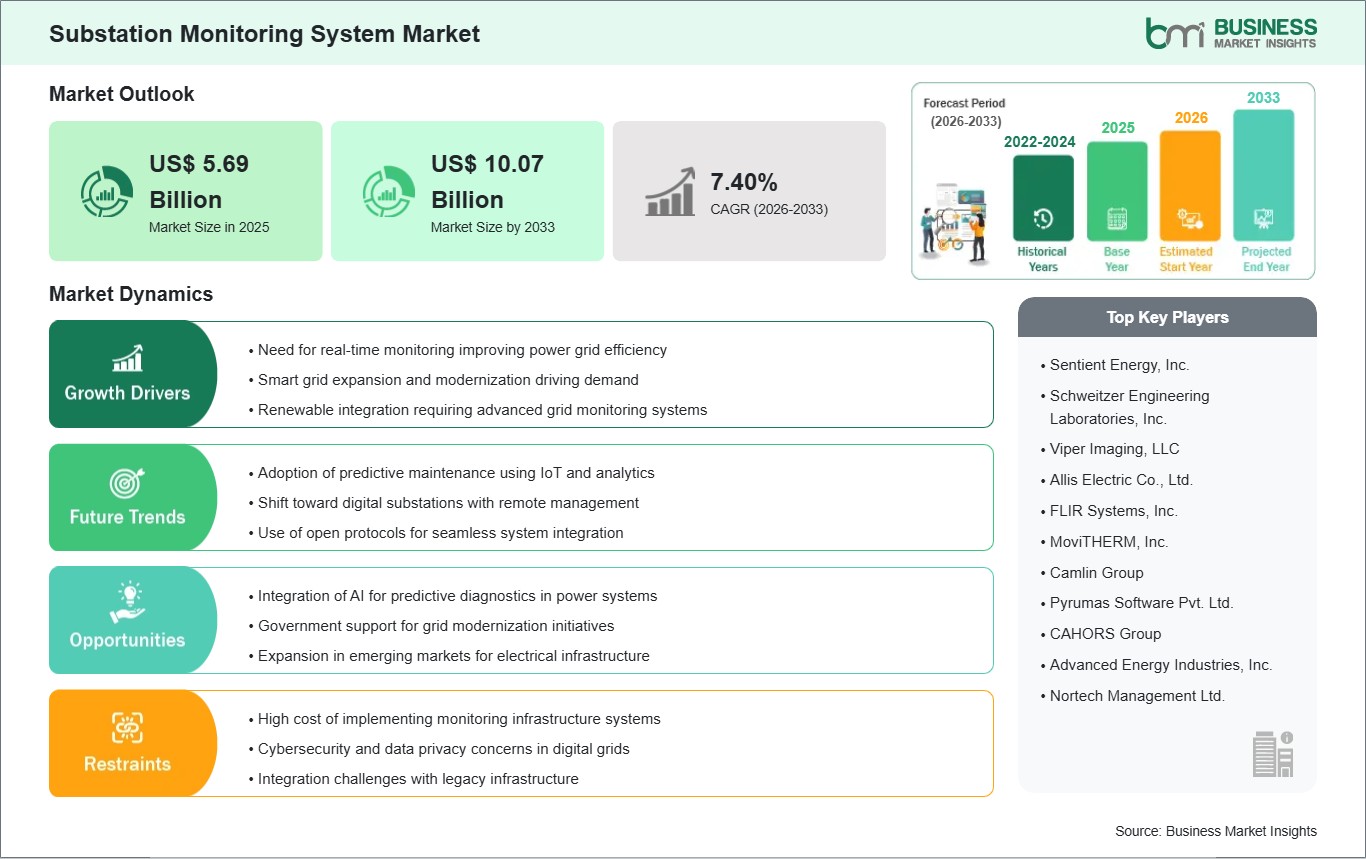
A substation monitoring system is an integrated suite of hardware and software designed to collect, analyze, and transmit real-time data regarding the operational health and performance of electrical substation equipment. These systems utilize a network of sensors, monitoring parameters such as transformer temperature, dissolved gas levels (DGA), circuit breaker vibration, and busbar voltage, coupled with Intelligent Electronic Devices (IEDs). By converting physical signals into actionable digital insights, they enable utilities to transition from traditional reactive maintenance to proactive, condition-based management, ensuring grid stability and preventing catastrophic asset failure. Market expansion is primarily attributed to the rising global demand for grid modernization and aging infrastructure refurbishment, the rapid integration of variable renewable energy (VRE) sources, and the escalating frequency of extreme weather events necessitating enhanced situational awareness.
However, several challenges can restrain market growth: high initial procurement and integration costs, particularly for retrofitting legacy "analog" yards with advanced digital sensors, can limit adoption among smaller cooperatives and municipal utilities. Stringent regulatory hurdles and evolving cybersecurity mandates (such as NERC CIP compliance) lengthen the time-to-market for connected solutions and increase the technical overhead for data protection. Additionally, the industry faces constraints due to interoperability gaps in multi-vendor environments, where a lack of seamless data exchange between different manufacturers' devices can lead to fragmented monitoring landscapes and increased maintenance complexity.
Despite these hurdles, the market holds immense opportunities in the universal mandate for "Substation-as-a-Service" and the accelerating deployment of virtualized protection and control. The expansion of EV charging hubs requiring localized distribution monitoring and the development of edge-computing nodes, which process data at the substation level to reduce latency and cloud-bandwidth costs, are expected to create significant opportunities for market growth.
Segment Analysis
Substation Monitoring System Market Segmentation
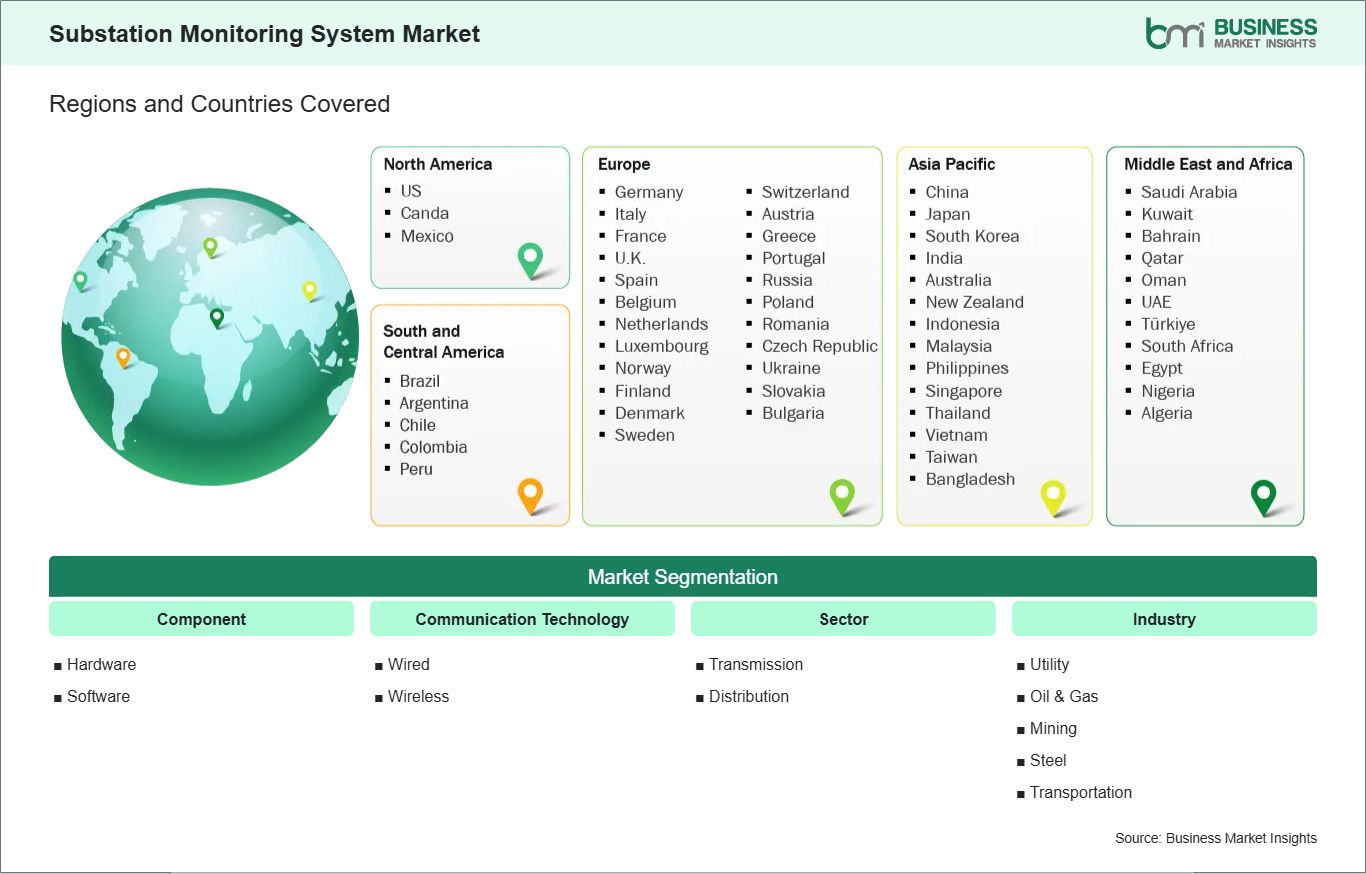
Key segments that contributed to the derivation of the Substation Monitoring System market analysis are component, communication technology, sector, and industry.
- By Component, the market is segmented into Hardware and Software.
- By Communication Technology, the market is divided into Wired and Wireless.
- By Sector, the market is segmented into Transmission and Distribution.
- By Industry, the market is categorized into Utility, Oil and Gas, Mining, Steel, and Transportation.
Market Forces
Substation Monitoring System Market Drivers and Opportunities
Advancing Grid Resilience and Renewable Energy Integration
The primary driver for the Substation Monitoring System Market is the accelerating global requirement for grid modernization and the seamless integration of intermittent renewable energy sources. As power networks transition from centralized generation to decentralized, bidirectional ecosystems, the need for real-time visibility into load flows and asset health has become non-discretionary. This demand is further amplified by the rapid expansion of energy-intensive infrastructures, such as AI-driven data centers and electric vehicle (EV) charging networks, which place unprecedented stress on aging substation equipment. To prevent catastrophic failures and minimize unplanned downtime, utilities are aggressively adopting digital monitoring solutions, specifically those aligned with the IEC 61850 standard, to replace legacy analog systems. Furthermore, government-backed "Smart Grid" initiatives and strict reliability mandates are compelling operators to invest in automated monitoring layers that can detect anomalies in milliseconds, ensuring that the global power infrastructure remains resilient against both surge demands and increasingly volatile environmental conditions.
AI-Native Digital Twins and Predictive Asset Management
A significant high-value opportunity lies in the convergence of Substation Monitoring with AI-native Digital Twin technology. By creating a synchronized virtual replica of physical substation assets, operators can perform risk-free simulation of maintenance decisions and stress-test grid configurations before implementation. There is also a major growth frontier in the adoption of AI-driven predictive maintenance and "Substation-as-a-Service" models. These systems leverage machine learning to analyze thermal, vibration, and acoustic data, accurately predicting the Remaining Useful Life (RUL) of transformers and circuit breakers. This shift from reactive to prescriptive maintenance can reduce unplanned downtime by up to 35% and significantly lower long-term operational costs. Furthermore, the rise of Virtualized Protection, Automation, and Control (vPAC) presents a lucrative opportunity for software-defined monitoring platforms that reduce physical hardware footprints and wiring complexity through fiber-optic process buses. Manufacturers who focus on cyber-resilient, modular monitoring solutions tailored for high-voltage retrofits in emerging markets are positioned to lead the most profitable segments of the 2026 energy landscape.
Size and Share Analysis
Substation Monitoring System Market Size and Share Analysis
The Substation Monitoring System market demonstrates steady growth, with size and share analysis revealing evolving trends and competitive positioning among key players. The report further examines subsegments categorized within component, communication technology, sector, and industry, offering insights into their contribution to overall market performance.
Based on component, the Hardware subsegment holds the dominant market share. Hardware elements, including Intelligent Electronic Devices (IEDs), smart sensors, and power quality analyzers, are indispensable for capturing the primary data required to stabilize the grid. A notable trend in 2026 is the surge in the Software subsegment, which is registering a higher growth rate as utilities prioritize advanced analytics and asset management platforms. These software solutions are particularly vital for "digital twin" implementations, allowing operators to simulate various load scenarios and predict transformer degradation before it leads to a regional blackout.
Report Coverage
Substation Monitoring System Market Report Coverage and Deliverables
The "Substation Monitoring System Market Size and Forecast (2022 - 2033)" report provides a detailed analysis of the market covering below areas:
- Substation Monitoring System market size and forecast at global, regional, and country levels for all the key market segments covered under the scope
- Substation Monitoring System market trends, as well as market dynamics such as drivers, restraints, and key opportunities
- Substation Monitoring System market analysis covering key market trends, global and regional framework, major players, regulations, and recent market developments
- Industry landscape and competition analysis covering market concentration, heat map analysis, prominent players, and recent developments for the Substation Monitoring System market
- Detailed company profiles, including SWOT analysis
Geographic Insights
Substation Monitoring System Market Geographic Insights
The geographical scope of the Substation Monitoring System market report is divided into five regions: North America, Asia Pacific, Europe, Middle East and Africa, and South and Central America.
The Asia-Pacific Substation Monitoring System Market is segmented into China, Japan, South Korea, India, Australia, New Zealand, Indonesia, Malaysia, the Philippines, Singapore, Thailand, Vietnam, Taiwan, Bangladesh, and the Rest of Asia. This region is emerging as the fastest-growing market globally. The expansion is primarily fueled by rapid urbanization and massive investments in high-voltage transmission networks, particularly in China and India. China`s State Grid Corporation and India`s Smart Grid Mission are allocating billions toward upgrading substations with digital technologies to reduce outages and support the integration of massive solar and wind farms.
Growth is further bolstered by a significant shift toward "Intelligent Substations" in Southeast Asian nations like Indonesia and Vietnam, where utilities are prioritizing the reduction of technical losses in rural distribution networks. The integration of IoT-enabled sensors and AI-driven predictive maintenance platforms, alongside the rising demand for wireless communication protocols to monitor remote assets, solidifies Asia-Pacific as a critical hub for innovation and the future scaling of the Substation Monitoring System industry.
Industry Activity
Recent Developments
The Substation Monitoring System market is evaluated by gathering qualitative and quantitative data post primary and secondary research, which includes important corporate publications, association data, and databases. A few of the key developments in the Substation Monitoring System market are:
- In Feb 2026, Ubicquia launched AI-driven power monitoring services for commercial and industrial customers, providing real-time visibility and predictive insights into power quality. The solution enables proactive detection of anomalies, reduces equipment damage and downtime, and supports coordination with utilities. This represents a move toward intelligent, AI-enabled substation and transformer monitoring systems, highlighting the trend of integrating AI for smarter grid management.
- In Feb 2026, Systems With Intelligence launched INTELLINSPECT™, a cloud-based platform that automates thermal and visual inspections of substations, identifies anomalies, and provides trend-based actionable insights. The system enhances operational efficiency, safety, and predictive maintenance for utilities. This represents a move toward intelligent, AI-enabled substation and transformer monitoring systems.
Trust & Transparency
Research Methodology
The market analysis combines proprietary research with secondary data from government agencies, company disclosures, regulatory filings, industry databases and expert interviews. Market estimates are validated through data triangulation, cross-market benchmarking and analyst
review.
View Full Research Methodology
Key Sources Referred:
World Bank - Global Trade Indicators World Trade Organization (WTO) International Monetary Fund (IMF) International Trade Administration (ITA) Company website Company annual reports Company investor presentations