Market Summary
Executive Summary and Global Market Analysis
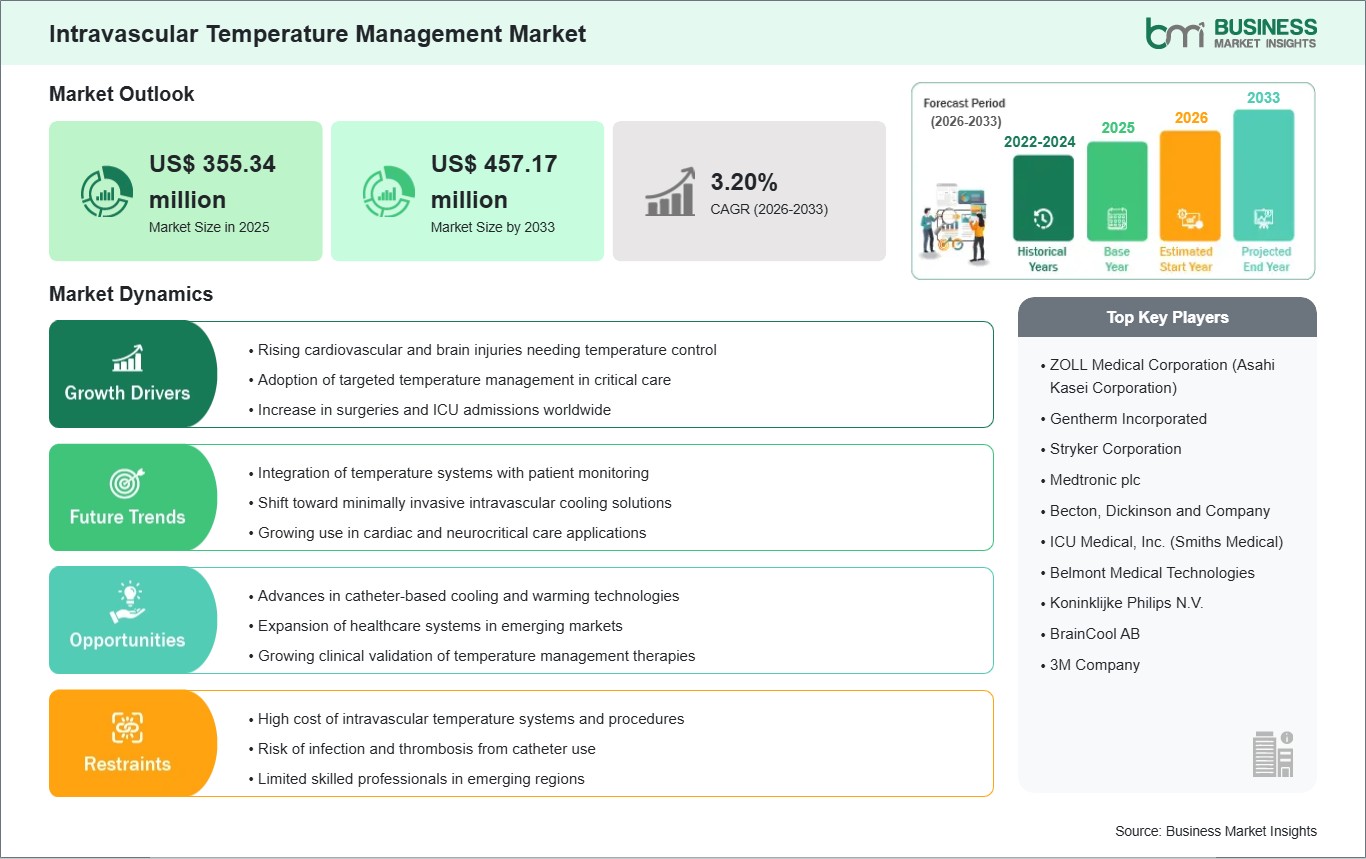
Intravascular temperature management (IVTM) is a precise medical procedure designed to rapidly induce, maintain, or reverse a patient`s core body temperature by directly warming or cooling the venous blood supply. IVTM devices provide significant strategic value by ensuring superior thermal stability for patients in intensive care units (ICUs), emergency departments, and neuro-critical care settings. The expansion of this market is driven by a global increase in neurological and cardiovascular emergencies, the rapid adoption of Targeted Temperature Management (TTM) protocols, and the growing use of closed-loop artificial intelligence (AI) feedback systems that reduce human error in thermoregulation. Additionally, the transition to minimally invasive, multi-lumen catheters that integrate temperature management with traditional infusion functions is enhancing bedside efficiency and patient safety.
Several challenges may limit market growth. High costs associated with proprietary disposables and capital equipment present financial barriers for smaller regional hospitals. Clinical risks, including catheter-related thrombosis and infection, remain significant concerns and necessitate intensive monitoring by specialized nursing staff. Furthermore, the industry is constrained by complex regulatory requirements and the necessity for extensive clinical trial data to support new therapeutic indications, which can delay the introduction of next-generation hardware.
Despite these challenges, the market presents substantial opportunities. The global emphasis on improving neurological outcomes following stroke and the increasing use of portable IVTM systems for pre-hospital and emergency transport are key growth drivers. Additionally, the integration of thermoregulation in robotic surgery and advancements in anti-thrombogenic catheter coatings are anticipated to support long-term market expansion.
Segment Analysis
Intravascular Temperature Management Market Segmentation
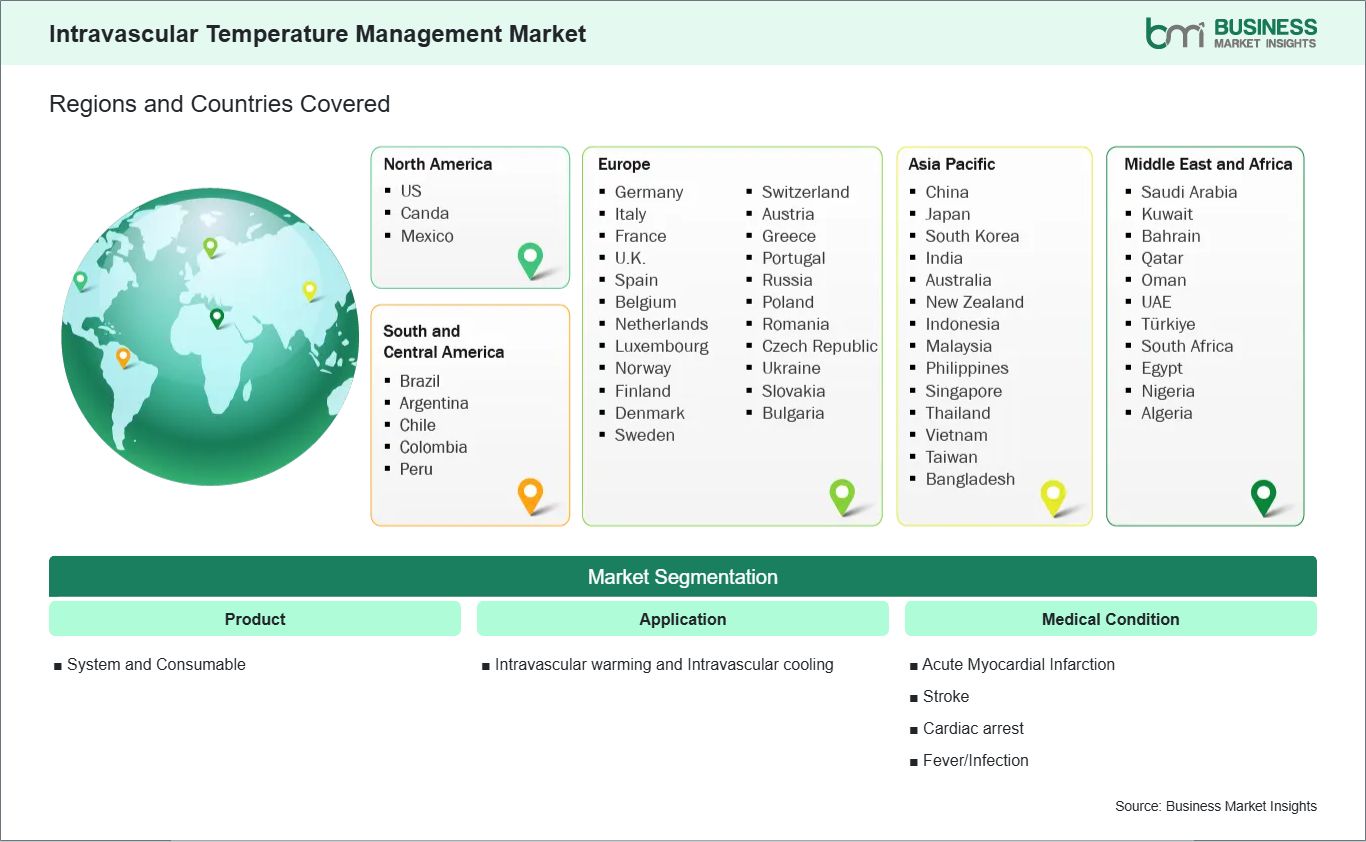
Key segments that contributed to the derivation of the Intravascular Temperature Management market analysis are product, application, and medical condition.
- By Product, the market is segmented into System and Consumable.
- By Application, the market is divided into Intravascular warming and Intravascular cooling.
- By Medical condition, the market is categorized into Acute Myocardial Infarction, Stroke, Cardiac arrest, and Fever/Infection.
Market Forces
Intravascular Temperature Management Market Drivers and Opportunities
Advancing Neuroprotection and Institutionalizing TTM Protocols
The primary driver of the Intravascular Temperature Management Market is the widespread adoption of Targeted Temperature Management (TTM) within standardized clinical guidelines. The increasing incidence of Sudden Cardiac Arrest (SCA) and stroke serves as a significant market force, given that neurological recovery is closely linked to the rapidity and stability of temperature control, areas in which intravascular systems consistently outperform surface methods. Additionally, the expanding clinical application of intravascular temperature management (IVTM) in the treatment of traumatic brain injury (TBI) has led to its use as a proactive intervention for managing refractory intracranial pressure. In surgical contexts, the high volume of complex cardiovascular and neurovascular procedures further drives market growth, as maintaining normothermia is critical for reducing surgical site infections and coagulopathy.
Furthermore, the Integration of AI-driven feedback Loops within IVTM consoles serves as a major catalyst; these systems now utilize real-time patient data to auto-adjust thermal exchange, minimizing temperature overshoot and reducing the labor-intensive monitoring traditionally required by ICU staff. Together, these factors, rigorous clinical guidelines, a growing high-risk patient demographic, and automated precision ensure that intravascular systems are becoming a non-discretionary component of modern critical care portfolios.
Tele-ICU Integration and Minimalist Next-Gen Catheter Designs
A significant opportunity exists in the integration of intravascular temperature management (IVTM) with Tele-ICU and cloud-linked monitoring platforms. Next-generation consoles are being developed to stream temperature data directly to remote dashboards, enabling centralized specialists to manage targeted temperature management (TTM) protocols for multiple patients across various geographic locations. This capability is particularly valuable for rural or spoke hospitals. Additionally, substantial growth potential is evident in the advancement of minimalist, multi-lumen heat-exchange catheters. By combining heat exchange with standard central venous access, manufacturers can eliminate secondary punctures, thereby reducing infection risk and decreasing the time required to reach target temperature.
The expansion of ambulance and pre-hospital cooling initiatives creates a promising market for portable, battery-operated IVTM units capable of initiating neuroprotective cooling as soon as a patient is stabilized in the field. In addition to conventional cooling, the emergence of integrated warming for sepsis and trauma represents a significant area of growth, where rapid-infusion IVTM systems are employed to reverse accidental hypothermia in patients experiencing shock. Manufacturers prioritizing disposable, biocompatible catheter materials and those developing bundled device-as-a-service (DaaS) models for emerging economies are well positioned to lead the most innovative and high-margin segments of the global intravascular temperature management market.
Size and Share Analysis
Intravascular Temperature Management Market Size and Share Analysis
The Intravascular Temperature Management market demonstrates steady growth, with size and share analysis revealing evolving trends and competitive positioning among key players. The report further examines subsegments categorized within product, application, and medical condition, offering insights into their contribution to overall market performance.
Based on product, the Consumables and Systems subsegment holds a significant market presence, representing the classic razor-and-blade business model of high-capital investment followed by high-volume recurring revenue. Consumables, specifically heat-exchange catheters, are indispensable for the Acute Care vertical, as they are the primary point of contact with the patient's venous system and must be replaced for every procedure. A notable trend is the surge in the Systems subsegment, which is registering higher interest as hospitals upgrade to Multi-Mode Consoles. These next-generation systems are becoming essential for Stroke Centers, providing the computational power necessary to manage both cooling and warming through a single interface, thereby streamlining hospital procurement and training.
Report Coverage
Intravascular Temperature Management Market Report Coverage and Deliverables
The "Intravascular Temperature Management Market Size and Forecast (2022 - 2033)" report provides a detailed analysis of the market covering below areas:
- Intravascular Temperature Management market size and forecast at global, regional, and country levels for all the key market segments covered under the scope
- Intravascular Temperature Management market trends, as well as market dynamics such as drivers, restraints, and key opportunities
- Intravascular Temperature Management market analysis covering key market trends, global and regional framework, major players, regulations, and recent market developments
- Industry landscape and competition analysis covering market concentration, heat map analysis, prominent players, and recent developments for the Intravascular Temperature Management market
- Detailed company profiles, including SWOT analysis
Geographic Insights
Intravascular Temperature Management Market Geographic Insights
The geographical scope of the Intravascular Temperature Management market report is divided into five regions: North America, Asia Pacific, Europe, Middle East and Africa, and South and Central America.
North America holds a significant revenue share, supported by advanced critical care infrastructure, high intensive care unit (ICU) bed density, and rigorous implementation of evidence-based Targeted Temperature Management (TTM) protocols. Europe ranks second, with significant adoption in countries such as Germany, the United Kingdom, and France, where centralized healthcare systems and robust clinical research networks emphasize precise thermal regulation to enhance neurological outcomes. The Asia Pacific region demonstrates the fastest growth, driven by rapid urbanization, substantial investment in tertiary hospitals, and a shift toward modernized emergency care pathways.
The Asia-Pacific Intravascular Temperature Management Market is segmented into China, Japan, South Korea, India, Australia, and the Rest of Asia-Pacific. China serves as a primary growth driver, advancing toward higher ICU standards that integrate catheter-based cooling for post-cardiac arrest and stroke patients. India is experiencing a rapid expansion of private-sector hospitals, resulting in increased demand for cost-effective modular systems. In Japan and South Korea, the market is characterized by a preference for high-precision devices designed for an aging population, with intravascular systems preferred over surface cooling due to greater accuracy and faster induction times.
Industry Activity
Recent Developments
The Intravascular Temperature Management market is evaluated by gathering qualitative and quantitative data post primary and secondary research, which includes important corporate publications, association data, and databases. A few of the key developments in the Intravascular Temperature Management market are:
- In January 2026, Lightera announced a development program integrating real-time fiber-optic temperature sensing with laser delivery for medical procedures. The platform provides precise temperature feedback at the treatment site, enabling safer intravascular interventions and supporting collaboration with medical device partners to commercialize tailored solutions.
- In January 2026, Nichia and Illumi Medical announced a joint development of an ultra-compact intravascular laser catheter for deep-tissue phototherapy. The collaboration aims to enable minimally invasive, precise light-based treatments, advancing next-generation intravascular therapy solutions.
Trust & Transparency
Research Methodology
The market analysis combines proprietary research with secondary data from government agencies, company disclosures, regulatory filings, industry databases and expert interviews. Market estimates are validated through data triangulation, cross-market benchmarking and analyst
review.
View Full Research Methodology
Key Sources Referred:
World Bank - Global Trade IndicatorsWorld Trade Organization (WTO)International Monetary Fund (IMF)International Trade Administration (ITA)Company websiteCompany annual reportsCompany investor presentations