Market Summary
Executive Summary and Global Market Analysis
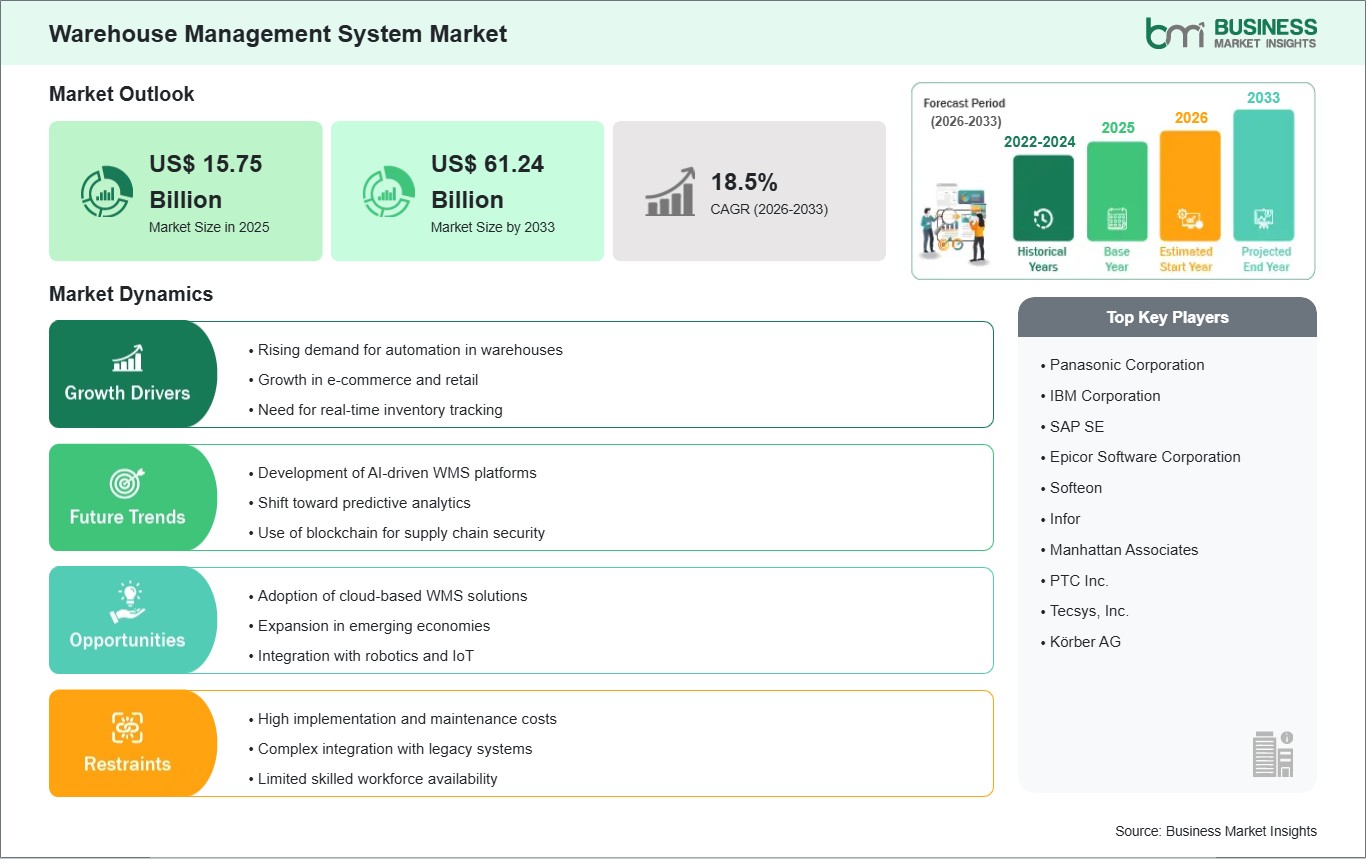
A Warehouse Management System (WMS) is a software solution designed to oversee and optimize all aspects of a company's warehouse operations, from the moment goods arrive until they are shipped out. It manages key processes such as inventory tracking, receiving and putaway, picking and packing, shipping, and labor management, providing real-time visibility and control.
The WMS market is experiencing robust growth driven by the explosive expansion of e-commerce and the associated complexity of omnichannel fulfillment. Businesses globally are recognizing that manual or legacy systems cannot cope with the demand for faster, more accurate order processing and are increasingly adopting modern WMS solutions. The shift toward cloud-based WMS, coupled with the integration of technologies like IoT, AI, and robotics, is further propelling the market by offering enhanced efficiency and scalability.
Segment Analysis
Warehouse Management System Market Segmentation
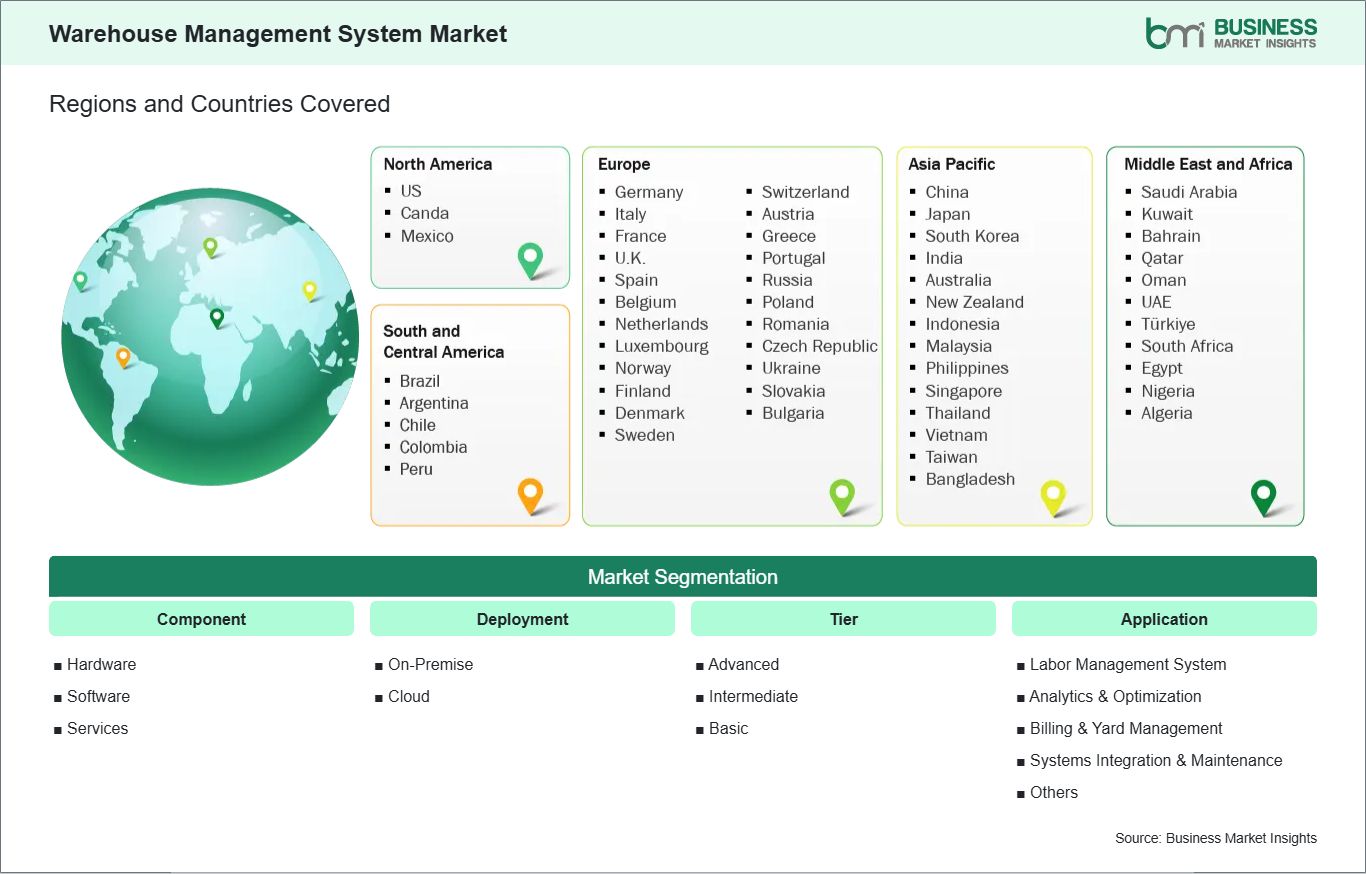
Key segments that contributed to the derivation of the Warehouse Management System Market analysis are component, deployment, tier, and application.
- By Component, the market is segmented into Hardware, Software, and Services.
- By Deployment, the market is bifurcated into On-Premise and Cloud.
- By Tier, the market is segmented into Advanced, Intermediate, and Basic.
- By Application, the market is segmented into Labor Management System, Analytics & Optimization, Billing & Yard Management, Systems Integration & Maintenance, and Others.
Market Forces
Warehouse Management System Market Drivers and Opportunities
Increasing Adoption of Automation and Robotics in Warehousing
The global trend towards warehouse automation is the single most powerful driver for the WMS market. Modern warehouses are rapidly adopting automated material handling equipment (like conveyors and Automated Storage and Retrieval Systems - AS/RS), along with robotics, such as Autonomous Mobile Robots (AMRs) for tasks like picking, sorting, and transport.
- Necessity for Integration: These advanced automated systems cannot operate in silos; they require a sophisticated WMS to act as the central brain. The WMS must integrate seamlessly with all automated equipment, providing real-time data for optimized task scheduling, route planning for robotics, and sequencing for AS/RS.
- Efficiency and Throughput: Automation significantly boosts warehouse throughput, reduces dependency on manual labor (addressing labor shortages), and minimizes errors. The WMS is essential for realizing these benefits by managing the integrated workflow to ensure continuous, high-speed, and accurate movement of goods from receiving to shipping, thereby driving WMS adoption across all major industries.
Expansion of E-Commerce and Omnichannel Fulfillment
The relentless growth of e-commerce and the widespread shift toward omnichannel retail models present a massive structural opportunity for the WMS market. Omnichannel fulfillment requires a system capable of managing inventory, not just in one distribution center, but across multiple locations, including dedicated fulfillment centers, retail stores, and 3PL networks.
- Complexity Management: This environment introduces complex requirements like managing high volumes of single-item orders, implementing dynamic order fulfillment strategies (e.g., wave-less picking), and handling reverse logistics (returns).
- Demand for Agility: The WMS must be agile enough to provide real-time inventory visibility across all channels, prioritize orders based on service level agreements (SLAs), and coordinate last-mile delivery. The continued dominance and evolution of e-commerce guarantee sustained, high demand for advanced, flexible, and scalable WMS solutions, especially cloud-based platforms, to manage this rapidly growing supply chain complexity.
Size and Share Analysis
Warehouse Management System Market Size and Share Analysis
The Warehouse Management System Market demonstrates consistent growth, with size and share analysis revealing strong positioning for material and product leaders amid customization trends. The report examines subsegments within component, deployment, tier, and application, offering insights into their contribution to overall market performance.
For instance, the Services subsegment holds a significant share due to the high demand for consulting and integration. However, Cloud-based deployments are anticipated to grow fastest due to their flexibility and cost-effectiveness. Retail and E-commerce lead industry revenues, driven by the popularity of rapid fulfillment procedures.
Report Coverage
Warehouse Management System Market Report Coverage and Deliverables
The "Warehouse Management System Market Size and Forecast (2022 - 2033)" report provides a detailed analysis of the market covering below areas:
- Warehouse Management System Market size and forecast at global, regional, and country levels for all the key market segments covered under the scope
- Warehouse Management System Market trends, as well as market dynamics such as drivers, restraints, and key opportunities
- Warehouse Management System Market analysis covering key market trends, global and regional framework, major players, regulations, and recent market developments
- Industry landscape and competition analysis covering market concentration, heat map analysis, prominent players, and recent developments for the Warehouse Management System Market
- Detailed company profiles, including SWOT analysis
Geographic Insights
Warehouse Management System Market Geographic Insights
The geographical scope of the Warehouse Management System Market report is divided into five regions: North America, Asia Pacific, Europe, Middle East & Africa, and South & Central America.
Europe holds a significant share of the global market, driven by its extensive, mature logistics infrastructure, a high concentration of sophisticated Third-Party Logistics (3PL) providers, and early regulatory adoption of advanced supply chain technologies. WMS implementation in Europe is characterized by modernization and integration with advanced automation.
Furthermore, the market in Asia Pacific is expected to expand rapidly. It is fueled by the explosive growth of e-commerce and the swift industrialization of economies like China and India, leading to massive investments in new warehousing and fulfillment centers. The region's price sensitivity often favors the adoption of scalable, cloud-based WMS solutions, providing lower entry costs for the large base of SMEs and e-commerce companies looking to professionalize their supply chain operations rapidly. North America follows closely as a major revenue contributor, driven by a strong focus on cloud adoption and addressing severe labor shortages through robotics integrated with WMS.
Industry Activity
Recent Developments
The Warehouse Management System Market is evaluated by gathering qualitative and quantitative data post-primary and secondary research, which includes important corporate publications, association data, and databases. A few of the key developments in the Warehouse Management System Market are:
- In May 2024, Blue Yonder, a global leader in end?to?end digital supply chain transformation, announced that it had acquired the business of Pledge Earth Technologies Ltd. (“Pledge”), including its supply chain sustainability platform serving beneficial cargo owners (BCOs), enterprise supply chain organizations, and logistics service providers (LSPs).
- In March 2024, Panasonic Connect Co., Ltd., announced that it has developed a new AI-based technology that optimizes tasks in the warehouse to enhance efficiency and solve issues in logistics with the aim of future implementation with Blue Yonder Warehouse Management solutions.
Trust & Transparency
Research Methodology
The market analysis combines proprietary research with secondary data from government agencies, company disclosures, regulatory filings, industry databases and expert interviews. Market estimates are validated through data triangulation, cross-market benchmarking and analyst
review.
View Full Research Methodology
Key Sources Referred:
World Bank - Global Trade IndicatorsWorld Trade Organization (WTO)International Monetary Fund (IMF)International Trade Administration (ITA)Company WebsitesCompany Annual ReportsCompany Investor Presentations