Market Summary
Executive Summary and Global Market Analysis
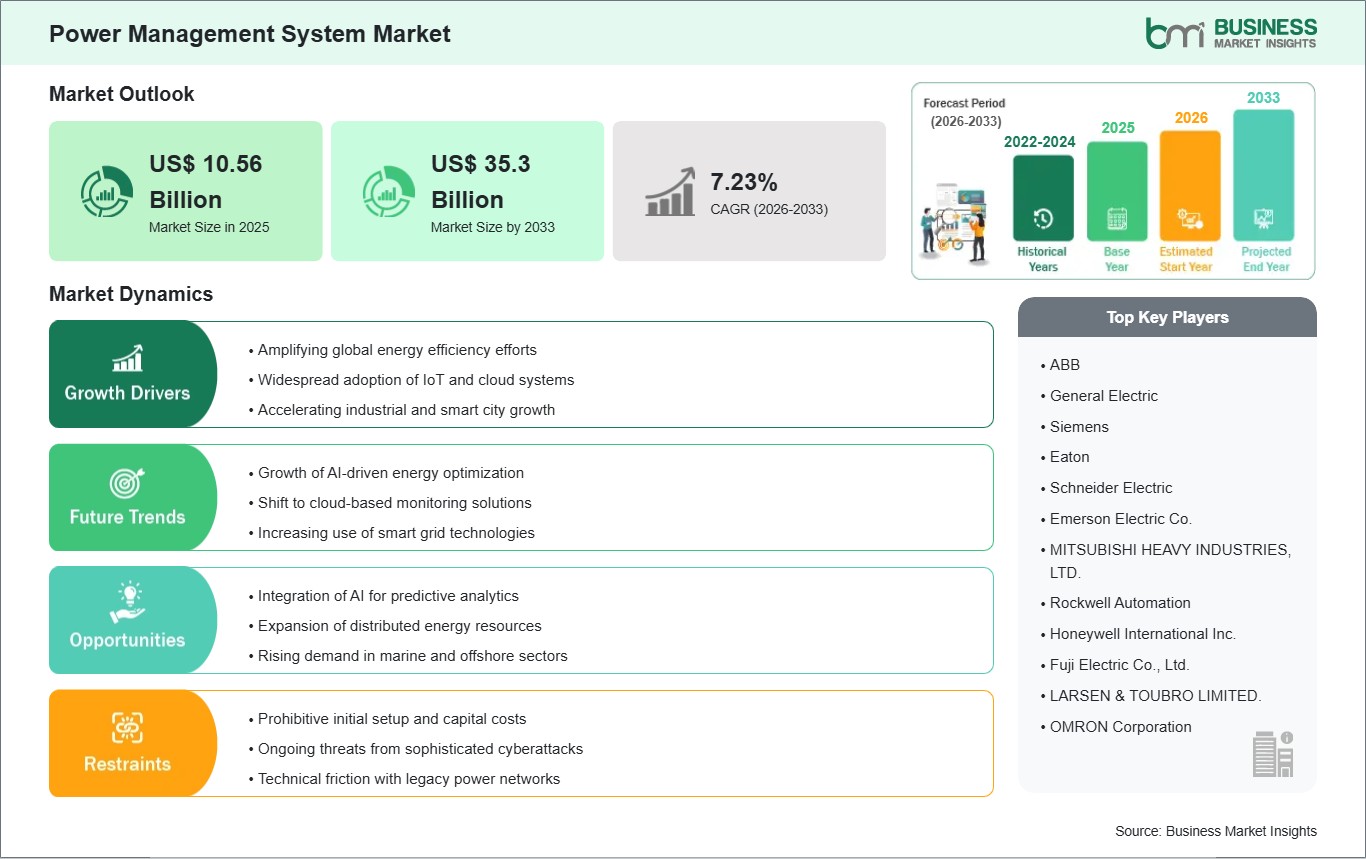
Power Management System (PMS) plays a critical role in the oversight, control, and optimization of power generation, distribution, and consumption across various facilities. It provides essential capabilities for key end-user segments: utilities, large data centers, oil & gas operations, and marine vessels. PMS offers advantages, including ensuring grid stability, preventing blackouts through load management, significantly enhancing energy efficiency, and reducing operational expenditure. The market is being fueled by stringent regulatory pressure for industrial-scale energy efficiency programs, the rapid global integration of intermittent renewable energy sources (solar and wind), and the exponential power demands of hyperscale and AI data centers. Additionally, the pervasive adoption of Industrial IoT (IIoT) and digitization is enabling real-time optimization and analytics for power usage.
However, several challenges can restrain market growth: the high upfront capital investment required for installation and technical expertise, particularly for retrofitting aging infrastructure, can be prohibitive. Data security and escalating cyber-security risks associated with cloud-based and highly interconnected systems present a constant barrier to trust and adoption. Furthermore, incompatibility issues when integrating modern PMS software and hardware with legacy operational technology (OT) systems create significant technical and cost hurdles. Despite these challenges, the market holds significant opportunities due to the global trend toward Energy-as-a-Service (EaaS) models, which lower initial costs, the necessity for enhanced grid stability solutions to manage renewable energy fluctuations, and the growing corporate focus on achieving sustainability and net-zero goals.
Segment Analysis
Power Management System Market Segmentation
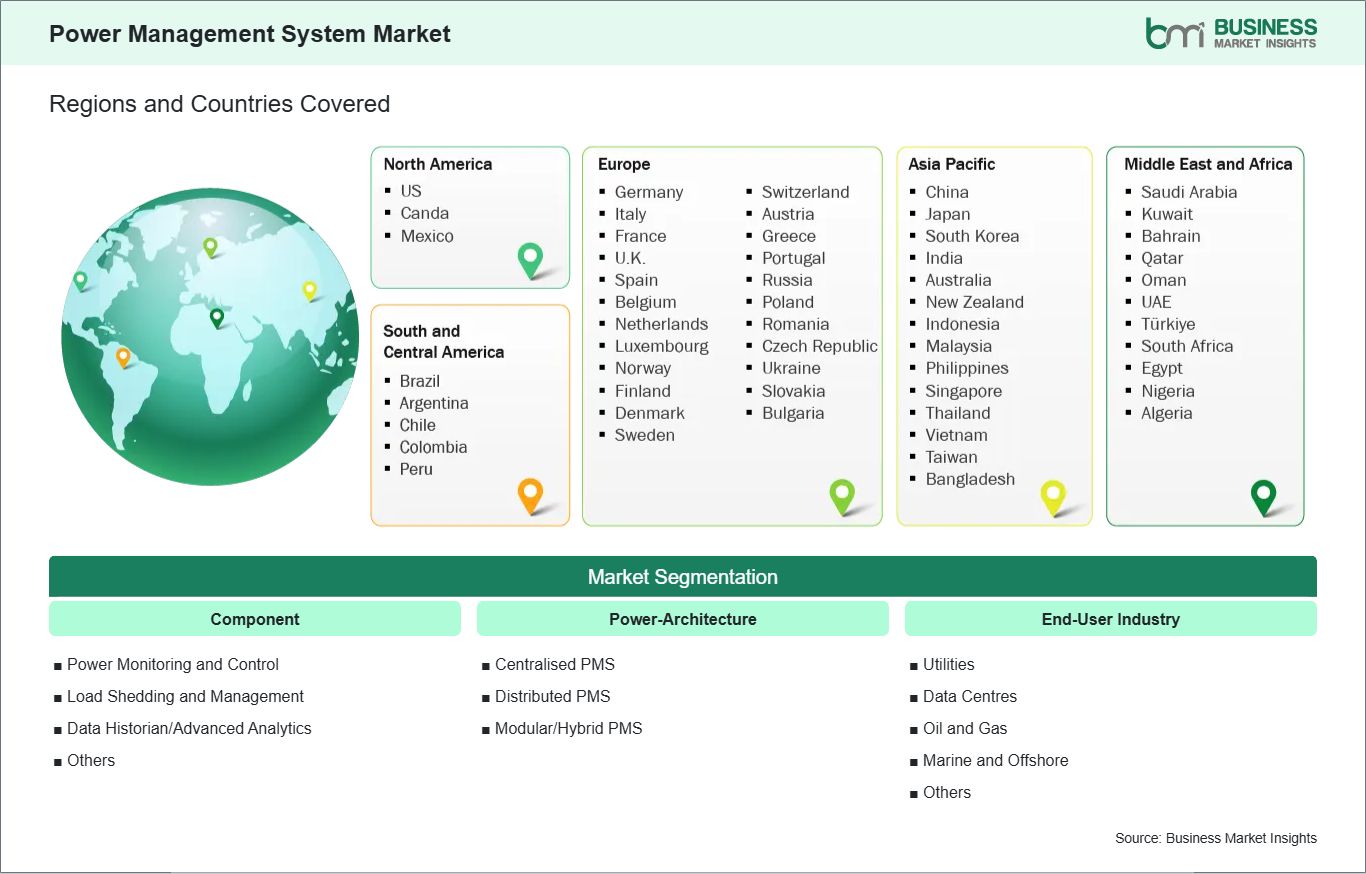
Key segments that contributed to the derivation of the Power Management System market analysis are component, power-architecture, and end-user industry.
- By Component, the market is segmented into Power Monitoring and Control, Load Shedding and Management, Data Historian/Advanced Analytics, and Others.
- By Power-Architecture, the market is segmented into Centralised PMS, Distributed PMS, and Modular/Hybrid PMS.
- By End-User Industry, the market is segmented into Utilities, Data Centres, Oil and Gas, Marine and Offshore, and Others.
Market Forces
Power Management System Market Drivers and Opportunities
Demand for Energy Efficiency and Sustainability
The fundamental factor propelling the Power Management System (PMS) market is the increasing, non-negotiable global focus on energy efficiency, cost reduction, and environmental sustainability. Businesses and utilities worldwide are under escalating pressure to reduce operating costs while meeting stringent governmental and corporate mandates to lower carbon footprints. Power Management Systems directly address this need by providing comprehensive tools for real-time monitoring, analysis, and precise control of power consumption across various sectors. These systems enable energy-intensive industries (such as oil & gas, metals & mining, and manufacturing) to identify and eliminate energy waste, optimize load distribution, and reduce peak demand charges. The ability of a PMS to supervise, control, and optimize complex electrical networks for reliability and efficiency is essential for modern business strategy, making it a critical investment rather than an optional expense.
AI-Powered Smart Grids and Data Centers
The most dynamic opportunities for the Power Management System market exist in the integration of artificial intelligence (AI) with smart grids and the explosion of power demand from hyperscale data centers. The integration of intermittent renewable energy sources (like solar and wind) requires the power grid to be far more intelligent and responsive. PMS solutions, particularly those utilizing AI and advanced analytics, enable the creation of true smart grids. These systems can perform complex functions like adaptive islanding, automatic load shedding, and predictive maintenance in real-time to maintain grid stability despite variable supply. Furthermore, the massive power requirements of new data centers and AI computing are creating a critical need for highly reliable, ultra-efficient power blocks. PMS is essential in these facilities for ensuring an uninterruptible power supply, optimizing the efficiency of enormous power blocks, and integrating localized power generation, representing a high-growth, high-value segment for advanced power management solutions.
Size and Share Analysis
Power Management System Market Size and Share Analysis
The Power Management System market demonstrates steady growth, with size and share analysis revealing evolving trends and competitive positioning among key players. The report further examines subsegments categorized within component, power-architecture, and end-user industry, offering insights into their contribution to overall market performance.
For instance, the Power Monitoring and Control segment is a primary driver in the Utilities sector, frequently utilizing Centralised PMS. This configuration allows grid operators to maintain a "single pane of glass" view of the network, ensuring voltage stability and frequency regulation across large geographical areas. The centralized approach is valued for its ability to enforce uniform security policies and provide consistent data governance across the entire utility infrastructure.
Report Coverage
Power Management System Market Report Coverage and Deliverables
The "Power Management System Market Size and Forecast (2022 - 2033)" report provides a detailed analysis of the market covering below areas:
- Power Management System market size and forecast at global, regional, and country levels for all the key market segments covered under the scope
- Power Management System market trends, as well as market dynamics such as drivers, restraints, and key opportunities
- Power Management System market analysis covering key market trends, global and regional framework, major players, regulations, and recent market developments
- Industry landscape and competition analysis covering market concentration, heat map analysis, prominent players, and recent developments for the Power Management System market
- Detailed company profiles, including SWOT analysis
Geographic Insights
Power Management System Market Geographic Insights
The geographical scope of the Power Management System market report is divided into five regions: North America, Asia Pacific, Europe, Middle East & Africa, and South & Central America.
The Asia-Pacific Power Management System Market is segmented into China, Japan, South Korea, India, Australia, New Zealand, Indonesia, Malaysia, the Philippines, Singapore, Thailand, Vietnam, Taiwan, Bangladesh, and the Rest of Asia. The market is primarily driven by rapid industrialization and the aggressive integration of renewable energy sources such as solar and wind into national grids.
Growth is further accelerated by the expansion of hyperscale data centers and the rising demand for reliable power in the marine and oil & gas sectors. The increasing adoption of AI-driven load orchestration and the shift toward decentralized microgrids solidify Asia-Pacific as the critical global hub for power management system deployment.
Industry Activity
Recent Developments
The Power Management System market is evaluated by gathering qualitative and quantitative data post primary and secondary research, which includes important corporate publications, association data, and databases. A few of the key developments in the Power Management System market are:
- In February 2025, ABB and Samsung Electronics announced the upcoming integration of ABB's InSite energy management system into Samsung's SmartThings and SmartThings Pro platforms, marking a significant advancement in smart building technology. Building on the previous incorporation of the ABB-free@home® smart home system into SmartThings, this advancement allows users to easily visualize, control, and optimize energy consumption in residential, multi-apartment, mixed-use, and light commercial buildings.
- In February 2025, Schneider Electric Debuts New Smart Power Management Solution Enabling Builders to Avoid Costly Electrical Service Upgrades. The new Smart Power Manager feature in the Square D QO Smart Panel Solution available this summer provides smarter energy management to homes anywhere in the country.
Trust & Transparency
Research Methodology
The market analysis combines proprietary research with secondary data from government agencies, company disclosures, regulatory filings, industry databases and expert interviews. Market estimates are validated through data triangulation, cross-market benchmarking and analyst
review.
View Full Research Methodology
Key Sources Referred:
World Bank - Global Trade IndicatorsWorld Trade Organization (WTO)International Monetary Fund (IMF)International Trade Administration (ITA)Company WebsitesCompany Annual ReportsCompany Investor Presentations