Market Summary
Executive Summary and Global Market Analysis
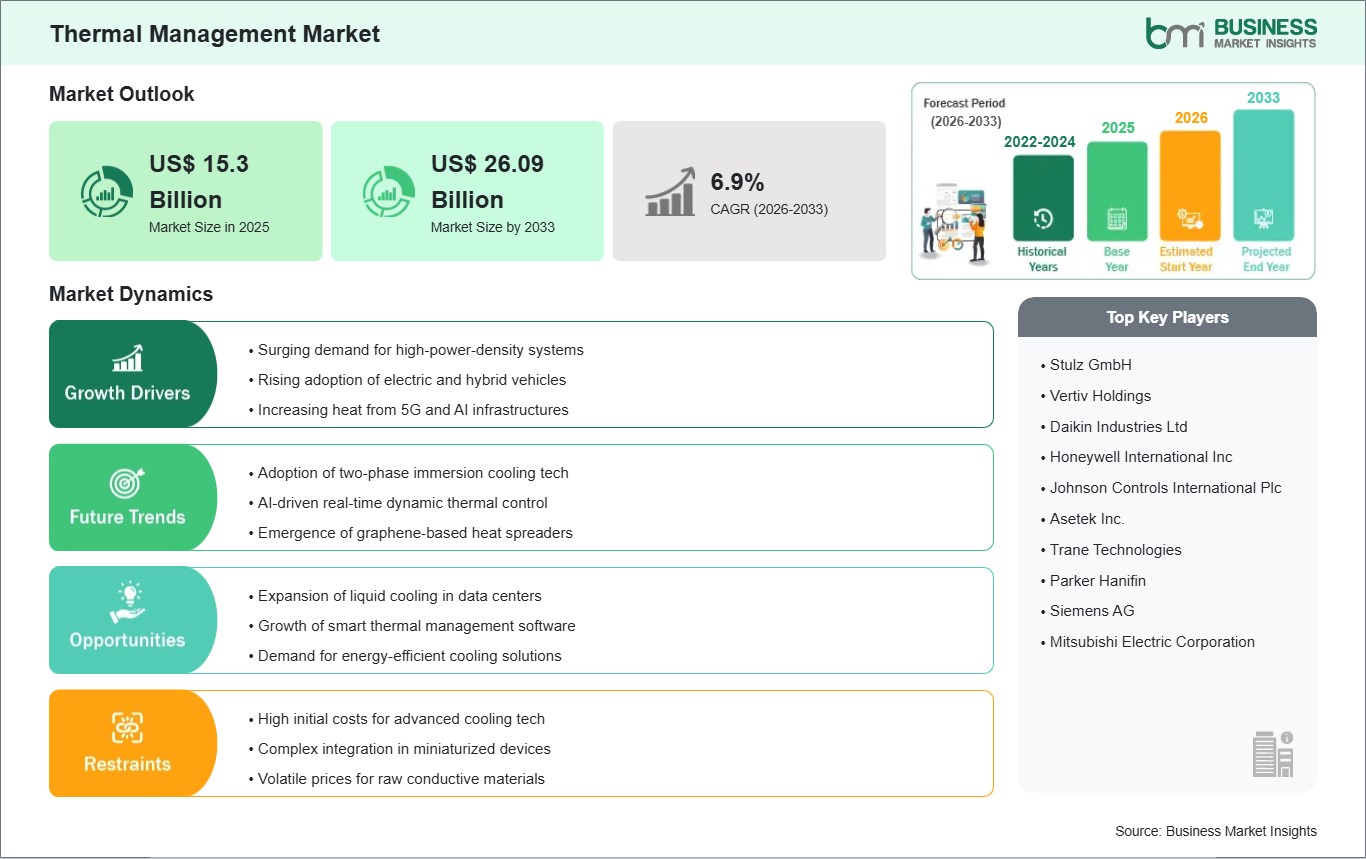
Thermal Management plays a pivotal role in ensuring the optimal performance, reliability, and safety of modern electronic systems and high-power applications. It provides essential solutions for dissipating heat, which is vital for industries such as consumer electronics, data centers, electric vehicles (EVs), and aerospace. Efficient thermal management offers advantages; for instance, extended component lifespan, improved energy efficiency, and prevention of dangerous failures such as thermal runaway in batteries. The market is being fueled by the rising power density and miniaturization of electronic devices (5G and AI chips), the explosive growth of hyperscale data centers requiring liquid cooling, and the massive global expansion of the EV market, which critically depends on advanced battery thermal management systems (BTMS). Furthermore, the integration of smart, AI-driven cooling systems is enhancing efficiency.
However, several challenges can restrain market growth, such as the increasing design complexity required to manage high heat loads in extremely compact spaces, which limits design flexibility and efficiency. The high initial capital and deployment costs associated with advanced solutions like immersion cooling can also hinder adoption, especially for smaller enterprises. Despite these hurdles, the market holds significant opportunities due to the global focus on energy efficiency and sustainability, stringent vehicular emission regulations (driving demand for efficient automotive thermal systems), and ongoing innovations in materials science, including the adoption of advanced thermal interface materials and liquid cooling technologies. The rapid technological shifts in the Asia-Pacific region further position the market for continued robust expansion.
Segment Analysis
Thermal Management Market Segmentation
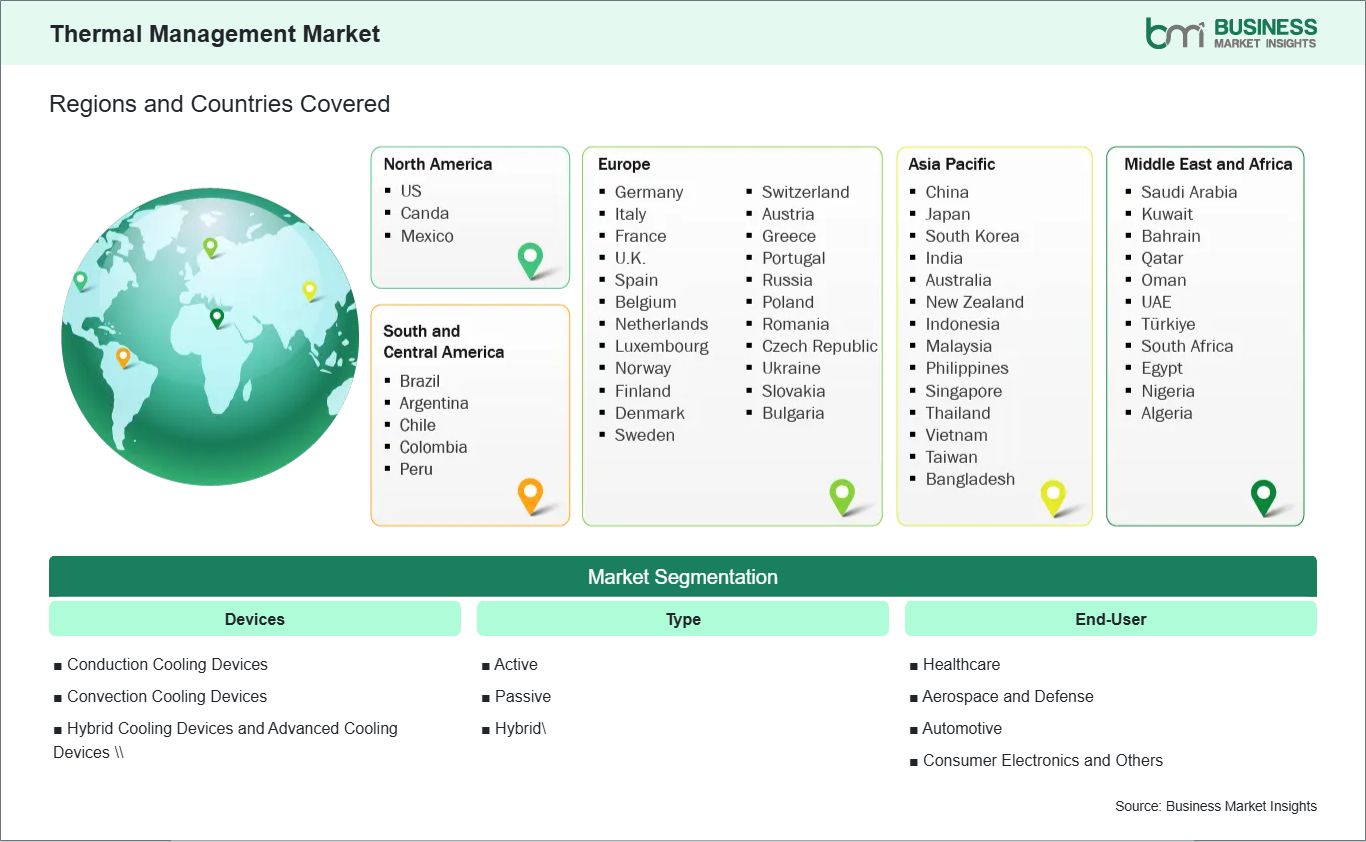
Key segments that contributed to the derivation of the Thermal Management market analysis are devices, type, and end-user.
- By Devices, the market is segmented into Conduction Cooling Devices, Convection Cooling Devices, and Hybrid Cooling Devices and Advanced Cooling Devices.
- By Type, the market is segmented into Active, Passive, and Hybrid.
- By End-User, the market is segmented into Healthcare, Aerospace and Defense, Automotive, and Consumer Electronics, and Others
Market Forces
Thermal Management Market Drivers and Opportunities
Miniaturization and High-Power Density in Electronics
The primary force driving the thermal management market is the continuous trend of miniaturization and the resulting surge in heat flux across modern electronic components. Devices across all sectors are becoming smaller, simultaneously more powerful, and functionally integrated. This confluence of compact size and high-performance processing (e.g., in advanced microprocessors, 5G devices, and high-end consumer electronics) leads to a substantial increase in heat generation within very small volumes. Failure to dissipate this heat efficiently leads to immediate performance throttling, reduced component lifespan, and potential failure. Consequently, the demand for sophisticated, compact, and high-efficiency thermal management solutions, such as advanced heat sinks, thermal interface materials, and micro-channel heat exchangers, is critical to ensure the reliability and optimal operation of the latest generation of electronic devices.
Electric Vehicles (EVs) and Data Centers
The rapid and non-negotiable electrification of the automotive industry and the massive expansion of global data centers represent the largest growth opportunities for the thermal management market. Electric vehicles require complex Battery Thermal Management Systems (BTMS) to regulate the temperature of large lithium-ion battery packs. This is vital for maximizing driving range, ensuring fast-charging capability, and preventing catastrophic thermal runaway events. As EV adoption accelerates, so does the demand for advanced liquid cooling loops, cold plates, and thermal interface materials tailored for battery packs. Similarly, the relentless growth of cloud computing, Artificial Intelligence (AI), and Big Data processing is creating ultra-high-power density in data centers. This has catalyzed a major shift toward high-efficiency cooling technologies, particularly liquid cooling and immersion cooling, which are far more effective than traditional air cooling for managing the extreme heat generated by modern server racks.
Size and Share Analysis
Thermal Management Market Size and Share Analysis
The Thermal Management market demonstrates steady growth, with size and share analysis revealing evolving trends and competitive positioning among key players. The report further examines subsegments categorized within devices, type, and end-user, offering insights into their contribution to overall market performance.
For instance, Convection Cooling Devices represent a significant share and are widely utilized in Active systems across the Consumer Electronics sector. This segment is driven by the universal need for cost-effective heat dissipation in laptops and smartphones, where fans and forced-air systems are critical for maintaining performance in increasingly compact hardware.
Report Coverage
Thermal Management Market Report Coverage and Deliverables
The "Thermal Management Market Size and Forecast (2022 - 2033)" report provides a detailed analysis of the market covering below areas:
- Thermal Management market size and forecast at global, regional, and country levels for all the key market segments covered under the scope
- Thermal Management market trends, as well as market dynamics such as drivers, restraints, and key opportunities
- Thermal Management market analysis covering key market trends, global and regional framework, major players, regulations, and recent market developments
- Industry landscape and competition analysis covering market concentration, heat map analysis, prominent players, and recent developments for the Thermal Management market
- Detailed company profiles, including SWOT analysis
Geographic Insights
Thermal Management Market Geographic Insights
The geographical scope of the Thermal Management market report is divided into five regions: North America, Asia Pacific, Europe, Middle East & Africa, and South & Central America.
The Asia-Pacific Thermal Management Market is segmented into China, Japan, South Korea, India, Australia, New Zealand, Indonesia, Malaysia, the Philippines, Singapore, Thailand, Vietnam, Taiwan, Bangladesh, and the Rest of Asia. The market is primarily driven by the region's dominance in electronics manufacturing and the rapid miniaturization of consumer devices. China and South Korea lead the growth, fueled by the massive production of smartphones, laptops, and high-performance computing systems that require advanced heat dissipation.
Growth is further bolstered by the booming Electric Vehicle (EV) sector and the expansion of hyperscale data centers, particularly in Southeast Asia and India. The increasing adoption of liquid cooling and advanced thermal interface materials to manage high power densities in AI-driven infrastructure and automotive batteries solidifies Asia-Pacific as the critical global hub for thermal management innovation.
Industry Activity
Recent Developments
The Thermal Management market is evaluated by gathering qualitative and quantitative data post primary and secondary research, which includes important corporate publications, association data, and databases. A few of the key developments in the Thermal Management market are:
- In October 2025, Trane Technologies (NYSE: TT), a global climate innovator, announced the launch of the industry’s first comprehensive thermal management system reference design, specifically engineered for the NVIDIA Omniverse DSX Blueprint for gigawatt-scale AI data centers. This pioneering solution sets new standards for performance, scalability, and rapid deployment, supporting the most demanding AI factories, including gigawatt-scale factories powered by the latest NVIDIA AI infrastructure.
- In October 2025, Vertiv (NYSE: VRT), a global leader in critical digital infrastructure, announced the North America availability of low-GWP refrigerant versions of its perimeter, row, and wall-mount cooling systems for data centers. These systems are part of Vertiv’s direct expansion (DX) thermal management portfolio and are available more than a year in advance of US EPA requirements taking effect on January 1, 2027. Further, they are fully compliant with current California regulations as well as with impending New York state regulations that take effect in January 2026.
Trust & Transparency
Research Methodology
The market analysis combines proprietary research with secondary data from government agencies, company disclosures, regulatory filings, industry databases and expert interviews. Market estimates are validated through data triangulation, cross-market benchmarking and analyst
review.
View Full Research Methodology
Key Sources Referred:
World Bank - Global Trade IndicatorsWorld Trade Organization (WTO)International Monetary Fund (IMF)International Trade Administration (ITA)Company WebsitesCompany Annual ReportsCompany Investor Presentations