Market Summary
Executive Summary and Global Market Analysis
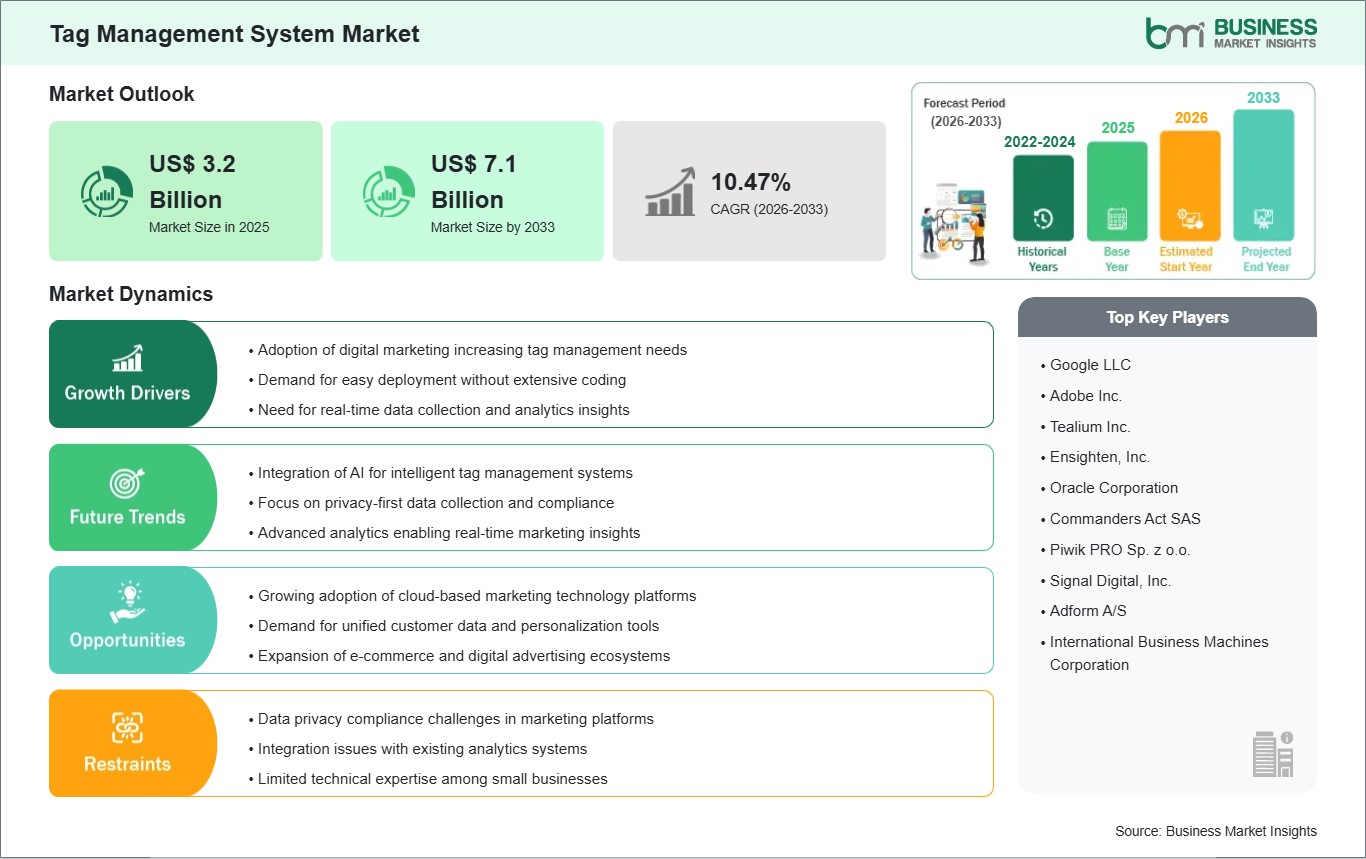
A Tag Management System (TMS) is a specialized software solution that allows digital marketers and developers to implement, maintain, and manage "tags", small snippets of code or tracking pixels, without directly modifying a website`s or mobile application`s source code. By using a single "container" tag, a TMS provides a centralized web interface where users can deploy third-party marketing tools (e.g., Google Analytics, Facebook Pixels, AdWords) and define specific triggers (rules) for when those tags should fire. This technology effectively decouples marketing agility from IT development cycles. Market expansion is primarily attributed to the rising global demand for first-party data strategies as third-party cookies are phased out, the rapid acceleration of mobile app and IoT tracking, and the escalating need for centralized data governance.
However, several challenges can restrain market growth: high initial procurement and setup costs, particularly for enterprise-grade solutions that require complex data layer architecture, can limit adoption among smaller organizations. Stringent regulatory hurdles, specifically evolving privacy mandates like GDPR and CCPA, lengthen the time-to-market for new tracking implementations and increase compliance overhead. Additionally, the industry faces constraints due to extreme vendor dominance potentially slowing competitive innovation and creating high switching costs for established enterprises.
Despite these hurdles, the market holds immense opportunities in the universal mandate for hyper-personalized customer journeys and the accelerating deployment of AI-driven tag optimization. The expansion of SME-focused cloud solutions and the development of identity resolution features within TMS platforms are expected to create significant opportunities for market growth.
Segment Analysis
Tag Management System Market Segmentation
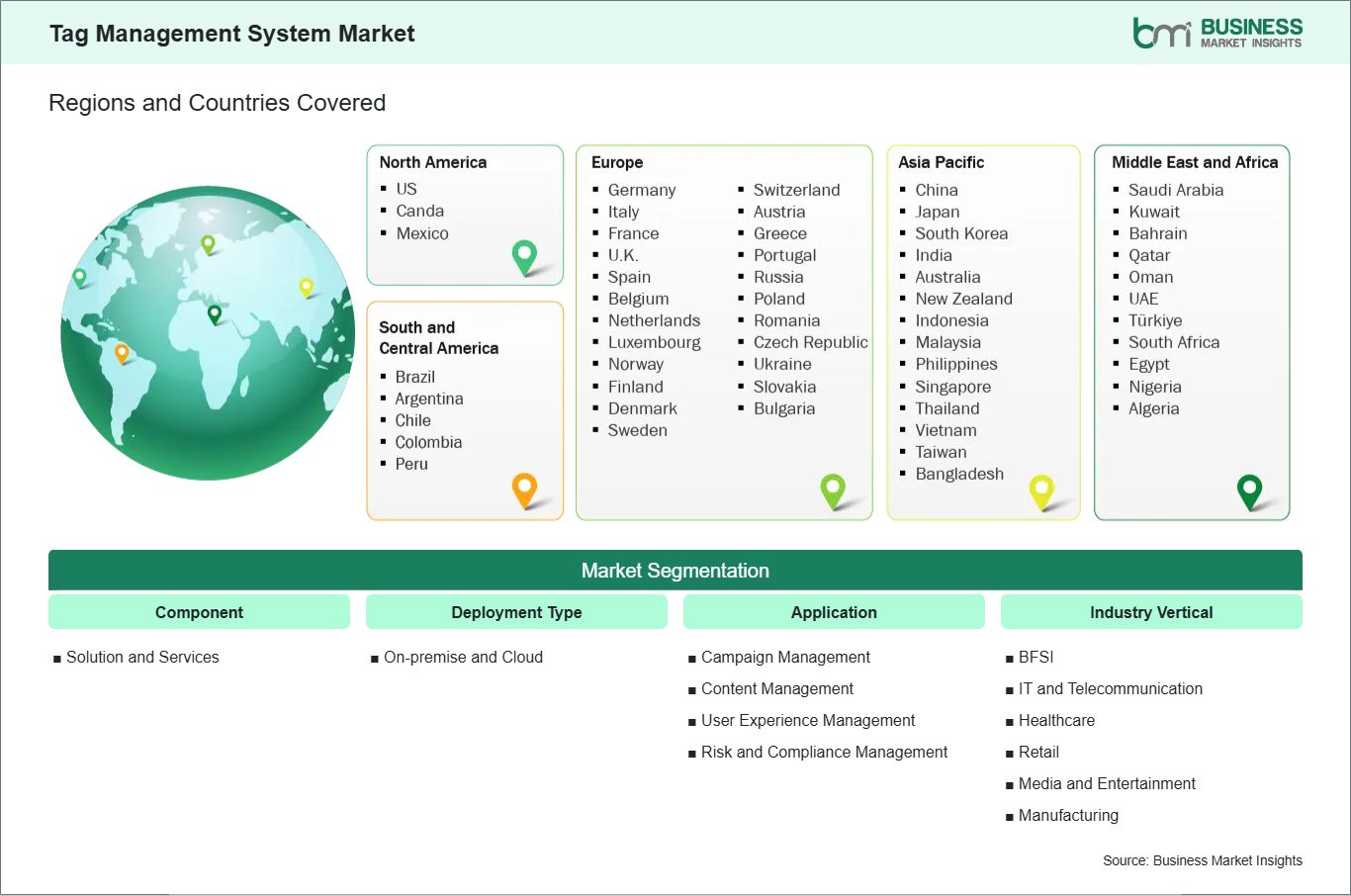
Key segments that contributed to the derivation of the Tag Management System market analysis are component, deployment type, application, and industry vertical.
- By Component, the market is segmented into Solution and Services.
- By Deployment Type, the market is divided into On-premise and Cloud.
- By Application, the market is categorized into Campaign Management, Content Management, User Experience Management, and Risk and Compliance Management.
- By Industry Vertical, the market is segmented into BFSI, IT and Telecommunication, Healthcare, Retail, Media and Entertainment, and Manufacturing.
Market Forces
Tag Management System Market Drivers and Opportunities
Advancing Data Governance and Privacy Compliance Mandates
The primary driver for the Tag Management System (TMS) Market is the intensifying global requirement for sophisticated data governance and strict adherence to evolving privacy regulations. As of 2026, the full implementation of the EU AI Act alongside established frameworks like GDPR and CCPA has turned tag management from a simple marketing utility into a critical compliance engine. Organizations are increasingly deploying TMS platforms to centrally manage user consent and govern the execution of third-party scripts, which helps prevent data leakage and shields websites from malicious "tag-based" exploits. This momentum is further amplified by the industrial shift toward server-side tagging, a non-discretionary move aimed at bypassing browser-based tracking restrictions and ad-blockers. By moving data processing from the client`s browser to a secure server, companies can maintain data accuracy and website performance while ensuring that only consented first-party data is shared with marketing partners. Together, these requirements for privacy-first infrastructure and operational agility ensure a robust and high-velocity growth path for the market.
AI-Driven Tag Optimization and First-Party Data Synergy 5.0
A significant high-value opportunity lies in the convergence of Tag Management Systems with Artificial Intelligence (AI) and Machine Learning. Next-generation "Intelligent TMS" platforms can autonomously detect broken tags, optimize script loading sequences to improve Core Web Vitals, and identify anomalous data patterns that suggest a security breach or bot activity. There is also a major growth frontier in the integration of TMS with Customer Data Platforms (CDPs) to fuel first-party data strategies in a cookieless world. As third-party cookies become obsolete, the ability of a TMS to capture high-quality, consented behavioral data directly from the source allows brands to build richer, unified customer profiles for hyper-personalized marketing. Furthermore, the expansion of IoT and Connected Device ecosystems, including smart TVs and wearables, presents an opportunity for cross-platform tag management solutions that offer a single point of control for tracking across diverse digital properties. Manufacturers who focus on "no-code" interfaces for non-technical marketers and those pioneering automated "Consent Mode" integrations are positioned to lead the market`s digital transformation.
Size and Share Analysis
Tag Management System Market Size and Share Analysis
The Tag Management System market demonstrates steady growth, with size and share analysis revealing evolving trends and competitive positioning among key players. The report further examines subsegments categorized within component, deployment type, application, and industry vertical, offering insights into their contribution to overall market performance.
Based on component, the Solution subsegment holds the dominant market share, representing the core software platforms required to centralize tag deployment. These tools are indispensable for marketing teams to launch campaigns across web and mobile properties with agility. However, the Services subsegment is witnessing the fastest growth as organizations grapple with the technical complexities of migrating to server-side environments. A notable trend in 2026 is the surge in "Managed Tagging" services, where specialized consultants assist enterprises in navigating the increasingly fragmented privacy landscape, ensuring that tag configurations do not inadvertently violate regional data protection mandates.
Report Coverage
Tag Management System Market Report Coverage and Deliverables
The "Tag Management System Market Size and Forecast (2022 - 2033)" report provides a detailed analysis of the market covering below areas:
- Tag Management System market size and forecast at global, regional, and country levels for all the key market segments covered under the scope
- Tag Management System market trends, as well as market dynamics such as drivers, restraints, and key opportunities
- Tag Management System market analysis covering key market trends, global and regional framework, major players, regulations, and recent market developments
- Industry landscape and competition analysis covering market concentration, heat map analysis, prominent players, and recent developments for the Tag Management System market
- Detailed company profiles, including SWOT analysis
Geographic Insights
Tag Management System Market Geographic Insights
The geographical scope of the Tag Management System market report is divided into five regions: North America, Asia Pacific, Europe, Middle East and Africa, and South and Central America.
The Asia-Pacific Tag Management System Market is segmented into China, Japan, South Korea, India, Australia, New Zealand, Indonesia, Malaysia, the Philippines, Singapore, Thailand, Vietnam, Taiwan, Bangladesh, and the Rest of Asia. This region is emerging as the fastest-growing market globally. The expansion is primarily fueled by rapid digitalization and the massive surge in internet and smartphone penetration, which has created an extensive pool of web users. China and India lead the regional growth, supported by a burgeoning IT sector and the aggressive expansion of local e-commerce platforms. These factors drive the demand for sophisticated tag management to handle complex customer data and optimize real-time marketing performance in highly competitive online environments.
Growth is further bolstered by a significant shift toward cloud-based deployment models among enterprises looking to improve website loading speeds and reduce reliance on IT departments for marketing updates. The integration of server-side tagging and consent management tools into TMS platforms, alongside the rising demand for personalized customer journeys in the post-pandemic digital economy, solidifies Asia-Pacific as a critical hub for innovation and the future scaling of the tag management system industry.
Industry Activity
Recent Developments
The Tag Management System market is evaluated by gathering qualitative and quantitative data post primary and secondary research, which includes important corporate publications, association data, and databases. A few of the key developments in the Tag Management System market are:
- In January 2026, Adobe Experience Platform released new features and updates across its tag management, Real-Time CDP, and segmentation services, including AI-powered agents and enhanced destination connectors. These enhancements enable real-time customer data activation, personalized engagement, and improved audience management.
- In October 2025, Tealium introduced new AI-powered features for its tag management and customer data platform, including the Behavioral Insights Agent and enhanced MCP workflows. These updates enable real-time personalization, smarter segmentation, and improved data governance, positively impacting growth in the market.
Trust & Transparency
Research Methodology
The market analysis combines proprietary research with secondary data from government agencies, company disclosures, regulatory filings, industry databases and expert interviews. Market estimates are validated through data triangulation, cross-market benchmarking and analyst
review.
View Full Research Methodology
Key Sources Referred:
World Bank - Global Trade Indicators World Trade Organization (WTO) International Monetary Fund (IMF) International Trade Administration (ITA) Company website Company annual reports Company investor presentations