Market Summary
Executive Summary and Global Market Analysis
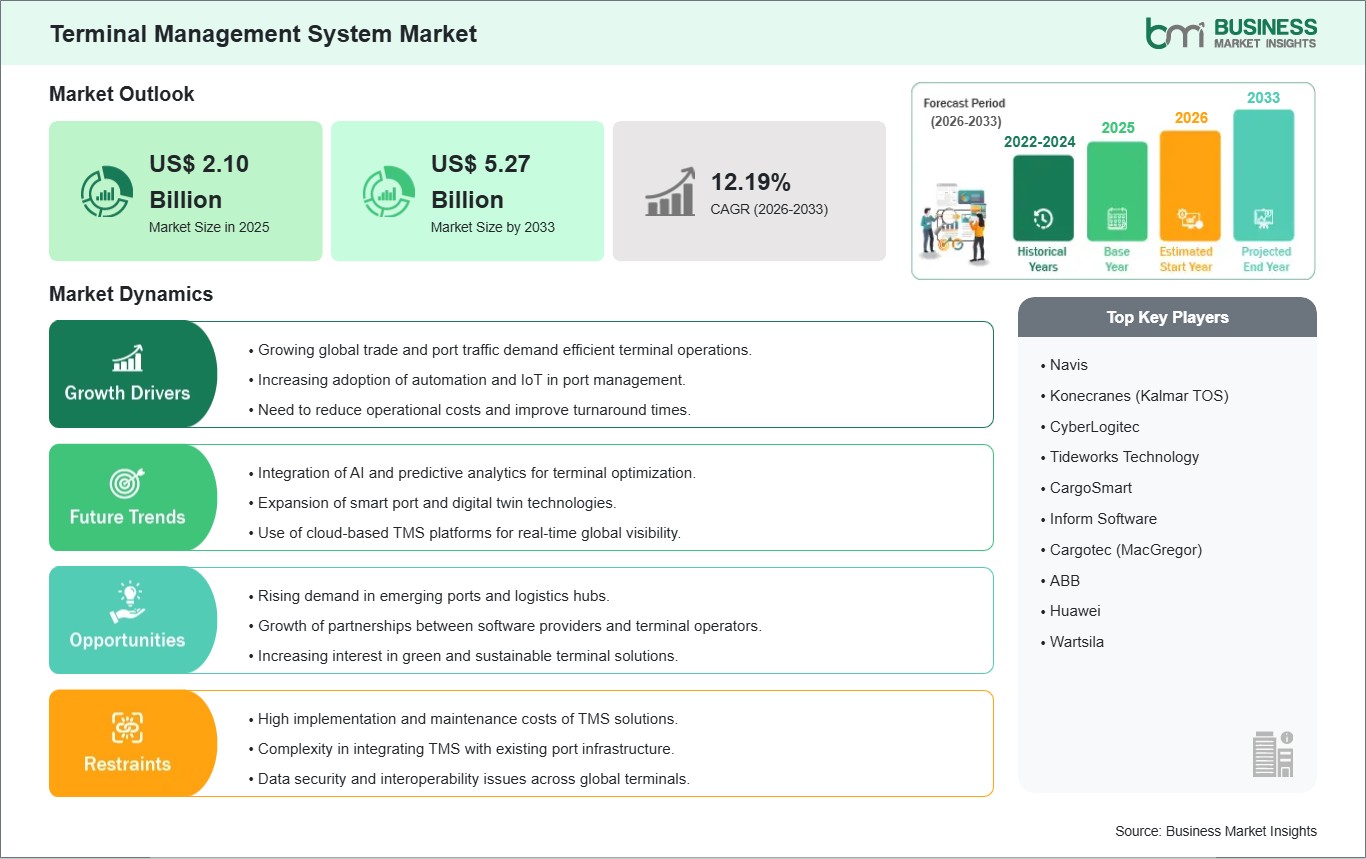
A Terminal Management System (TMS) is a centralized software platform designed to automate and optimize the movement of bulk liquids, gases, and cargo at storage and distribution terminals. It serves as the "brain" of the facility, integrating hardware, such as flow meters, weighbridges, and tank gauges, with back-office ERP systems. By managing the end-to-end lifecycle of a product, from vessel arrival and inventory storage to truck loading and documentation, a TMS ensures high-precision accounting, regulatory compliance, and operational safety while minimizing human error in hazardous environments. Market expansion is primarily attributed to the rising global demand for digitalized midstream infrastructure, a massive surge in greenfield terminal projects in emerging economies, and the escalating need for centralized multi-site control.
However, several challenges can restrain market growth: legacy system dependency, affecting established facilities, and high integration complexity can slow the adoption of modern software. Stringent regulatory hurdles regarding hazardous material handling and evolving cybersecurity mandates lengthen the time-to-market and increase administrative overhead. Additionally, the industry faces constraints due to workforce training gaps and high initial capital expenditure, where the cost of transitioning to full automation can be prohibitive for smaller, independent terminal operators.
Despite these hurdles, the market holds immense opportunities in the universal mandate for green energy transition and the accelerating deployment of digital twin modeling for terminal design. The expansion of hydrogen and ammonia storage infrastructure and the development of AI-driven vehicle scheduling tools are expected to create significant opportunities for market growth.
Segment Analysis
Terminal Management System Market Segmentation
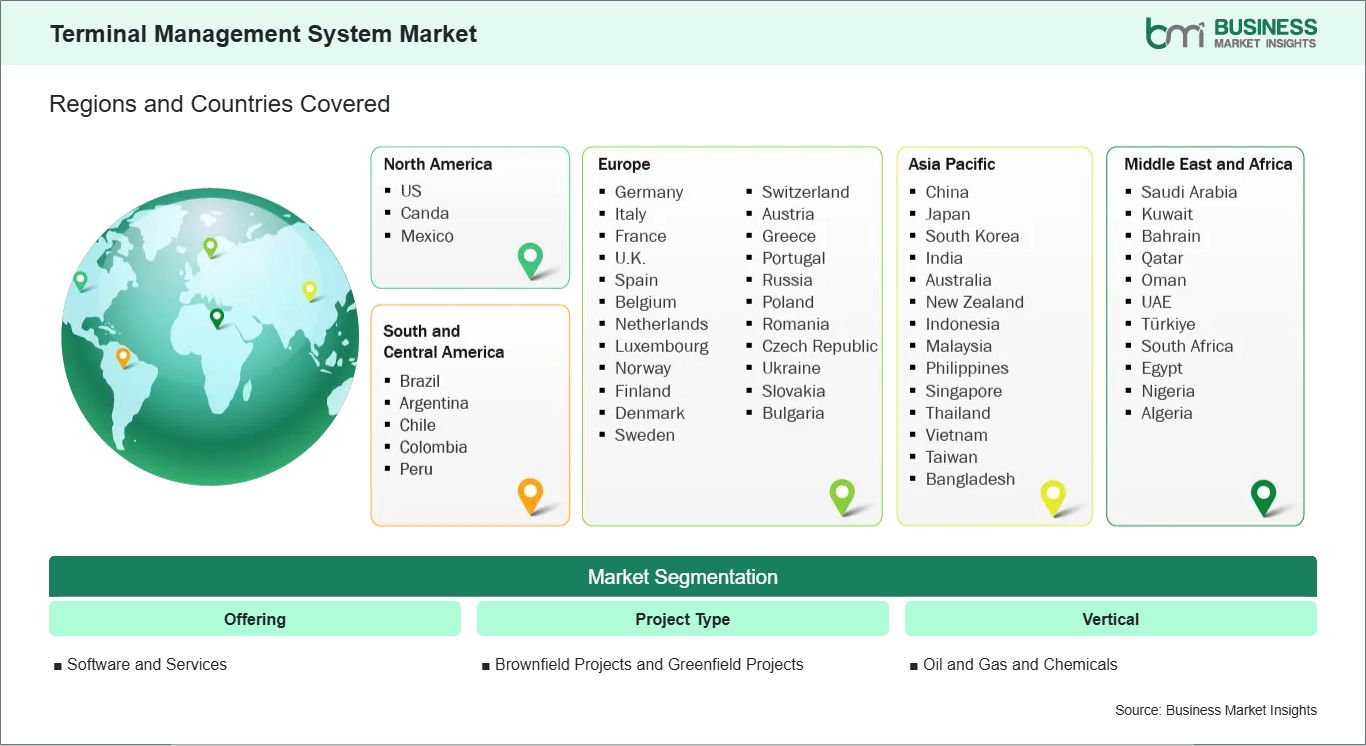
Key segments that contributed to the derivation of the Terminal Management System market analysis are offering, project type, and vertical.
- By Offering, the market is segmented into Software and Services.
- By Project Type, the market is divided into Brownfield Projects and Greenfield Projects.
- By Vertical, the market is categorized into Oil and Gas and Chemicals.
Market Forces
Terminal Management System Market Drivers and Opportunities
Advancing Digital Transformation and Global Trade Optimization
The primary driver for the Terminal Management System (TMS) Market is the accelerating digital transformation of global trade hubs and the non-discretionary need for operational efficiency. As maritime trade volumes and bulk material movements, particularly in oil, gas, and chemicals, continue to scale, terminal operators are facing immense pressure to reduce vessel turnaround times and eliminate manual errors in inventory tracking.
Advanced TMS solutions have become essential command centers that integrate Internet of Things (IoT) sensors, automated loading racks, and real-time tank gauging to provide a unified view of terminal health. This momentum is further amplified by stringent regulatory mandates for safety and environmental compliance, where automated reporting and safety interlocks are required to mitigate the risks associated with handling hazardous materials. Furthermore, the rise of "Smart Ports" and the systemic transition toward cloud-based logistics management allow for seamless multi-site coordination, ensuring a robust and high-velocity growth path for these systems across both established and emerging economies.
AI-Driven Predictive Logistics and Green Terminal Innovation
A significant high-value opportunity lies in the convergence of Terminal Management Systems with Artificial Intelligence (AI) and Machine Learning (ML) to enable predictive logistics. By utilizing AI-driven vehicle scheduling and predictive maintenance tools, terminals can autonomously reduce congestion at high-volume depots and identify potential equipment failures before they cause costly operational halts. There is also a major growth frontier in the development of Sustainable and "Green" Terminal Solutions.
As global energy sectors face mounting pressure to reduce carbon footprints, a lucrative market is emerging for TMS platforms that optimize energy consumption, monitor emissions in real-time, and facilitate the handling of renewable fuels like green hydrogen and biofuels. Furthermore, the expansion of Digital Twin technology presents an opportunity for terminal designers to simulate throughput scenarios and optimize facility layouts in a virtual environment before physical construction. Manufacturers who focus on cyber-resilient, interoperable architectures, allowing for the seamless integration of legacy SCADA systems with modern cloud platforms, are positioned to lead the most innovative and high-margin segments of the global terminal landscape.
Size and Share Analysis
Terminal Management System Market Size and Share Analysis
The Terminal Management System market demonstrates steady growth, with size and share analysis revealing evolving trends and competitive positioning among key players. The report further examines subsegments categorized within offering, project type, and vertical, offering insights into their contribution to overall market performance.
Based on offering, the Software subsegment holds the dominant market share, accounting for significant revenue. Software solutions are indispensable for the Oil and Gas sector, serving as the "central nervous system" for managing complex workflows like automated bay allocation, blending, and real-time tank gauging. A notable trend in 2026 is the surge in the Services subsegment, which is registering the fastest growth rate. This expansion is driven by the demand for "System Integration and Consulting," where operators require specialized expertise to layer modern cloud monitoring over legacy hardware and retrain workforces for automated environments. This shift provides a data-driven path to operational excellence, allowing firms to reduce loading errors by significant margins through digital scheduling and automated access control.
Report Coverage
Terminal Management System Market Report Coverage and Deliverables
The "Terminal Management System Market Size and Forecast (2022–2033)" report provides a detailed analysis of the market covering below areas:
- Terminal Management System market size and forecast at global, regional, and country levels for all the key market segments covered under the scope
- Terminal Management System market trends, as well as market dynamics such as drivers, restraints, and key opportunities
- Terminal Management System market analysis covering key market trends, global and regional framework, major players, regulations, and recent market developments
- Industry landscape and competition analysis covering market concentration, heat map analysis, prominent players, and recent developments for the Terminal Management System market
- Detailed company profiles, including SWOT analysis
Geographic Insights
Terminal Management System Market Geographic Insights
The geographical scope of the Terminal Management System market report is divided into five regions: North America, Asia Pacific, Europe, Middle East & Africa, and South & Central America.
The Asia-Pacific Terminal Management System Market is segmented into China, Japan, South Korea, India, Australia, New Zealand, Indonesia, Malaysia, the Philippines, Singapore, Thailand, Vietnam, Taiwan, Bangladesh, and the Rest of Asia. This region is currently the fastest-growing market globally. The expansion is primarily fueled by massive government investments in greenfield port projects and the rapid industrialization of China and India. China alone acts as a central manufacturing powerhouse, driving the market through the increasing integration of smart port technologies and IoT sensors to manage soaring trade volumes.
Growth is further bolstered by a significant shift toward fully automated terminals among operators looking to reduce human error and optimize vessel turnaround times. The integration of AI-driven predictive analytics for maintenance, alongside the rising demand for unified platforms that manage multi-modal transportation (rail, road, and sea), solidifies Asia-Pacific as a critical hub for innovation and the future scaling of the Terminal Management System industry.
Industry Activity
Recent Developments
The Terminal Management System market is evaluated by gathering qualitative and quantitative data post primary and secondary research, which includes important corporate publications, association data, and databases. A few of the key developments in the Terminal Management System market are:
- In December 2025, Datacap Systems introduced PayLoader™, a multi-OEM Terminal Management System (TMS) that enables POS partners to remotely manage devices, perform firmware updates, inject keys, and control configurations. The solution streamlines operations, reduces costly site visits, and enhances scalability for merchants and service providers.
- In November 2025, Adyen launched the S1E4 Pro and S1F4 Pro POS terminals, designed for rugged, mobile, and high-volume environments in retail, F&B, hospitality, and wellness sectors. The devices feature Android OS, integrated printers (S1F4 Pro), durability, and full connectivity, enhancing operational efficiency and customer experience across merchant locations.
Trust & Transparency
Research Methodology
The market analysis combines proprietary research with secondary data from government agencies, company disclosures, regulatory filings, industry databases and expert interviews. Market estimates are validated through data triangulation, cross-market benchmarking and analyst
review.
View Full Research Methodology
Key Sources Referred:
World Bank – Global Trade Indicators World Trade Organization (WTO) (International Monetary Fund )IMF International Trade Administration (ITA) Company website Company annual reports Company investor presentations